DeFi · Explainer
What Are Crypto Loans? How They Work, Costs and Risks (2026)
A crypto loan lets you borrow cash or stablecoins by pledging crypto as collateral instead of selling it. This guide explains how it works, what it costs, and where it goes wrong.
By the DappsAtlas editorial team · Updated
What is a crypto loan?
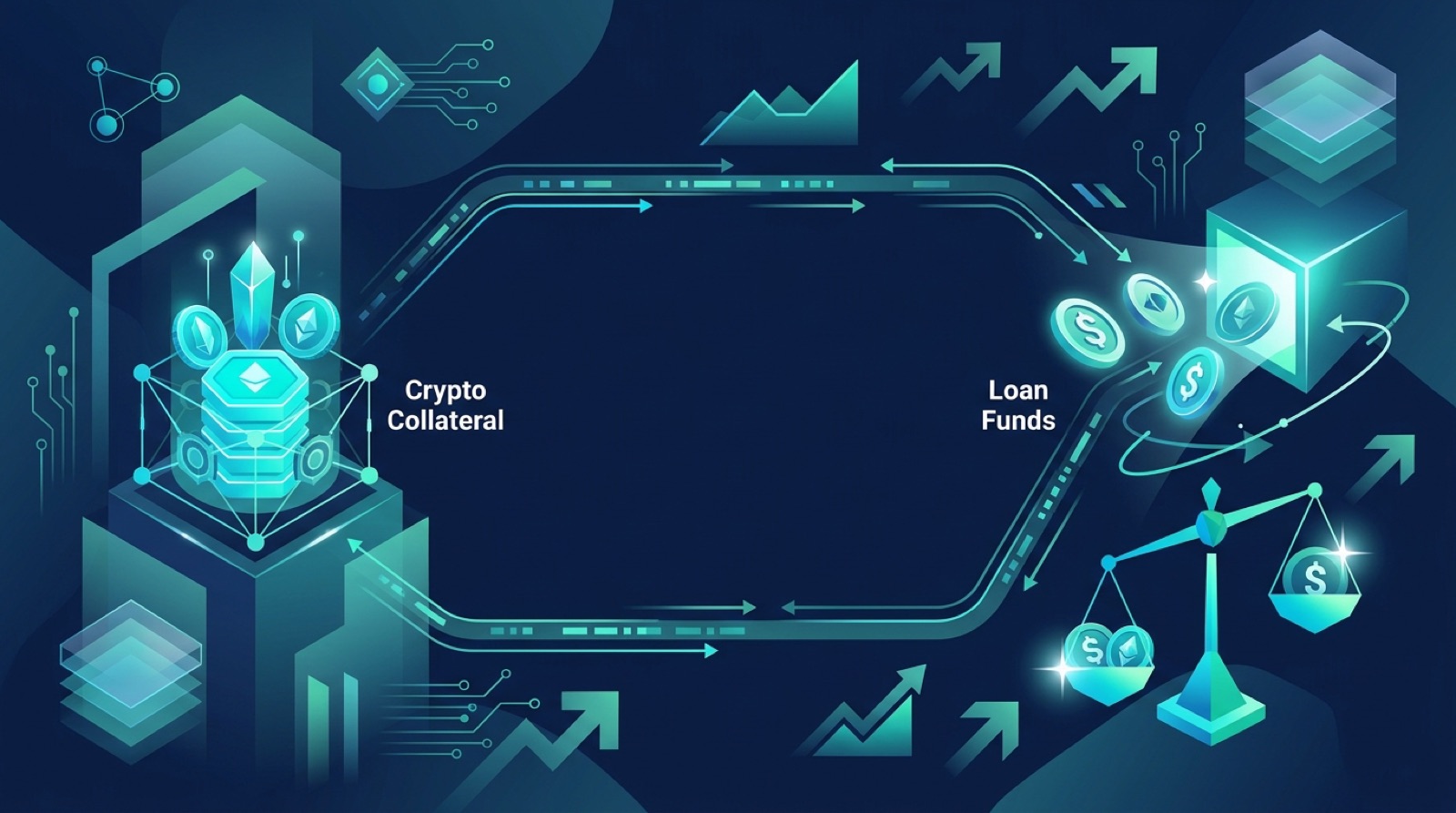
A crypto loan is a secured loan in which you pledge cryptocurrency as collateral and receive funds in return. The funds are usually stablecoins or fiat currency, though some platforms lend other crypto assets. You keep ownership of the collateral in the sense that it is returned when you repay, but you cannot spend or move it while it is locked.
People use these loans to get cash or buying power without selling their holdings. That can matter if they expect the asset to rise, want to avoid triggering a sale, or need liquidity for a short period.
The key difference from a bank loan is the basis of lending. Banks assess income and credit history. Crypto lenders mostly assess the collateral. If the collateral's value stays high enough, the loan is safe for the lender, so approval is quick and often automated.
The key difference from simply selling is the obligation. You owe the debt plus interest, and if your collateral loses enough value, the lender can sell it for you. Crypto loans are also called crypto-backed loans, collateralized crypto loans or crypto lending, though "crypto lending" more broadly covers both sides: the person who supplies assets to earn interest and the person who borrows.
Crypto loans are offered by centralized exchanges, specialist lenders and decentralized finance (DeFi) protocols. Each works a little differently, which the next sections cover.
How does a crypto loan work, step by step?
Most crypto loans follow the same sequence, whichever platform you use.
- Choose collateral and a loan asset. You pick the crypto you will pledge, such as BTC or ETH, and what you want to borrow, usually a stablecoin.
- Deposit the collateral. On a centralized platform you transfer it to the provider. On a DeFi protocol you deposit it into a smart contract from your own wallet.
- Borrow up to a limit. The platform lets you draw a share of the collateral's value. That share is the loan-to-value (LTV) ratio.
- Pay interest. Interest may accrue continuously, be charged at a fixed rate, or float with market demand. Some loans have no set repayment schedule, while others have a fixed term.
- Monitor the position. Price moves change your LTV. If it climbs too high, you must add collateral or repay part of the debt.
- Repay and withdraw. Once you repay the principal and interest, the collateral is released.
Because crypto loans are over-collateralized, you pledge more value than you borrow. This protects the lender from price swings, since the collateral can be sold quickly if needed. A few products offer undercollateralized or unsecured credit, but these rely on credit assessment, underwriters or other safeguards and are less common.
What types of crypto loans exist?
Crypto loans come in three main forms. The right choice depends on how much you trust companies versus code, and on what is legally available where you live.
| Type | Who holds collateral | Typical examples | Main risk |
|---|---|---|---|
| Centralized lender or exchange | The company | Exchange loan desks, specialist lenders | Counterparty risk, withdrawal limits, insolvency |
| DeFi money market | Smart contract | Dolomite, Save | Smart-contract bugs, oracle failures, liquidations |
| Specialized or credit-based | Varies | 40 Acres, Cap | Product-specific design, newer and less tested |
Centralized loans are the simplest to use. You sign up, complete identity checks, deposit collateral and borrow. Support is available, but you rely on the company's solvency and policies. Several exchanges, including OKX, Bitget and Gate, offer borrowing or margin features. Availability varies by region.
DeFi loans are permissionless and transparent. Rules are written in code, rates change with supply and demand, and you stay in control of your wallet. Liquidations are automatic. You are responsible for your own security.
Specialized designs exist as well. For example, 40 Acres offers loans against veNFTs that are described as self-repaying and non-liquidatable, and Cap offers credit backed by underwriters. These products have different mechanics and risk profiles from standard money markets, so read how each one works before using it.
What are LTV and liquidation, and why do they matter?
Two numbers define the safety of a crypto loan: the loan-to-value ratio and the liquidation threshold.
LTV is the debt divided by the collateral's value. The liquidation threshold is the LTV at which the lender can sell your collateral. Platforms set both per asset, based on how volatile and liquid it is.
Here is a hypothetical illustration with invented figures, not a quote from any provider. You pledge ETH worth $10,000 and borrow $4,000 in stablecoins. Your LTV is 40%. Suppose the liquidation threshold is 80%. Liquidation would begin when your collateral falls to $5,000, since $4,000 is 80% of $5,000. That is a 50% drop in the collateral's price.
Borrowing more shrinks that cushion. At an LTV of 70% with the same threshold, a drop of only around 12.5% would be enough.
What liquidation involves:
- The platform sells part or all of your collateral to cover the debt.
- A penalty or fee is often added.
- Sales may happen during fast, thin markets, which can make the outcome worse.
- In some cases, automated systems act within minutes, so you may not get time to react.
A margin call, common on centralized platforms, is a warning asking you to add collateral or repay. DeFi usually offers no warning beyond what you monitor yourself.
What do crypto loans cost?
The interest rate is only one part of what a crypto loan costs. Check each of these before borrowing.
- Interest rate. It may be fixed or variable. In DeFi money markets, rates usually shift with supply and demand and can change in hours. Advertised "from" rates apply to the best case, such as the lowest LTV or the largest collateral.
- Origination or service fees. Some providers charge a flat fee on opening the loan.
- Liquidation penalties. These apply if your position is closed out.
- Network and transaction fees. Moving collateral and repaying on a blockchain involves gas or withdrawal costs.
- Opportunity cost. If the collateral would have been staked or earning yield elsewhere, locking it may cost you that income, though some platforms let collateral keep earning.
- Price risk on repayment. If you borrow a stablecoin against volatile crypto, the debt stays stable while your collateral can change in value. If you borrow a volatile asset, the debt itself can grow.
Because rates, loan limits and supported assets change often, check the provider's live rate page or the protocol's app instead of relying on a number from an article. Compare the effective cost across a realistic loan period, not just the headline rate.
What are the main risks of crypto loans?
A crypto loan can cause losses that exceed the interest paid. The main risks are:
- Liquidation risk. A sharp price fall can wipe out your collateral quickly, and the lender will sell it regardless of your plans.
- Counterparty risk. With a centralized lender, your collateral is in the company's hands. If it becomes insolvent, freezes withdrawals or reuses collateral in ways you did not expect, you may not recover your assets. Past failures of crypto lenders are a reminder of this.
- Smart-contract risk. DeFi protocols can have bugs. Audits reduce this risk but do not eliminate it.
- Oracle and market risk. DeFi platforms rely on price feeds. Faulty or manipulated feeds can trigger wrongful liquidations or bad debt.
- Rate risk. Variable rates can climb when demand for borrowing rises.
- Leverage loops. Borrowing stablecoins to buy more of the same collateral multiplies both gains and losses and makes liquidation far more likely.
- Operational risk. Phishing, malicious approvals and wallet compromise can drain a DeFi position. Use a hardware wallet where possible, check contract addresses, and revoke approvals you no longer need.
- Regulatory risk. Rules on crypto lending change, and a provider may restrict or end service in your region.
A simple defense is to borrow far less than the maximum, keep spare funds to add collateral, and never put in crypto you cannot afford to lose.
Are crypto loans taxable or regulated?
Tax and legal treatment vary by country, so treat this section as a list of questions rather than advice.
Tax questions to ask:
- Does pledging collateral count as a disposal, or does ownership stay with you?
- Is the loan itself taxable income? In many systems, borrowed funds are not income, but this depends on the jurisdiction and structure.
- Does a liquidation count as a sale, and how is the gain or loss calculated?
- Is the interest you pay deductible, and under what conditions?
- How should you keep records of deposits, borrowings, repayments and liquidations?
Keep a complete transaction history, including wallet addresses and timestamps, since DeFi activity is not summarized for you the way a bank statement would be.
Legal and regulatory points:
- Some countries restrict or license crypto lending, and providers may not serve every region.
- Centralized platforms generally require identity verification (KYC) and may ask about the source of funds. Follow these checks honestly and do not try to get around location or identity requirements.
- Check whether the provider is registered or authorized where you live and what protections apply if it fails. Deposits with crypto firms are generally not covered the way bank deposits are.
If the amounts are significant, a qualified tax professional who understands crypto is worth consulting before you borrow.
How to decide whether a crypto loan is right for you
Run through these questions before you pledge anything.
- Why am I borrowing? A clear purpose, such as short-term liquidity, is safer than speculation.
- How much cushion do I have? Work out the price at which liquidation would start and ask whether you could ride out a drop that large.
- Who holds my collateral? Understand whether you are trusting a company, a smart contract or both.
- What are the full costs? Include interest, fees, gas and liquidation penalties.
- What are the terms? Check whether the loan has a fixed term, whether rates are variable, and whether the provider can change the rules or call the loan.
- Is the provider credible? Look for audits, a track record, transparent reserves or risk reporting, and clear regulatory status. Risk managers such as Gauntlet and Steakhouse Financial curate parameters for some lending vaults, which is useful to know when you assess a protocol, though it does not remove risk.
- Can I repay easily? Know how repayment and withdrawal work before you borrow.
- Am I legally able to use it? Confirm that the service is available and lawful where you live.
If you are comparing options, start with a small test loan, keep a low LTV, and set price alerts. Crypto loans are financial products with real risk of loss, and they are not suitable for everyone.
Frequently asked questions
Do crypto loans need a credit check?
Usually no. Most crypto loans are secured by collateral, so lenders look at the value and volatility of what you pledge rather than your credit history. Terms differ by provider, and some centralized lenders still run identity checks. DeFi protocols usually only need a connected wallet.
What happens if my collateral price drops?
A liquidation happens when your collateral falls in value, or your debt grows, until your loan-to-value ratio crosses the lender's limit. The platform then sells some or all of your collateral to repay the debt, often with a penalty. You keep any borrowed funds but lose the collateral that was sold.
Is a crypto loan the same as selling my crypto?
No, in the sense that you are not selling your crypto, so you keep your exposure to its price. Whether the loan itself is a taxable event depends on your country and how the product is structured, and liquidations can count as disposals. Check local tax rules or ask a qualified adviser.
What is the difference between DeFi and centralized crypto loans?
Both are secured crypto loans, but a DeFi loan runs on smart contracts, you keep control of your wallet, and rates and liquidations follow public rules. A centralized loan runs through a company that holds your collateral under its own terms and credit policies. The trade-offs are smart-contract risk on one side and counterparty risk on the other.
How can I reduce the risk of being liquidated?
Provider choices vary, but a lower loan-to-value ratio is the main safeguard. Borrowing a small share of your collateral's value gives you room for price drops. Monitoring alerts, adding collateral early and avoiding borrowing to buy more volatile assets also help.
Are crypto loans legal everywhere?
Some are, depending on the jurisdiction, and rules differ widely. Providers may be restricted or require licences in certain countries. Confirm the service is legal where you live and do not try to bypass location checks or identity verification.
Mentioned in this guide
dApps in this guide
Dolomite is a multi-chain DeFi money market for lending, borrowing and leveraged strategies across 1,000+ assets, with its own DOLO token.
Save, formerly Solend, is a Solana lending and borrowing protocol where users earn interest on deposits or borrow against collateral.
40 Acres is a DeFi lending protocol offering self-repaying, non-liquidatable USDC loans against veNFTs on Base and Avalanche.
Cap is an Ethereum stablecoin and credit protocol offering cUSD and yield-bearing stcUSD, with underwriters backing unsecured USD loans.
Backpack is a crypto exchange, US stock broker and self-custody wallet offering perps, lending yield and cross-collateral margin in one app.
OKX is a major centralized crypto exchange for spot and derivatives trading, earn products and a Web3 wallet, with its own OKB token.
Bitget is a centralized exchange for crypto spot and futures that also offers tokenized stocks, commodities and forex in one account, for active traders.
Gate is a centralized crypto exchange founded in 2013 offering spot, futures, stocks and earn products for traders who want one multi-asset account.
Gauntlet is a DeFi risk manager that curates non-custodial yield vaults for fintechs, exchanges, wallets and asset managers.
Keep reading
Related guides
DeFi · Explainer
What Are Crypto Loans? A Plain Guide to Borrowing Against Crypto
A crypto loan lets you borrow against tokens you already hold instead of selling them. This guide covers how the mechanics work, the main loan types, the risks, and how to compare lenders.
DeFi · How-to
Hyperliquid Features and How to Get Started: A Step-by-Step Guide
Hyperliquid is an on-chain exchange for perpetual futures and spot trading that runs on its own Layer 1. This guide covers what it offers, how to set up an account, and the risks to understand before depositing.
DeFi · Explainer
SparkDEX Eternal Explained: How On-Chain Perps Work
SparkDEX Eternal is the perpetual futures product of SparkDEX, a decentralized exchange on the Flare network. This guide explains how it works, how on-chain perps differ from exchange perps, and what to check before risking money.
Token · How-to
How to Buy Gold and Silver Alongside Crypto: A Practical Guide
You can hold gold and silver exposure in the same place you buy crypto, through tokenized metals, exchange commodity products or derivatives. This guide covers each route, what to verify, what it costs and where the risks sit.
DeFi · Explainer
What Are Crypto Liquidations? How They Work
Crypto liquidation is the forced closure of a leveraged trade or sale of collateral when an account no longer meets its platform’s risk rules. Learn how it works in derivatives and DeFi lending, what triggers it, and how to manage the risk.
DeFi · Explainer
What Are DeFi Markets? A Practical Guide for 2026
DeFi markets are blockchain-based venues and protocols for swapping, lending, borrowing and trading digital assets. Learn how they work, how to compare them, and what risks to check before using one.
DeFi · Explainer
Do Feudalz Whales Trade Derivatives? A 2026 Explainer
Large holders of crypto assets often use futures, perpetuals and options to hedge risk or take leveraged positions. This guide explains what those instruments are, why big wallets use them, how to read derivatives data without copying trades, and where the risks sit.
DeFi · Explainer
What Does DEX Mean in Crypto? A Beginner’s Guide
DEX stands for decentralized exchange: a crypto trading service that uses blockchain software to let you swap tokens from your own wallet. Learn how DEXs work, how they differ from centralized exchanges, and what to check before trading.