NFT · Explainer
How Ticketmaster's NFT Ticketing on Flow Blockchain Works
Ticketmaster explored NFT tickets with Dapper Labs' Flow blockchain from 2021 onward, and its later launches tied presales and token-gated access to digital collectibles. This guide explains how those mint-event tickets were meant to work, what fans needed, and how to check the status of any event today.
By the DappsAtlas editorial team · Updated
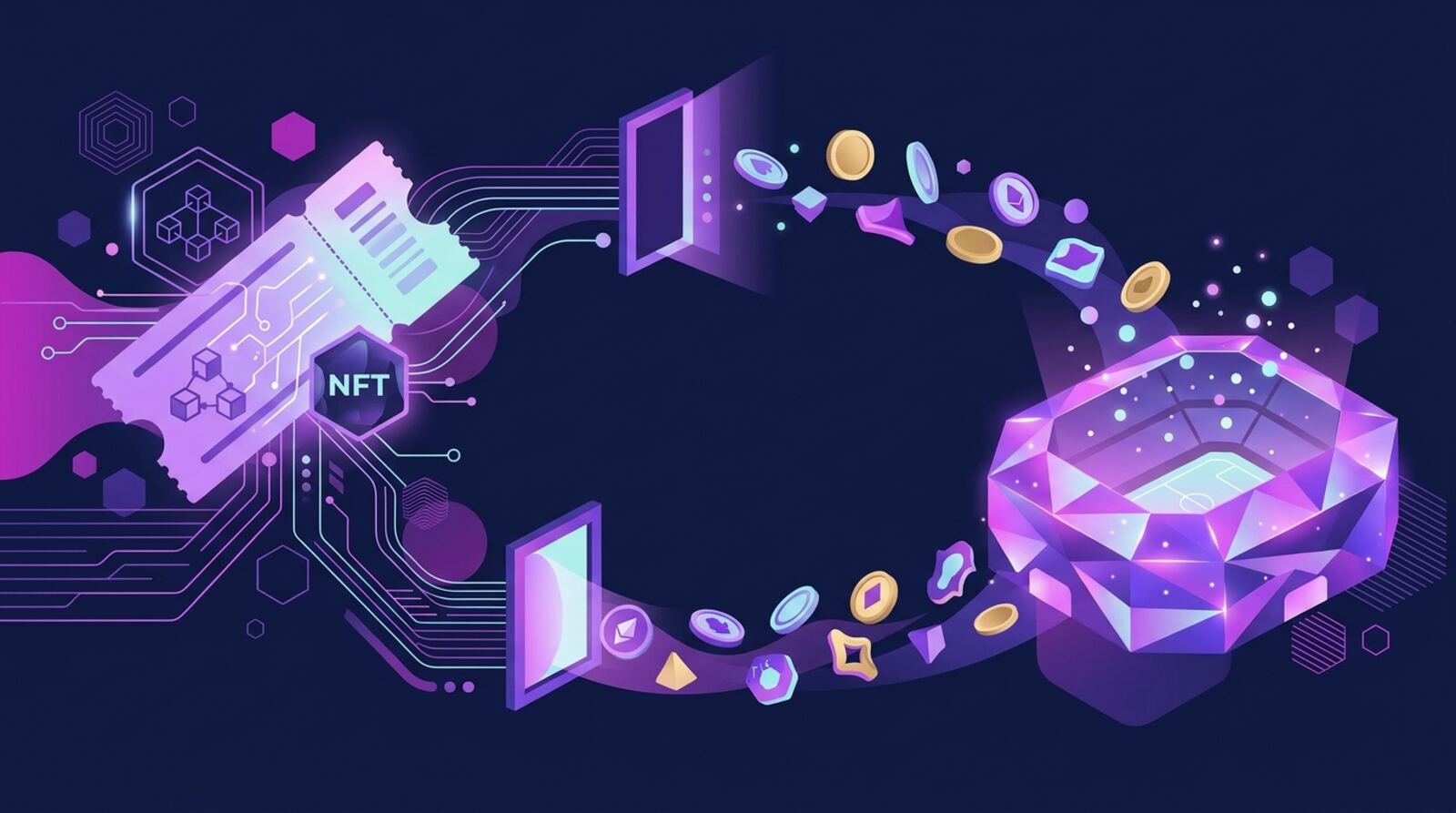
What Ticketmaster's NFT ticketing actually was
Ticketmaster is the large live-event ticketing company, and in the early 2020s it began testing ways to use non-fungible tokens (NFTs) for event access. An NFT is a unique token recorded on a blockchain. In a ticketing setting, the token can represent a seat, a general admission entry, a presale right or a collectible that lets the holder into a special sale.
The idea was pitched publicly in 2021, when Live Nation, Ticketmaster's parent company, said it was working on how an event ticket and an NFT could be created together. The concept was that a fan might receive a ticket and a collectible tied to the same concert, so the memento and the entry would be linked.
By 2022, Ticketmaster had announced that it would use the Flow blockchain from Dapper Labs to mint some event tickets as NFTs for selected shows. In 2023, the company launched an NFT-powered ticket sales platform aimed at stronger connections between artists and fans, with presales, prime seats and exclusive access as the main examples. Later in 2023, Ticketmaster rolled out token-gated access, which let artists and communities restrict certain ticket sales to people who hold a specific token.
It helps to separate three ideas. The first is an NFT ticket, which is a token that proves you hold a seat or entry. The second is a collectible, which is a memento that may or may not grant entry. The third is token-gated access, which uses ownership of a token as an eligibility check for a normal ticket purchase. Many of the programs discussed in public reporting mix these ideas, so reading each event's terms is important.
Why Ticketmaster chose the Flow blockchain
Ticketmaster's NFT ticketing work centered on Flow after the company said in 2022 that it would mint some event tickets on that chain. Flow is a blockchain developed by Dapper Labs, the same company behind NBA Top Shot and NFL All Day. Those consumer products were built to let people buy, hold and trade digital collectibles without needing to understand every blockchain detail.
That design goal matters for ticketing. A ticket buyer usually wants a simple purchase, clear proof of entry and a reliable way to get into the venue. A blockchain that can handle many small transactions, and that supports wallets built for ordinary users, is one reason a company might choose Flow for a consumer-facing product.
Public reporting describes Flow as the chain chosen for Ticketmaster's NFT tickets, but they do not give a full technical specification of how each ticket was minted or stored. For a general reader, the useful points are these. The chain records who owns a token. The token can be transferred under rules set by its smart contract. The ticket holder usually does not need to run a node or manage network settings.
If you want to understand how Flow compares with other chains, the official Flow documentation from Dapper Labs is the right place to read about its design and fees. Fee levels and network details change over time, so do not rely on a single figure from an old article. Check the current documentation before making any decision that depends on costs.
How a mint event worked step by step
A mint event is the moment when a new batch of tokens is created and made available to buyers. For NFT tickets, the flow often looked like a normal ticket sale with a blockchain step added. The exact steps depend on the event, but a typical sequence works like this:
- The organizer creates the event and sets the ticket categories and prices.
- The organizer or the platform mints a set of tokens, each tied to a seat, entry or access right.
- Buyers enter a queue or presale window, verify eligibility and complete payment.
- After purchase, the token is delivered to a wallet or account that the platform manages for the buyer.
- At the venue, the entry is checked against the token or the linked account.
Some events are minted in advance. Others are minted on demand as buyers arrive. Minting in advance gives the organizer a fixed supply. Minting on demand can reduce waste but may create timing issues during high-demand sales.
Because the process spans a sales page and a blockchain, failure points are more numerous than in a standard ticket sale. A payment may complete while a token delivery is delayed, or a wallet may not show a token immediately. Keep your order confirmation, your account email and any transaction references until you have seen the ticket in your official Ticketmaster app or the entry method listed for the event.
Never assume the minting step is optional or can be skipped by paying elsewhere. If the sale requires a particular wallet or account link, the terms will say so.
How token-gated presales and access worked
Token-gated access is different from a standard NFT ticket. In a token-gated sale, the artist or community chooses a token or collectible that makes a buyer eligible to purchase early. The purchase itself may be a normal ticket order. Ownership of the token is checked before the buyer can enter the presale.
Ticketmaster's 2023 rollout was described in the results as letting any artist who minted their own NFTs, or partnered with another independent community, explore token-gated ticketing. That wording shows the model: the token belongs to the artist's community, and the ticket remains a ticket.
The benefits are clearer to the artist than to the fan. Artists can reward loyal supporters with early access, and fans who hold a collectible may get a better chance at popular shows. The downside is that access depends on owning a token, so the rules matter. If the token price moves, your eligibility can change, and a presale that was open to you yesterday may not be open today.
Before buying any token for access, read the eligibility rules, the purchase limits and the deadline. Check whether the token is tradable and whether holding it is the only requirement. If the rules are unclear, do not buy the token in a hurry. Official Ticketmaster support and the artist's verified channels are the places to confirm the current requirements.
What fans needed to take part
To use an NFT-based or token-gated event sale, fans generally needed three things: an account with the ticketing platform, a supported way to receive and hold the token, and proof that they met any eligibility rule. The exact requirements depend on the event and the year of the sale, so the sale page is the final authority.
In many cases, the platform handled the wallet for you. In other cases, a user connected an existing wallet that supported the relevant blockchain. Wallet connection is a security step, so take it seriously. Only connect wallets you control, and only approve actions you understand.
Identity and account checks are common in ticketing. Event sales often limit purchases per person to reduce resale and bot activity. Expect to verify your account and to follow purchase limits. Do not try to bypass these checks, and do not use multiple accounts to get around a limit, because that can cause your tickets to be cancelled.
If you do not want to manage a wallet, look for events that offer a standard ticket purchase with no token requirement. The NFT layer is not always necessary for entry, and an event can be fully accessible without one. Read the entry instructions before you travel, and bring the proof the venue asks for.
Transfers, resale and the secondary market
Once a ticket is an NFT, questions about transfer and resale become part of the purchase. Some NFT-based tickets could be moved between wallets or accounts, and some could not. The rules are set by the organizer and by the smart contract used for that event, so the terms of sale decide what you can do with your ticket.
Reselling an NFT ticket on an open marketplace can conflict with the event's resale rules. Some organizers prohibit resale above face value, require resale through an official channel, or cancel tickets that appear on unauthorized sites. Check the terms before you list or transfer anything.
If you want to trade a collectible that came with an event, that is a different activity. A collectible may be sold on a general NFT marketplace such as OpenSea, but a collectible is not always the same as the entry right. Keep the two separate in your head, and check whether the entry right remains valid after the collectible is sold.
Market prices for NFT tickets and collectibles move, sometimes sharply. Do not treat an event token as an investment, and do not buy one because you expect its price to rise. Set a budget for entertainment purchases, and remember that a ticket is only worth its value if you can use it.
Security risks and how to avoid scams
Ticketing sales attract scams because buyers are motivated and time-limited. NFT-based ticketing adds new ways to deceive people. The following habits reduce your risk:
- Buy only through the official Ticketmaster site or app, or through links the artist publishes on verified channels.
- Never share your seed phrase or recovery phrase with anyone, including someone claiming to be support staff.
- Do not approve a wallet transaction you cannot explain. A signature request can grant permissions you did not intend.
- Be wary of direct messages that offer early access, free tokens or resale tickets at a discount.
- Use a separate wallet for event purchases if you can, and keep only the funds you need in it.
Phishing pages often copy the look of a ticketing site. Check the web address carefully, and type it yourself or use a bookmark you saved from the official site. If a page asks you to connect a wallet before you can see the event, pause and check the event through a second route.
If you think you have sent funds or approved a suspicious request, act quickly. Change passwords on the affected accounts, move remaining funds to a new wallet you control, and contact the platform's official support. Keep records of the transaction and the messages you received, since they may help any investigation.
What happened to Ticketmaster's NFT push
The NFT ticketing push has not followed a straight line. The 2021 comments from Live Nation described a plan to combine tickets and NFTs. The 2022 Flow announcement and the 2023 platform launch showed that the company was putting parts of that plan into practice. The later token-gated rollout suggested a narrower use, focused on presales and artist communities.
Public reporting also include a 2025 conference headline in which a team said NFT ticketing did not work and that it was selling to Ticketmaster. Headlines of that kind are a reminder that the market for NFT tickets has been uneven. A single headline is not proof of the full story, and the results do not provide enough detail to judge the deal, so treat it as a signal to check current sources rather than a settled fact.
The broader NFT market also changed. Many collectibles lost value after their peak, and the appetite for NFT-based products shifted. Ticketing companies that continue to use blockchains are likely to focus on uses where a blockchain record adds clear value, such as proof of a presale right, rather than on speculative collectibles.
For a reader in 2026, the practical takeaway is that the format of a given event can differ from what was announced in earlier years. Look at the current sale page, not old articles, when you plan to buy.
How to check if an event uses NFT tickets
Because the format changes, the most reliable check is the event listing and its terms. Start with the event page on the official Ticketmaster site or app. Look for any mention of a presale tied to a token, a collectible, a wallet or an artist community. If none is listed, the event is probably a standard ticket sale.
Next, read Ticketmaster's help pages on NFT or token-gated ticketing. These pages should describe what is required, what you receive and how entry works. Compare the help page with the event terms, because the event terms are the final word for that show.
If the artist announced an NFT-linked presale, check the artist's verified website or social accounts. Confirm that any link you follow leads to the same official domain as the sale. Be cautious of links shared in group chats or comment sections, even when they look official.
Finally, plan for entry. Save your ticket or entry proof offline if possible, bring a valid form of identification if the venue asks for it, and arrive with time to spare. If a token or wallet is needed for entry, test the process before the day of the show, using the official instructions only.
Frequently asked questions
Does Ticketmaster still sell NFT tickets?
Ticketmaster announced in 2022 that it would use Flow, the blockchain built by Dapper Labs, to mint some event tickets as NFTs. The results available for this guide describe that choice and later token-gated ticketing rollouts, but they do not show a single, permanent product that every event uses. Check the event page and Ticketmaster's help pages for the format used by a specific show.
Why did Ticketmaster use the Flow blockchain?
Flow is a blockchain developed by Dapper Labs, the company behind NBA Top Shot and NFL All Day. Ticketmaster selected it in 2022 to mint certain event tickets as NFTs. Dapper's existing consumer tools and wallet experience were part of why Flow was a practical choice for mainstream fans who did not want to manage complex crypto steps.
Do I need a crypto wallet to get an NFT ticket?
Not necessarily. Some NFT-based ticketing used a wallet so that proof of ownership lived on-chain. Other programs used token-gated access, where holding a specific token or collectible made a fan eligible for a presale or a seat category. Many fans only interacted with a normal ticket purchase flow, with the blockchain running in the background. Read the terms for each event to see which applies.
How can I avoid fake NFT ticket sales?
Use only the official Ticketmaster website or app, or the official links printed on the artist's verified channels, and never buy from a direct message or a link someone sent you. Look for the event's terms before paying, and be careful with any page that asks for your seed phrase or a signature you do not understand. Ticketmaster's support pages are the reliable place to confirm what is official.
Where can I check whether a specific event uses NFT tickets?
Start with the event page and the terms attached to the sale. Then check Ticketmaster's help center for NFT or token-gated ticketing notes. If the event uses a presale tied to a collectible, the eligibility rules should be listed in plain language. The results for this guide do not give a current list of events, so the official sources are the only dependable check.
Mentioned in this guide
dApps in this guide
NBA Top Shot is a licensed NBA highlight NFT marketplace on Flow from Dapper Labs, built around pack drops and trading for basketball fans.
NFL All Day is the NFL and NFLPA licensed NFT platform from Dapper Labs on Flow, where fans buy and trade video highlight Moments.
Tomorrowland's three Solana NFT collections form the Medallion of Memoria, which gives holders priority access to some festival ticket pre-sales.
Fifa Collect is FIFA's official digital collectibles platform, launched on Algorand, offering World Cup items and Right-to-Buy ticket packs for football fans.
OpenSea is a peer-to-peer NFT marketplace for buying, selling and minting digital collectibles, aimed at collectors, creators and developers.
Save, formerly Solend, is a Solana lending and borrowing protocol where users earn interest on deposits or borrow against collateral.
Keep reading
Related guides
NFT · Review
DGFamily NFT Boxes by Dolce&Gabbana: What to Know in 2026
Dolce&Gabbana's DGFamily NFT boxes were built as membership passes tied to fashion, physical and experiential perks. This guide explains what the project was, what went wrong for some buyers, and how to check the terms of any new box release before you buy.
NFT · Explainer
Coachella NFTs Explained: The 2022 Launch and Where It Stands
Coachella's February 4, 2022 NFT launch offered lifetime-pass tokens and keepsake collectibles. This explainer covers what was sold, how the sale worked, why some holders report redemption problems, and what to check today.
NFT · Explainer
How the VeVe NFT Marketplace Works in 2026: A Clear Guide
VeVe is a collectibles app that sells licensed digital items from entertainment brands and lets owners trade them with other users. This guide explains how its store, secondary marketplace, in-app currency and token fit together, and what to check before you spend money.
NFT · Explainer
Celebrities and the NFT Hype: What Happened and What It Means in 2026
Celebrity involvement drove a lot of the NFT attention in 2021 and 2022, with August often cited as a peak of buzz. This guide explains what happened, what is left of those trends, and how to judge a celebrity-linked NFT before you buy.
NFT · Explainer
Tiny Titans Name-and-Win Contests: How to Check Them
Public reporting for Tiny Titans mostly point to a DC Comics children's series, not a crypto product. This guide explains what that means if you see a name-and-win offer using the phrase and how to verify it before you take any action.
NFT · Explainer
ThunderCore Wolverine Pack, TT Farm and NFT Giveaways Explained
ThunderCore is an EVM-compatible blockchain, and promotions such as Wolverine Pack openings, TT farms and NFT giveaways are often marketed under its name. This guide explains how each type of promotion works, what to verify before taking part, and how to protect your wallet.
NFT · Explainer
Tiny Titans NFT Drops on Binance: What to Verify in 2026
Binance has listed NFT categories before and later removed some of them, so a drop announcement is not proof of a safe purchase. This guide explains how to check a Tiny Titans release before you connect a wallet or spend funds.
NFT · Explainer
Zora Explained: The NFT Marketplace for the Creator Economy
Zora started as an open NFT marketplace protocol and grew into a creator-focused minting platform with its own Ethereum layer-2 network. This guide covers how it works, how creators earn, and the risks to check.