Web3 gaming · Explainer
Why Play-to-Earn Needs Privacy and Scalability in 2026, Explained
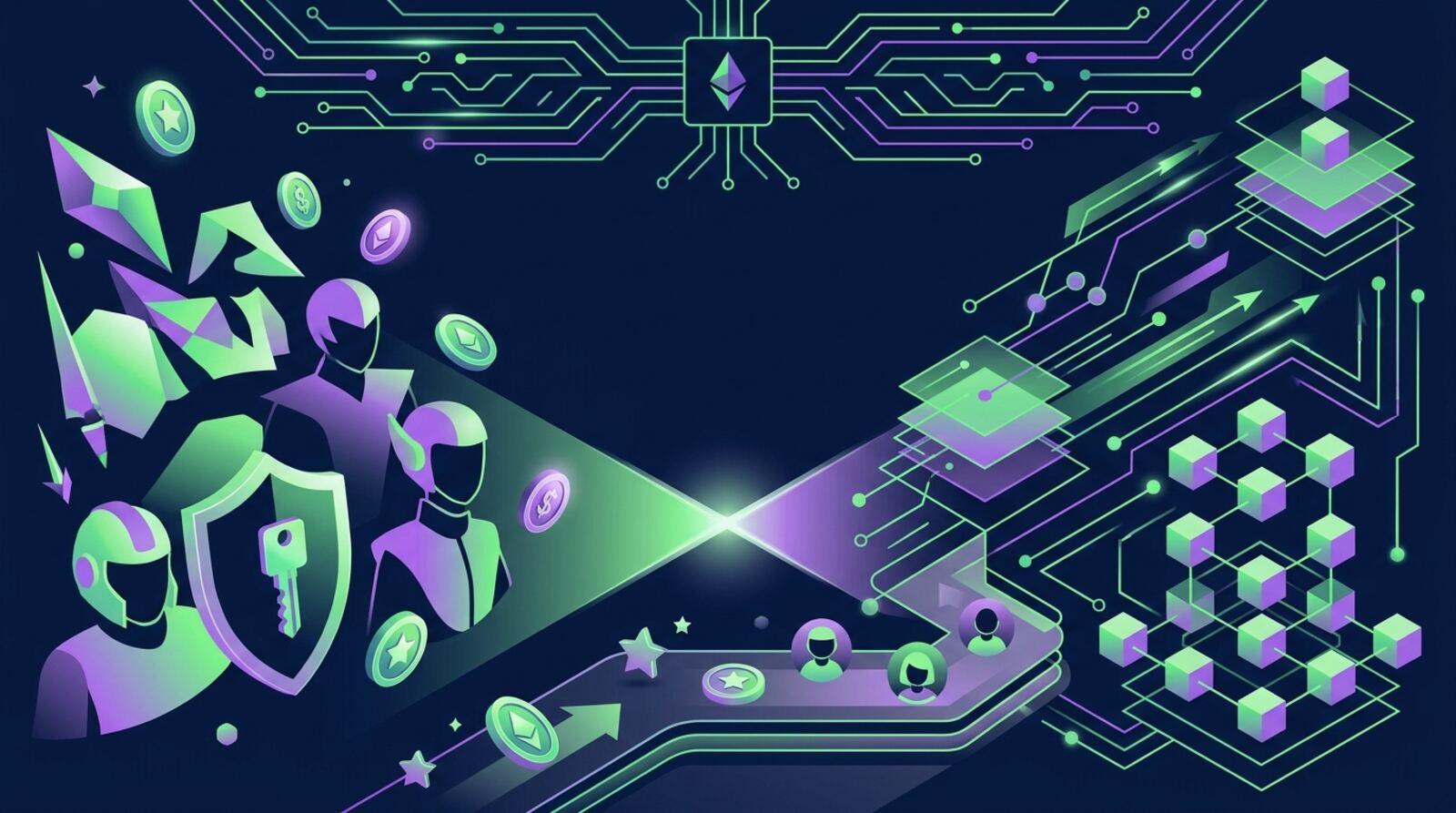
Play-to-earn games depend on public blockchains, and that creates two problems: fees and delays that make games hard to play, and open ledgers that expose players' finances and habits. This guide explains both problems, how game chains and developers try to solve them, and what players can do to protect themselves today.
By the DappsAtlas editorial team · Updated
What play-to-earn asked of blockchains
Play-to-earn, usually shortened to P2E, promised that players could earn digital assets they truly owned, and that those assets could hold value outside a single game. To do that, the game needs a shared record of who owns what. A public blockchain provides that record, so most P2E games store items, tokens or characters on a ledger rather than on a studio's private servers.
That design brings real benefits. Ownership can be verified without trusting the developer, and assets can move between wallets or marketplaces. It also brings costs. Every action that changes an asset must be written to the chain, and every record on that chain is visible to anyone who knows where to look.
The two problems that matter most are scalability and privacy. Scalability decides whether the game can run smoothly for many players at once. Privacy decides how much of a player's financial life is exposed by the same record that proves ownership. Most games that struggled in the P2E wave had difficulty with at least one of these, and many of the design choices made since then respond to both.
The term also carried a narrower meaning. Early models often tied rewards to token prices, which made the economy depend on new players buying in. Later discussion shifted toward play-and-own models, where the emphasis moved from earning to owning and enjoying the game. The underlying technical needs stayed the same either way.
Why scalability decides whether a game feels playable
A game is a stream of small events. A player moves a unit, fires a shot, crafts an item, claims a daily reward or finishes a match. Each event may need a transaction if it changes something the player owns. A single session can produce many of them.
Scalability is the chain's capacity to process that volume. It depends on how many transactions the network can confirm per second, how much each one costs and how long players wait for confirmation. If any of these is poor, the game feels slow even when the graphics and design are good.
Fast-paced games are the most sensitive. A research discussion on Web3 games notes that scalability can hurt the player experience in games where immediate responses matter. A turn-based strategy game can tolerate a short wait between moves. A shooter or racing game cannot.
Scalability also affects the economy. If fees are high relative to the value of a small reward, players lose money on routine actions. Developers then face a choice: absorb the fees, pass them on to players, or reduce the number of on-chain actions. Each option changes the game in ways players notice.
A useful test is to ask what happens during a busy weekend, when many players log on at once. Ask whether the game still responds quickly and whether the fees you pay stay predictable.
How gas fees and confirmation times shape game design
Gas fees are the payments that the network collects for processing transactions. When a network is busy, fees often rise, and when it is quiet, they often fall. For a player who earns small rewards, a fixed or rising fee can cancel out the value of those rewards.
Developers respond in several ways. Some move gameplay off the chain and record only key events, such as final ownership or trade settlements. Others choose a chain built for games or for high throughput. Some use a sponsored-fee model, where the game pays the cost so the player does not need to hold the chain's native token for every action.
Each approach has trade-offs. Keeping most gameplay off-chain is fast, but it leaves more of the game's logic in the developer's hands. Sponsored fees make onboarding easier, but they can hide costs and create dependence on the sponsor's policies. A fully on-chain design offers more transparency, but it demands more from the network.
Players should look at what they actually pay. Check whether a game lists its fee policy, whether fees are paid in the chain's native token or in another asset, and whether the game warns about delays. A game that is vague about these points should be treated with caution.
Fees and speed are not fixed. Networks change their designs, and games can switch chains. Check current information in the game's own documentation and on the chain's public status pages rather than relying on older articles.
Scaling approaches game chains use
Several approaches now appear across the P2E space. The right choice depends on the game's needs, and no single design fits every title. The table below describes the main categories and the examples in this guide. It does not rank the networks or make claims about their performance, which change over time.
| Approach | How it works in brief | Examples in this guide |
|---|---|---|
| Ethereum layer 2 network | Processes transactions off the main Ethereum chain and settles to it | Arbitrum and Base hosting games such as Heroes of Mavia, Anichess and Mighty Action Heroes |
| zkEVM on Ethereum | Ethereum-compatible execution using zero-knowledge proofs | Immutable zkEVM, used by Immutable-based games and TokenTrove |
| Sidechain | Separate chain linked to a main network, built for a specific use | Ronin, home of Axie Infinity and Ronin Market |
| Dedicated game chain | Independent chain designed around consumer apps and games | Flow, used by Chainmonsters; WAX, used by Alien Worlds and Warsaken |
| Independent chain | Standalone network with its own rules | Hive, used by Splinterlands |
When reading a game's documentation, note which category it belongs to. Each category has different security assumptions, different bridges for moving assets and different levels of developer control. Bridges in particular deserve careful reading, since they have been a frequent target for attacks in the broader crypto industry.
For readers who want a practical starting point, compare the chain's fee model, its tooling for wallets and its record of uptime. Then read the game's own explanation of why it chose that chain.
Why public ledgers expose player finances
Most people assume that a blockchain record is private. In practice, a public blockchain is open by design. Anyone can read the ledger, and the wallet address is a pseudonym rather than a secret. Pseudonyms are weak when they are linked to real identities, and linking often happens through exchanges, social media posts, shared usernames or games that ask for personal details.
For a P2E player, the exposed information can include balances, reward history, trading patterns and the assets that show what someone spends time and money on. That information can be used for targeted scams, unwanted contact or simply to judge someone's finances. Players who earn in one game and cash out through a public exchange often leave a clear trail.
Privacy is also a question of what a game collects. Some developers ask for email addresses, phone numbers or identity documents as part of account creation or cash-out. Others rely only on a wallet connection. Each data request creates a new place where personal information can be stored, leaked or misused.
The design challenge is to keep ownership verifiable while protecting the personal link to the wallet. Some projects explore techniques such as zero-knowledge proofs, which can confirm a statement without revealing the data behind it. These techniques are still developing, and their use varies widely from project to project, so players should not assume that any game has adopted them without reading the documentation.
A simple habit helps: treat your wallet address as personal information, and avoid posting it alongside your real name or other accounts.
Privacy risks players face and how to reduce them
Privacy risks in P2E are practical, and most can be reduced with ordinary careful habits. The main risks fall into a few groups.
- Wallet linkage: connecting a gaming wallet to an exchange account, a social profile or a public forum can reveal the rest of your activity.
- Phishing: fake websites and messages often imitate popular games and ask players to connect a wallet or sign a request that gives away access.
- Impersonation: scammers copy game support staff and offer help in exchange for seed phrases or passwords.
- Targeting: visible holdings can attract unwanted messages or attempts to take over accounts.
- Data breaches: centralized services that store personal data can be compromised, exposing names, emails and identity documents.
Defensive steps that help:
- Use a separate wallet for gaming, with only the funds you can afford to lose.
- Never share a seed phrase or private key with anyone, including people claiming to be support staff.
- Check the website address carefully before connecting a wallet, and bookmark official sites.
- Read each transaction request before approving it, and reject requests you do not understand.
- Limit the personal data you give to a game, and use a unique email address for gaming accounts.
- Review wallet connections regularly and revoke access for games you no longer use.
No single step is enough. The combination of separation, caution and minimal data sharing covers most of the common risks.
Privacy and fairness in competitive games
Competitive games have a different privacy problem. In a card game, a player's hand is hidden from opponents. If the game stores that hand on a public chain in plain form, opponents could read it before the moves are made, which would make the game unfair. The same concern applies to hidden stats, unrevealed map areas and any information that the game's rules keep secret.
Some games address this with commit-reveal schemes. A player commits to a choice by publishing a cryptographic fingerprint of it, then reveals the choice after the opponent has also committed. The fingerprint hides the choice while it matters, and the reveal proves that it was not changed afterward. Other games keep the hidden state off-chain and publish only verifiable results.
These methods have limits. They add steps and can slow matches. They depend on the code being correct and on the reveal step being completed. Players who abandon a match can sometimes leave an opponent waiting, so the game's rules for timeouts matter.
When you evaluate a competitive P2E title such as Splinterlands, Gunnies or Wild Forest, look for an explanation of how hidden information is handled. A clear answer is a good sign. A vague answer about fairness is a reason to read further before spending money.
For players, the practical takeaway is that a public ledger is not automatically a fair one. The game's design determines whether hidden information stays hidden where it needs to.
Balancing privacy with cash-outs and local rules
Many players eventually want to convert game rewards into money they can spend outside the game. This is where privacy and compliance meet. Exchanges and cash-out services often require identity verification, which means a company holds personal records linked to a wallet address. That is a legitimate control, but it is also a point where privacy depends on the company's own practices.
Rules differ by country. Some places treat certain tokens as securities, some tax rewards as income, and some restrict services for particular users. Gambling-style features, including wagering on fights in games such as Cambria Duel Arena, also carry separate legal rules that vary by location. If a feature involves real money, check the rules where you live before taking part, and only play where you are legally allowed. This is a reminder to check local laws, not a suggestion to avoid any checks.
For privacy, the useful question is what each service stores and for how long. Read the privacy policy of any exchange or game you use. Look for statements about data sharing, retention and deletion. Be cautious with services that ask for more information than the transaction needs.
P2E players should not try to avoid identity checks, use services designed to bypass age or location rules, or hide the origin of funds from the services they use. Those actions create legal risk and do not protect privacy in any durable way. Keep records of your activity, which will help with tax reporting and with resolving disputes.
A practical checklist before you play
Scalability and privacy are not solved problems, and no game can offer both perfect speed and perfect confidentiality on a public network. The practical question for a player is whether a specific game makes sensible trade-offs and explains them clearly.
Before joining a P2E game, consider the following checks:
- Chain: identify the blockchain the game uses and read its basic description.
- Fees: find out who pays transaction costs and whether that can change.
- Data: list the personal information the game asks for and decide whether it is necessary.
- Hidden information: check how the game keeps secret information secret and fair.
- Wallet safety: confirm that you can use a separate wallet and that the game never asks for your seed phrase.
- Token risk: recognize that game tokens and in-game assets can fall in value, and that many games have failed or changed significantly over time.
For current fee levels, token prices, player counts and network status, use the game's own dashboard and the public blockchain explorer for the network the game uses. Those sources change constantly and are more reliable than any static summary, including this one.
This guide is general information, not financial, legal or tax advice. Play for entertainment, set limits on time and money, and stop if the game stops being fun. If you find that gaming or trading is causing you stress, seek support from a qualified professional or a local support service.
Frequently asked questions
What does scalability mean in play-to-earn?
Scalability is a blockchain's ability to process many transactions quickly and cheaply. Games create a high volume of small actions, such as moving items, claiming rewards or completing matches, so a chain that handles only a few transactions per second with high fees struggles to support them.
Does a faster, cheaper game chain also protect my privacy?
Not necessarily. Many game chains and layer 2 networks give players a way to hold and move assets without paying high fees on every action, but they still record activity on a ledger. Privacy depends on how a game handles wallet data, what information it asks for, and which chain it uses. Read each game's privacy policy and check how its assets are recorded.
Why can other people see what I earned in a game?
Anyone can look up a public wallet address on a blockchain explorer and see its balances and transaction history. If someone links that address to your name, username or social accounts, they can see what you earned, spent and traded. Using separate wallets for gaming and savings and avoiding public posts that link them reduces this exposure.
Do I need to check local rules before earning tokens in a game?
Play-to-earn rewards are often taxable in many places, and token prices can change sharply. Cash-out routes usually require identity checks. Rules differ by country and by the platform you use, so check the rules where you live and talk to a qualified tax adviser if you have questions. This is general information, not financial or legal advice.
How should I evaluate a play-to-earn game before joining?
Look for a clear reason to use the chain, such as a fee structure you can understand and an active developer community. Check whether the game explains how assets are stored, whether it asks for unnecessary personal data, and how it handles hidden information in competitive play. Avoid any game that pressures you to buy assets or move funds quickly.
Mentioned in this guide
dApps in this guide
Axie Infinity is a Ronin-based NFT game where players collect, combine and battle creatures called Axies, with its own AXS token.
Ronin Market is the NFT marketplace for game assets on the Ronin blockchain, aimed at players and collectors in the Axie Infinity and Ronin gaming ecosystem.
ImmutableX is a web3 gaming platform on Ethereum whose IMX token covers fees, staking, governance and gas on Immutable zkEVM, aimed at gamers and token holders.
Splinterlands is a blockchain collectible card game on Hive where players battle with NFT cards and earn or stake the SPS governance token.
Alien Worlds is a community-built play-to-earn metaverse on WAX where players mine and play to earn TLM tokens and NFTs.
Pixels is a web3 farming and exploration game with a PIXEL token, guilds and ecosystem staking, aimed at gamers who are comfortable with wallets and token risk.
The Beacon is a free-to-play fantasy action roguelite RPG with MMO features on Arbitrum, with a BCN token and Season 1 rewards launched in May 2026.
Illuvium Overworld is a third-person open-world RPG on the IMX blockchain where players explore, capture Illuvials and craft items.
Anichess is a free-to-play chess game with magical spells from Animoca Brands and Play Magnus Group, with a CHECK token and staking on Base.
Keep reading
Related guides
Web3 gaming · Explainer
Immutable X and Play-to-Earn Gaming: What the Push Really Means
Immutable X is one of the most visible infrastructure providers for web3 games, but it is not a single game and has not replaced the play-to-earn model. This guide explains what it does, what the 'takeover' idea gets right and wrong, and how to check current activity yourself.
Web3 gaming · How-to
Play-to-Earn Games Guide 2026: How Crypto Gaming Rewards Work
Play-to-earn games pay out tokens or NFTs for in-game activity, but the rewards depend on game design, market demand and your own risk tolerance. This guide explains how the models work and how to evaluate a game before you put in time or money.
Web3 gaming · Explainer
Vulcan Forged NFT Lending in Play-to-Earn: How It Works (2026)
Vulcan Forged has been linked to NFT lending in its play-to-earn ecosystem. This guide explains how NFT lending works in these games, what the public record shows so far, and what to check before lending or borrowing any asset.
Web3 gaming · Best list
Blockchain Game Companies: A Guide to Who Builds What in 2026
Blockchain gaming company lists from 2020 are hard to verify today, so this guide explains what such rankings measure, which companies shaped the sector, and how to check whether a studio is still active. It is built for readers who want to research the field without relying on a single snapshot.
Web3 gaming · Explainer
Why Splinterlands Leads GameFi Weekly Charts: A 2026 Explainer
Splinterlands often appears near the top of GameFi weekly game lists because its card battles draw steady player activity on the Hive blockchain. This explainer covers what those lists measure, why Splinterlands keeps ranking well, and how to check current activity yourself.
Web3 gaming · Explainer
Why Game Tokens Surged in the Metaverse Hype and What Remains
Game tokens surged during the 2021 metaverse boom because investors expected virtual worlds and play-to-earn games to become large economies. This guide explains why that happened, why many of those prices later fell, and how to judge game tokens now.
Web3 gaming · Explainer
Will Gamers Drive Web3 Mass Adoption? An Explainer for 2026
The idea that players will bring blockchain tools into everyday use is plausible but unproven. This guide explains the argument, what past play-to-earn cycles taught, and how to judge a Web3 game before you spend time or money on it.
Web3 gaming · Explainer
Why Gaming Tokens Bounce Back After a Dip: A 2026 Guide
Gaming tokens often fall sharply and then rebound, but a rebound alone does not show that a project is healthy. This guide explains what drives both the drop and the recovery, and which checks help you judge whether a bounce has real support behind it.