Real-world asset · Explainer
Tokenizing Real-World Assets: 5 Things to Look Out For
Tokenizing a house, a bond or a fund share is easy to announce and hard to do well. These five checks separate a token that represents a real claim from one that is only a picture of one.
By the DappsAtlas editorial team · Updated
What does it mean to tokenize a real-world asset?
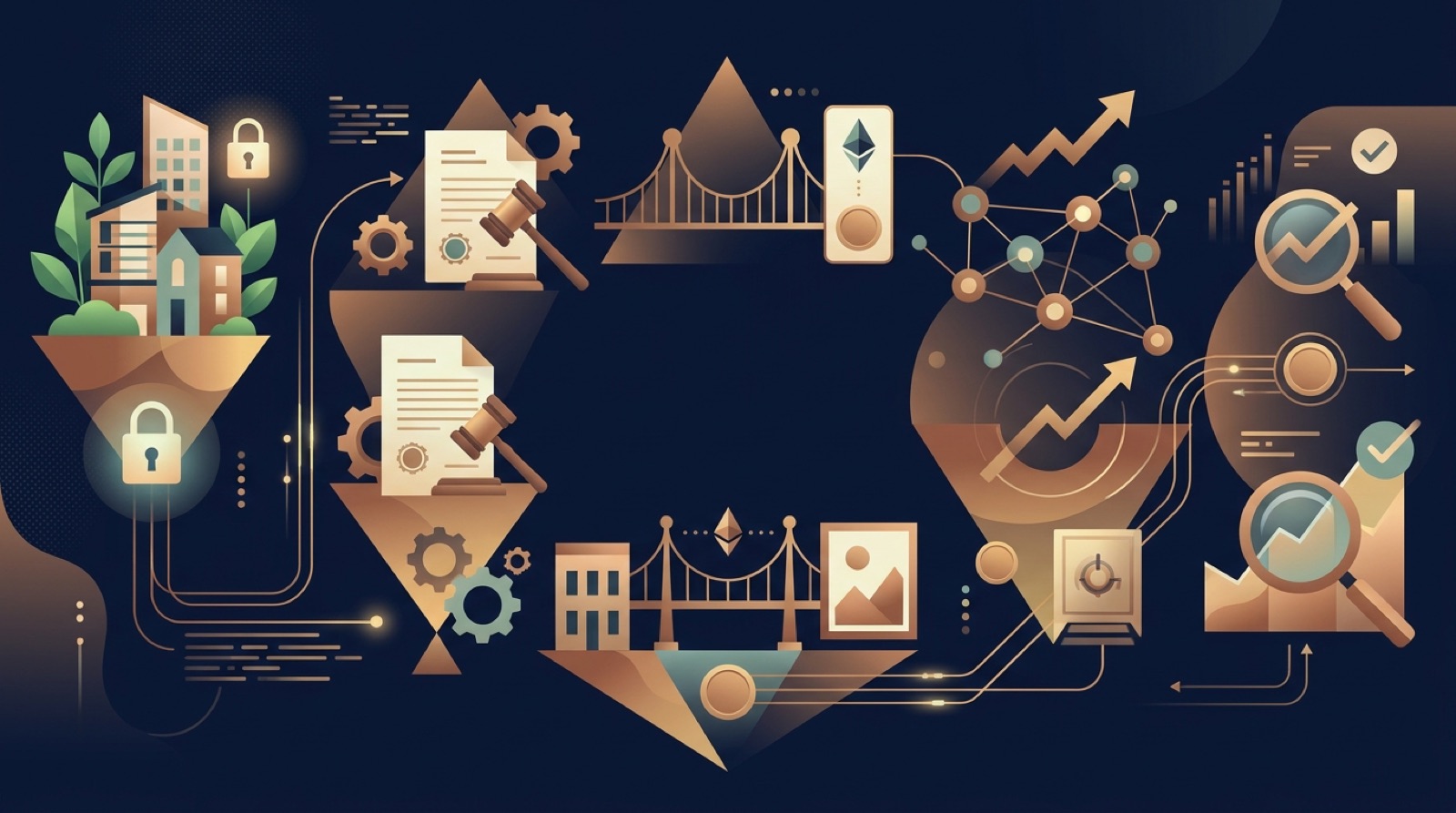
Real-world asset (RWA) tokenization means representing a claim on something that exists outside a blockchain, such as a government bond, a money market fund, a loan, a commodity, a property or a company share, as a token on a blockchain. The token can then be held in a wallet, transferred between addresses and, in some designs, used in DeFi.
The important word is claim. The blockchain records who holds the token. It does not, on its own, make the asset exist, prove that it is safe, or force anyone to honor what the token promises. Those things come from contracts, regulated entities, custodians and legal systems, all of which sit off-chain.
That gap is where most problems come from. A well-built tokenization connects three layers:
- The asset itself, with a clear owner and a clear value.
- The legal structure, which says what the token holder is entitled to.
- The technical layer, which handles issuance, transfers, compliance rules and payouts.
If any layer is weak, the token is weaker than it looks. This guide is written for both sides of the process: people considering buying tokenized assets, and teams considering issuing them. The five checks below apply to both, because an issuer who cannot answer them will struggle to earn trust, and a buyer who does not ask them is taking risks they cannot see.
Nothing here is investment, legal or tax advice. Rules differ by country and change often, so confirm details with qualified professionals.
The five checks at a glance
Most failures in tokenized assets trace back to one of five areas. Use this table as a quick reference, then read the detail in the sections that follow.
| # | What to look at | The question to ask | Typical warning sign |
|---|---|---|---|
| 1 | Legal rights | What exactly does the token entitle me to, and against whom? | Marketing says "ownership" but documents say otherwise |
| 2 | Custody and the off-chain link | Who holds the asset, and how is it kept separate from the issuer's funds? | No named custodian or no independent verification |
| 3 | Valuation and data | How is the value set, and who checks it? | Price comes from a single source with no audit trail |
| 4 | Compliance and transfers | Who may hold it, and can transfers be blocked? | Unclear eligibility rules or hidden freeze powers |
| 5 | Liquidity and redemption | How do I get out, and at what price? | No redemption right and thin or no secondary market |
Two extra areas deserve attention after these five: smart contract and platform risk, and tax treatment. They are covered later because they apply to almost every token, not only RWAs.
A useful habit is to treat the five checks as a gate. If you cannot get a clear, written answer to one of them, treat that as a reason to pause, not a detail to resolve later. Tokenized assets look uniform on a screen, since each is just a ticker and a balance, but the structures behind them vary enormously. Two tokens with similar names and similar yields can carry very different legal and operational risks.
Check 1: What does the token actually give you?
The first question is what the token legally represents. There are several common structures, and they are not equivalent:
- Direct ownership or beneficial interest in the asset, often held through a special-purpose vehicle (SPV) or trust.
- A share or unit in a fund that holds the asset, where the fund is the legal owner.
- A debt claim against an issuer, which means you are an unsecured or secured creditor of that company.
- A synthetic or price-tracking token, which follows the asset's price but gives no claim on the asset at all.
The difference matters most when something goes wrong. If the issuer becomes insolvent, a holder with a claim over assets held in a properly segregated vehicle is in a very different position from an unsecured creditor or from someone holding a token that only tracks a price.
What to read:
- The offering document, prospectus or terms of service, not the marketing page.
- The description of the legal entity that issues the token, and where it is registered.
- Whether the token holder, the wallet address, or only a verified account is recognized as the owner on the off-chain register.
- Which law governs disputes and where claims must be brought.
For issuers: decide the structure first and design the token around it, not the other way round. A property placed in an SPV with shares represented by tokens is a clear design. A token launched first with the legal wrapper to be sorted out later is a common source of regulatory trouble.
Check 2: Who holds the asset, and how is it verified?
Every tokenized RWA depends on someone, or something, holding the real asset. That might be a bank, a broker, a trust company, a vault operator, a land registry or a fund administrator. The token is only as reliable as that off-chain link.
Questions to ask about custody:
- Who is the named custodian, and are they regulated for this activity?
- Is the asset held in an account separate from the issuer's own funds, so creditors of the issuer cannot reach it?
- Does an independent party, such as an auditor or administrator, confirm that the assets match the number of tokens issued?
- What happens to the asset if the issuer or the tokenization platform shuts down?
Reconciling supply and assets. For every token in circulation, there should be a matching claim on a real asset. Look for regular reports from an independent party, and understand how often they are published. A one-off attestation at launch tells you little about today's position. Some issuers publish on-chain data or recurring attestations; read what those attestations actually cover, since some confirm balances at a point in time and say nothing about legal ownership.
Physical assets add more steps. Gold in a vault, art in storage or property needs insurance, inspection, title records and a process for resolving disputes. Ask how the physical item is linked to the token, and who is responsible for upkeep and insurance costs.
For issuers: choose custodians and administrators that outside parties can verify, and document the process for handling a failure. Buyers will ask.
Check 3: How is the value set, and who checks it?
A tokenized asset is useful only if its price or value is trustworthy. Unlike a native crypto token, an RWA often has a value that comes from outside the chain, and that value has to be fed in somehow.
Where the value comes from. Depending on the asset, it might be a net asset value (NAV) calculated daily by a fund administrator, a market price from an exchange, an appraisal for property, or a payment history for loans. Each has different weaknesses:
- NAV and appraisals are updated infrequently, so the stated value can lag reality, especially in stressed markets.
- Market prices can be accurate for liquid assets, but thin markets produce noisy or manipulated prices.
- Loan books depend on the quality of underwriting and on how defaults are recognized.
Oracles. When a token is used in DeFi, a price oracle usually tells smart contracts what the token is worth. If the oracle reports the NAV, the on-chain price may not move even when the secondary-market price does. If the oracle follows a thin market, it can be pushed around. Neither is safe by default. Check how often the value updates, what happens if the feed stops, and whether there are limits on how fast it can change.
Questions to ask:
- Who calculates the value, and is that party independent of the issuer?
- How often is it updated, and how can I verify it?
- What fallback exists if data is missing or looks wrong?
Lending markets and risk managers such as Gauntlet pay close attention to these inputs when deciding whether an asset can serve as collateral.
Check 4: Who can hold it, and can transfers be restricted?
Tokenized securities, funds and similar products are usually regulated. Unlike most crypto tokens, an RWA may come with rules about who can buy it, where it can move and what the issuer can do to it.
Common features to look for:
- Eligibility limits. Some tokens are restricted to verified or accredited investors, or exclude residents of certain countries.
- Identity checks (KYC). Issuers or platforms may require identity verification before you can hold or receive the token.
- Allowlists. Transfers may work only between approved wallets. A transfer to an unapproved address can fail or be reversed.
- Issuer controls. Many compliant tokens let the issuer freeze, pause or reassign tokens, for example to meet a court order or fix an error.
- Holding periods. Some products restrict resale for a set time.
These controls are not necessarily red flags. In a regulated product they are often required. The risk is not knowing about them. A token you can only hold on one platform, or that can be frozen, is a different asset from a freely transferable token.
Respect the rules. If a product is not offered in your country, or you do not meet its eligibility rules, the correct response is not to look for a workaround. Using tools or tricks to bypass location limits or identity checks can breach the terms and local law, and may leave you unable to recover funds.
For issuers: get legal advice in every jurisdiction where tokens will be offered, define the transfer rules in the token's code and in the legal documents, and keep both consistent.
Check 5: Can you actually redeem or sell?
A token can be transferable in theory and still be hard to sell in practice. Liquidity has two parts: the ability to redeem with the issuer, and the ability to sell to someone else.
Redemption. Ask whether holders have a right to exchange tokens for the underlying asset or its cash value, and what the conditions are:
- Minimum redemption sizes, which may exclude small holders.
- Notice periods or settlement times, which may be days or longer.
- Fees, gates or limits that apply when many holders redeem at once.
- Whether redemption is open to everyone or only to approved parties.
Some assets are naturally illiquid, such as property, private loans and private company shares. Putting them on a blockchain does not change that. A token can trade 24 hours a day while the underlying asset cannot be sold quickly.
Secondary markets. If there is no redemption right, your exit depends on other buyers. Check where the token trades, how deep the order books or pools are, and how far the market price strays from the stated value. A wide gap, or wide spreads, is a sign that exit costs may be high.
Questions to ask:
- Can I redeem directly, and what does it cost?
- How much could I sell today without moving the price much?
- What happens in a stress event when many holders want out?
For issuers: be honest about liquidity in the product description. Overstating how easy it is to exit is one of the fastest ways to lose trust and attract regulators' attention.
What about smart contract, platform and DeFi risk?
Beyond the five core checks, every tokenized asset runs on software, and software fails.
Smart contract risk. Token contracts, bridges, vaults and issuance systems can contain bugs. Look for independent security audits, a public record of how issues were handled, and clear information about who can upgrade the contracts. An admin key that can change rules or mint tokens is a central point of failure and should be controlled by a multi-signature setup or similar safeguards, with clear disclosure.
Platform and chain risk. The platform that issues, lists or custodies the token can fail separately from the asset. If the token is bridged to another chain, the bridge adds its own risk.
Composability risk. Some tokenized assets can be used as collateral in lending markets such as Aave V3 or Compound V3, or sit inside vaults and tokenized funds built with tools like Enzyme Finance. This extends the asset's use, but also stacks risks: if the token's price feed lags, if redemption is slow, or if transfers can be frozen, liquidation systems may not work as designed. Whether a given RWA is accepted as collateral on any market, and under what limits, changes over time, so check the market's own documentation and governance pages.
Practical defenses:
- Use a hardware wallet for meaningful amounts.
- Verify contract addresses from official sources, not from public reporting or messages.
- Be cautious with token approvals and revoke those you no longer need.
- Do not put more into a single product than you can afford to lose.
Products that carry the words "treasury" or "yield" are not automatically low risk. The yield comes from somewhere, and you should know where.
What about tax and local law?
Tokenization does not remove tax or reporting obligations, and in some places it adds them. The right treatment depends on what the token legally is.
Why classification matters. Depending on the country and structure, a token might be treated as a security, a fund unit, a debt instrument, property or a crypto-asset. Each can lead to different tax outcomes for purchases, sales, interest, dividends and rental income. A token that pays yield may produce taxable income when received, not only when sold.
Securities and financial-services law. Offering tokens to the public often triggers prospectus, licensing or investor-protection rules. In some regions, there are dedicated crypto-asset regimes, and these may treat asset-referenced tokens and tokenized securities differently. These regimes continue to develop, so check the current rules for your location with an official regulator or a qualified adviser rather than relying on an article.
What buyers should do:
- Keep records of dates, amounts, prices and fees for every transaction.
- Note any payouts, and whether they were received in cash, stablecoins or more tokens.
- Ask a qualified tax adviser how your country treats the specific product.
What issuers should do:
- Obtain legal advice before launch on securities, fund, property and anti-money-laundering rules in each target market.
- Plan for investor reporting, such as tax statements.
- Document the ongoing duties of the issuer, including audits and disclosures.
If a platform says a product is unavailable in your region, treat that as final. Local law applies to you regardless of where the issuer is based.
A due diligence checklist you can reuse
Use this list before you buy a tokenized asset, or as a self-check before you issue one. If you cannot answer an item from official documents, treat it as unknown risk.
Before you buy
- Identify the issuer. Find the legal entity, its country and its regulator, if any.
- Read the terms. Confirm what the token represents, your rights on insolvency and the governing law.
- Find the custodian. Check who holds the asset and how it is kept separate.
- Check reporting. Look for recurring independent attestations or audited accounts, and note how recent they are.
- Understand valuation. Know who sets the value and how often it updates.
- Review transfer rules. Look for allowlists, freeze powers and eligibility limits.
- Test the exit. Read the redemption terms, then look at secondary-market depth for the token.
- Review the code. Look for audits, admin-key controls and upgrade rights.
- Plan for tax. Speak to an adviser about the treatment in your country.
- Size the position. Keep it small enough that a total loss would not harm you.
Before you issue
- Choose the legal structure first and get advice in each target jurisdiction.
- Appoint independent custodians, administrators and auditors.
- Define the value calculation and update schedule in writing.
- Write transfer and freeze rules into both the code and the legal terms.
- Describe redemption and liquidity plainly, without overstating them.
- Prepare an incident plan for failures, hacks and legal orders.
A product that welcomes these questions and answers them in public documents is usually in a better position than one that answers with marketing language.
Where to check current information
Tokenized assets change quickly. Issuers launch and close products, regulators update guidance, and platforms change which assets they accept. Anything about current availability, yields, sizes or approvals is out of date quickly, so confirm it at the source.
Where to check:
- The issuer's official documents: the prospectus, terms, fact sheets and audit or attestation reports.
- Your financial regulator: for whether a product or issuer is authorized, and for local rules on crypto-assets and tokenized securities.
- Block explorers: to verify the token contract, total supply, admin permissions and large holders.
- Protocol documentation and governance forums: for lending markets, vaults and risk managers, to see whether a token is accepted as collateral and under which limits.
- Security audit reports: for scope, findings and whether issues were fixed.
Where tokenized exposure appears. Some exchanges and brokerages list tokenized stocks, commodities or similar products, for example Bitget, and some brokerage apps such as Robinhood and Backpack offer stocks alongside crypto. These are different structures from on-chain RWA tokens held in your own wallet, and each has its own custody, eligibility and regional availability. Read the product terms of each one rather than assuming they work the same way. Savings products in the Sky ecosystem, such as Spark Savings, and collateral-market protocols like Symbiotic that mention RWA products also work differently from each other, so check each one's current documentation.
The core idea does not change: know what you hold, who stands behind it, how it is valued, who can move it and how you get out.
Frequently asked questions
Does owning a tokenized asset mean I legally own the underlying asset?
No. A token is a record on a blockchain. Whether it gives you ownership, a contractual claim against an issuer, or only exposure to price movements depends on the legal documents behind it. Read those documents before assuming the token carries any rights.
What is the biggest risk with tokenized real-world assets?
Usually the issuer, a custodian or a transfer agent holds the underlying asset, and the token is a claim on it. If that party fails, is hacked or mismanages the asset, the token can lose value regardless of how well the smart contract works. Check who holds the asset and how it is segregated from the issuer's own funds.
Can anyone buy tokenized real-world assets?
Many tokenized securities and funds are limited to verified or accredited investors, or to certain countries. Transfers to non-approved wallets can fail or be frozen. Check the eligibility rules and your local law, and do not try to get around age, location or identity checks.
Can I always sell a tokenized asset at its net asset value?
Not by default. Without a redemption right, market makers and a liquid venue, you may be unable to sell near the stated value. Read how redemption works, any minimum sizes, notice periods and fees, and check trading depth before you buy.
How are tokenized real-world assets taxed?
Tokenized assets can be treated as securities, funds or property depending on the country and structure, and gains or income may be taxable. Rules differ and change, so ask a qualified tax adviser and keep records of every purchase, sale and payout.
Mentioned in this guide
dApps in this guide
Enzyme Finance is infrastructure for issuing and managing tokenized funds and on-chain strategies, aimed at asset managers, institutions and DeFi builders.
Symbiotic is an Ethereum collateral-markets protocol where shared deposits back credit, insurance, stablecoin and RWA products via curated vaults.
Gauntlet is a DeFi risk manager that curates non-custodial yield vaults for fintechs, exchanges, wallets and asset managers.
Aave V3 is a non-custodial DeFi lending protocol on 21 chains where users earn interest on deposits or borrow against collateral.
Compound V3 is a lending protocol on Ethereum and nine other chains where users supply a base asset for yield or borrow it against collateral.
Spark Savings is a Sky ecosystem savings product where users deposit stablecoins and other assets to earn a variable yield tied to the Sky Savings Rate.
Bitget is a centralized exchange for crypto spot and futures that also offers tokenized stocks, commodities and forex in one account, for active traders.
Robinhood is a US brokerage app offering commission-free stocks, options, futures and custodial crypto trading for retail investors.
Backpack is a crypto exchange, US stock broker and self-custody wallet offering perps, lending yield and cross-collateral margin in one app.
Keep reading
Related guides
Real-world asset · Explainer
Courtyard Explained: Tokenized Collectibles Backed by Real Assets
Courtyard turns graded trading cards and other physical collectibles into tokens, with the originals held in an insured vault. This guide explains how it works, what the token represents and which risks to weigh before buying.
Real-world asset · Explainer
What Is Lingo? The Gamified RWA-Powered Rewards Ecosystem
Lingo markets itself as a token that turns real-world asset yield into community rewards through points and airdrops. This guide explains the model, where the rewards are said to come from, and what to check before taking part.
Real-world asset · Explainer
Tokel Explained: How the Tokenization Platform Works
Tokel is a Komodo-ecosystem blockchain built around creating tokens and NFTs. This guide explains what tokenization means, how a chain like Tokel fits in, and how to judge any tokenization project.
DeFi · Explainer
What Is Stratex? How to Get More From Your Crypto Assets
Stratex is a name we could not pin to one verified product, so this guide shows how to check any platform that uses it. It then covers the main ways to put crypto to work, and the risks that come with each.
Real-world asset · Best list
Best RWA Tokenization Tools: Platforms and Use Cases
Compare the main tools and infrastructure used to issue, manage and distribute tokenized real-world assets. Learn what each layer does, how to choose a platform and which legal, operational and technical risks to check.
Real-world asset · Explainer
Tokel Tokenization Platform Explained: How It Works in 2026
Tokel, also written Tokels, is a platform for creating tokens and NFTs without gas fees, according to its own description. This guide explains what tokenization platforms do, what the public material does and does not confirm, and how to evaluate one before you use it.
Real-world asset · Best list
RWA Crypto Tokens to Know in 2026
RWA crypto tokens can represent Treasury funds, gold, credit, or governance rights—and those roles carry very different risks. Learn which examples to research, what each token actually represents, and how to check access, backing, and redemption terms.
Real-world asset · Explainer
Tokenized Gold Explained: How It Works and Its Risks
Learn what tokenized gold represents, how physical backing and redemption work, and how it differs from gold ETFs and synthetic tokens. This guide also covers the main risks and checks to make before buying or using a token.