Blockchain · Explainer
Scalability Trilemma Explained, With Horizen's Approach (2026)
The scalability trilemma describes the trade-off between decentralization, security and scalability that blockchain designers face. This guide explains each corner, how Horizen positions itself, and how to judge any chain's trade-offs.
By the DappsAtlas editorial team · Updated
What is the scalability trilemma?
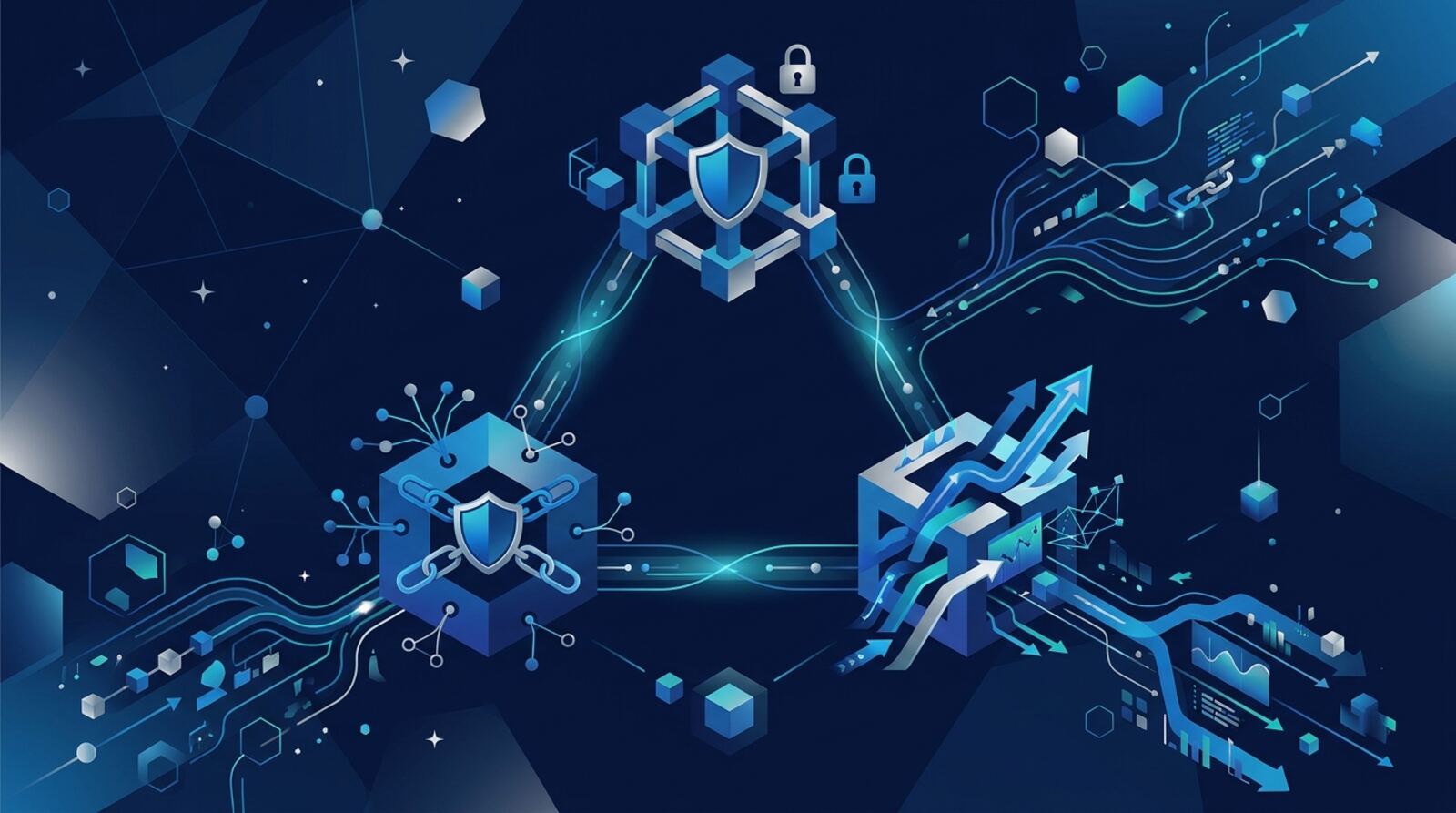
The scalability trilemma is a way of describing a design problem that every public blockchain faces. A network should be decentralized, meaning many independent parties can take part in running it. It should be secure, meaning it resists attacks, double spending and unauthorized changes. And it should be scalable, meaning it can process a large number of transactions quickly and at a reasonable cost.
The idea is often summarized as a claim that a blockchain can only fully deliver two of the three at once. Vitalik Buterin is widely credited with popularizing the phrase blockchain trilemma. Some sources present it as a generally accepted belief, while others treat it as an engineering observation about current designs. Either way, it gives you a shared vocabulary for comparing networks.
The trilemma matters for DeFi because lending markets, exchanges and payment apps all depend on fast, cheap and trusted settlement. When a network is slow or expensive, users move to alternatives. When a network is fast but few parties run it, users must trust a small group. The trilemma is the lens for understanding that tension.
The three corners: decentralization, security and scalability
Decentralization describes how widely the work of running a network is spread. Measures include the number of validators or full nodes, how much stake or hash power the largest operators control, how easy it is for an ordinary person to run a node, and whether more than one software client is in use. A network with a handful of operators may be fast, but a failure or capture in one place can affect everyone.
Security describes how expensive it is to attack the network and how well it recovers from failures. It depends on the consensus mechanism, the economic cost of an attack, the maturity of the code, and whether upgrades are controlled by a clear process. Security is not the same as decentralization. A small, well-audited network can be secure in some respects while being concentrated in others.
Scalability describes throughput, latency and cost. Throughput is how many transactions can be processed per second. Latency is how long it takes for a transaction to be final. Cost is what users pay under normal and busy conditions. Scalability claims should always be read alongside the hardware, bandwidth and trust assumptions that make them possible.
Why does the trade-off appear?
The trade-off appears because every node in a traditional blockchain must check and store the same data. If a network wants to process more transactions, each node needs more bandwidth, storage and computing power. Over time, that raises the hardware bar for running a node. Fewer people can afford to participate, and the network becomes more concentrated.
If designers keep the hardware bar low so that anyone can run a node, they usually limit how many transactions each block can carry. That keeps the network decentralized and secure, but it can cause congestion and high fees during busy periods.
A third path is to reduce how much work each participant must do, for example by checking only proofs or summaries rather than every detail. This can improve scalability but adds complexity, new trust assumptions or new failure modes. Much of the current research in blockchain design is about moving these trade-offs rather than eliminating them.
How does Horizen approach the trilemma?
Horizen is a blockchain project that presents itself as addressing the trilemma by combining security, scalability and privacy-preserving features. Its public materials and third-party write-ups describe a sidechain framework, known as Zendoo, intended to let separate chains run specialized workloads while connecting to the main network. The idea is to place heavy activity on sidechains so that the base chain carries less load.
When you evaluate a claim like this, separate three questions. First, what is the main chain's security model and who runs its validators or nodes? Second, how do sidechains inherit or fail to inherit that security? Third, what happens when assets move between chains, and who controls the bridge or cross-chain logic?
You should also check the date of any article you read. Network designs, token economics and feature sets change, and older commentary may describe a version that no longer runs. Use the project's current technical documentation, its published network statistics and independent analysis to form your own view.
Common ways chains try to solve the trilemma
Several approaches are used across the industry, and most networks combine more than one. Parameter tuning raises block sizes or shortens block times, which can help throughput but may add hardware demands. Sharding splits the network into partitions that process transactions in parallel. Layer-2 rollups execute transactions off the base chain and post data or proofs back to it. Sidechains run separately with their own consensus and connect through bridges. Modular designs separate execution, data availability and consensus into different layers.
The table below compares these approaches in general terms. It does not rank specific networks, and actual performance depends on implementation.
| Approach | Main gain | Main cost or risk |
|---|---|---|
| Parameter tuning | Simple, quick throughput gains | Higher node requirements |
| Sharding | Parallel processing | Cross-shard complexity |
| Rollups | Lower fees, base-chain security for data | Sequencer and proof assumptions |
| Sidechains | Independent throughput | Weaker inherited security, bridge risk |
| Modular stacks | Specialized layers | More moving parts to trust |
No approach removes the trilemma entirely. Each one moves the trade-off to a different place, so the useful question is where the cost lands.
How do rollups and bridges change the trade-offs?
Rollups and bridges are central to how many DeFi users now move between networks. A canonical bridge, such as the one that connects Ethereum mainnet with the Arbitrum rollup, typically relies on the rules of the base chain and the rollup's own security design. Third-party bridges and messaging protocols, such as LayerZero V2 and the intent-based Across protocol, rely on different verification and relayer models. Each one changes the trust assumptions.
When you move assets across networks, consider several points. Check whether the bridge is the official canonical route or a third-party service. Understand who can pause or upgrade the contracts. Know how long withdrawals take and whether they depend on a challenge period. Read the documentation about what happens if a relayer or verifier fails.
Many bridge losses in the past came from smart contract bugs or compromised keys rather than from the trilemma itself. That is why the security of the bridge's code, key management and monitoring matters as much as its throughput claims.
How to compare chains against the trilemma
You can compare any chain with a short, repeatable checklist. Start with decentralization: how many validators or nodes exist, how stake or power is distributed, whether a single client dominates, and whether the community can run a node on ordinary hardware. Then look at security: the consensus design, how finality works, the history of incidents, and how upgrades are authorized and reviewed.
Next examine scalability: typical transaction fees during normal and busy periods, time to finality, and whether performance figures come from independent measurements or from the project itself. Finally, look at the architecture: is the chain a monolithic base layer, a rollup, a sidechain, or part of a modular stack, and what does each choice imply?
Write down the answers and the date you checked them. Figures for fees, validator counts and total value locked change often. For TVL and cross-chain activity, public aggregators such as DefiLlama can show current values, but treat any single dashboard as one input among several.
What the trilemma means for DeFi users
For DeFi users, the trilemma shows up as practical choices. A cheap, fast network may have fewer independent operators, so your funds depend more on that group's honesty and competence. A slower, expensive network may give stronger guarantees but make small transactions uneconomic. Many people split their activity across chains, which adds bridge exposure and more addresses to manage.
The same logic applies to the protocols you use. A lending market or decentralized exchange on a particular chain inherits that chain's trade-offs. Smart contract risk, oracle dependence, liquidity conditions and governance decisions also matter, and none of these is solved by a faster block time alone.
Defensive habits help regardless of chain. Verify contract addresses from official sources rather than search ads or unsolicited messages. Use a wallet you control, keep recovery phrases offline and never share them. Review token approvals and revoke ones you no longer need. Start with amounts you can afford to lose while you learn how a network behaves.
Limits of the trilemma as a model
The trilemma is a helpful framework, but it is a simplification. It groups very different systems under three labels, and it can hide differences in how decentralization is measured or how security is defined. Some critics argue that the framing is too pessimistic because newer designs move the trade-offs rather than accept them. Others argue that the framing understates how concentrated some networks become in practice.
A fair reading treats the trilemma as a set of questions. Who runs the network? What does it cost to attack it? How quickly and cheaply can it process activity? What breaks if one part fails? Those questions can be answered for any chain, and the answers change as networks upgrade.
When you read claims about solving the trilemma, check which corner was improved, what was traded away, and what evidence supports the statement. A claim that sounds complete usually omits one of the three corners or depends on assumptions that deserve scrutiny.
Frequently asked questions
Is the scalability trilemma proven to be impossible to solve?
No. The trilemma is a useful mental model, not a mathematical theorem. Many designers argue that the trade-offs are real under current architectures, but newer designs such as rollups, modular stacks and parallel execution try to weaken them. Treat it as a checklist of questions rather than a fixed limit.
What is Horizen's connection to the scalability trilemma?
Horizen is a blockchain that describes itself as offering security, scalability and privacy features, with a sidechain framework called Zendoo intended to move work off the main chain. Its claims should be checked against its current technical documentation, validator or node figures, and independent analysis, because marketing summaries can differ from how the network actually runs.
How can I check a chain's trilemma trade-offs myself?
Start with the official documentation and recent network statistics, then compare the number and geographic spread of validators or nodes, the software client diversity, how fast transactions reach final settlement, typical fees under load, and who can change protocol rules. Public data aggregators and block explorers can help, but figures change often, so check the date on any number you read.
Do rollups and bridges remove the trade-offs?
Not necessarily. Layer-2 rollups and cross-chain bridges can add speed and lower fees, but they also add trust assumptions, such as sequencer behaviour, bridge contract risk and message verification. Read what security model each system uses before moving funds, and understand that the risk profile changes when assets cross networks.
What should a DeFi user take from this topic?
Gambling is not part of this topic, but if you use any crypto platform, check your local laws and the rules that apply where you live. Keep your own security habits strong: verify contract addresses from official sources, use hardware or well-known wallets, and never share seed phrases or recovery details with anyone who contacts you unprompted.
Mentioned in this guide
dApps in this guide
DeFipedia is an educational website for readers exploring DeFi, with articles, a glossary, protocol reviews and community Q&A.
Arbitrum Bridge is the canonical bridge that moves ETH and ERC-20 tokens between Ethereum mainnet and the Arbitrum Layer-2 rollup.
LayerZero V2 is a cross-chain messaging protocol and bridge infrastructure for developers and asset issuers, connecting dozens of blockchains.
Across is an intent-based cross-chain bridge and swap protocol for moving tokens between Ethereum, rollups and other chains, with an API for apps.
Hyperliquid is a Layer-1 blockchain with a non-custodial onchain exchange for perpetual futures and spot trading, aimed at active crypto traders.
Aave V3 is a non-custodial DeFi lending protocol on 21 chains where users earn interest on deposits or borrow against collateral.
Uniswap V3 is a non-custodial decentralized exchange protocol for token swaps and concentrated liquidity provision across 40+ chains.
DefiLlama is a data site that aggregates total value locked, trading volume and fees for DeFi protocols across many chains.
Common is a non-custodial ZK privacy dapp on Arbitrum and Aleph Zero EVM that lets users shield funds and withdraw to a new, unlinkable wallet.
Keep reading
Related guides
Blockchain · Explainer
Multichain DeFi vs Ethereum Dominance: What Is Changing in 2026
Ethereum still anchors much of decentralised finance, but activity now spreads across layer-2 rollups and other base chains. This guide explains what multichain DeFi means, why the split is happening, and how to read the numbers yourself.
Blockchain · Explainer
Ethereum Scalability and Gas Fees: How It Works in 2026
Ethereum's base layer keeps transactions expensive and slow at peak demand, so most of the scaling work now happens in rollups, data-availability upgrades and a multi-year protocol roadmap. This guide explains how each piece works, what it means for your fees, and how to choose where to transact.
Blockchain · Explainer
Why Ethereum Layer 2 Scalability Matters in 2026
Ethereum layer 2 networks process transactions off the main chain and tie their security back to Ethereum. This guide explains why that matters for fees, speed and safety, and how to judge any layer 2 before you use it.
Blockchain · Review
How to Discover dApps and NFTs on Mantle Network in 2026
Mantle Network is an Ethereum layer-2 where you can find decentralized apps and NFT collections at lower transaction costs. This guide covers how to set up a wallet, find trustworthy sources, check contracts before you interact with them, and avoid the scams that target new networks.
Blockchain · Explainer
SKALE's 100 Million Ecosystem Incentive Program: What to Know
SKALE has announced a 100 million incentive program to grow its ecosystem. This guide explains what programs like this usually offer, what the public sources we could check do and do not confirm, and how to verify the current terms before you build, apply or take part.
Blockchain · Explainer
Ronin Security Upgrades and Validator Expansion Explained
Ronin raised the signing threshold on its bridge after the 2022 hack, and it has since announced plans for more validators and a move back to Ethereum. This guide explains what changed, what the numbers mean, and how to check the current status yourself.
Blockchain · Explainer
SKALE Scalability Explained: How Its Modular Design Works (2026)
SKALE is an Ethereum-connected network of elastic blockchains that aims to scale by letting each app run on its own chain with shared validators. This guide explains how that design works, where it sits among scaling options, and what to check before relying on it.
Blockchain · Explainer
Ronin Network Free Transactions Ran Out: What Players Can Do
Ronin's free transactions are a limited allowance that game players can run out of when demand spikes, and paying gas in RON is the usual fallback. This guide explains why the network sometimes feels slow or restricted, what the past pauses mean for users today, and what to check before you act.