Presale and ICO · Explainer
Sandwich Network Token: Minting, Launch and Lock Explained (2026)
Sandwich Network (SANDWICH) appears on public price listings, but the sources reviewed do not establish its purpose or team. This guide explains how minting, token launches and liquidity locks work, how to verify each one, and what sandwich attacks mean for anyone buying a new token.
By the DappsAtlas editorial team · Updated
What is Sandwich Network (SANDWICH)?
Sandwich Network, traded under the ticker SANDWICH, is a token that appears on public price listings. Those listings show a price and trading activity, but they do not on their own explain what the token is for, who runs the project, or what rights holders have. The sources reviewed for this guide do not establish either the purpose or the team, so this article does not describe them.
That gap matters. A token with a price is not the same as a token with a working product. Some tokens exist mainly as trading instruments, some represent access to a service, some give governance votes, and some have no clear use at all. Before relying on any description of SANDWICH, look for an official project website, named team members with verifiable profiles, published documentation, and a contract address you can check on a block explorer.
Be careful with names as well. Many tokens borrow a familiar word, and unrelated projects or imitation tokens often use similar names to attract buyers. Confirm the exact contract address from a source you trust, not from a search result, a social post or a direct message.
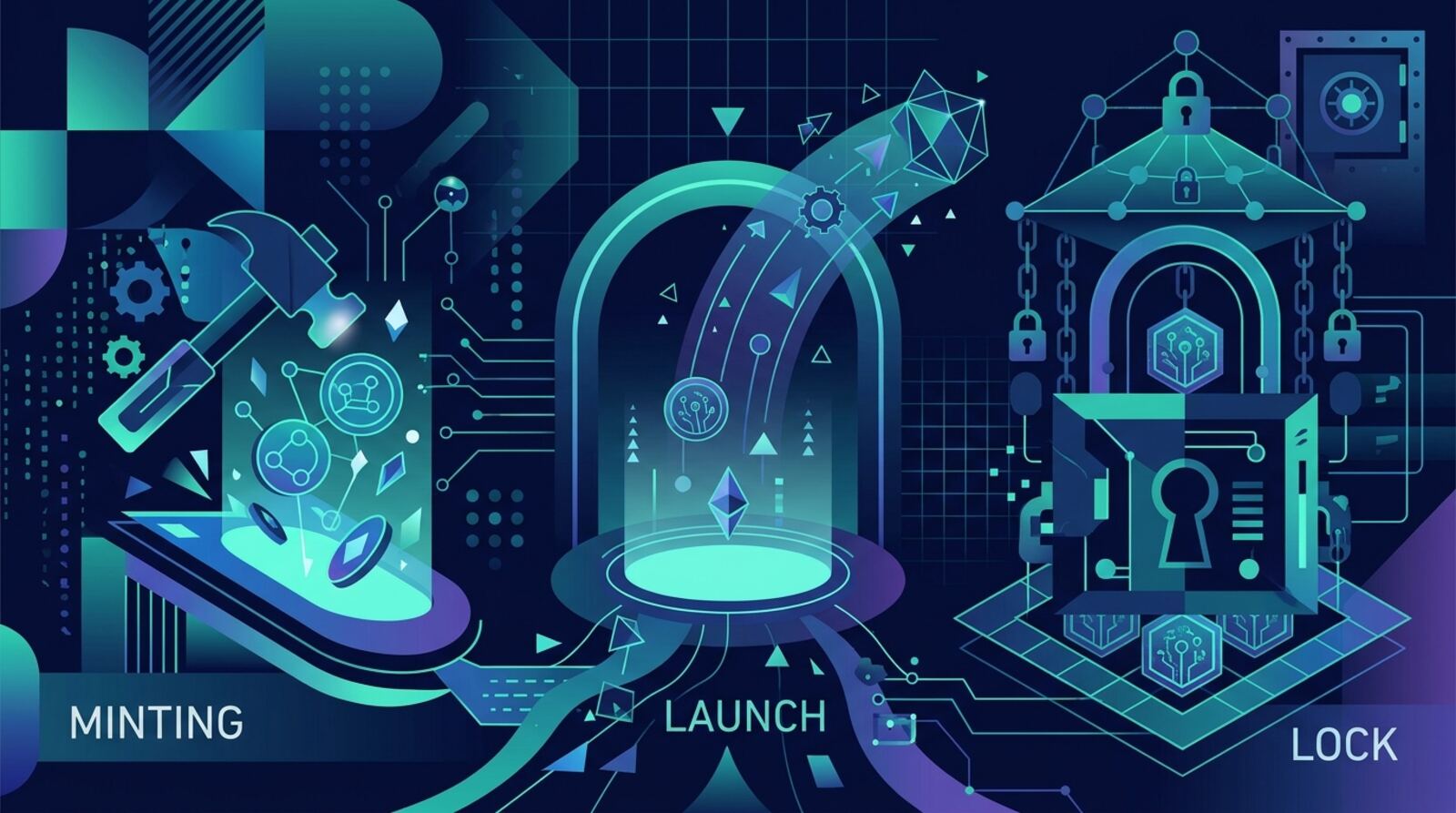
The rest of this guide covers the three processes in the title, minting, launching and locking, and then the separate meaning of sandwich attacks, which is why the word sandwich appears in so many trading discussions. The aim is to give you a method you can apply to SANDWICH or any other new token rather than a verdict on one project.
What does minting mean for a token?
Minting is the act of creating new units of a token and recording them on a blockchain. On Ethereum and other smart contract chains, a token is defined by a contract, and that contract's mint function, if it has one, controls how new supply is created. Some tokens have a fixed supply set at deployment. Others let an owner or a set of addresses mint more later.
Minting is not a warning sign by itself. Stablecoin issuers mint tokens when customers deposit money, and lending and liquidity protocols mint receipt tokens when users deposit assets. The useful questions are who can mint, under what published rules, and whether those rules can change.
When reviewing a new token, check the following. First, whether the contract has a mint function and which address holds permission to call it. Second, whether the owner can pause transfers, blacklist addresses or change fees. Third, the total supply, and how much is in circulation compared with how much is held by the team, insiders or a treasury. Fourth, whether any supply schedule, vesting plan or emission rule is written down in public documents.
A token with no mint function and a fixed supply is simpler to reason about. A token with an open mint function can dilute holders at any time. Neither fact tells you whether a project is worth using, but both change the risks you take on. Block explorers show the contract, its owner address and recent mint events, so these checks do not require special access.
How does a token launch usually work?
A token launch is the point at which a token becomes tradable by the public. On decentralized exchanges this usually means a liquidity pool is created, paired with a base asset such as ETH, BNB or SOL, and trading opens. Launches can also happen on centralized exchanges, through fundraising rounds, or through launchpads that sell allocations to participants before public trading.
The first minutes after a launch are often the most volatile. Liquidity can be thin, so modest orders may move the price sharply, and early buyers may hold large shares of supply. Some launches describe themselves as fair, meaning everyone had the same access. Test such claims against the actual on-chain distribution rather than accepting the label.
Common launch mechanics include an initial liquidity deposit into a DEX pool, often in a single pair; team or insider allocations that unlock on a schedule; presale or private rounds held before the public market; and trading limits or transfer taxes that apply for a set period after launch.
If a launch has already happened, review the earliest transactions on a block explorer. Note who received the initial supply, how much liquidity was added, when it was added, and whether large wallets sold early. These details shape the risk more than the launch announcement does. Where documented rules and on-chain behaviour disagree, treat the difference as important information.
What is a token lock and what does it protect against?
A lock is a smart contract arrangement that holds tokens for a set period so they cannot be withdrawn or sold before a release date. The two common forms are liquidity locks, which hold the paired tokens or LP tokens in a DEX pool, and team or vesting locks, which hold founder or investor allocations.
Locks exist to reduce the risk of a rug pull, where insiders remove liquidity or sell their holdings after attracting buyers. A lock does not guarantee that a project will succeed, and it does not stop a team from abandoning the project after the lock ends. It only limits one kind of sudden exit for a defined period.
Team Finance is one example of a non-custodial platform that projects use to create tokens, lock liquidity and team tokens, set up vesting, and run staking pools or airdrops. A lock created on a platform like this is recorded on chain, so anyone can check the locked amount, the locker contract and the unlock time.
Key terms to understand are these. Lock amount is how many tokens or LP tokens are held. Unlock date is when they become withdrawable. Vesting releases tokens gradually rather than all at once. LP tokens are receipts for pool shares, and locking them keeps liquidity in place. Some lockers allow an unlock date to be extended but not shortened, while others leave more control with the project owner. Read the locker's terms before relying on it.
How can you check whether a token lock is real?
A lock is only useful if it is real and covers the risk you care about. Many misleading listings describe a token as locked when the tokens sit in a wallet the team controls, the timer is short, or the lock covers only a small part of supply.
To verify a lock, first confirm the token contract address from the project's official channels and make sure it matches the token you are looking at. Second, locate the liquidity pair address on the decentralized exchange where the token trades. Third, find the LP tokens for that pair and see which addresses hold them. If the LP tokens sit in a known locker contract, check the amount and the unlock timestamp on a block explorer. If they sit in an ordinary wallet, assume the liquidity is not locked unless the owner can prove otherwise on chain. Finally, check whether the unlock date is far enough away to match your own holding period.
Also check team tokens separately. Liquidity can be locked while a large team allocation remains unlocked and sellable. Compare the locked amount with total supply, not only with the size of the pool. A lock that covers a small share of supply protects less than its label suggests.
Remember that a lock is enforced by code only until its release date. After that, the tokens can move, and the project's conduct is the main factor. Set your own exit plan, and do not rely on a lock to protect a position indefinitely.
What is a sandwich attack and why does it matter?
A sandwich attack is a form of front-running in which someone places two transactions around a victim's trade. First, the attacker buys the token ahead of the victim, which pushes the price up. The victim's trade then executes at a worse price. Immediately after, the attacker sells and keeps the difference. The attack depends on the victim's transaction being visible in the public mempool before it is confirmed, and on the victim accepting a loose slippage tolerance.
This activity is a type of maximal extractable value, usually shortened to MEV. Searchers and block builders can reorder, insert or exclude transactions to earn profit. Sandwich attacks are among the most common forms because they are simple to run and can be profitable on thin liquidity.
Sandwiching is not limited to one chain, but it is discussed most often on decentralized exchanges, where pending trades are public before they execute. Reports of large losses from sandwich attacks on major DEX platforms have appeared in the news, which shows the problem affects established venues as well as new tokens.
The attack matters in token launches. A new token with thin liquidity is easier to sandwich because each buy moves the price more. Buyers who want to ensure their order fills often set high slippage, which gives attackers more room. Understanding this link explains why sandwich comes up in discussions about new token trading.
How do slippage settings create sandwich risk?
Slippage tolerance is the maximum price movement a trade will accept before it fails. It exists to protect traders from price changes between submitting and confirming a transaction. The problem is that a high tolerance also tells an attacker how far they can push the price before your trade is rejected.
In a sandwich attack, the attacker's first buy moves the price up. If your tolerance allows a large move, your trade still executes at the inflated price, and the attacker's sale afterwards captures the gap. A tight tolerance makes this harder, because the attacker cannot move the price far enough without causing your trade to fail. A failed trade costs gas but avoids a bad fill.
The right setting depends on the token's liquidity and volatility. For a deep, established pair, a small tolerance is usually workable. For a thin new token, a very small tolerance may cause repeated failures, so the trade size itself may need to shrink. Splitting a large order into smaller pieces can also reduce the price impact of each step.
Check the price impact shown by the interface before confirming. If a modest order moves the price by a large amount, that is a sign the pool is too thin for the position you want to take. Each exchange and aggregator displays these figures slightly differently, so read the labels carefully.
What steps reduce sandwich risk when trading?
No single step removes sandwich risk on a public blockchain, but several habits lower it. Start with tight slippage limits that still allow your trade to fill under normal conditions. Avoid trading thin new pools in the first minutes after launch, when price swings are largest. Split large orders into smaller ones where the liquidity allows. Compare prices across venues before committing.
Some trading tools also offer different execution models. CoW Swap settles trades in batch auctions, matches opposing orders directly and aims to protect traders from MEV, so a sandwich attacker has less room to reorder trades. Aggregators such as Jupiter, 1inch and others route swaps across many liquidity sources and may offer protected or private execution options. Uniswap and PancakeSwap interfaces and their underlying pools are public, so the protection you get depends largely on how you submit the trade.
Because these features change, check each platform's current documentation before relying on any of them. Do not assume a protection setting covers every route or every token. Review the transaction details in your wallet before you sign, and confirm that the token address and amount match what you intended.
Finally, keep records of your trades and any approvals you grant. Revoking unused token approvals is a simple step that limits exposure if a contract you interacted with later becomes unsafe. The same discipline helps whether you are buying an established token or a new one.
What should you check before buying a new token?
Before buying any newly launched token, including SANDWICH, work through a short checklist. Confirm the exact contract address from an official source. Identify who the team is and whether their identities or track records can be checked. Read the documentation to find out what the token does, and note any claims that cannot be verified.
Next, review the on-chain picture. Look at the mint function and who can call it. Check the total supply and how it is distributed between the public, the team, insiders and any treasury. Find the liquidity pair, see who holds the LP tokens, and verify any lock on a block explorer, including its amount and unlock date. Check whether team or insider tokens are vested or can be sold immediately.
Then consider the trade itself. Compare the price impact of your intended order with the depth of the pool. Set slippage carefully, and consider splitting the order. Avoid acting on urgency created by social posts or countdown timers, since these are common in misleading launches.
Finally, decide the amount you can afford to lose entirely and set an exit plan before you buy. A token can lose most of its value even when a lock is in place, because locks only limit certain sales for a set period. Revisit your assumptions as new information appears, and treat any gap between official claims and on-chain facts as a reason to reduce your position.
Frequently asked questions
Is Sandwich Network a legitimate project?
The sources reviewed show public price listings for SANDWICH but do not establish its purpose or the identity of its team. A listing shows that a price exists, not that a project is sound. To assess it yourself, look for an official website, named team members, published documentation, a contract address you can verify on a block explorer, and evidence of how supply and liquidity are controlled. If any of these are missing, treat that as a reason for caution rather than a reason to assume the worst.
Is the liquidity for SANDWICH locked?
This guide cannot confirm that from the sources reviewed. To check, find the official contract address, locate the liquidity pair on the exchange where it trades, then see who holds the LP tokens. If they sit in a known locker contract, read the locked amount and unlock time on a block explorer. If they sit in an ordinary wallet, the liquidity is not locked unless the owner can show otherwise on chain.
What is the difference between a sandwich attack and a rug pull?
A sandwich attack is a short-term manipulation of a single trade, where someone buys ahead of a victim and sells right after, taking a small profit from the price move. A rug pull is when the people behind a project remove liquidity or dump their holdings and leave holders with worthless tokens. Sandwich attacks happen during trades on exchanges, while rug pulls depend on the project's own control over funds and supply.
Can I avoid sandwich attacks completely?
You can reduce the risk but not remove it on a public blockchain where pending trades are visible. Use tight slippage limits, split large orders, avoid trading thin new pools in the first minutes, and consider routes that batch orders or offer protected execution, such as the batch auction model used by CoW Swap. Check each exchange or aggregator's current documentation, since features change over time.
Does minting always mean a token is risky?
No. Minting is how new tokens are created, and it is normal for stablecoins and receipt tokens. What matters is who can mint, under what published rules, and whether the owner can change those rules or dilute holders without notice. A fixed supply with no mint permission is simpler to assess, but a mint function alone does not prove a token is unsafe.
Mentioned in this guide
dApps in this guide
Sandwich Network is not reliably identifiable; its product, official website, chain, and connection to similarly named tokens are unconfirmed.
Team Finance is a non-custodial platform where token projects create tokens, lock liquidity and team tokens, set up vesting, run staking pools and airdrops.
CoW Swap is a DEX aggregator that settles trades in batch auctions, matches opposing orders directly and aims to protect traders from MEV.
Uniswap V3 is a non-custodial decentralized exchange protocol for token swaps and concentrated liquidity provision across 40+ chains.
Uniswap V4 is the latest Uniswap DEX version with hooks and concentrated liquidity, running on 22 chains for self-custody token swaps and liquidity provision.
1inch is a non-custodial DEX aggregator that routes swaps across many exchanges for better prices, with its own wallet and 1INCH token.
Jupiter is a Solana DEX aggregator for traders who want routed swaps, limit orders, DCA, perps and token launches, with its own JUP token.
PancakeSwap is a BNB Smart Chain decentralized exchange with swaps, farming, staking and CAKE governance for self-custody DeFi users.
Common is a non-custodial ZK privacy dapp on Arbitrum and Aleph Zero EVM that lets users shield funds and withdraw to a new, unlinkable wallet.
Keep reading
Related guides
Token · Explainer
How New Token Rankings Improve Crypto Discovery in 2026
New token rankings sort recently launched and recently active tokens by on-chain activity, which can surface projects that market-cap tables hide. They are a starting point for research, not a verdict on safety or value.
Memecoin · Explainer
Meme Coins in 2026: Smart Investment or Scam to Avoid?
Meme coins can make money for a few buyers and leave most of them with heavy losses. This guide explains what separates a high-risk speculative bet from a scam, and which checks to run before you spend anything.
DeFi · Review
Leonicorn Swap and the IJO Launchpad: A 2026 Review
Leonicorn Swap and its IJO launchpad could not be checked against current sources for this guide, so this review explains what to verify and how to judge a decentralized exchange and token launch before you trade or buy.
DeFi · Explainer
Uniswap and Risky DeFi Tokens: How It Works and What to Check
Uniswap is a permissionless exchange, so new and high-risk tokens often appear there first. This guide explains why that happens, how the 2020 micro-cap surge worked, and what to check before trading a token that has just launched.
Presale and ICO · Explainer
Serra Presale Launch: What to Verify Before Buying
Public details on Serra's presale and partnerships could not be checked for this guide, so it explains how to verify a presale's claims, token terms and partner links yourself.
Presale and ICO · Explainer
Polkamon Public Sale and the NFT Market: What Buyers Should Check
Interest in the Polkamon public sale is rising alongside wider NFT market headlines, but verified details about the project are limited. This guide explains how to check a public NFT sale, its token terms and its risks before you spend anything.
Presale and ICO · Explainer
Velas Fund and Accelerator: How Blockchain Projects Get Funding
Velas ran a fund and accelerator program for blockchain projects that was announced in 2022, with a minimum investment of $25,000 and a program length of up to three months. This guide explains what that offer was, how to check whether any version of it is still open, and which funding and launch routes a project can use today.
Presale and ICO · Explainer
Mocaverse and Animoca's $20M Raise: What It Means in 2026
Animoca Brands announced a $20 million raise for Mocaverse in September 2023, and later tranches followed. This guide explains what the funding was, what came after it, and how to check funding and price claims for yourself.