Real-world asset · Explainer
Real-World Asset Tokenization: A 2026 Guide
Real-world asset tokenization puts claims on off-chain assets such as government bills, private credit and real estate onto a blockchain. This guide explains how the structures work, what rights a token may or may not give you, and what to check before you hold one.
By the DappsAtlas editorial team · Updated
What real-world asset tokenization means
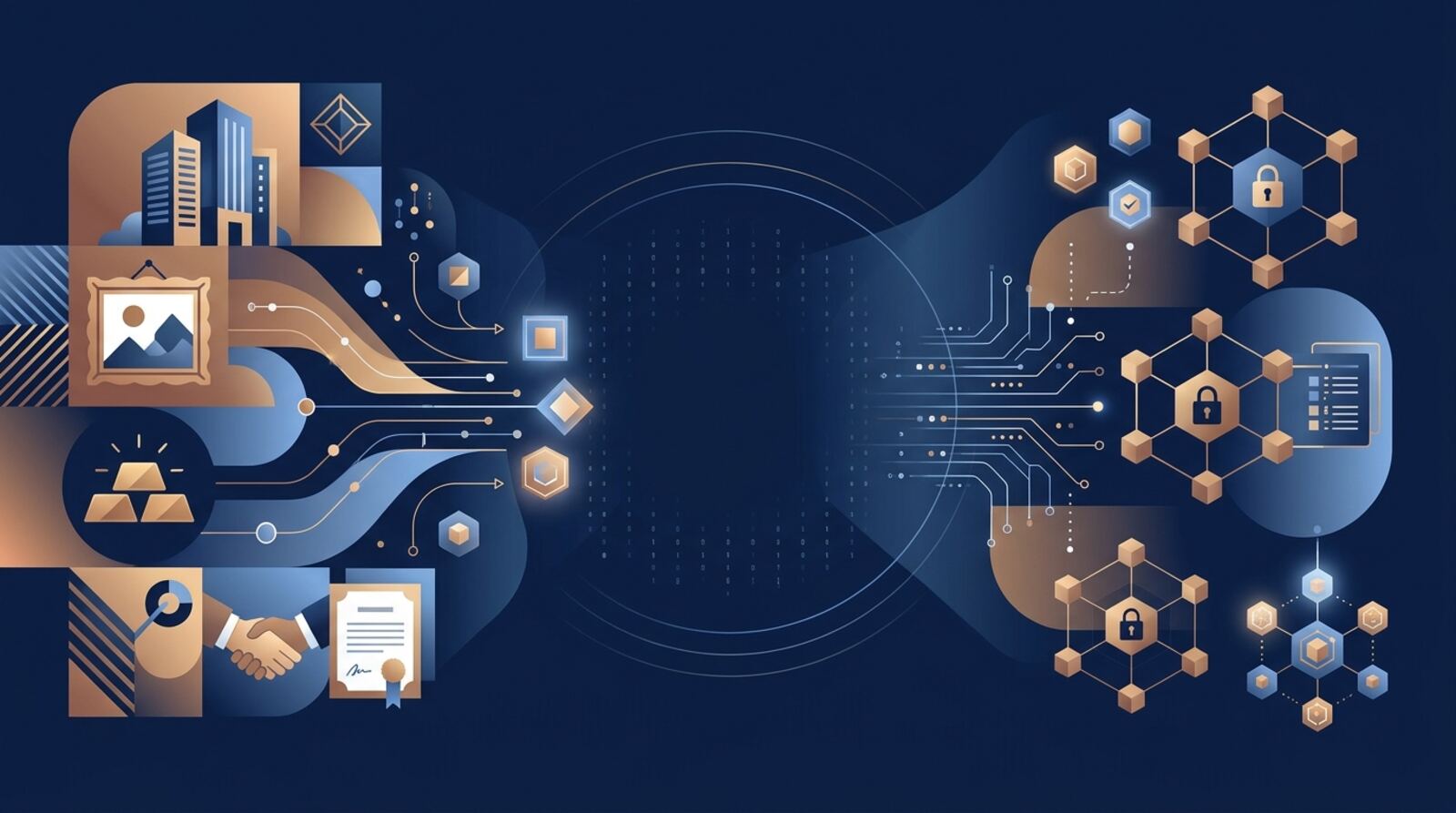
Real-world asset tokenization means creating a digital token on a blockchain that stands for a claim on an asset that exists outside the chain. The asset might be a government bill, a loan, a property, a commodity or a share in a fund.
The token itself is only one piece. Behind it sits a legal arrangement that decides what the holder owns, how income is paid, and how the asset can be sold or redeemed. A token that moves on a blockchain is not useful on its own if the legal link to the asset is weak or unclear.
Tokenization is useful for three main reasons. It can make records easier to transfer and reconcile, it can allow fractional ownership in smaller units, and it can let tokens be used as collateral or settlement assets in other on-chain systems. These benefits depend on how the product is built, so they should be verified rather than assumed.
The term covers a wide range of products. Some are simple tokenized funds that hold cash-like instruments. Others are tokenized loans or property interests with long terms and limited liquidity. Treat the category as a set of different products with different risks.
Which assets are commonly tokenized
Most tokenized real-world assets fall into a few groups.
- Government bills and money market funds. These are the most common. They usually hold short-term government debt and pay income that reflects prevailing rates.
- Private credit. These tokens represent loans to businesses or other borrowers. Returns can be higher, but credit risk and liquidity risk are also higher.
- Real estate. Some products give exposure to property or property loans. Valuation and exit timing are often the main concerns.
- Commodities. Tokens may be backed by stored metals or other goods. Storage, audit and redemption terms matter here.
- Equities and funds. Some tokens track shares or fund units, which may be subject to securities rules in each jurisdiction.
The category a product falls into tells you little about its safety on its own. A tokenized government bill fund and a tokenized loan portfolio can both be called real-world assets while carrying very different risks. Read the description of the underlying assets and compare it with what the token is said to represent.
How a tokenized asset is structured
A typical structure has several parties, each with a defined role.
- The originator or sponsor designs the product and selects the assets.
- A legal vehicle, such as a fund, trust or special purpose vehicle, holds the assets for investors.
- A custodian holds the underlying assets or cash on behalf of the vehicle.
- A transfer agent or administrator keeps the register of who owns what.
- The token issuer creates tokens that reflect entries in that register.
- An auditor or administrator reports on the assets and their value.
The key question is how these pieces connect. The token should map to a recorded entitlement in a legal vehicle. If the token is only a marketing label with no legal backing, it gives weak protection. Ask who the legal owner of the assets is, who can instruct the custodian, and what happens if the sponsor fails.
Some structures also use a separate entity to handle redemptions or to hold the token-side records. Each extra party adds a dependency. Map the chain of parties before you buy so you know whose failure would affect you.
Who can hold tokenized assets and transfer restrictions
Many tokenized products restrict who can hold them and where they can move. These limits often come from securities or fund rules.
Some products use permissioned tokens. The issuer keeps an approved list of wallet addresses and only allows transfers between approved holders. Others limit transfers by investor type, jurisdiction or lock-up period. A few products are open to any buyer, but this is less common for regulated assets.
Eligibility checks are a normal part of this process. Issuers may ask for identity details, proof of residence, or confirmation that you meet an investor category. These checks are part of the product's legal design. They are not a technical detail that can be skipped.
If you hold a token that can only move to approved addresses, you may not be able to sell it on an open decentralized exchange. Check the transfer terms before you buy. Also check what happens if you lose access to an approved wallet, since many products have no simple recovery path for a restricted token.
How yield and redemption typically work
Income from tokenized assets usually comes from the cash flows of the underlying assets. For a fund that holds government bills, that means interest. For a loan product, it means loan repayments and fees.
There are two common ways income reaches holders. Some tokens increase in value over time as income accrues inside the fund, so the token price rises. Others pay income separately, often on a set schedule, into a wallet or into a cash account. Read the product documents to see which method applies.
Redemption is the other key feature. Redemption is the process of turning the token back into cash or the underlying asset. Check the redemption schedule, the minimum amounts, any fees, the cut-off times, and whether redemptions may be delayed or suspended under stress. A product that is easy to buy but slow to redeem may not match your need for access to cash.
Yield figures change with market conditions and the product's holdings. Do not rely on a number you saw earlier. Check the current income and terms on the issuer's disclosures or a public data source, and compare the net return after fees.
Risks to weigh before buying
Tokenized assets carry the risks of the assets they represent, plus extra risks from the technology and the legal wrapper.
Credit and market risk. If the underlying assets lose value or borrowers default, the token value can fall. Income may also drop.
Liquidity risk. Redemptions can take time, and secondary trading may be thin or limited to approved holders. The price you can get on a secondary market may differ from the stated value.
Legal and structural risk. If the legal vehicle is weak, or the token is not properly linked to a recorded entitlement, holders may have limited recourse in a dispute or insolvency.
Operational risk. Custodians, administrators and issuers can make errors or fail. Records can be inconsistent between the on-chain token and the off-chain register.
Technical risk. Smart contracts can contain bugs, and access keys can be lost or stolen. Some tokens also have administrative controls that allow the issuer to freeze or move balances. Find out which controls exist and who holds them.
No part of this list goes away because a product is on a blockchain. Weigh each risk against your own situation before you commit funds.
How to check an issuer and its documents
A good check starts with the primary documents rather than the marketing page.
- Offering or prospectus documents. These set out the structure, the rights of holders and the risks.
- Legal opinions. Ask whether the token's legal link to the assets has been reviewed by counsel.
- Custodian and administrator details. Confirm who holds the assets and whether they are a regulated or recognized firm in their jurisdiction.
- Audit or assurance reports. Check what was reviewed, by whom, and when. Look for the period covered.
- Smart contract reviews. Confirm that the contracts behind the token have been independently reviewed and that the reports are dated.
- Regulatory status. Check whether the product is authorized or registered where you live and whether that status applies to your investor category.
Do not rely on a single summary. Compare what the documents say with what the website says. If a claim cannot be traced to a named document, treat it as unverified.
You can also check whether the issuer has a clear history of publishing reports and responding to questions. A product with little disclosure is harder to assess, and that is itself useful information.
How tokenized assets are used in DeFi
Tokenized assets are used in several ways within on-chain finance. Some are held as a store of value, some are used as collateral in lending markets, and some serve as reserves behind stablecoins.
Lending markets may accept certain tokenized assets as collateral, subject to their own risk settings. Whether a given token is accepted, and at what collateral value, depends on the protocol's rules and governance. Those settings can change, so check the current parameters on the protocol's own documentation before relying on them.
Stablecoin reserves are another use. Some stablecoin issuers hold short-term government debt, sometimes through tokenized funds. The reserve mix, custodians and redemption rights differ between issuers, so the stablecoin's reserve report is the place to check how those assets are held.
Protocols such as Aave V3, Morpho, Compound V3 and Curve are examples of on-chain lending and trading venues where tokenized assets may appear. Check whether an asset is listed on a venue, what its risk parameters are, and what happens if its price moves sharply. Being listed on a venue does not mean the underlying asset has been verified.
Keep the on-chain and off-chain roles separate in your mind. A token can trade freely on a decentralized exchange while the legal claim it represents can only be redeemed through the issuer.
Legal and tax considerations
Tax and legal treatment of tokenized assets varies widely. The same product may be treated as a fund interest, a security, a debt instrument or a digital asset depending on where you live and how the product is structured. Income may be taxed in the year it is earned or when it is received, and gains on sale may follow different rules.
Before buying, check the rules that apply to you. Your national or regional securities regulator and tax authority are the main sources. A licensed tax adviser or legal professional can help with cross-border questions.
Some products are restricted or not offered in certain countries. If a product is not available where you live, do not look for ways around the restriction. Eligibility and residence rules exist for legal reasons and are part of the product's compliance design.
Keep records of purchases, income, transfers and redemptions. A clear record makes it easier to report accurately and to respond to any questions from a tax authority or an issuer.
This section is general information, not legal or tax advice. Rules change, and your position depends on your own circumstances.
Practical security for holders
Holding a tokenized asset carries the same security needs as holding any digital asset. The main risks are phishing, lost keys and fake token offers.
- Use a hardware wallet or a reputable software wallet, and keep your recovery phrase offline and private.
- Confirm that the token contract address matches the one in the issuer's official documentation before you buy or approve any transaction.
- Be cautious of unsolicited messages offering access to restricted products, and never share your recovery phrase or private keys with anyone.
- Check the permissions you grant to smart contracts. Revoke unused approvals using a reputable approval management tool.
- Bookmark official issuer and protocol sites rather than following links from messages or search ads.
- Keep a record of your transactions and the documents you relied on at the time you bought.
If you suspect a compromise, move any remaining assets to a new wallet you control and contact the issuer through its published channels. Do not send funds to anyone who claims they can recover them for a fee.
Summary and how to decide
Real-world asset tokenization is best understood as a set of legal and technical arrangements rather than a single product. The token is a useful record of a claim, but its value and reliability depend on the documents, custodians and redemption terms behind it.
A practical approach is to start with the asset you want exposure to, then read the legal structure, the transfer rules and the redemption terms before looking at yield. Compare more than one product where possible, and check each one against the same list of questions.
Keep your expectations realistic. Income is not guaranteed, redemptions can be slow, and secondary markets can be thin. Only use funds you can afford to have tied up or at risk.
For current product data such as size, yield and holder counts, use the issuer's disclosures and public dashboards, and check them on the day you decide. Figures in older articles may no longer be accurate.
Frequently asked questions
Does owning a tokenized asset mean I own the underlying asset?
Not always. A token may represent a legal claim recorded in a fund, trust or special purpose vehicle, or it may be a more limited representation. The rights attached to the token depend on the legal documents behind it, so read the offering terms and the issuer's disclosures rather than relying on the token name or the chain it sits on.
Can anyone buy tokenized real-world assets?
Many tokenized products are limited to eligible or institutional investors, and some require identity checks before you can subscribe or receive transfers. Rules differ by jurisdiction and by product. Check the eligibility terms in the issuer's documents and the rules that apply where you live. Do not try to get around any eligibility or identity check.
How is yield paid on tokenized treasury products?
Some tokens pay yield that accrues in the token price or is distributed to holders. Others pay out on a schedule. Income can change with the underlying rates or cash flows, and it is not guaranteed. Look for the stated method in the product documents and check the current figures on the issuer's own disclosures or a public dashboard, since these change over time.
What should I check before buying a tokenized asset?
Check the issuer's legal structure, who holds the underlying assets, how redemptions work, whether the token can be transferred freely or only by approved parties, and whether the smart contracts have been independently reviewed. Also confirm which jurisdiction governs the product and whether it has regulatory authorization where you live.
Is a tokenized asset safer than the traditional version?
Tokenization changes how an asset is recorded and transferred, but it does not remove the credit, liquidity, legal or operational risks of the asset itself. It can add smart contract, key management and transfer restriction risks. Treat tokenized assets as financial products that need the same due diligence as traditional ones.
Mentioned in this guide
dApps in this guide
BlackRock BUIDL is a tokenized U.S. Treasury-backed fund issued via Securitize, paying daily dividends to eligible, mostly institutional investors.
Spiko is a French-regulated platform offering T-bill money market funds and multi-currency cash accounts with daily yield for companies and individuals.
Sky is the rebranded MakerDAO, a DeFi protocol issuing the USDS and DAI stablecoins, governed by SKY token holders, for DeFi users and stablecoin holders.
Morpho is a decentralized lending protocol with isolated markets, curated vaults and fixed-rate loans for crypto lenders, borrowers and developers.
Aave V3 is a non-custodial DeFi lending protocol on 21 chains where users earn interest on deposits or borrow against collateral.
Uniswap V3 is a non-custodial decentralized exchange protocol for token swaps and concentrated liquidity provision across 40+ chains.
Curve is a decentralized exchange on Ethereum built for low-slippage swaps of stablecoins and similar assets, with CRV governance and a crvUSD stablecoin.
Compound V3 is a lending protocol on Ethereum and nine other chains where users supply a base asset for yield or borrow it against collateral.
Compound is a decentralized lending protocol where users earn interest on deposited crypto or borrow against collateral, governed by COMP holders.
Keep reading
Related guides
DeFi · Explainer
DeFi vs TradFi Banks in 2026: How They Differ and Converge
DeFi protocols and traditional banks both move money, lend and manage risk, but they rely on different structures for custody, access and accountability. This guide explains those differences and where the two systems are now connecting in 2026.
Token · Explainer
Stablecoins Explained: A Simple Guide for 2026
Stablecoins are crypto tokens designed to hold a steady value, usually one US dollar. This guide explains how the main types work, what keeps them near their target price, where they are used, and what to check before you hold or send one.
DeFi · Explainer
Crypto Yield Explained: How to Earn Interest on Crypto in 2026
Crypto yield is the return you earn for lending, staking, providing liquidity or holding a yield-bearing product. This guide explains where yield comes from, how the main options differ, and what risks to weigh before committing funds.
DeFi · Explainer
The Curve Wars Explained: How DeFi Protocols Compete for Liquidity
The Curve Wars were a multi-year contest between DeFi protocols to direct CRV rewards toward their own liquidity pools. This guide explains the mechanics, the players, the 2022 flashpoint, and what the fight means for users now.
Real-world asset · Explainer
What Is RealtyX? A Guide to Real Estate Tokenization in 2026
RealtyX is a platform that aims to tokenize real estate and link property-backed assets to DeFi yield. This guide explains how real estate tokenization works, what the DAO label does and does not mean for RealtyX, and what to check before you take part.
Real-world asset · Explainer
Courtyard Explained: Tokenized Collectibles Backed by Real Assets
Courtyard turns graded trading cards and other physical collectibles into tokens, with the originals held in an insured vault. This guide explains how it works, what the token represents and which risks to weigh before buying.
Real-world asset · Best list
RWA Crypto Tokens to Know in 2026
RWA crypto tokens can represent Treasury funds, gold, credit, or governance rights—and those roles carry very different risks. Learn which examples to research, what each token actually represents, and how to check access, backing, and redemption terms.
Real-world asset · Explainer
Champ Association Explained: Champagne, RWA, AI and Crypto
Champ Association appears in the sources we checked only as a name, with no public detail on its products, owners or activity. This guide explains how champagne, real-world asset tokenization, AI and crypto can connect in general, and how to check any project that claims a link between them.