Blockchain · How-to
How to Stake RON on Ronin: Validators, Rewards, Unstaking
Ronin uses delegated proof of stake, so RON holders can back a validator and earn a share of block rewards without running hardware. This guide covers choosing a validator, delegating, claiming, unstaking and the risks.
By the DappsAtlas editorial team · Updated
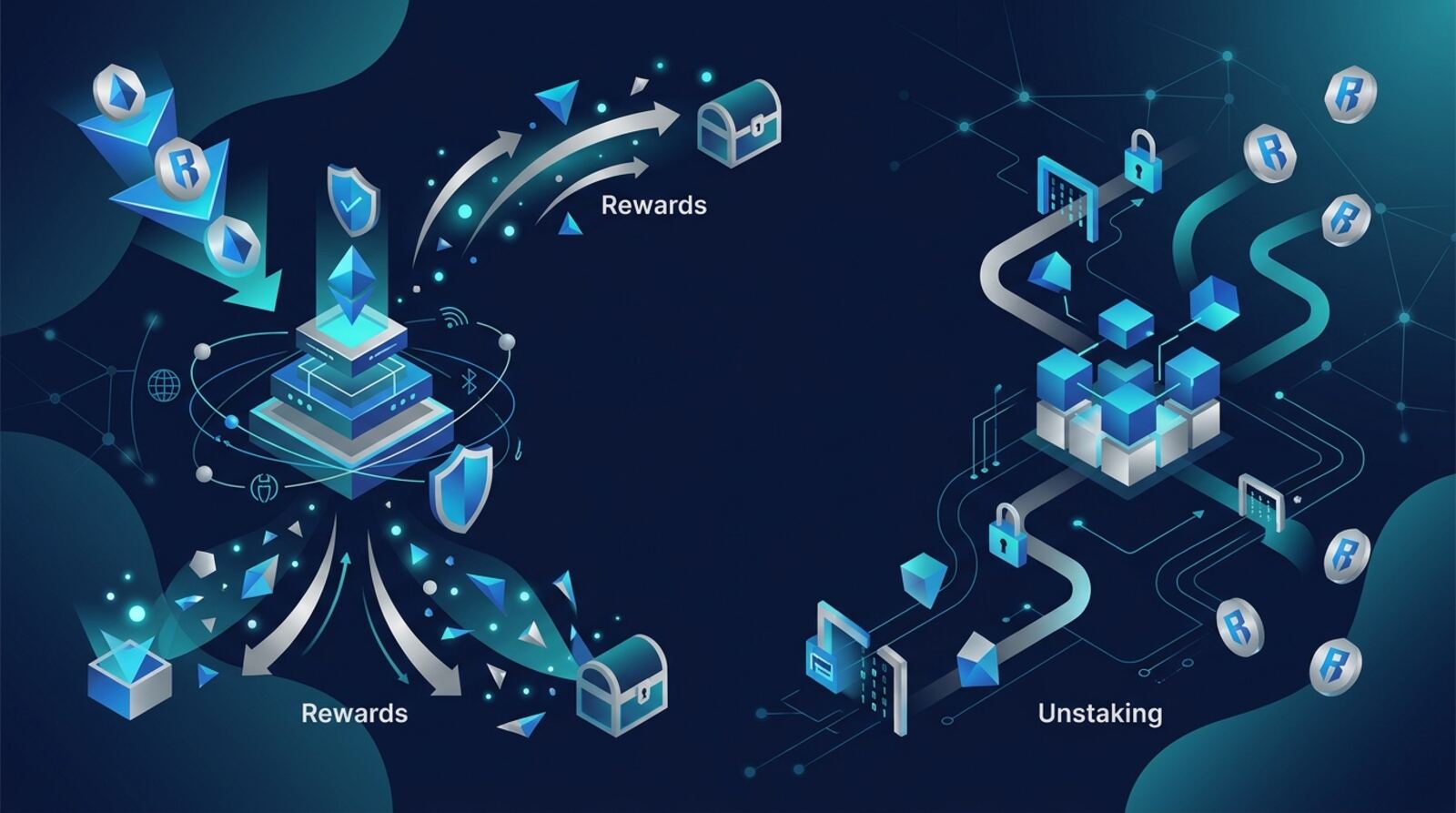
How does staking RON work on Ronin?
Ronin is the EVM-compatible chain built for games, best known through Axie Infinity. In 2023 it moved from a small set of trusted validators to a delegated proof of stake (DPoS) model. RON is the native token, used for gas fees and for staking.
In DPoS, a limited group of validators produce and confirm blocks. Anyone holding RON can delegate tokens to a validator. Delegating does not transfer ownership of your RON. The tokens stay tied to your wallet address, but they are locked in the staking contract and counted toward that validator's total stake. Validators with more stake are more likely to earn a place in the active set, and they earn more block rewards.
Rewards are shared. The validator keeps a commission, a percentage the validator sets, and the remainder goes to delegators in proportion to what each delegated. Ronin staking rewards started flowing to stakers in April 2023, when announcements cited over 100 million RON staked and about 8,500 delegators.
There are three roles worth knowing:
- Delegator: holds RON, picks a validator and earns a share of rewards.
- Validator: runs infrastructure, must self-stake a minimum amount, and sets a commission rate.
- Governing and standby validators: the network distinguishes validators that sit in the active block-producing set from others waiting to join it. The exact structure and counts can change, so check the Validator Portal rather than relying on older articles.
The rest of this guide focuses on delegating, which is the route most holders take.
What do you need before staking RON?
Preparation takes a few minutes and avoids most beginner mistakes.
1. A Ronin-compatible wallet. The official Ronin Wallet is available as a browser extension and a mobile app. Other EVM wallets can often connect to the Ronin network by adding it manually, but the official wallet is the simplest path to the staking interface. If you use a hardware wallet, check that it is supported before you rely on it.
2. RON on the Ronin network. Staking requires RON on Ronin itself, not RON as an ERC-20 token on Ethereum. If your RON is on an exchange, withdraw it to your Ronin address and select the Ronin network. If your funds are on Ethereum, you will need to move them across the bridge or use a supported cross-chain route. A small test withdrawal first is a cheap safeguard against sending to the wrong network.
3. A gas buffer. Transactions on Ronin are paid in RON. Delegating, claiming and undelegating are each transactions, so do not stake every last token. Keep a small amount liquid.
4. A recovery phrase stored offline. Write the seed phrase on paper or metal. Never type it into a website, share it in chat, or photograph it. Genuine staking never asks for it.
5. The right website. Reach the staking interface and the Validator Portal through the official Ronin site or the wallet's built-in link. Fake claim pages and fake airdrop posts circulate whenever staking news breaks.
How to stake RON step by step
The exact button labels change as the interface is updated, but the flow has been stable.
- Open the official staking interface. Use the Ronin Wallet's own link, or reach it from the official Ronin site. Check that the address bar matches before you connect.
- Connect your wallet. Approve the connection request. A connection request is not a transaction and does not move funds.
- Browse the validator list. Compare commission, total staked, uptime and any displayed reward estimate. The next section explains what to look for.
- Select a validator and choose Stake. Enter the amount of RON. Leave a little in the wallet for gas.
- Review the transaction. The wallet shows the contract you are interacting with, the amount and the estimated fee. Read it before you sign.
- Confirm and wait. Once the transaction is confirmed, your delegation appears in the staking dashboard. Rewards typically begin accruing from the next reward period rather than the second you confirm.
- Check the dashboard later. Confirm that your staked amount, chosen validator and pending rewards display correctly.
You can delegate to more than one validator. Splitting your stake across two or three is a simple way to reduce the impact if one validator has problems, at the cost of extra transactions and extra gas when you claim or move funds.
Start with a small amount if this is your first time. Once you have seen a full cycle of staking, claiming and unstaking, scaling up is easier.
How do you choose a validator?
Validators are not interchangeable. Your return and risk depend on how well the one you choose operates.
| Factor | What to look for | Why it matters |
|---|---|---|
| Commission | A rate that is fair, not just the lowest | Commission is deducted before delegators are paid. A very low rate can still be a poor choice if the validator is unreliable |
| Uptime and block production | Consistent participation | Missed duties can reduce rewards and may lead to jailing |
| Total stake | Neither tiny nor dominant | Very small validators may drop out of the active set. Very large ones concentrate power on the network |
| Identity and track record | A named team with public communication | Anonymous operators are harder to assess |
| Active status | Present in the current validator list | Validators have renounced their role during network changes, so older lists go stale |
Some practical habits help. Lists such as the one BitPinas published in March 2024 can be a starting point, but they age quickly, so confirm every name against the live Validator Portal. Look at how the validator communicates. Teams that post maintenance notices and respond to delegators tend to handle incidents better.
Avoid choosing purely by the highest displayed reward figure. Displayed numbers are estimates and can be temporarily inflated by short-term conditions. Spreading stake across several reputable validators is more sensible than chasing one headline rate.
Finally, check whether a validator's commission can change. If it is raised later, your net reward drops, so revisit your choice from time to time.
How are RON staking rewards calculated?
Ronin staking rewards come from the network's reward pool, which pays active validators and, through them, delegators. The amount you receive depends on several things:
- Your share of the validator's stake. More delegated RON means a larger slice of that validator's delegator pool.
- The validator's commission. The validator keeps its percentage first.
- The validator's performance. A validator that misses its duties can earn less, and so can you.
- Total RON staked across the network. When more RON is staked, the same reward pool is spread more thinly, so rates tend to fall as participation grows.
APR is therefore a moving figure. When staking rewards launched in April 2023, announcements cited rates between 20% and 33%. Later, Coinbase's page for Ronin staking displayed an estimated reward rate of 11.22%, with a note that it is an average over a year of holding. Both are snapshots, neither is a promise, and the current rate may differ again.
Rewards are paid in RON, so your holding is denominated in a volatile asset. A 10% reward does not help much if RON's price falls by more than that. Compare the nominal rate with your view of price risk.
To see where your rate stands today, open the staking dashboard and read the estimated APR and the validator's commission together. For an independent view, compare with an exchange's staking page, remembering that exchanges take their own fee.
Do not confuse validator rewards with liquidity pool incentives. Ronin has also paid RON rewards to liquidity providers on its Katana DEX, and it has announced reductions to those. That is a separate programme with different risks.
How to claim, compound and track your rewards
Rewards accumulate as you stake, but you usually have to take an action to receive them in your wallet.
Claiming. Open the staking dashboard, find your pending rewards and choose Claim. The rewards arrive as RON in your wallet after the transaction is confirmed. You pay a small gas fee, so claiming tiny amounts very often is not efficient.
Compounding. Many users re-stake rewards to increase their delegation. The interface typically offers a stake-rewards option, or you can claim and then delegate manually. Compounding raises your future rewards a little each time, but every action costs gas, so a weekly or monthly rhythm usually beats daily.
Tracking. A simple spreadsheet is enough. For each claim, record:
- The date and time
- The amount of RON received
- The RON price in your local currency at that moment
- The transaction hash
- The validator it came from
This record helps with tax reporting. In many countries staking rewards count as income when received, and later gains or losses arise when you sell. Rules differ, so ask a local tax professional rather than assuming.
Verifying. Cross-check your claim against the wallet's transaction history. If rewards look lower than expected, check whether your validator's commission changed, whether it missed blocks, or whether network-wide staking grew. None of these indicates a bug on its own.
If you are comparing a self-custody setup with an exchange, remember that exchanges often pay out rewards automatically but keep a share as a fee.
How do you unstake RON and switch validators?
Staking is not instant liquidity. When you undelegate, your RON typically enters a waiting period before it can be withdrawn. The cooldown length is set by the protocol and can be changed through governance, so read the current figure in the staking interface instead of relying on an article, including this one.
The usual sequence is:
- Open the dashboard and select the delegation you want to reduce.
- Choose Unstake or Undelegate and enter the amount. You can often take out part of a delegation.
- Sign the transaction.
- Wait for the cooldown to finish. During this time the tokens do not earn rewards and cannot be traded.
- Return to the dashboard and withdraw or claim the released RON into your wallet.
- Claim any remaining rewards, if they are shown separately.
Switching validators. There may be a redelegation option, but if there is not, the process is to undelegate, wait out the cooldown and then delegate again. Plan for the delay. If your validator is in trouble, moving early is better than waiting for rewards to stop completely.
Timing sales. If you might want to sell RON during a price move, a locked position cannot react. Keep a portion unstaked if you value flexibility. Staking suits RON you plan to hold for months rather than days.
Before you move large amounts, run a small test of the full cycle: stake, claim, undelegate, withdraw. It shows you the real timings and fees with little at stake.
What are the risks of staking RON?
Staking carries risks that a quoted APR does not show.
Validator risk. Validators can underperform, get jailed for missing duties, or renounce their role. Network changes have led to some validators stepping down, as Ronin community updates have noted. When that happens, rewards from that validator stop and you must move your stake. Penalty rules for misbehaviour are set by the protocol, so read the current Validator Portal documentation to understand what a delegator can lose.
Price risk. Rewards are paid in RON. If the token falls, your fiat value falls with it, regardless of the APR.
Liquidity risk. The unstaking cooldown means you cannot exit immediately.
Smart contract and protocol risk. Staking runs on contracts and a chain that, like any software, can have bugs. Ronin has a history, including a major 2022 bridge exploit, so treat the network's security record as part of your risk assessment.
Scams. Staking news attracts impersonators. Be wary of:
- Posts offering to claim RON or an airdrop through a link
- Messages from fake support staff asking you to connect a wallet
- Websites that ask for your seed phrase
- Approval requests you do not understand
Defensive habits: use bookmarks for official sites, review what each transaction signs, consider a hardware wallet for larger balances, and keep the seed phrase offline. Never stake money you cannot afford to have locked or to lose.
Self-custody staking or an exchange: which fits you?
You can stake RON yourself or through an exchange that offers it. Availability depends on the platform and your country. Among the exchanges on this site, check OKX, Bitvavo, Gate and Bitget for whether RON staking is listed in your region, and Coinbase's Ronin page shows one published reward estimate.
| Self-custody delegation | Exchange staking | |
|---|---|---|
| Custody | You hold your keys | The exchange holds the tokens |
| Validator choice | You choose | The exchange chooses |
| Fees | Validator commission plus gas | Exchange fee, often built into the rate |
| Effort | Wallet, bridging, claims | Few steps, often automatic payouts |
| Unstaking | Protocol cooldown | Exchange terms, may differ |
| Main risk | Your own errors, validator problems | Counterparty and platform risk |
Self-custody suits holders who want control and are comfortable with wallets. It also lets you vote with your stake by supporting independent validators. Exchange staking suits people who value simplicity and are already using the platform, but you accept the exchange's terms, its choice of validator and the risk that withdrawals could be paused.
If you stake on an exchange, read the terms on lock-up periods, how rewards are credited, and what happens in a protocol incident. Eligibility is often limited by country, and you should respect those restrictions and the platform's identity checks rather than trying to work around them.
Neither option is risk-free. Choose the one whose risks you understand best.
Should you run a validator instead of delegating?
Running a validator is a different job from delegating. According to the Validator Portal, the requirements include staking a minimum of 250,000 RON and using high-performing devices. That is a significant capital and technical commitment.
What the role involves:
- Self-stake. You lock the minimum amount, and your own tokens are exposed to any penalties.
- Infrastructure. You operate nodes that must stay online, in sync and secure. Downtime can cost rewards and risk jailing.
- Commission and reputation. You set a commission rate and compete for delegations. Delegators look at uptime, communication and trustworthiness.
- Governance. Validators take part in network proposals. The portal lists DPoS proposals, including decisions on reward amounts.
- Ongoing maintenance. Updates, monitoring, key management and incident response are continuing work.
A validator also has to attract delegations to be competitive, because the active set is limited. Being in the set is not guaranteed by self-staking alone. Read the portal's current requirements and the rules for entering the set before committing capital.
For most holders, delegating achieves the main goal of earning staking rewards with far less overhead. Consider running a validator only if you have operations experience, enough capital to lock, and a plan to keep the node reliable.
Whatever route you take, revisit the official portal and announcements regularly. Parameters such as minimums, cooldowns and validator counts can change through governance, and the portal is the authority.
Frequently asked questions
What is the minimum RON needed to stake?
The Ronin Validator Portal lists 250,000 RON as the minimum stake to become a validator. Delegators backing an existing validator face a much lower threshold. Check the staking interface for the current minimum before you move funds.
What APR can I expect from staking RON?
No fixed figure applies. The rate depends on total RON staked, network rewards, and the validator's commission. Early 2023 launch announcements cited ranges of roughly 20-33%, and exchange pages now show lower estimates that change. Treat any quoted APR as a snapshot, and check the live number in the staking interface or on the exchange you use.
Can I withdraw my staked RON immediately?
Not by default. Unstaking usually starts a waiting period, so the tokens are locked for a time before you can withdraw. Rewards may be claimed separately. Check the current cooldown in the staking interface before you delegate, especially if you may need the funds soon.
What happens if my validator renounces or is jailed?
Your RON is not lost just because a validator stops operating, but rewards from that validator can stop. You should undelegate and then delegate to another active validator. Watch official Ronin announcements, because validators have renounced their role in the past during network changes.
Can I stake RON on a centralized exchange?
Yes, on some exchanges that list RON staking, such as Coinbase. You hand custody to the exchange and accept its terms, fees and lock-up rules, but you skip wallet steps. Availability depends on your country, so check the exchange's staking page.
Are RON staking rewards taxable?
Rewards generally count as income in many countries, and the rules differ by jurisdiction. Keep a record of each claim with its date and the RON price at that time. Ask a local tax professional how staking rewards are treated where you live.
Mentioned in this guide
dApps in this guide
OKX is a major centralized crypto exchange for spot and derivatives trading, earn products and a Web3 wallet, with its own OKB token.
Bitvavo is an Amsterdam-based, MiCA-authorized crypto exchange offering 400+ assets, euro deposits, staking and leverage trading for European users.
Gate is a centralized crypto exchange founded in 2013 offering spot, futures, stocks and earn products for traders who want one multi-asset account.
Bitget is a centralized exchange for crypto spot and futures that also offers tokenized stocks, commodities and forex in one account, for active traders.
Across is an intent-based cross-chain bridge and swap protocol for moving tokens between Ethereum, rollups and other chains, with an API for apps.
Lido is a liquid staking protocol where users stake ETH and receive stETH, a reward-earning token usable across DeFi, governed by LDO holders.
Rocket Pool is a decentralised Ethereum liquid staking protocol offering rETH for stakers and 16 ETH validators for node operators.
Ankr is a Web3 infrastructure provider offering multichain RPC, rollup services and liquid staking for stakers, developers and enterprises.
Axie Infinity is a Ronin-based NFT game where players collect, combine and battle creatures called Axies, with its own AXS token.
Keep reading
Related guides
Blockchain · Chain guide
LUKSO Blockchain Guide: Universal Profiles, LYX and Staking (2026)
LUKSO is an EVM-compatible proof-of-stake chain built around smart-contract accounts called Universal Profiles. This guide covers how it works, what LYX is for, how staking runs, how to get started and where the risks sit.
Blockchain · How-to
How to Stake HBAR on Hedera: The Complete 2026 Guide
HBAR staking on Hedera is non-custodial, has no lock-up and no slashing. This guide covers how it works, how to stake from a wallet or an exchange, how to pick a node, and how to unstake.
Blockchain · Chain guide
Casper Network Explained: A Blockchain Built for Enterprise
Casper Network is a proof-of-stake layer-1 that has aimed at enterprises and developers since its 2021 mainnet launch. This guide covers how it works, what CSPR does, how staking works and what to weigh before using it.
Blockchain · Explainer
What Is Polkadot? A Plain-English Guide to the Blockchain
Polkadot is a network of specialized blockchains that share one security layer and talk to each other natively. This guide explains how it works, what DOT does, and what to check before you use it.
Blockchain · How-to
How to Start Using Solana DeFi dApps and Wallets in 2026
Solana offers low fees and fast transactions, which makes it a practical place to learn DeFi. This guide covers wallet setup, funding, safe connections, and a first few low-risk steps.
Blockchain · Explainer
Radar Chain Vote: How to Read a Blockchain Deployment Poll
A token vote on which blockchain a project should launch on is a governance decision with real costs for holders, users and developers. This guide explains what such a vote asks, how to read the proposal, and what to check before you take part.
Blockchain · How-to
How to Search a Blockchain: A Practical 2026 Guide
A blockchain explorer lets you look up public transactions, wallets, blocks and tokens. Learn how to choose the right chain, read public reporting and avoid common mistakes.
Blockchain · Explainer
Immutable's $500M Fund for NFT and Game Developers: What to Know
Immutable announced a $500 million developer and venture fund in June 2022 to support builders of games and NFT products. This guide explains what that fund was, how it differs from a later $100 million gaming fund, and how game developers and players can check its status today.