Wallets and tools · Explainer
Freename Free Domain Claim: How Integrations Work in 2026
Freename lets wallets, apps and communities hand out blockchain domains, and some of those offers are free to claim. This guide explains how the claim works, what 'free' usually covers, and how to avoid fake claim pages.
By the DappsAtlas editorial team · Updated
What is Freename, and what does a free domain claim mean?
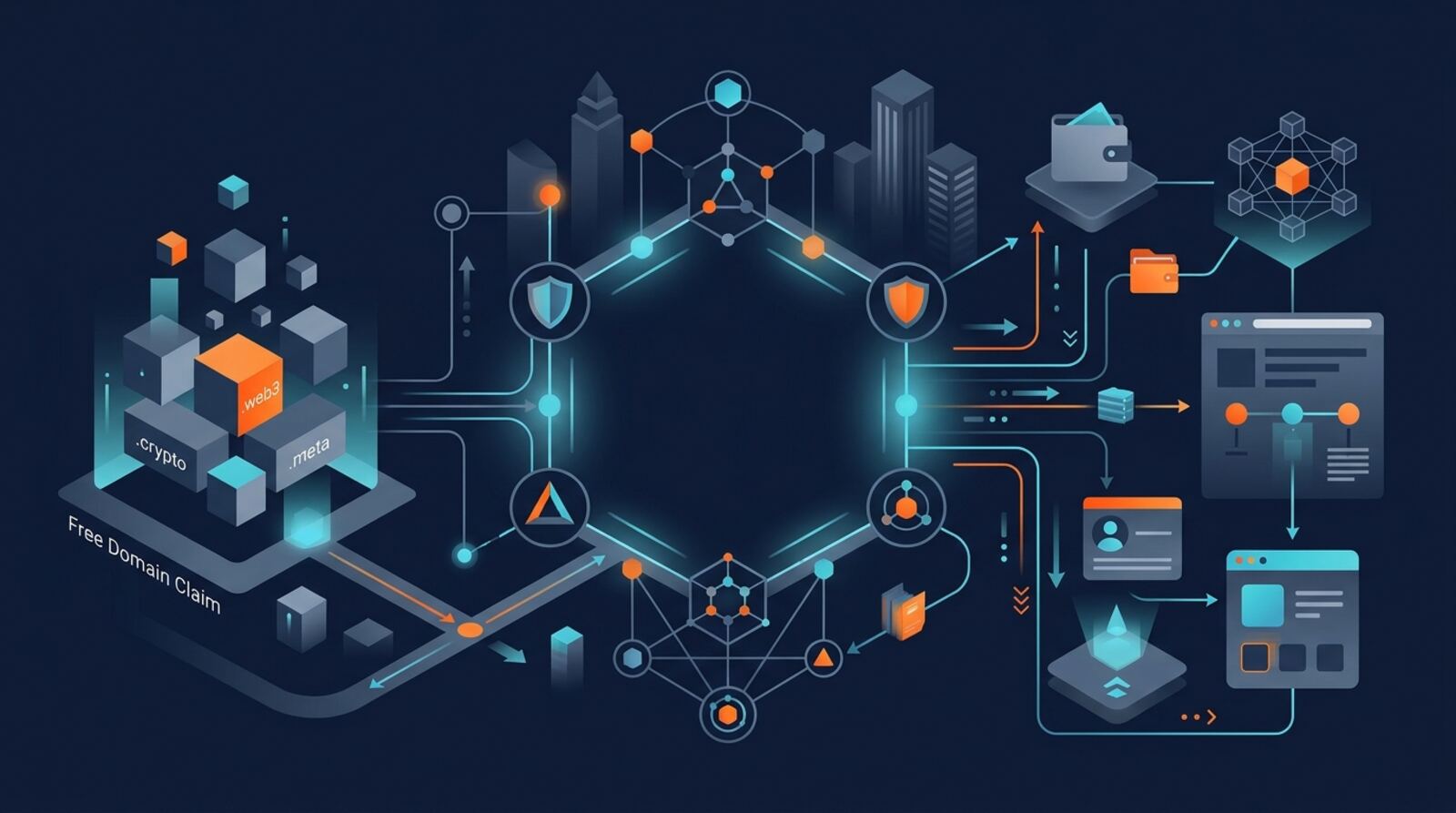
Freename is a Web3 domain platform. It lets people register names on a blockchain, rather than through the traditional registrar system, and it also lets projects and communities create and operate their own top-level domains. A name registered this way is recorded onchain and held in your wallet, much like a token or an NFT.
An integration is an arrangement where another product, such as a wallet, a community app or a project, connects to Freename so its users can get a domain from inside or alongside that product. A free domain claim is a promotion within such an integration: eligible users get a domain without paying the usual registration price.
The details vary by promotion. Typical variations include:
- A domain on a top-level domain run by a specific community or project.
- A free first-year registration that later needs renewal or a new payment.
- A claim limited to holders of a token, NFT or wallet product.
- A claim open to anyone who connects a wallet, with a cap on how many names each wallet can take.
Because these offers differ and change quickly, no evergreen guide can list what is currently open. What a guide can do is explain the mechanics, so you can judge any offer you come across and avoid the common traps. The sections below cover how Web3 domains differ from the traditional kind, the normal claim flow, what 'free' really means, and how to stay safe while claiming.
How do Web3 domains differ from ENS and traditional DNS?
A traditional domain, such as one ending in.com, is leased from a registrar. The registrar and the registry control it, and it resolves through the global Domain Name System (DNS), which every browser understands.
A Web3 domain is a record on a blockchain. You hold it with a wallet key, so ownership is tied to that key rather than to an account with a company. The same name can point to wallet addresses, a decentralised website, or profile data.
The key differences:
- Ownership: Onchain domains are held by your wallet address. If you lose access to the wallet, you lose control of the name.
- Resolution: Browsers and wallets resolve a Web3 domain only if they have built support for its registry or top-level domain. This is the main practical limit.
- Top-level domains: Many Web3 systems allow top-level domains that do not exist in the official DNS root. Names ending in these will not load in an ordinary browser unless an extension, a gateway or built-in support handles them.
- Transferability: Because the name is a token, it can usually be moved to another wallet or traded.
ENS is the best-known Ethereum naming system, and Freename is one of several alternatives. The right choice depends on where you want the name to work. A domain that your wallet and favourite apps cannot resolve has little everyday use, however cheap it was to claim.
How does a free Freename domain claim usually work?
Most claims follow the same pattern, even though the exact screens differ between integrations.
- Find the official offer. Start from the wallet, app or project that announces the claim, and confirm the offer from its official channels. Avoid links from replies, direct messages or ads.
- Check eligibility. Some offers need a token balance, an NFT, an account in a partner app, or simply a connected wallet. The page should state the rule clearly.
- Search for a name. Enter the name you want and the top-level domain the offer covers. Premium or short names are often excluded from free claims.
- Connect your wallet. Connecting only shares your public address. It does not give the site control of your funds.
- Review the transaction. Free offers frequently still require you to sign a minting transaction, which may cost a small network fee. Read the prompt in your wallet: it should describe a mint or registration, not a token approval for your assets.
- Confirm and wait. Once the transaction confirms, the domain appears in your wallet or on your Freename dashboard.
- Set records. Link the domain to your receiving addresses or website if the platform supports it.
If any step asks for a seed phrase, a payment to an unknown address, or an unlimited approval, stop. A legitimate claim never needs those things. Keep a record of the transaction hash in case you need to prove ownership later.
What does 'free' actually cover?
The word 'free' can cover very different things. Before you claim, work out which costs the offer removes and which it leaves in place.
Usually waived:
- The registration fee for the first term.
Often not waived:
- Network fees. Minting is an onchain transaction. Even where the platform covers the price, you may pay gas in the network's native token, unless the integration sponsors it.
- Renewal. A free first period may be followed by a paid renewal. If you miss it, the name might become available to others, depending on the top-level domain's rules.
- Premium names. Short, common or brandable names are often priced separately.
- Extras. Additional records, website hosting or other top-level domains might be separate purchases.
Questions to answer from the offer terms:
- How long does the free period last?
- What does renewal cost, and who sets the price?
- Is there a limit per wallet?
- Does the top-level domain's operator have rules on transfers, resale or reclaiming names?
The last point matters because top-level domains run by communities can set their own policies. A free name that cannot be transferred or that carries restrictions is less valuable than one you fully control. Treat any claim as having a possible future cost, and decide whether you would want the name if you had to pay to keep it.
What do you need before you claim?
Preparation prevents most failed claims. A short checklist:
- A self-custodial wallet you control. The wallet address that signs the claim receives the domain. Pick one you will keep using, and back up its recovery phrase offline before you start. Use a hardware-backed wallet for names you value.
- The right network. Confirm which blockchain the mint uses. The offer page or your wallet's transaction prompt should name it. Your wallet must be set to that network.
- A little native token for fees. If the integration does not sponsor gas, you need a small balance of the network's token. Without it, the transaction fails.
- Eligibility proof. If the claim is for token or NFT holders, hold the asset in the wallet you connect, not on an exchange.
If your funds sit on a different chain, you may need to bridge a small amount first. Canonical bridges such as Polygon Bridge, Base Bridge, Optimism Bridge and Arbitrum Bridge move assets between Ethereum and their own networks. Intent-based and cross-chain routers such as Across and Stargate V2 cover moves between other chains. Always send a small test amount first, and confirm the destination network before you approve anything.
Do not buy gas tokens from a link in a claim page or a message. Use a reputable exchange or a bridge you have opened yourself.
Where can a claimed Freename domain be used?
A claimed domain is only as useful as the software that understands it. Common uses include:
- Readable wallet addresses. Some wallets and apps let people send funds to a name instead of a long address, if they support that domain's registry.
- Onchain identity. Apps that read domain records can show your name as a profile.
- Decentralised websites. A domain can point to content stored on distributed networks, though visitors need a browser, extension or gateway that resolves the name.
- Community branding. If a project runs its own top-level domain, its members can share a recognisable namespace.
The main limit is resolution support. Before you rely on a name, test it:
- Set your address record, then send a small amount to the name from a wallet that claims to support it.
- Open the name in the browser or app you plan to use.
- Check whether the people you want to reach can resolve it too.
Support changes over time, in both directions, so check the Freename documentation and the support pages of your wallet or browser for the current list. Do not assume that a name working in one app means it works everywhere. If broad compatibility matters most, a name in a widely supported system may serve you better than a free one in a niche system.
How can you spot fake claim pages and protect your wallet?
Free offers attract scammers because many people click quickly. Defensive habits that matter:
- Verify the source. Reach the claim page through the official site or announcement of the wallet or app. Bookmark it. Treat links in direct messages, comments and sponsored public reporting as suspect.
- Check the address bar. Look-alike spellings of real site names are common.
- Read every prompt. A claim should involve connecting a wallet and signing a mint or registration. A token approval, a permit signature or a request to 'verify your wallet' by sending funds is a warning sign.
- Never share a seed phrase or private key. No support agent or claim page needs it.
- Use a separate wallet. Claim from a wallet that holds little value, then move the domain only if you need to. This limits damage if you sign something harmful.
- Review approvals afterwards. If you are unsure about something you signed, use an approval-checking tool to see what permissions exist and revoke any you do not recognise.
- Beware of urgency. Countdown timers and claims of limited supply are standard pressure tactics.
If you suspect you signed a harmful transaction, move remaining assets to a fresh wallet with a new recovery phrase, then revoke approvals from the old one. Do this from a device you trust, and avoid replying to anyone offering to 'recover' funds for a fee.
Free claim or paid registration: how do they compare?
A free claim and a paid registration produce the same type of asset, but the surrounding terms often differ.
| Point | Free claim via integration | Standard paid registration |
|---|---|---|
| Upfront price | Waived or discounted | Listed price |
| Network fee | Possibly still payable | Payable |
| Name choice | Often restricted | Wider choice, premium names priced separately |
| Top-level domain | Usually set by the offer | You choose from what is available |
| Eligibility | May need a token, NFT or partner account | Open to anyone who pays |
| Renewal | Terms vary, may start after a free period | Stated at purchase |
| Availability | Often limited in time or quantity | Ongoing |
When the free option is a good fit: you want to experiment with Web3 naming, the offer's top-level domain suits your community, and you are comfortable losing the name if you choose not to renew.
When paying may be better: you want a specific name, you need broad app support, or you plan to build a brand around the name. In that case, compare the top-level domain, the registry's rules and where the name resolves before you spend anything.
Whichever route you choose, record the exact terms at the time. Screenshots of the offer page, the renewal date and the transaction hash help if the terms change later.
What should you do after claiming?
Once the domain is in your wallet, a few steps keep it safe and useful.
- Note the renewal date. Set a calendar reminder well before the term ends. Missing a renewal could cost you the name, depending on the registry's rules.
- Secure the wallet. The domain is controlled by your keys. Store the recovery phrase offline, never in a screenshot, note app or cloud folder. A hardware wallet adds protection for valuable names.
- Set only the records you need. Add receiving addresses carefully and double-check each one. A wrong address in a record can send funds to the wrong place.
- Test small transfers. Before sharing the name publicly, send a small amount to it and confirm that it arrives.
- Be careful with transfers. Moving a domain is an onchain transaction that is hard to reverse. Confirm the destination address and the marketplace or app you are using.
- Watch for phishing aimed at domain holders. Messages claiming that your domain is 'expiring' or 'suspended' often lead to fake sites. Check your dashboard through a bookmark you made yourself.
- Consider privacy. A domain linked to your main wallet makes your holdings and activity easier to trace. If that matters, use a separate wallet for the name, or privacy tools such as Railgun for the assets you move.
Keep a written record of which wallet holds which domain, so you do not lose track of it years later.
How do you check whether a Freename offer is current?
This guide cannot say which Freename free claims are open today. Offers change often, and the stable approach is to check at the source.
Where to check:
- The official Freename site and documentation. They show the current domain search, supported top-level domains, pricing, and any listed partner integrations.
- The official channels of the partner wallet or app. The partner announces eligibility, deadlines and caps.
- Your wallet's own support pages. They list which naming systems it resolves.
Questions worth answering before you act:
- Is the offer still live, and does it have an end date?
- Which blockchain and which top-level domain does it use?
- What is the renewal price, and who controls the top-level domain?
- What does my wallet prompt say I am signing?
- Does the apps I use resolve this name?
If an offer is region-limited or requires identity checks, follow the stated rules and do not try to bypass them. Terms of service and local regulations apply to you, and an offer that is not available where you live is simply not available.
Free domains are low-cost experiments, but treat them like any onchain action: verify the source, read what you sign, and keep your keys safe. If you cannot confirm an offer from an official channel, skip it.
Frequently asked questions
Is a Freename domain claim really free?
Often the registration fee is waived, but you may still need the native token of the network to pay the minting transaction fee. Some offers also exclude premium names or charge for renewal or extra top-level domains. Read the terms on the offer page before you start.
Do I need to give my seed phrase to claim a domain?
Usually no. A normal claim needs you to connect a wallet and approve one minting transaction. You should never be asked for a seed phrase, a private key, or an unlimited token approval. If a page asks for any of these, leave it.
Will my Freename domain work in every wallet and browser?
Not necessarily. Web3 domains only resolve in software that supports their registry and top-level domain. Many wallets and apps support some Web3 domains, but support differs between names, so check where you plan to use yours.
Can I sell or transfer a claimed domain?
Freename domains are minted on a blockchain, so they sit in your wallet like other onchain assets and can generally be transferred or sold on supported marketplaces. Rules for each top-level domain can differ, so check how the specific domain behaves before you assume it can be traded.
Which wallet should I claim to?
The address that signs the claim transaction receives the domain, so use a wallet you control long term. If you claim to a throwaway or exchange address, you may struggle to manage or move the domain later. Hardware-backed wallets suit valuable names.
How do I know if a free claim offer is still active?
Check the official Freename site and the official channels of the wallet or app running the promotion. Free claims are often time-limited, region-limited or capped, and this guide cannot confirm what is open today. Treat unsolicited messages about claims as suspicious.
Mentioned in this guide
dApps in this guide
Polygon Bridge is the canonical route between Ethereum and the Polygon network, used by people moving assets onto Polygon via the official Portal.
Base Bridge is the canonical bridge for moving supported assets and data between Ethereum and Coinbase's Base layer-2 chain, with about $3B in TVL.
Optimism Bridge is the canonical bridge between Ethereum and OP Mainnet, used to move assets to the Optimism layer 2.
Arbitrum Bridge is the canonical bridge that moves ETH and ERC-20 tokens between Ethereum mainnet and the Arbitrum Layer-2 rollup.
Across is an intent-based cross-chain bridge and swap protocol for moving tokens between Ethereum, rollups and other chains, with an API for apps.
Stargate V2 is a LayerZero-powered cross-chain bridge for moving USDC, USDT, ETH, BTC and OFTs across many chains, aimed at DeFi users and liquidity providers.
Picnic is a self-custodial on-chain account app for reais, dollars, euros and crypto with a Visa card, aimed mainly at Brazilian users.
Railgun is a zk-SNARK privacy protocol for Ethereum, Arbitrum, BNB Chain and Polygon that shields DeFi transactions, for users wanting on-chain privacy.
Common is a non-custodial ZK privacy dapp on Arbitrum and Aleph Zero EVM that lets users shield funds and withdraw to a new, unlinkable wallet.
Keep reading
Related guides
Wallets and tools · Best list
Best Ethereum Wallet in 2026: Software, Hardware and Layer-2 Options
Most searches for the best Ethereum wallet are really asking which option is safe and easy to use today. This guide compares the main wallet types and names, then explains how to choose and set one up without exposing your recovery phrase.
Wallets and tools · How-to
How to Use a Ledger With the Coinbase Wallet App (2026 Guide)
Coinbase Wallet can be paired with a Ledger hardware device so your keys stay offline while you use the app. This guide covers preparation, setup, signing, dApp use and fixes for common pairing problems.
Wallets and tools · How-to
How to Set Up MyEtherWallet (MEW) Safely in 2026
MyEtherWallet runs as a website, a mobile app and a browser extension, and each stores your keys differently. This guide covers choosing one, creating a wallet, backing it up, connecting hardware and sending a safe first transaction.
Wallets and tools · Explainer
Opera's Web3 Crypto Wallet Beta Explained: Features and Risks
Opera put a crypto wallet and Web3 dApp access directly into its browser. This guide covers what a browser-native wallet is, how beta software changes the risk, and how to check and use it safely.
Wallets and tools · Explainer
GasNow Explained: How Gas Price Prediction Tools Work
GasNow was a popular gas price tracker built by a Chinese mining pool for Ethereum users. This guide explains what it did, how gas price predictors work, and what to use now.
Wallets and tools · How-to
How to Find Your Crypto Wallet Address
Your wallet address is the public destination used to receive crypto. Find it in the wallet or exchange’s Receive or Deposit screen, then confirm the asset and network before sharing it.
Wallets and tools · Explainer
Guardarian: Features, Fees and How It Works
Guardarian is a fiat-to-crypto service for buying, selling and swapping digital assets. Learn how its checkout works, what can affect the price, and what to check before confirming a transaction.
Wallets and tools · Explainer
Exodus Wallet Guide: Setup, Security and Use
Exodus is a self-custody wallet for managing crypto on desktop and mobile. Learn how to set it up, protect your recovery phrase, receive and send assets, and understand the costs and risks of swaps and staking.