Web3 gaming · Explainer
Borrow NFTs to Play Blockchain Games: NFT Rental Explained
Renting an NFT lets you use a game asset without buying it, while the owner earns from an item that would otherwise sit idle. This guide explains the rental models, the costs, the risks and a safe way to start.
By the DappsAtlas editorial team · Updated
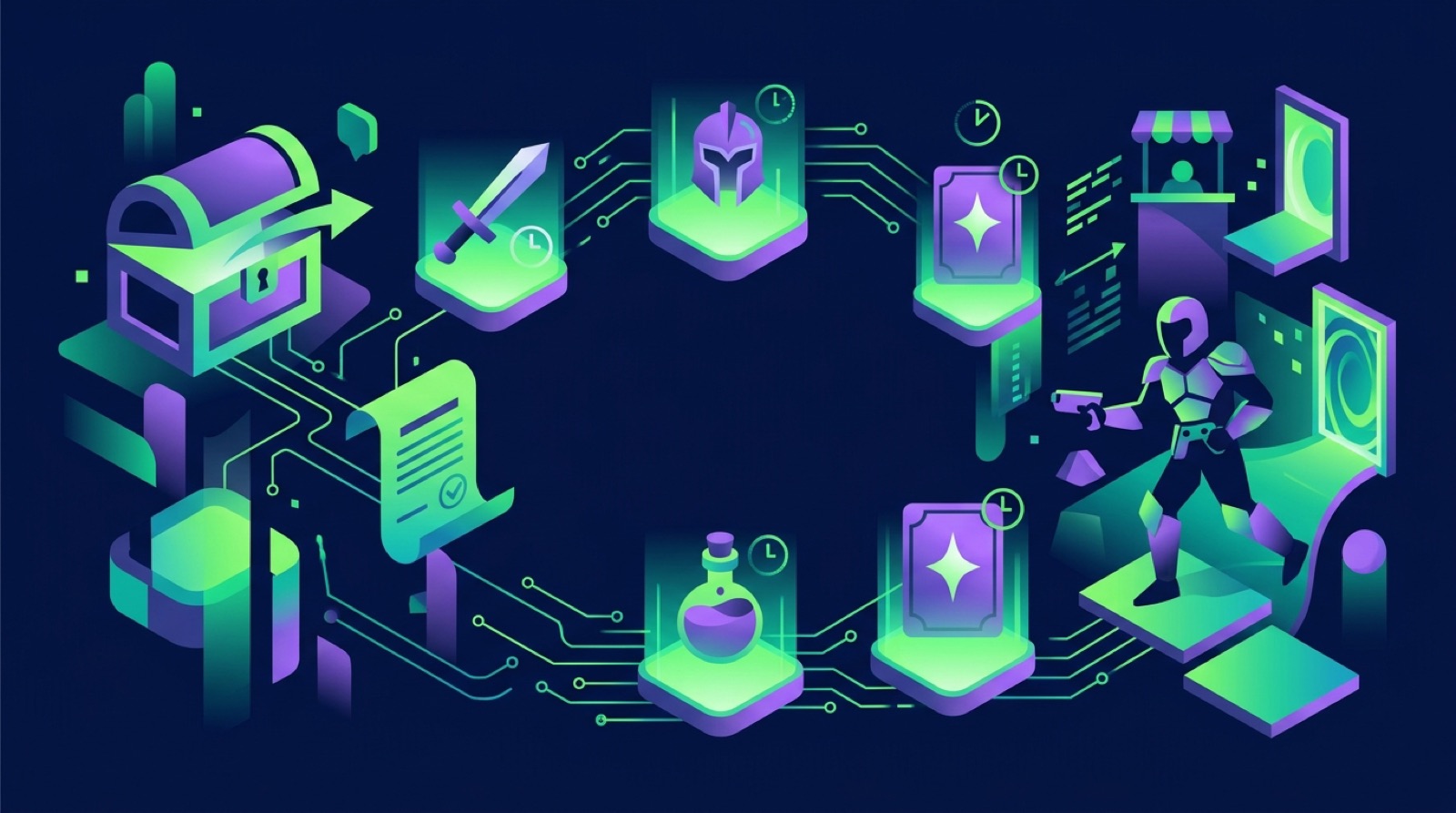
What is NFT rental for blockchain games?
NFT rental is an arrangement in which the owner of a game asset lets another player use it for a set time or under agreed terms, while the owner keeps the NFT. The asset might be a character, a spaceship, a plot of land, a tool or a piece of equipment. The borrower gets access to play, and the owner gets a fee, a share of rewards, or both.
The idea exists because many blockchain games require you to hold specific NFTs before you can take part. Entry costs can be high, and a player who is unsure about a game may not want to commit. Meanwhile, owners may hold assets they are not actively using. Rentals connect the two groups.
A rental is not the same as a sale. In a sale, ownership transfers permanently. In a rental, the owner's claim stays intact and the borrower only receives usage rights. Those rights can be enforced in different ways:
- By a smart contract that holds the NFT in escrow and releases usage rights.
- By a token standard that defines a separate "user" role with an expiry time.
- By delegation of a wallet's permissions, so the game recognises the borrower without moving the NFT.
- By an off-chain agreement, such as a guild's scholarship program, where the owner lends account access under rules set by the guild.
The last option carries the most trust risk, because it depends on people and policies rather than code. Understanding which mechanism a game uses is the first step to renting safely.
The practice is sometimes described as a trend, but it is really a recurring answer to a recurring problem: high entry prices in games that tie access to NFT ownership.
Why do players borrow NFTs, and why do owners lend them?
Borrowers and owners have different motives, and knowing both helps you judge whether a deal is fair.
Why borrowers rent
- Lower upfront cost. You pay a fee or share rewards instead of buying the asset outright.
- Trial before you buy. You can test a game's loop, difficulty and reward flow before committing capital.
- Flexibility. If the game does not suit you, you walk away without needing to resell an illiquid NFT.
- Access to specific assets. Some content is only open to holders of a particular rarity or class.
Why owners lend
- Income from idle assets. An NFT you are not using can still produce a return.
- Shared effort. Players with limited time can let others play on their behalf.
- Community building. Guilds and studios sometimes lend assets to grow an active player base.
What the model does not guarantee
Renting does not guarantee profit. Game rewards depend on the game's economy, token prices, player numbers and design changes, all of which can shift quickly. A rental that looks attractive when rewards are high can become a loss if rewards fall or the fee stays fixed.
Renting also usually means you build no lasting asset. When the term ends, the NFT returns to the owner, and so does any upside in its value. If a game's NFTs rise in value, the borrower does not share in that unless the agreement says so.
Treat a rental as a short-term access fee, not an investment. Decide in advance what you want from it, such as learning the game, trying a class, or earning a modest return, and then judge the deal against that goal.
How do the main NFT rental models work?
Most rentals fall into a few broad models. The names vary between platforms, but the mechanics are similar.
| Model | How it works | Main risk |
|---|---|---|
| Fixed-fee rental | Borrower pays a set price for a set period | Rewards may not cover the fee |
| Revenue share | Borrower pays nothing or little upfront and splits earnings with the owner | Split may be unfavourable; earnings are variable |
| Collateralized rental | Borrower locks a deposit equal to or above the NFT's value | Capital is tied up; deposit may be lost if terms are broken |
| Non-collateralized rental | NFT sits in a contract that restricts transfer, so no deposit is needed | Depends on the contract being sound |
| Guild scholarship | A guild lends assets to players under a program with set rules | Trust in the guild and its policies |
| Land commission | A landowner lets others mine or play on their land and takes a cut | Commission can reduce your take |
Fixed-fee rentals are the simplest. You know the cost upfront, so you can calculate whether the game is likely to cover it.
Revenue-share models reduce your risk of paying for nothing, but they cap your earnings. Check how the split is calculated and whether it applies to gross or net rewards.
Collateral protects the owner from theft. The cost is that you need capital to borrow, which partly defeats the purpose of renting if the aim was a small outlay.
Escrow-based or standard-based rentals can remove the need for collateral because the borrower cannot move the NFT in the first place. That safety depends entirely on the quality of the contract, so prefer platforms with published audits and a track record.
What is ERC-4907 and how does delegation fit in?
Under the common ERC-721 standard, an NFT has one owner, and the game normally treats whoever holds it as the person entitled to use it. That makes lending awkward. If you send the NFT to a borrower, you are trusting them to send it back.
Several technical approaches try to fix this.
ERC-4907 is an Ethereum token standard that extends ERC-721 with a second role called the "user", along with an expiry time. The owner stays the owner. The user can use the asset in compatible apps until the expiry passes, after which the role lapses automatically. A game must be built to read the user role for this to work, so support is not universal.
Wrapper or escrow contracts take custody of the NFT and issue a temporary token or permission to the borrower. The original NFT stays locked until the rental ends. The game or the platform must recognise the wrapper.
Wallet delegation registries let a wallet that holds NFTs authorise a second wallet to act on its behalf for certain purposes. The NFT never leaves the owner's wallet, which helps keep valuable assets in cold storage while a hot wallet plays. Again, the game has to check the registry.
Game-native rental features are built by the studio itself. When a game offers its own lending system, the rules are enforced inside the game's contracts and are usually the least confusing option for a newcomer.
The practical point for borrowers is that the technical method decides who bears the risk. Native or standard-based systems put it on the code. Informal arrangements put it on the other person. Whichever route you take, confirm that the game itself recognises the rental.
What are scholarships and guilds?
Scholarships are the best-known rental arrangement in blockchain gaming. The term became widely used around Axie Infinity, where players who could not afford the required NFTs were lent them by owners or guilds, and rewards were split by agreement.
A typical scholarship works like this:
- A manager or guild owns a set of game NFTs.
- A scholar applies, often with onboarding or training.
- The scholar plays with the lent assets, either through a delegated wallet or an account the manager controls.
- Earnings are divided according to a stated ratio.
Guilds such as Yield Guild Games grew largely around this idea, pooling assets and recruiting players across several games. Programs differ widely in terms, so avoid assuming that a split used by one guild applies to another.
Questions to ask before joining a program
- Who holds the assets and who can revoke access?
- How is the split calculated, and who pays network fees?
- Are there performance targets or minimum play hours?
- What happens if the game changes or rewards drop?
- Are payouts made on a schedule, and in which asset?
- Is there any written agreement?
Cautions
A scholarship is informal in legal terms in many places, and can raise questions about whether the arrangement is employment, a loan or something else. That is a matter for local law. Also be wary of any program that asks for payment to join, or asks for your seed phrase or private key. Legitimate programs do not need either.
Scholarships also tend to depend on the strength of a single game's economy, so they can end quickly if that economy weakens.
How do I rent an NFT safely, step by step?
Follow a consistent process every time you consider a rental. The steps below apply to most games and platforms.
- Read the game's official documentation. Confirm that rentals, lending or delegation are allowed, and find out which marketplaces or tools the studio recognises.
- Use a separate wallet. Create a wallet just for gaming, holding only what you need for fees and the rental. Keep your main holdings elsewhere.
- Verify the platform. Reach it through the game's official channels, not through a link sent in a chat or direct message. Look for published audits and a history of operation.
- Inspect the listing. Check the NFT's contract address, the rental term, the fee, any revenue split, and whether a deposit is required.
- Work out your break-even. Estimate how much you need to earn per day to cover the fee and gas costs. Use current in-game data rather than screenshots or promotional claims.
- Read the transaction before you sign. Your wallet should show what you are approving. Be suspicious of requests for broad token approvals or "set approval for all" permissions that do not match what you are doing.
- Start small. Choose a short term first. If it goes well, extend it.
- Revoke approvals afterwards. When the rental ends, remove any permissions you granted using a reputable approval-management tool.
- Keep records. Save the rental terms, transaction hashes and reward amounts for your own tracking and any tax reporting.
If any step feels unclear, pause. A rental you do not fully understand is not worth the risk, and a legitimate owner or platform will not pressure you to hurry.
What are the main risks and red flags?
Rentals involve a few distinct risks. Some are technical, some economic and some are plain fraud.
Scam patterns
- Requests for your seed phrase or private key. No rental needs these. Anyone who asks is trying to take your wallet.
- Fake marketplaces and cloned sites. Scammers copy real rental pages and promote them through ads, replies and direct messages.
- Malicious approvals. A transaction that looks like a rental may actually grant a contract permission to move your tokens or NFTs.
- Too-good-to-be-true listings. Promised daily returns with no risk are a warning sign in any form.
- Upfront fees to "unlock" a scholarship. Genuine programs rarely require this.
- Fake support staff. People who message you first offering help are usually not official.
Economic and operational risks
- Reward volatility. Token rewards can lose value faster than your rental term runs out.
- Rule changes. A game can alter reward rates, add fees or restrict rentals.
- Contract risk. Even audited contracts can have bugs, and escrow contracts hold valuable assets.
- Account bans. Some games restrict account sharing or automation, and a ban could leave you owing a fee.
- Liquidity. Collateral can be locked until the term ends.
Defensive habits
Use a dedicated wallet, use a hardware wallet for anything valuable, check URLs by typing or bookmarking the official address, and review every signature request. If something feels off, stop and verify through the game's official documentation.
None of this removes risk entirely. It reduces the chance that a mistake becomes a total loss.
What does renting really cost, and how do I work out if it pays?
A rental is only worthwhile if what you earn exceeds what you spend. The cost side is usually more than the headline fee.
Typical cost components
- Rental fee or revenue share. The main price of access.
- Deposit or collateral. Often returned, but locked for the term and exposed to price changes if paid in a volatile token.
- Network fees. Gas for starting the rental, claiming rewards and ending it, which can add up on busier networks.
- Platform or marketplace fees. Some platforms take a percentage from the owner, the borrower or both.
- Game-specific costs. Energy, entry fees, repair or upgrade costs that you pay while playing.
- Opportunity cost. The time you spend playing could be used elsewhere.
A simple break-even method
- Add up all costs for the term.
- Estimate daily rewards using the game's current mechanics, not past peaks.
- Convert rewards to the currency you track, using a live price source.
- Subtract your share of any split.
- Compare the result with your costs, and test the outcome with lower rewards and lower token prices.
If the deal only works in optimistic scenarios, it is probably not worth taking.
Where to check current figures
Prices, reward rates and rental fees change constantly, so this guide does not quote any. Use the game's official dashboard, its documentation, and an independent token price tracker. For platform fees, read the rental platform's own published fee schedule at the time you borrow.
How should owners lend NFTs?
If you hold game NFTs, lending can generate income, but it exposes you to risks that are easy to underestimate.
Choosing a method
Prefer systems where the NFT stays under your control or in a well-audited escrow, rather than sending it directly to another person. Delegation and user-role standards help because the NFT does not change hands. Check that the game recognises whichever method you choose.
Setting terms
- Pricing. Look at comparable listings and consider the asset's real use in the game. Overpriced listings simply sit unused.
- Duration. Shorter terms let you reprice, longer ones give predictable income.
- Collateral or none. Decide how much counterparty risk you accept.
- Revenue split. Be clear about what counts as earnings and when they are paid.
- Usage rules. State any restrictions, such as no account sharing outside the agreement.
Protecting yourself
- Keep valuable NFTs in a separate wallet and lend through delegation where possible.
- Read what you approve. Approvals for rental contracts should be limited to the specific asset where the platform allows it.
- Track which assets are lent, to whom and until when.
- Keep records of rental income. In many jurisdictions, income from lending can be taxable, so consider speaking to a qualified adviser.
Consider the downside
A lent asset may be locked and unavailable if the game's value changes suddenly or you want to sell. Factor that illiquidity into your pricing. Lending is a business decision, so treat it with the same care you would give any asset you let someone else use.
Which kinds of blockchain games use rentals?
Rental support depends on each game's design, and it can change. The examples below show the kinds of rental-like mechanics that exist, but check each project's own documentation for what is currently supported.
Hero and character games. In games such as Defi Kingdoms, characters are NFTs with different roles and traits. Games like this have used in-game systems that let players make use of other players' heroes, for example in breeding-style or summoning mechanics. Check the game's current documentation to see whether and how this works now.
Land and tool-based mining games. Alien Worlds, on the WAX blockchain, uses NFT tools and land. Landowners can earn from activity on their land, which resembles a commission-style arrangement, and players use tools to mine TLM. Whether you need to own tools yourself, and how land commissions apply, is set by the game and may change.
Ship and asset-earning games. Warp uses NFT starships that earn credits and take part in battles and expeditions across several chains. Whether you can lend or delegate a ship depends on the project's current features.
Gaming platforms and marketplaces. ImmutableX is a platform on which many web3 games run and trade NFTs. Rental or delegation options are usually provided by the individual game or third-party tools, not by the platform alone.
What to do before you commit
For any of these, read the official guides, confirm which networks and marketplaces are supported, and look for recent announcements. Avoid assuming that a rental method that worked for one game will work for another.
What legal, age and tax points should I check?
Some games that include token rewards, randomised drops or gambling-style mechanics have age limits, usually 18 or over. Check the game's terms and your local laws before you take part, and do not try to bypass any age, region or identity checks a game or platform applies.
Tax and legal points to check
- Income. Rewards, rental fees and revenue shares may count as taxable income in your country. The rules differ widely, and so does the timing.
- Capital gains. If you receive tokens and later sell them, a separate gain or loss may apply.
- Scholarship status. Whether a guild arrangement is a loan, a partnership or employment can depend on local law.
- Platform terms. Some games ban account sharing or restrict how assets are used, and a breach could lead to suspension.
This guide is general information, not tax, legal or financial advice. If you plan to rent regularly or at scale, speak to a qualified professional in your country.
A short checklist before your first rental
- You are of legal age for the game and platform.
- The game's official documentation confirms the rental method.
- You use a dedicated wallet and have revoked unnecessary approvals.
- You have calculated break-even using current data.
- You are renting only an amount you could afford to lose.
- You keep records of every transaction.
NFT rental can make blockchain games more accessible, but it is not risk-free and it is not a reliable income source. Start small, verify everything through official channels, and stop if the terms stop making sense.
Frequently asked questions
Do I need to pay to borrow an NFT for a game?
Usually yes, but the terms vary. Some rentals need a deposit, some charge an upfront fee, and some take a share of whatever you earn. Read the full terms before you confirm, and work out your break-even point first.
Do I own the NFT while I rent it?
Not in the ownership sense. Under most rental systems the owner keeps the NFT and you receive temporary rights to use it in the game. Some systems hold the NFT in escrow, and others use a standard such as ERC-4907 that separates the owner role from the user role.
Can I lose money renting game NFTs?
Yes. Rewards can be lower than the rental cost, token prices can fall, a game can change its rules or shut down, and a scam listing can cost you your deposit or wallet access. Never rent anything you cannot afford to lose.
Does every blockchain game support NFT rentals?
Not necessarily. Many players use a rental marketplace or a guild program, but each game decides what it supports. Check the game's official documentation to see whether lending, delegation or scholarships are allowed, and whether the rules are current.
How do I avoid scams when borrowing an NFT?
Never share your seed phrase or private key, and never accept an arrangement that asks for them. Legitimate rentals use smart contracts, approvals or delegation, so you can play without ever handing over your wallet.
Are there legal or tax rules I should check?
Rules differ by country. Rental income, fees and token rewards can all be taxable events in some places, and some games with token rewards or gambling-style mechanics have age limits, usually 18 and over. Check your local laws and consider asking a tax professional.
Mentioned in this guide
dApps in this guide
DeFi Kingdoms is a pixel-art fantasy RPG that wraps a DEX, liquidity pools and Hero NFTs into one game.
Alien Worlds is a community-built play-to-earn metaverse on WAX where players mine and play to earn TLM tokens and NFTs.
Warp is a GameFi project where NFT starships earn daily WARP credits and play battles, expeditions and minigames across several chains.
ImmutableX is a web3 gaming platform on Ethereum whose IMX token covers fees, staking, governance and gas on Immutable zkEVM, aimed at gamers and token holders.
Save, formerly Solend, is a Solana lending and borrowing protocol where users earn interest on deposits or borrow against collateral.
Axie Infinity is a Ronin-based NFT game where players collect, combine and battle creatures called Axies, with its own AXS token.
Infinity is a DeFi lending and borrowing protocol offering floating and fixed rates and yield curve trading, still shown as testnet or beta on its homepage.
Native is a specialist insurance broker for crypto and emerging tech, placing Lloyd's-backed and onchain cover for teams and financial institutions.
nReach is a B2B outbound sales platform for Web3 companies, offering a contact database and automated Telegram, email and Slack outreach.
Keep reading
Related guides
Web3 gaming · Explainer
Earthlings and Metaverse Land: A Guide for Mainstream Gamers
Earthlings is a colony-management game that gets linked to metaverse land talk, and mainstream gamers keep asking whether owning virtual land is worth it. This guide explains how land works in games, where it fails, and how to judge a project.
Web3 gaming · Best list
Best NFT Games in 2026: Top Blockchain Games Compared
A plain-English guide to the best NFT games and blockchain games: what each one is, how ownership and tokens work, and the risks to understand before you buy anything.
Web3 gaming · Best list
Top Animoca Brands Games: Best Web3 Titles to Know in 2026
Animoca Brands builds, publishes and backs a large number of web3 games. This guide sorts the titles worth knowing into first-party games, licensed titles and backed ecosystems, and explains how to judge each one before spending anything.
Web3 gaming · Explainer
Axie Infinity Lunar New Year Event: What Ended and What to Check
Axie Infinity ran a limited-time Lunar New Year event with a new burn mechanic, but the sources available here do not confirm the February 20 end date in the query. This guide explains what the event was, how to verify its end date from official channels, and what players should do now.
Web3 gaming · Explainer
Brawlers on WAX and Amazon Prime Gaming: What the Partnership Was
Brawlers, previously known as Blockchain Brawlers, is a WAX blockchain game that gained public attention in 2023 when its platform was promoted through Amazon Prime Gaming. This guide explains what that partnership was, what it did and did not mean for players, and how to check the current status of any similar offer.
Web3 gaming · Explainer
Bored Apes, Benji Bananas and APE Play-to-Earn Explained
Benji Bananas is a free Animoca Brands runner, and Bored Ape Yacht Club is a separate Yuga Labs NFT project. This guide explains how the two connect, what public reporting do and do not confirm about earning APE in the game, and how to check current rules yourself.
Web3 gaming · Best list
Bullish Polygon Gaming Dapps in 2026: What to Check
Only two titles on our list are clearly tied to Polygon, so this guide explains how to judge whether a Polygon gaming dapp deserves a bullish view, and what to check before believing it. It also shows where the other titles in our list are deployed.
Web3 gaming · Explainer
Bored Ape Yacht Club and Animoca Brands P2E Game: What to Know
Bored Ape Yacht Club, run by Yuga Labs, has been linked to Animoca Brands on games for several years. This guide explains what the partnership covers, how it has developed, and how to check the status of any BAYC-branded game before you spend time or money on it.