NFT · Explainer
Blue-Chip NFT Price Drops and the Goblin Town Surge Explained
Headlines that pair a drop in blue-chip NFT prices with a Goblin Town surge usually compress several moving parts into one number. This guide explains what the claim can and cannot show, why blue-chip floors fell in past periods, and how to check any percentage yourself.
By the DappsAtlas editorial team · Updated
What the headline claim actually measures
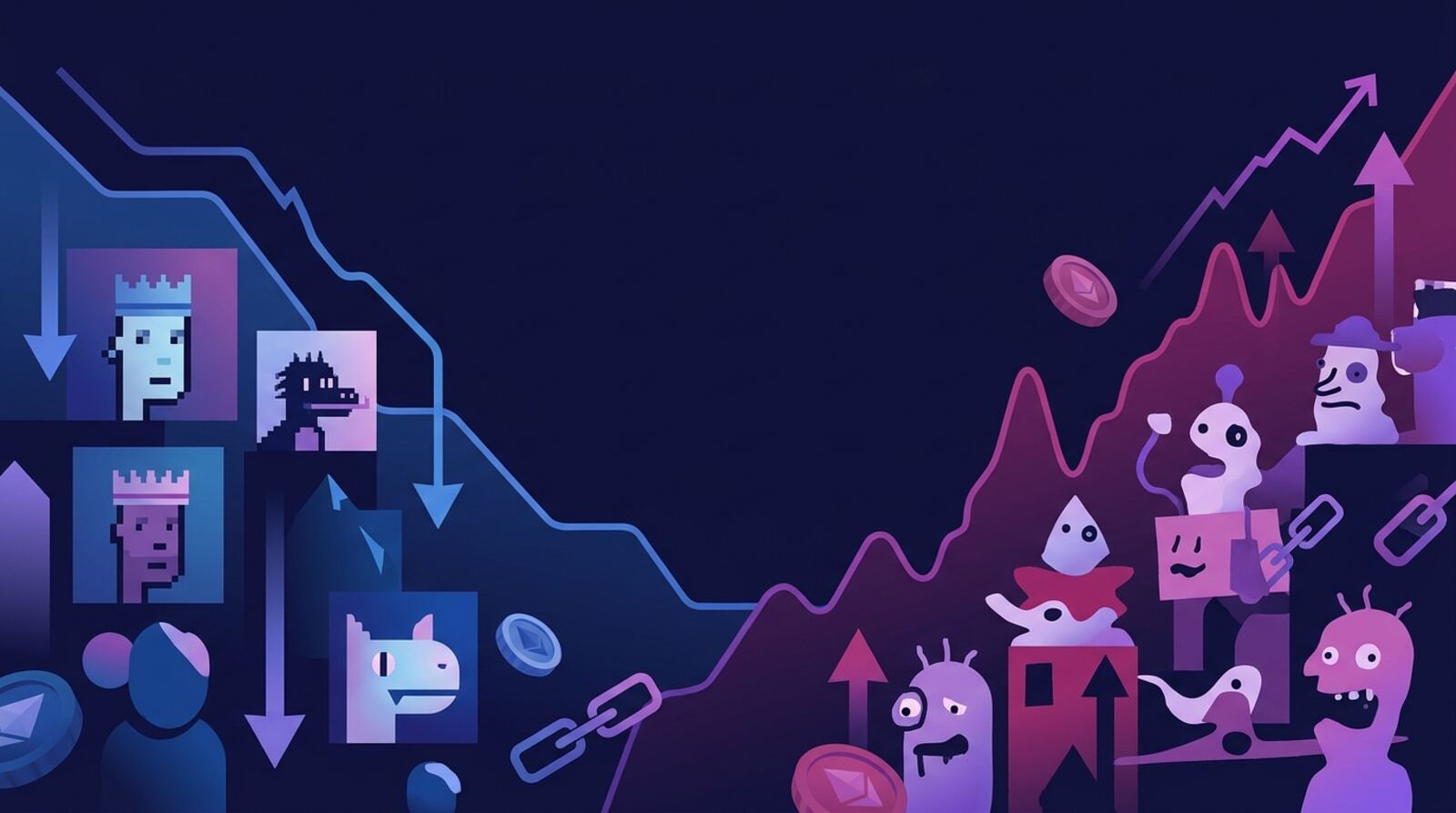
Headlines that say blue-chip NFT collections lost about half their value while Goblin Town surged usually squeeze several things into one number. A blue-chip collection is typically measured by its floor price, the lowest listed price for any item in the collection. A surge in another collection is measured the same way, or by trading volume.
Both figures change with three things:
- Timeframe. A one-week move can look very different from a six-month move.
- Currency. A floor quoted in ETH can fall by a different amount than the same floor quoted in US dollars, because the token itself moves.
- Snapshot date. Floor prices can shift within hours.
This guide does not confirm a specific percentage for this period. Public reporting support a narrower set of points: blue-chip floors fell sharply in several periods, including mid-2023 and March 2024, and Goblin Town drew heavy attention after its 2022 launch. The more useful question is not only how far a collection fell, but why, and whether the fall reflects the collection itself, the wider market, or a shift in where buyers were spending.
What counts as a blue-chip NFT collection
"Blue-chip" is an informal label, not an official list. It usually describes collections that have:
- A long trading history and repeated sales over time
- A large number of distinct holders
- Consistent trading volume rather than occasional spikes
- Strong brand recognition among collectors
- Deeper liquidity, meaning more buyers willing to bid
In the NFT space, blue-chip status has often been associated with well-known profile picture (PFP) collections. Mutant Ape Yacht Club, which spun off from Bored Ape Yacht Club, is one example of a collection in this category. CryptoPunks, with its 10,000 pieces, is another frequently cited example. Hashmasks, with 16,384 portraits, and Redacted Remilio Babies, a 10,000-piece collection on Ethereum, are often grouped with the PFP category as well.
Because the label is informal, two people can disagree about whether a given collection counts as blue-chip. When you read an article about blue-chip prices, check which collections it includes. A list that changes between articles can make the same headline mean different things.
Why blue-chip floor prices fell in 2022 and 2023
Public reporting describes several periods of sharp declines across established collections. In early July 2023, one report said more than 1,000 NFTs were liquidated in a single week as floor prices of several collections, including Bored Ape, fell. Another report from the same week described a dramatic selloff in major collections as concerns grew across the market.
Several forces tend to drive these moves:
- Broader crypto downturns. When the base tokens fall, NFT buyers often have less capital and become more cautious.
- Forced selling from loans. Some lending platforms accept NFTs as collateral. If a floor drops below a threshold, positions can be liquidated, which adds sell pressure.
- Distressed holders. The results note that in 2023 Sotheby's planned to auction blue-chip NFTs seized from the firm 3AC, which added supply to the market.
- Thin liquidity. When few buyers are active, a modest amount of selling can push floors down quickly.
The results also show that NFT prices do not always follow the wider market. A March 2024 report described floor prices of many leading collections falling more than 20% in one week while ETH and BTC rallied. That divergence suggests collection-specific or sentiment-driven factors can matter as much as the broader trend. When you assess a decline, look at the market conditions on the same dates.
What Goblin Town was and why it drew attention
Goblintown, the project usually associated with the Goblin Town name, launched in May 2022 on OpenSea. According to a 2022 report, it consists of 9,999 generative NFTs. The same report noted that the project claimed it had no roadmap and no utility, which set it apart from many collections that promised features, games or membership perks.
Its appeal rested largely on community identity and humor. Collections built around a shared joke or in-group culture can draw attention quickly, and they can also lose it just as fast. That dynamic is why a fast-rising collection often shows large swings in both price and volume.
The current status of Goblin Town is something to check directly. Its floor price, sales history and holder count can all have changed since the 2022 coverage. Open the collection page on a marketplace that lists it, look at the sales chart over several months, and note whether the volume is driven by a few large trades or by many buyers. A surge in 2022 does not tell you what the collection looks like today.
How money can rotate between collections
A surge in one collection does not create value in another. Still, money can move between collections for reasons that look like a connection from the outside. Common patterns include:
| Pattern | What it can look like | What to check |
|---|---|---|
| Attention shift | Buyers move from older collections to newer ones with more social buzz | Social mentions and new-buyer counts over time |
| Profit taking | Holders sell blue-chip items to fund a new purchase | Sales volume and seller counts in the blue-chip collection |
| Liquidity drain | Traders sell to free up capital for a trending collection | Floor depth and listings in the blue-chip collection |
| Coincidence | Both collections move for unrelated reasons | Market-wide conditions on the same dates |
One way to test a claimed link is to ask whether the timing holds across several snapshots. If blue-chip sales volume fell while the surging collection's volume rose, that is more consistent with rotation. If both collections fell together, a shared cause such as market sentiment is more likely.
Rotation is also not one-directional. The same buyers may move in and out of several collections over a month, so a single week of data rarely settles the question.
How to check a percentage claim yourself
Before you repeat a claim like the one in this headline, work through these steps:
- Write down the exact metric. Is it floor price, average sale price, last sale or market cap?
- Fix the start and end dates. Use the same dates for every collection you compare.
- Choose a currency. Compare ETH-denominated figures with other ETH figures, and USD figures with other USD figures.
- Check sales, not only listings. A low listing can exist without a matching sale.
- Look at volume. A floor move on very few trades says less than the same move on heavy volume.
- Cross-check two or more sources. Compare the marketplace history with an independent data source that shows timestamps.
- Record when you looked. Save the date, the source and the value, so someone else can reproduce your figure.
If you cannot reproduce a headline figure with these steps, treat it as unverified. Reporters sometimes use a peak-to-trough measure, a single outlier sale or a different currency than the one readers assume.
Reading floor price, volume and liquidity correctly
Floor price is only one signal, and it can mislead on its own. These measures help you read a collection more accurately:
- Floor price. The lowest current listing. A floor can be set by a single listing with no real buyers behind it.
- Floor depth. How many items are listed near the floor. A shallow floor can move sharply after a few sales.
- Average or median sale price. Often more representative than the floor, especially if trades cluster in a narrow range.
- Trading volume. The total value traded over a period. Compare it with the same period in earlier months.
- Unique buyers and sellers. Many unique wallets suggest broader demand than a handful of repeat trades.
- Trait rarity. Within a collection, prices can differ widely between items with rare traits and common ones.
Wash trading, where one party trades with itself to inflate activity, has been a known problem across NFT markets. Be cautious when volume spikes with few unique buyers, or when sales happen at odd prices with no clear reason. Marketplace filters and sales history pages can help you see whether activity looks organic.
The measures above describe past activity. They do not forecast future prices or guarantee that you could sell at the floor.
Security and risk checks before trading NFTs
Price data is only part of the picture. Before you buy or sell any NFT, including blue-chip items, keep these risks in mind:
- Price volatility. Collections can lose much of their value within weeks, even if they have a long history.
- Liquidity risk. You may not find a buyer at the price you expect, especially for rare or high-priced items.
- Phishing. Fake marketplace sites and direct messages that impersonate support staff are common. Type marketplace addresses yourself or use bookmarks you created.
- Token approvals. Signing a request can give a contract ongoing permission to move assets. Read each request, and review and revoke approvals you no longer need.
- Seed phrase exposure. No legitimate marketplace or support team needs your recovery phrase. Never type it into a website or share it with anyone.
- Contract risk. Check the contract address for the collection you intend to trade, since copycat collections use similar names.
A hardware wallet can reduce exposure to some of these risks, though it does not protect you from approving a malicious transaction. Keep software updated and keep your recovery phrase offline.
Nothing in this guide is financial advice. Decide only with money you can afford to lose.
Where to research and trade blue-chip NFTs in 2026
Several marketplaces are commonly used to research and trade NFTs. Each works differently, so compare fees, supported chains and liquidity before you choose one:
- OpenSea is a general peer-to-peer marketplace for buying, selling and minting NFTs. Its collection pages show floor, volume and sales history.
- Sudoswap V2 is a decentralized NFT marketplace on several chains that uses pools and bonding curves, which can offer a different trading model from listing-based markets.
- NFTX turns NFT collections into vault-backed ERC20 tokens, so users can trade against a pool at a price tied to the collection rather than a single listing.
- Element Market aggregates listings across many blockchains, which can help you compare prices across venues.
- Punks Terminal is a dedicated CryptoPunks trading terminal that lets you place trait-filtered bids from a personal Stash contract on Ethereum.
No marketplace is a substitute for checking price history. Before trading, confirm the chain, the collection contract, the current fees and whether the marketplace is still operating as described. Platform features and fee structures change, so verify them on the platform itself.
Frequently asked questions
Did blue-chip NFTs really lose half their value?
Public reporting do not confirm one specific figure for this period, and the number depends on the start date, end date, currency and metric used. A floor price measured in ETH can fall differently from the same floor measured in US dollars, and a one-week snapshot can look very different from a six-month one. Pull the floor price history for the exact dates in the headline before repeating any percentage.
Did Goblin Town cause blue-chip NFT prices to fall?
Nothing in the results establishes that Goblin Town caused the decline in blue-chip floors. Attention and money can move between collections, but many other forces were at work in the same periods, including the broader crypto market and forced selling from leveraged positions. Treat a timing overlap as a reason to investigate, not as proof of cause.
Are blue-chip NFT collections a safe investment?
No NFT collection, including a blue-chip one, can be treated as a safe store of value. Blue-chip collections are often more liquid than smaller projects, but they can still lose value quickly, and selling a specific item may take longer or require accepting a lower price than the floor. Only spend what you can afford to lose, and do your own research on price history and market conditions.
Where can I check current floor prices?
Use the price history and sales charts on the marketplace where the collection trades, and compare them with independent market data sources that show timestamps. Confirm whether the figure is a floor price, an average sale price or a last sale, and check trading volume alongside it. Always note when the data was captured, since floor prices can change within hours.
Could I lose money just by connecting my wallet?
Yes. Common losses come from phishing sites that imitate marketplaces, fake support messages, and signature requests that grant a contract permission to move your assets. Only connect your wallet to sites you have typed in yourself or reached from a verified source, read each request before approving it, and periodically review and revoke token approvals in your wallet settings.
Mentioned in this guide
dApps in this guide
OpenSea is a peer-to-peer NFT marketplace for buying, selling and minting digital collectibles, aimed at collectors, creators and developers.
Ethereum PFP NFT collection of up to 20,000 Mutant Apes from Yuga Labs, spun off from Bored Ape Yacht Club, for collectors and community members.
Hashmasks is a 16,384-piece NFT portrait collection on Ethereum, aimed at collectors who trade individual tokens.
Sudoswap V2 is a decentralized NFT marketplace on Ethereum, Base, Berachain and Arbitrum with on-chain royalties and ERC-1155 support, for NFT traders.
NFTX turns NFT collections into vault-backed ERC20 tokens so users can buy and sell NFTs instantly at floor price against a pool.
Element Market is a multi-chain NFT marketplace and aggregator for collectors and traders buying NFTs, collectibles and GameFi assets across many blockchains.
Punks Terminal is a CryptoPunks trading terminal from Lightyear for placing trait-filtered bids from a personal Stash contract on Ethereum.
Redacted Remilio Babies is a 10,000-piece Ethereum PFP NFT collection by Remilia, built on the Milady Maker style, for collectors.
Common is a non-custodial ZK privacy dapp on Arbitrum and Aleph Zero EVM that lets users shield funds and withdraw to a new, unlinkable wallet.
Keep reading
Related guides
NFT · Explainer
Jungle Freaks, Club Claims and the Bored Ape Challenge in 2026
A plain-language look at what it means when a PFP collection tries to challenge Bored Ape Yacht Club, how to check such claims, and the security and market risks to understand before acting.
NFT · Explainer
The Rise of the Hares: What It Means for the Bored Ape Empire
"Rise of the Hares" is a challenger narrative aimed at Bored Ape Yacht Club, one of the best-known Ethereum PFP collections. This explainer covers how rival collections compete for attention and holders, what the Bored Ape background is, and how to check any claim about a project yourself.
NFT · Explainer
What Are Blue-Chip NFT Collections? A Plain-English Guide for 2026
Blue-chip NFT collections are the best-known, most widely held NFT projects, judged on track record, trading depth and community. This guide explains what the label means, how people assess it, and the risks that still apply.
NFT · Explainer
Blue-Chip NFTs and the 2026 Resurgence: What Is Driving It
Blue-chip NFTs are the most established collections in the market, and their recent price recovery has drawn renewed attention. This explainer covers what they are, why they fell, what is lifting them now, and how to judge the risks before acting.
NFT · Explainer
Why NFT Mints Sell Out in Minutes: A 2026 Explainer
A headline saying a collection sold out in 30 minutes tells you how quickly the primary supply ran out, not whether the project is sound or whether you can still get in. This guide explains what drives sellouts like that and how to check public sources yourself.
NFT · Explainer
Blur Marketplace Token (BLUR): Complete Guide for 2026
BLUR is the governance and incentive token behind the Blur NFT marketplace, which is built for professional traders. This guide explains what the token does, how its past airdrops worked, and how to check its current status and avoid fake tokens.
NFT · Review
Blockchain Cuties: A Multi-Chain Case Study for 2026
Blockchain Cuties is a collectible NFT game that has been deployed across more than one blockchain. This review looks at what that choice involved, what it gained and cost, and what it teaches other projects and players in 2026.
NFT · Airdrop guide
Blur Season 2 Airdrop Guide: Eligibility, Claims and Risks
Blur's Season 2 airdrop rewarded wallets that used the marketplace in set ways during its tracking period. This guide explains how that kind of season airdrop works, how to check a past wallet's activity, and what to verify about claims and scams now.