Blockchain · Chain guide
Avalanche Subnets Explained: What They Are and Why dApps Use Them
Avalanche subnets are custom blockchains that run on Avalanche's shared infrastructure, each with its own validators, fee token and rules. This guide explains how they work, when a dApp benefits from one, and which trade-offs to check before building or using one.
By the DappsAtlas editorial team · Updated
What is an Avalanche subnet?
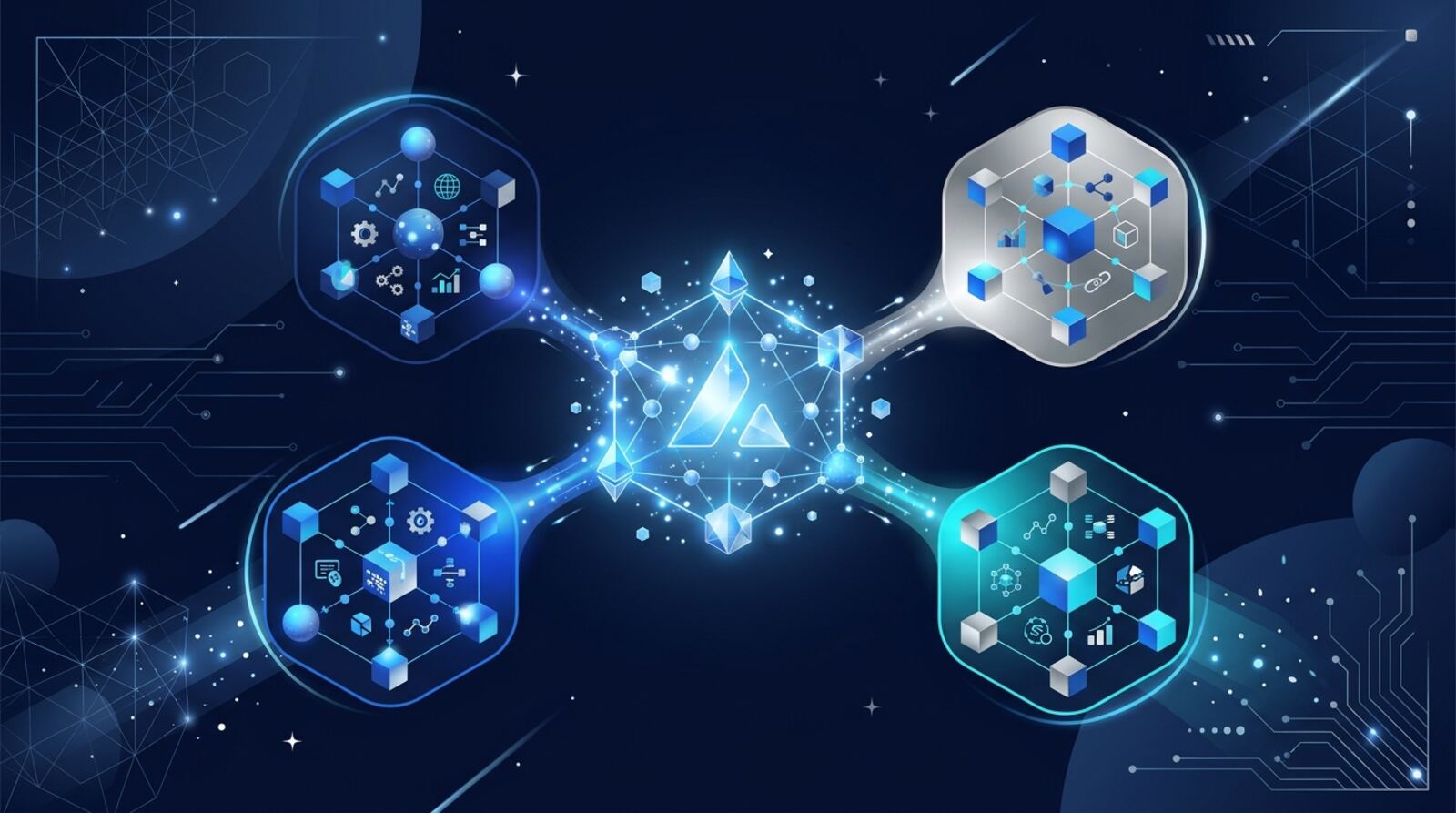
An Avalanche subnet is a group of validators that agree on the state of one or more blockchains. Each subnet can set its own rules for who may validate, which token pays transaction fees, how the chain is configured and which virtual machine runs smart contracts. The point is that a project does not have to share one fixed set of rules with every other application on the network.
The word subnet is older terminology, and some public reporting still use it as a generic description of a custom chain built on Avalanche. Avalanche's own documentation has moved toward the term Avalanche L1 after recent protocol changes, so you will see both names. When you read any guide, check its publication date and whether it describes the current model.
A useful way to think about it is this: the Avalanche network supplies the base infrastructure and a coordination layer, while a subnet supplies a dedicated chain with its own configuration. A subnet is not a disconnected network. Its validators and users still operate within the wider Avalanche ecosystem.
Subnets are most often discussed for gaming, payments, financial applications and enterprise pilots. In these cases, predictable performance and custom rules often matter more than access to every other application on the network. Whether that trade-off makes sense depends on the specific project, so the rest of this guide looks at the mechanics and the costs.
How do subnets fit into Avalanche's architecture?
Avalanche has three built-in chains, and each has a different job.
- The X-Chain handles the creation and transfer of assets.
- The C-Chain is the contract chain that runs Ethereum Virtual Machine smart contracts.
- The P-Chain is the platform chain. It tracks validators, coordinates staking and is where subnets are created and managed.
Together, these three chains make up the Primary Network. Validators on the Primary Network participate in all three chains, which is how the base network stays coordinated.
A subnet sits alongside this structure. Its validators agree on its own blockchain, and the P-Chain keeps the records that link the subnet to its validators. Because the P-Chain handles this bookkeeping, a subnet can exist without changing the rules of the C-Chain or the rules of other subnets.
For a dApp team, the practical question is which chain the application lives on. Applications deployed to the C-Chain share its fee market and block space with everything else on that chain. Applications deployed to a subnet run on a separate block space and use the subnet's configuration. Both options are legitimate, and they have different consequences for cost, speed and user experience.
Before planning a deployment, read the current architecture pages in the official Avalanche documentation, because chain roles and validator requirements have changed over time.
Who validates a subnet, and who can join?
Validators are the operators who run the nodes that produce and check blocks. On a subnet, the set of validators determines who can secure the chain and how decisions are made. The subnet's owner or design decides how that set is formed.
Some subnets are permissioned, meaning the owner approves who may validate. Others are designed to be more open, where anyone who meets the stated requirements can join. Each model has trade-offs. A permissioned validator set can be easier to coordinate and to comply with business rules, but it asks users to trust a smaller group. A more open set can be harder to coordinate but spreads trust more widely.
Validator requirements also change over time. Historically, validators on the Primary Network needed to stake AVAX, and subnet validators had to meet additional conditions. Recent protocol changes have altered the cost and structure of running validators on subnets and L1s. Because these figures move with network upgrades, do not rely on older numbers. Confirm the current stake, fee and operational requirements in the official documentation before committing resources.
For a dApp team, validator design is a core decision. Choosing very few validators may make the chain fast to coordinate but weaken its resilience. Choosing many validators may improve decentralization but raise the cost of operating the network. Write down who runs validators, how they are selected and what happens if one of them goes offline. Those answers affect how much users can trust the chain.
Why do dApp teams choose a subnet?
The reasons a dApp team might choose a subnet are mostly about control over the environment the application runs in.
- Fee design: a subnet can use its own gas token or fee arrangement, which can make costs more predictable for the application's users.
- Throughput isolation: activity from other applications on a shared chain will not compete for the same block space.
- Custom configuration: the Subnet-EVM template and other virtual machine options allow adjustments that a shared chain may not allow.
- Compliance and access controls: some projects need allowlists, identity checks or restricted participation. A subnet can be configured to support those requirements, although the legal obligations remain with the project.
- Upgrade control: the team can plan upgrades on its own timeline, rather than waiting for changes that affect a larger network.
These advantages are real, but they are not automatic. A subnet is only as useful as the users, liquidity and tooling it attracts. A well-designed application on a busy shared chain may outperform a subnet with few users and thin liquidity.
The honest test is whether the application's problems are caused by the shared environment. If the main issue is congestion, unpredictable fees or a need for custom rules, a subnet may help. If the main issue is getting users, a subnet will not solve it on its own. Successful applications usually pair infrastructure choices with product, security and distribution work.
What are the costs and trade-offs?
Running a subnet carries costs that are easy to underestimate. The most common ones fall into four groups.
First, operations. Someone must run validators, monitor them, apply upgrades and respond to outages. If the validator set is small, a single failure can affect the whole chain.
Second, liquidity. A new chain starts with few assets and few trading pairs. Decentralized exchanges, lending markets and oracles all need deployment and integration on the subnet before users can get value from them. Protocols such as Uniswap V3 or Aave V3 are deployed across many chains, but you must confirm which of their deployments exist on your subnet and whether their liquidity is meaningful there.
Third, fragmentation. Users and assets spread across chains can make an ecosystem harder to navigate. Each separate chain may have its own wallets, explorers and bridges to maintain.
Fourth, developer tooling. Indexers, node providers and analytics services must support the chain. If a tool lacks support, the team may need to build it. Services that cover many chains can help, but support needs to be confirmed chain by chain.
None of these costs make subnets a bad idea. They do mean that a subnet should come with a plan for each one. A team that expects to spend most of its effort on product and users will find the operational load heavier than expected. Budget for it before launch, not after.
How do subnets affect liquidity, bridging and user experience?
Users rarely care which chain an application runs on. They care whether it works, whether fees are clear and whether their assets are safe. A subnet affects all three.
For assets, the first challenge is getting value onto the subnet. Users usually need a bridge, and bridges are a common point of failure in crypto. Use only the bridge that the chain's official documentation names, verify contract addresses from official sources, and send a small test transfer first. Cross-chain messaging protocols such as LayerZero V2 and token bridges such as Across operate across many chains, but support for a specific subnet has to be confirmed.
For data, applications need indexers to show balances, history and events. Indexing services such as Envio cover many chains, yet a team should verify that support exists for its subnet and check how fresh the data is.
For prices, lending and derivatives protocols rely on oracles. Pyth Network is one example of a price oracle that serves many blockchain applications. Before relying on any oracle, confirm that it publishes feeds on your chain and understand how stale data is handled.
For wallets, make sure users can add the chain safely, with the correct chain ID and official RPC endpoint. Publish those details on your own official channels and warn users about lookalike sites that copy them.
A smooth user experience on a subnet depends on these pieces working together. If any one is missing, users may leave even when the application itself is well built.
How can a team tell if a subnet fits its dApp?
Use this sequence to test whether a subnet is the right choice for a specific application.
- Write down the main problem you are trying to solve, such as congestion, fee predictability, custom rules or isolation from other apps.
- Check whether a shared chain or an existing layer-2 network can solve the same problem at lower operational cost.
- List the users you need on day one and where they currently hold their assets.
- Estimate the bridging steps those users would need to take, and whether they would accept them.
- Confirm which protocols, oracles, indexers and wallets support your target chain today, using official pages rather than memory or social posts.
- Plan the validator set: how many validators, who runs them, how they are added and removed, and how an outage is handled.
- Budget for maintenance, including upgrades, monitoring, incident response and documentation.
- Launch on a test network first, run the full user journey, and record every point where a user could get stuck.
If you cannot answer steps 3 and 5 clearly, a subnet is probably too early for your project. Launching on a shared chain and moving later is a common path, and it avoids building infrastructure before there is demand for it.
Keep the answers in writing and revisit them after each protocol upgrade, since costs and supported features can change.
What security checks should you run before using or building on a subnet?
Security on a subnet involves the chain itself, the applications built on it and the way users interact with both. Practical defensive habits matter at each level.
For the chain, check the validator set, its size and its operators. Look for the official documentation of the chain's configuration, and confirm that its genesis details and validator information are published by the team that runs it. A chain run by one operator carries different risks from one with a broad, independent validator set.
For applications, look for independent audit reports and check whether the audited code matches what is deployed. Review admin keys and upgrade powers. Where a team can change contracts, confirm that changes require multiple approvers, timelocks or published notice.
For users, the most common losses come from fake sites, phishing messages and malicious token approvals. Bookmark official addresses, never enter a seed phrase on a website or in a message, and review token approvals regularly with a reputable tool. Be cautious about any link that asks you to switch networks or add an unfamiliar RPC endpoint.
For teams, maintain a public incident process, a security contact and a tested recovery plan. Publish known limits and risks honestly. A subnet adds surface area compared with a single shared chain, so the security budget should grow with it.
Where should you check current subnet facts?
Avalanche subnet details change as the protocol evolves, so this guide deliberately avoids fixed figures for fees, validator stakes, token prices or total value locked. Those numbers can be out of date within weeks.
To check current facts, use these sources in order.
- The official Avalanche documentation, for architecture, validator requirements and subnet or L1 creation steps.
- The protocol's own deployment page, for a list of chains where it is live and any notes on limits or pauses.
- A block explorer for the chain you plan to use, to confirm validator activity and transaction history.
- A data aggregator such as DefiLlama for total value locked and activity by chain. Read the methodology notes, because definitions differ.
- Official announcements from the chain's operators and the protocols you plan to use.
When two sources disagree, prefer the primary source, which is usually the protocol's documentation or on-chain data. Treat social posts and forum threads as leads to verify, not as facts.
As a habit, record the date you checked each figure and set a reminder to recheck it before any launch, deposit or integration decision. This keeps your decisions tied to the current state of the network rather than to an older article, including this one.
Frequently asked questions
Is an Avalanche subnet the same as an Avalanche L1?
A subnet is a group of validators that run one or more blockchains with their own configuration, such as who may validate, which token pays fees and which virtual machine runs smart contracts. Avalanche's documentation has moved toward the term Avalanche L1 after recent protocol changes, so you will see both names in older and newer material. The underlying idea is the same: a dedicated chain that still connects to the wider Avalanche network.
Does every dApp need its own subnet to succeed?
Not necessarily. A subnet suits a dApp that needs its own fee economics, predictable throughput, custom rules or an isolated environment for a specific user group. Many dApps do well on established chains where liquidity, users and tooling already exist. Compare the costs of running your own validator set and bridging users against the benefit of control before deciding.
Can I use Solidity on an Avalanche subnet?
Subnet-EVM is a virtual machine template that lets a subnet run Ethereum Virtual Machine smart contracts, so Solidity code and common EVM developer tools can often be reused. Support depends on the chain configuration and on the tools you choose, so test deployments on a test network first and confirm current compatibility in the official documentation.
Where should I check current subnet rules, fees and activity?
Start with the official Avalanche documentation for current validator, fee and creation rules, then read the security and status pages of any protocol you plan to use. For market data such as total value locked or activity by chain, use an aggregator like DefiLlama and treat its figures as changing over time. Check the chain ID and RPC endpoints against official sources before connecting a wallet.
Can users move assets between a subnet and the Avalanche C-Chain?
Yes, but the move usually depends on a bridge, and bridges carry their own risks. Use the bridge the chain's official documentation names, confirm the contract addresses from official sources, send a small test amount first, and keep in mind that bridges have been a frequent target for attackers. Some cross-chain protocols, such as LayerZero V2 and Across, support many chains, but you should confirm support for your specific subnet before relying on them.
Mentioned in this guide
dApps in this guide
DefiLlama is a data site that aggregates total value locked, trading volume and fees for DeFi protocols across many chains.
Envio is a blockchain indexing and data platform offering HyperIndex APIs and fast HyperSync raw data access for developers across 81+ chains.
LayerZero V2 is a cross-chain messaging protocol and bridge infrastructure for developers and asset issuers, connecting dozens of blockchains.
Across is an intent-based cross-chain bridge and swap protocol for moving tokens between Ethereum, rollups and other chains, with an API for apps.
Aave V3 is a non-custodial DeFi lending protocol on 21 chains where users earn interest on deposits or borrow against collateral.
Uniswap V3 is a non-custodial decentralized exchange protocol for token swaps and concentrated liquidity provision across 40+ chains.
Pyth Network is a first-party price oracle and market data provider for blockchain apps, trading venues and institutions, with its own PYTH token.
Aave is an Ethereum-based crypto lending protocol for supplying assets and borrowing against collateral.
Uniswap is a self-custody decentralized exchange protocol for swapping tokens through liquidity pools across multiple networks.
Keep reading
Related guides
Blockchain · Explainer
Horizen and Layer 0 Blockchains: What They Are and Why They Matter
Layer 0 blockchains are the base infrastructure that lets separate chains be built, secured and connected. This explainer covers what that means, how Horizen fits into the picture, and what to check before you rely on any project in this area.
Blockchain · Explainer
Harmony and the Multichain Future: What It Means for Users in 2026
Harmony is a Layer 1 blockchain that has pointed its strategy toward working across several networks rather than sitting on one chain alone. This guide explains what a multichain future means, how cross-chain assets move, where the risks sit, and how to check Harmony's current position yourself.
Blockchain · Explainer
Lisk Grant Program on the OP Superchain: 2026 Guide
Lisk was an early Ethereum-linked blockchain that later joined the OP Stack and the Optimism Superchain, backing developers with accelerator support and funding. Public reporting also report that Lisk plans to shut down its blockchain on October 31, 2026, which changes what grant recipients and LSK holders should do now.
Blockchain · Explainer
What Is a zkEVM? A Plain Guide to Zero-Knowledge EVMs (2026)
A zkEVM is a zero-knowledge proof system that can prove a program ran correctly on the Ethereum Virtual Machine, letting a network process transactions off the main chain and post a short proof back. This guide explains what that means, how it works, and what to check before relying on one.
Blockchain · Explainer
Bahamut Chain Update Explained: What Changes for Users in 2026
A chain update can change fees, tooling, validator rules and bridge routes. This guide explains how to read a Bahamut update, verify it from official sources and check what it means before you move funds.
Blockchain · Chain guide
How to Attract More DeFi Users to Tezos in 2026
Tezos has a smaller DeFi footprint than many chains, and new users often struggle to find apps. This guide covers the levers that can change that, what recent reporting shows, and how users and builders can track progress themselves.
Blockchain · Chain guide
Base Blockchain Guide: How Coinbase's Layer 2 Works in 2026
Base is Coinbase's Ethereum layer-2 network, built on the OP Stack and known for low fees and native USDC. This guide covers how it works, how to get funds onto it, and what to check before you use it.
Blockchain · Chain guide
Astar zkEVM Guide: Polygon CDK Layer 2 Explained
Astar zkEVM was an Ethereum layer-2 network built by the Astar team with Polygon's Chain Development Kit. This guide explains how it works, how it differs from Astar Network on Polkadot, how to use it safely and what to verify before you move funds.