Real-world asset · Explainer
What Is Asset Tokenization? How It Works and Its Risks
Asset tokenization represents rights to assets as digital tokens, often on a blockchain. Learn how the process works, what tokens do—and do not—own, and which legal, technical, and financial risks matter.
By the DappsAtlas editorial team · Updated
What is asset tokenization?
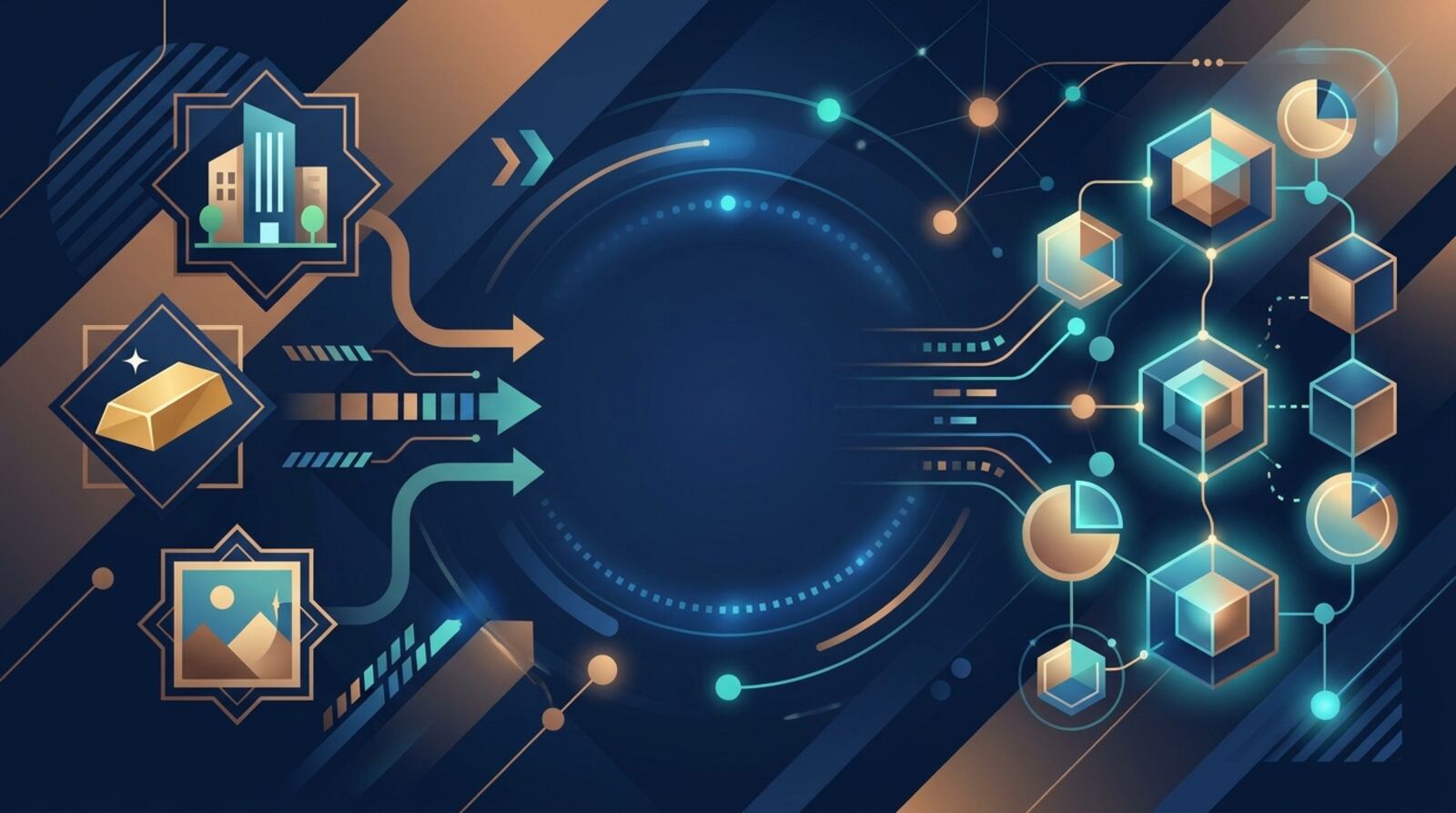
Asset tokenization is the creation of digital tokens that represent an asset or rights connected to it. The token is recorded on a blockchain, where a network can track its issuance, balances, and transfers. The asset itself might be a financial product, such as a bond or fund interest, or something tangible, such as property or a precious metal.
The key distinction is between the token and the thing it represents. A token does not automatically make its holder the direct legal owner of a building, bond, or share. It may instead represent a claim against an issuer, a share in a legal entity that owns the asset, or a right to receive payments. The governing documents and applicable law define those rights.
Tokenization is sometimes grouped under the term real-world assets, or RWAs. In crypto, that label usually refers to blockchain tokens connected to off-chain assets or financial activity. The label describes a broad category, not a guarantee of backing, liquidity, safety, or regulatory approval. To understand any product, ask what the token represents, who is responsible for the underlying asset, and how a holder can enforce their rights.
How does asset tokenization work?
A tokenized asset usually involves several parts working together. First, an issuer identifies the asset or pool of assets and establishes a legal structure. That might be a fund, company, trust, or contractual arrangement. The structure determines who owns the asset and what claim token holders have. An administrator or custodian may hold records, cash, securities, or physical property.
Next, a token is created on a blockchain. A smart contract sets rules for issuing and transferring tokens. It may restrict transfers to approved wallets, enforce supply limits, or support administrative actions such as freezing tokens. The issuer or its service providers connect off-chain information—such as subscription records, asset balances, or income—to the token system.
When an eligible buyer invests, they may pay through a bank transfer, a stablecoin, or another approved method. After required checks, the issuer or platform issues tokens to the buyer’s wallet. If the product pays income, that payment may be distributed separately, reflected in a token’s value, or handled through another mechanism. The details vary.
A blockchain can make the token record visible and programmable, but it does not independently confirm that the off-chain asset exists or is correctly managed. That depends on legal agreements, custodians, administrators, audits or other reporting, and the reliability of the processes linking the asset to the token.
Which assets can be tokenized?
Tokenized financial products are among the clearest examples of asset tokenization. A fund can issue blockchain tokens that represent an interest in its portfolio, subject to the fund’s legal terms and eligibility rules. Some funds invest in government debt or cash-like instruments; others may represent private credit, corporate debt, or different securities. The token is not necessarily the same as a freely transferable public-market share.
Real estate can also be tokenized. A common structure is to place a property inside a company or other legal entity, then issue tokens tied to an interest in that entity or its proceeds. This does not mean a token holder automatically appears on the property deed. Maintenance costs, tenant risk, valuation methods, voting arrangements, and sale decisions remain important.
Other possible examples include precious metals, invoices, intellectual property rights, and commodities. For each, the product must explain how the asset is held, how income or sale proceeds reach token holders, and how disputes are handled.
Two examples in the market are BlackRock BUIDL, a tokenized U.S. Treasury-backed fund issued via Securitize for eligible, mostly institutional investors, and Spiko, a French-regulated platform offering tokenized Treasury-bill money market funds and multi-currency cash accounts. Their structures and access rules differ. Neither example means all tokenized funds have the same terms or protections.
What benefits can tokenization offer?
Tokenization can change how asset ownership records are issued and managed. A blockchain-based register can make balances and transfers easier to reconcile among participants, especially when several parties currently maintain separate records. Smart contracts can automate some tasks, such as checking whether a wallet is approved, applying transfer restrictions, or recording distributions.
Tokens can also be divided into smaller units than the underlying asset. That may lower the minimum amount needed to participate in a product, although issuers can still set high minimums or eligibility requirements. Digital issuance may reduce some administrative steps and make it possible to integrate assets with digital settlement systems.
Another potential benefit is programmability. A token can be designed to interact with wallets and, where permitted, other software. Some tokenized products may be usable in on-chain applications, while others deliberately restrict transfers to approved users. Technical compatibility does not guarantee permission to use a token in any particular service.
These are potential efficiencies, not automatic outcomes. Tokenization does not create buyers, ensure continuous trading, or remove intermediaries. A product can still depend on custodians, transfer agents, fund administrators, banks, or legal entities. Compare the actual operating model and costs with the traditional alternative rather than assuming that a blockchain version is faster, cheaper, or more accessible.
What are the main risks?
The first risk is misunderstanding the legal claim. A token may represent a security, a fund interest, a contractual promise, or a right in an entity rather than direct ownership of the underlying asset. If the issuer becomes insolvent or a service provider fails, the outcome depends on the product’s legal structure, the jurisdiction, and how assets were segregated. A token balance alone does not settle those questions.
There are also asset and market risks. The underlying investment can lose value, and its price may be hard to establish. A token can have limited buyers, restricted transfers, or no dependable secondary market. Redemption may only be available at set times, subject to conditions, or not available at all. Claims that a token is “liquid” should be checked against actual exit terms.
Operational risks include mistakes in asset records, weak custody arrangements, cyberattacks, compromised administrator accounts, and failures in the systems that connect off-chain assets to blockchain records. Smart contracts can contain bugs. Blockchain transactions may be irreversible, while the issuer’s ability to correct, freeze, or reissue tokens may be governed by specific rules.
Finally, regulation can differ by product and country. Investor protections, tax treatment, and the right to transfer a token may vary. A tokenized format does not remove these risks or make a product suitable for every investor.
How can you assess a tokenized asset?
Start with the legal documents, not the token’s marketing description. Find the offering terms, fund documents, or other agreement that explains exactly what a holder owns or is owed. Identify the issuer, the legal entity holding the asset, the custodian, the administrator, and any party responsible for distributions or redemptions. Check what happens if one of those parties fails.
Then review the asset itself. Ask how it is valued, what supports the stated backing, whether holdings are reported independently, and how often records are updated. For a fund, read its investment policy, fees, liquidity terms, and eligibility restrictions. For a physical asset, check storage, insurance, inspection, and the process for selling or delivering it.
Confirm the token’s operating rules. Which blockchain and contract are used? Can tokens be transferred to any wallet, or only approved addresses? Who can pause transfers, freeze tokens, or change the contract? Check the exact contract address through the issuer’s official channels; similarly named tokens can be unrelated or fraudulent.
Finally, consider your own ability to access and exit the investment. Understand wallet responsibilities, payment methods, tax questions, and local rules. Do not assume that a visible on-chain balance can be redeemed on demand or sold at a fair price. If key terms, reports, or fees are missing, treat that uncertainty as a material risk.
Where do tokenized assets live and trade?
A token can be issued on a public blockchain, where transactions are generally visible and anyone may be able to interact with the network, or on a permissioned network with restricted participation. Even on a public chain, the asset product may be permissioned: the issuer can limit who may hold or transfer its tokens. The network’s openness and the investment’s availability are separate questions.
To receive a token, a user typically needs a compatible wallet and must follow the issuer’s onboarding process. For regulated products, that process may include identity, residency, investor-status, or other eligibility checks. Some products distribute tokens only after an application is approved and payment clears. A wallet address on its own does not establish a right to participate.
Trading and use also depend on the terms. A token may be transferable only between whitelisted wallets, through an approved venue, or under conditions set by the issuer. It may not appear on a public decentralized exchange. Even if a token can technically be sent to another wallet, transferring it in violation of restrictions may create legal or contractual problems.
If a token is eligible for a compatible DeFi application, that adds another layer of risk and rules. For example, Aave V3 is a lending protocol and Uniswap V4 is a decentralized exchange protocol; neither fact means a specific tokenized asset is supported, liquid, or appropriate to use there. Verify support and issuer permissions before interacting.
How do holders get their money back?
When a tokenized asset matures, is sold, or is redeemed, the issuer’s legal and operational process determines what happens. A fund might return proceeds to eligible holders after selling assets, or make redemptions available under stated conditions. A property-linked product might distribute sale proceeds only after an entity sells the property and pays its expenses and obligations. These processes can take time and may involve fees, checks, or minimum amounts.
The token may be burned or transferred back to the issuer as part of redemption. In another design, the token may remain in circulation while the holder receives a payment. Income can be paid in conventional currency, stablecoins, or another form, depending on the product. Do not infer a redemption promise from a token’s name, price, or apparent backing; locate the written terms.
Some tokenized assets have no routine redemption mechanism. Holders may need to find a permitted buyer, and the token could trade at a discount or be difficult to sell. An on-chain market, if one exists, does not ensure that a compliant buyer is available or that trading will continue.
Before buying, find the product’s exit route and test your understanding of it: who must approve a redemption, when can it be requested, what can delay it, and what amount might be returned? If the documents do not clearly answer those questions, do not assume you can get your money back on demand.
What should you remember about asset tokenization?
Asset tokenization is best understood as a change in how a claim is represented and managed, not as a shortcut that turns every asset into a simple crypto token. A blockchain can provide a shared record and support automated rules, but the real substance remains in the underlying asset, the legal structure, and the people or organizations responsible for it.
For readers exploring the category, separate three questions. What asset or portfolio stands behind the product? What enforceable rights does the token give its holder? And what practical route exists to transfer, redeem, or otherwise realize those rights? A positive answer to only one question is not enough. Strong technical design cannot fix unclear legal terms, and formal rights may be hard to use if there is no functioning redemption or transfer process.
The market includes products with very different access conditions. BlackRock BUIDL is aimed at eligible, mostly institutional investors, while Spiko offers regulated fund and cash-account products. Each requires its own review; neither should be treated as representative of all tokenized assets. Rules and availability can also change, so check current issuer documentation and local requirements before acting.
The most useful measure of a tokenized product is not whether it uses a blockchain, but whether its rights, assets, costs, safeguards, and exit terms are clear enough for you to evaluate. If they are not, that lack of clarity is itself a reason to pause.
Frequently asked questions
Does an asset token give me legal ownership of the asset?
Not necessarily. A token may represent legal ownership, a beneficial interest in a fund, a debt claim, or only a contractual right. The issuer’s documents and the laws that apply determine what a holder can claim.
Can I trade an asset token freely?
Some tokens can be transferred between compatible blockchain wallets, but transferability may be limited by issuer rules, investor eligibility, or local law. A token can also be difficult to sell if there is no active, compliant market.
Does blockchain guarantee that a token is backed by an asset?
No. A blockchain can record token balances and transfers, but it does not by itself verify that an off-chain asset exists, is properly valued, or is held for token holders. Those questions depend on the issuer, custodians, legal structure, and oversight.
Is asset tokenization safer than traditional investing?
Tokenization can make certain assets easier to divide, transfer, or administer, but it does not remove investment risk. The asset can lose value, the issuer can fail, and legal, custody, liquidity, or technology problems can affect your ability to recover funds.
What should I check before buying a tokenized asset?
Start with the issuer’s offering and legal documents, then identify the rights attached to the token, who holds the underlying asset, and what happens if a party fails. Check eligibility, fees, transfer limits, redemption terms, independent reporting, and the exact blockchain contract before committing funds.
Mentioned in this guide
dApps in this guide
Spiko is a French-regulated platform offering T-bill money market funds and multi-currency cash accounts with daily yield for companies and individuals.
BlackRock BUIDL is a tokenized U.S. Treasury-backed fund issued via Securitize, paying daily dividends to eligible, mostly institutional investors.
Aave V3 is a non-custodial DeFi lending protocol on 21 chains where users earn interest on deposits or borrow against collateral.
Uniswap V4 is the latest Uniswap DEX version with hooks and concentrated liquidity, running on 22 chains for self-custody token swaps and liquidity provision.
Aave is an Ethereum-based crypto lending protocol for supplying assets and borrowing against collateral.
Uniswap is a self-custody decentralized exchange protocol for swapping tokens through liquidity pools across multiple networks.
Keep reading
Related guides
Real-world asset · Explainer
Champ Association Explained: Champagne, RWA, AI and Crypto
Champ Association appears in the sources we checked only as a name, with no public detail on its products, owners or activity. This guide explains how champagne, real-world asset tokenization, AI and crypto can connect in general, and how to check any project that claims a link between them.
dApp basics · Best list
Blockchain Companies to Know in 2026
Blockchain companies span exchanges, payment networks, software tools, analytics, custody and tokenized finance. This guide profiles major names, explains what each does, and gives you a practical way to compare their roles and risks.
Token · Explainer
Types of Cryptocurrency: Coins, Tokens, Stablecoins and More
Cryptocurrencies include native blockchain coins, smart-contract tokens, stablecoins, governance assets, meme coins and more. Learn how these categories differ, where they overlap, and what to check before using or buying an asset.
dApp basics · Explainer
Types of Cryptocurrency Platforms: A 2026 Guide
Crypto platforms range from custodial exchanges to self-custody wallets and on-chain finance apps. Learn what each type does, how they differ and what to check before using one.
Real-world asset · Review
Zone 9 Rental Housing Ownership and Earnings: What to Check in 2026
Zone 9 pitches tokenized rental housing with ownership and earnings. This guide explains how these models are meant to work, which claims to verify, and the risks to weigh before committing money.
Real-world asset · Explainer
Courtyard Explained: Tokenized Collectibles Backed by Real Assets
Courtyard turns graded trading cards and other physical collectibles into tokens, with the originals held in an insured vault. This guide explains how it works, what the token represents and which risks to weigh before buying.
Real-world asset · Explainer
What Does Tokenized Mean in Crypto? A 2026 Guide
In crypto, “tokenized” usually means that an asset or a right to an asset is represented by a blockchain token. Learn what that token represents, how it differs from ordinary crypto, and what to check before using one.
Real-world asset · Explainer
Real-World Asset Tokenization: A 2026 Guide
Real-world asset tokenization puts claims on off-chain assets such as government bills, private credit and real estate onto a blockchain. This guide explains how the structures work, what rights a token may or may not give you, and what to check before you hold one.