Real-world asset · Explainer
What Does Tokenized Mean in Crypto? A 2026 Guide
In crypto, “tokenized” usually means that an asset or a right to an asset is represented by a blockchain token. Learn what that token represents, how it differs from ordinary crypto, and what to check before using one.
By the DappsAtlas editorial team · Updated
What does tokenized mean in crypto?
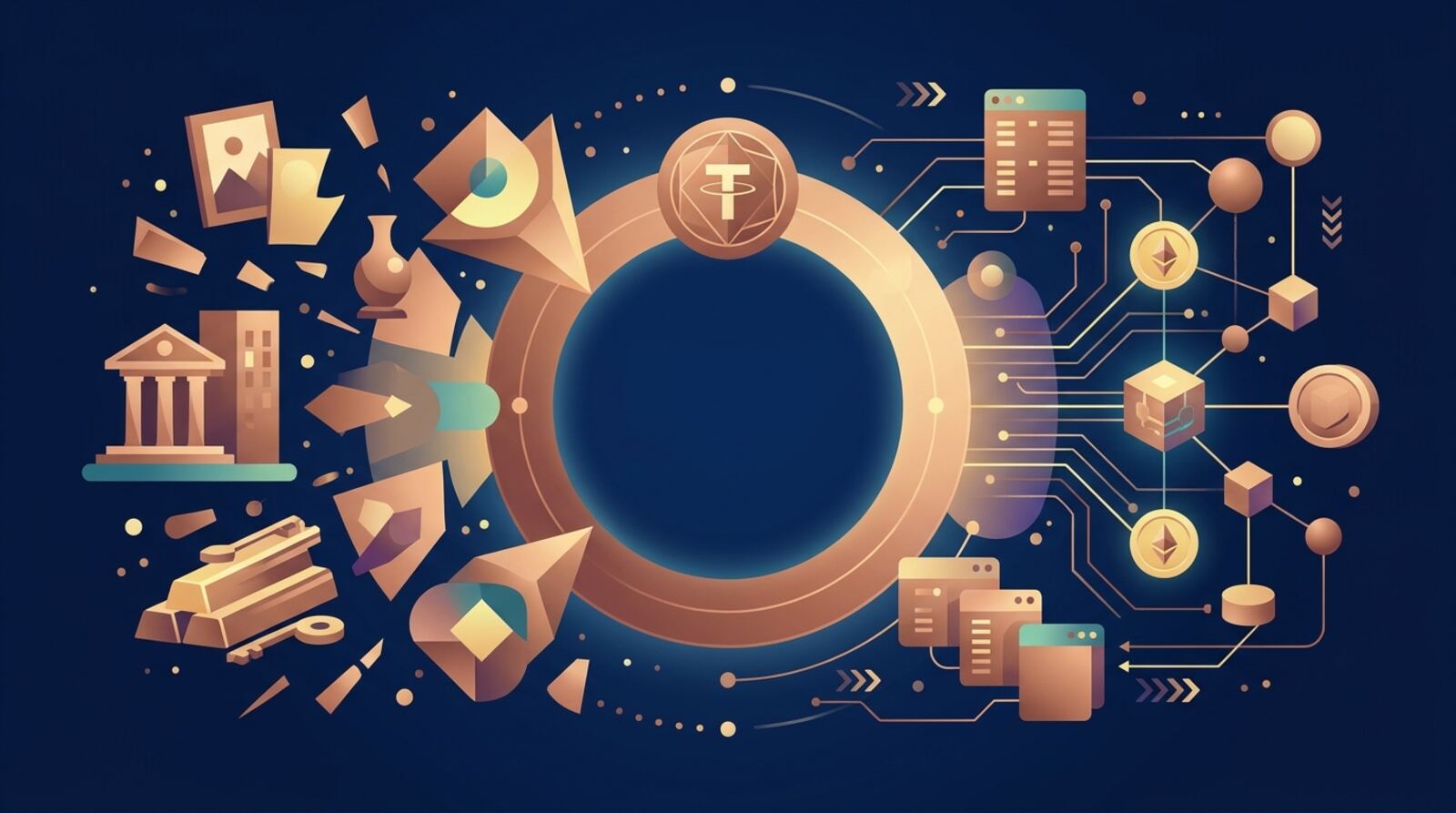
In crypto, tokenized usually means that something is represented by a digital token recorded on a blockchain. That “something” might be a financial asset, a physical item, a right to receive payments, or simply a unit of value created for use in an application. The token can generally be held and transferred using blockchain addresses, subject to the rules of its network and issuer.
The word is used in two related ways:
- A token represents an asset or a right. For example, a token might represent an interest in a fund or a claim linked to a real-world asset.
- An asset or value is issued as a blockchain token. This often means its ownership records or transfer process use a blockchain, rather than only conventional databases.
The label does not tell you exactly what you own. One token may give its holder a legally enforceable claim; another may only track a price or enable access to a service. The rights depend on the issuer, legal structure and terms, not on the word “tokenized” by itself.
A quick way to assess the term is to ask: What does the token represent, who is responsible for that representation, and what can a holder legally do with it?
How does asset tokenization work?
Tokenizing an asset involves more than creating a token contract. The issuer or service provider first decides what the token is meant to represent and arranges how the underlying asset, records and holder rights will work. If the asset is outside the blockchain—such as a government security or a fund—the relevant assets and records still need to be managed through conventional institutions and legal arrangements.
A typical process may involve:
- Define the rights. Set out whether a token represents ownership, a fund interest, a payment claim, redemption rights or something else.
- Hold or administer the asset. A custodian, fund manager, trustee or other entity may be responsible for the underlying asset and its records.
- Issue tokens. A smart contract creates tokens and records balances on a chosen blockchain.
- Apply transfer rules. The issuer may permit open transfers or restrict holders and transactions, for example through identity checks or approved wallets.
- Handle payments and redemptions. Processes outside the blockchain may be needed to pay income, update records or exchange tokens for cash or another asset.
A blockchain can record token transfers, but it cannot by itself ensure that the issuer holds the asset or honours a claim. Those obligations depend on the project’s legal structure, operations and enforcement arrangements.
Does a tokenized asset mean you own the asset?
A token’s technical record and its legal meaning are separate questions. The blockchain can show that a particular address holds a certain number of tokens. It does not automatically establish that the address holder owns a house, a share of a fund or a claim against an issuer under local law.
A tokenized product might give holders one of several different things:
- A legal interest in a fund or other entity, subject to its governing documents.
- A claim against an issuer that promises to pay or redeem under stated conditions.
- A digital representation of an asset held by a custodian, with redemption rules defined by the product.
- Price exposure to an asset without direct ownership of it.
These arrangements can have different protections if an issuer fails, a custodian loses assets or a dispute arises. A token’s transfer to another wallet may not automatically transfer legal rights unless the product’s documentation and applicable law recognise that transfer. Some products also require a holder to complete identity checks or register through an approved service.
Before treating a token as ownership, read the terms to identify the issuer, the asset-holding arrangement, the holder’s rights, the redemption process and any limits on transfer. If those details are unclear or unavailable, do not assume the token grants a direct claim to the underlying asset.
How is a tokenized asset different from crypto or a wrapped token?
“Tokenized” is not the same as “native crypto.” Bitcoin, for example, is created and transferred on its own blockchain. A tokenized real-world asset, by contrast, is commonly a blockchain representation of something that exists or is managed off-chain. Its value and rights may depend on an issuer, custodian, fund documents or other arrangements outside the network.
It is also useful to distinguish tokenized assets from wrapped tokens. A wrapped token generally represents an asset held or locked in another system so that a corresponding token can be used on a different blockchain. The holder depends on the wrapping mechanism and the entity or smart contracts that issue and redeem it. A tokenized asset may instead represent a legal interest, a payment claim or another defined right.
There is also a separate use of the word in data security. Payment-card tokenization replaces a sensitive card number with a substitute identifier. That can help protect card details, but it does not mean the card or a financial asset has been issued as a blockchain token.
| Term | Typical meaning | What to check |
|---|---|---|
| Native crypto | Asset operating on its own blockchain | Network and custody risks |
| Tokenized asset | Token representing an asset or related rights | Legal claim and issuer |
| Wrapped token | Token linked to an asset held elsewhere | Backing and redemption |
| Payment tokenization | Substitute for sensitive data | Who can map it back to the data |
Context matters: the same word can describe different systems.
What kinds of things can be tokenized?
Tokenization can be applied to many types of assets, but the token’s label does not guarantee that it is backed, redeemable or easy to trade. Common examples include:
- Funds and government securities: a token may represent an interest in a fund that holds assets such as short-term government debt. BlackRock BUIDL is an example of a tokenized fund with eligibility restrictions; it is aimed mainly at institutional investors. Spiko offers tokenized money-market funds linked to Treasury bills and other short-term government securities, with access and terms determined by the product.
- Real estate: tokens may represent an interest in a property-owning company or fund, rather than a deed to a specific property. Rental income, voting and sale rights depend on the structure.
- Commodities: a token may be tied to a commodity held by a custodian. The holder needs to check whether the token can be redeemed for the commodity and under what conditions.
- Credit and private assets: tokens can record interests or claims related to loans or private investments. These can be difficult to value or sell.
- Digital collectibles and in-game items: a token can represent a unique item or access right, but a token does not guarantee that a game or service will continue to support it.
These categories have different risks and rules. A token associated with a familiar asset name may still be issued by a separate company and may not provide direct ownership of the asset itself. Read the specific product terms rather than relying on the category name.
What are the potential benefits of tokenization?
Putting records and transfers on a blockchain can offer practical benefits, but results depend on how the product is built. A shared ledger may let participants check balances and transfer history without relying on one database administrator. Smart contracts can also apply predetermined rules, such as controlling which wallets may receive a token or automating parts of a transfer.
Other potential benefits include:
- Faster settlement: transactions may settle on a blockchain without following the same operating hours as some traditional systems. However, cash payments, identity checks and asset administration can still create delays.
- Programmable transfers: code can apply conditions to transfers or distributions. Errors in that code can also create risk.
- Fractional amounts: an issuer may divide a product into smaller token units. This can lower the minimum amount needed to participate, but it does not necessarily make the underlying investment suitable or liquid.
- Integration with digital services: compatible tokens may be used in blockchain applications, subject to both the token’s terms and the application’s rules.
These are possible features, not automatic outcomes. A blockchain record does not ensure transparent management of off-chain assets, fair pricing or a ready market. Nor does fractionalization mean that every unit can be sold at any time. Assess the entire arrangement: the asset, legal rights, issuer, service providers, blockchain and route for buying or redeeming.
What are the risks of tokenized assets?
Tokenized assets combine risks from traditional finance, digital assets and the systems that connect them. A product can be accurately recorded on a blockchain and still fail because of a problem with its issuer, asset custodian or legal structure.
Consider these main risks:
- Issuer and custody risk: the entity responsible for the asset may fail, mismanage it or be unable to return it. Check who holds the underlying assets and how they are kept separate from company funds.
- Legal risk: a token may not provide the ownership or redemption rights you expect. Rights can also vary by jurisdiction and investor eligibility.
- Liquidity risk: there may be few buyers, no reliable secondary market, or restrictions on transfers. The quoted price may not be the price at which you can sell.
- Technology risk: smart-contract bugs, compromised keys, blockchain outages or incorrect integrations may affect transfers or access.
- Operational and redemption risk: fees, processing delays, minimum amounts or identity checks can affect deposits, income and withdrawals.
- Market risk: tokenization does not prevent the underlying asset from losing value or the issuer from changing product terms where permitted.
A token’s price staying close to the value of an underlying asset is not proof that every token can be redeemed for that value. Check how pricing is determined, who can redeem, what the process costs and what happens if the issuer or custodian cannot perform.
How should you evaluate a tokenized asset?
Before buying or using a tokenized asset, work through the product details rather than judging it by its name or blockchain. Start with the issuer’s official documentation and confirm that the product is available to you under the rules in your location. Some offerings are restricted to eligible investors, specific jurisdictions or approved intermediaries.
Use this checklist:
- Identify the issuer and responsible parties. Find out who issues the token, holds or administers the underlying asset, and handles payments or redemptions.
- Read the rights and limits. Establish what the token gives you, whether it can be transferred, and whether it represents ownership or only a claim or price exposure.
- Understand all costs. Look for purchase, transfer, management, redemption and network fees. If fees or timing are not published clearly, treat that as an information gap.
- Check liquidity and exit routes. Determine whether trading is available, who can participate, and how redemption works. Do not count on being able to sell whenever you want.
- Verify the network and token contract. Use the issuer’s official contract details and check that your wallet supports the relevant blockchain. Sending tokens to the wrong network or address can cause permanent loss.
- Protect access. Keep recovery phrases private, use secure wallets and beware of impersonators promising guaranteed returns or urgent access.
Only commit an amount you can afford to lose, and seek qualified financial or legal advice if you cannot assess the rights or risks yourself.
Can tokenized assets be traded freely?
A token can be visible in a wallet and still be unusable. The issuer might restrict transfers to approved addresses, require identity verification, or limit trading to a particular platform. In some products, only a small set of eligible investors can buy or redeem tokens. Rules can also depend on where the holder lives and what local law permits.
Even when a token can move freely on-chain, the underlying asset may not. A property, fund interest or security still relies on its legal and administrative arrangements. A transfer recorded on the blockchain may not, by itself, update all relevant off-chain records or complete a legal transfer. Product terms should explain which records count and what steps holders must follow.
A useful distinction is between technical transferability and practical or legal transferability. The first asks whether a blockchain transaction can move the token. The second asks whether the new holder is allowed to own it, whether the transfer is recognised and whether the holder can exercise the associated rights.
If you cannot identify a clear route to sell or redeem, assume that your exit may be difficult. Verify eligibility before sending funds, make sure you understand any approved-wallet requirements, and do not treat a token appearing in a wallet as proof that the issuer recognises you as a holder.
What should you remember about tokenization?
“Tokenized” describes a way of representing or handling an asset or right; it is not a guarantee of quality, safety or value. The most important question is not simply whether a product uses a blockchain, but whether its token gives you clear rights and whether the arrangements behind those rights are dependable.
When reviewing a tokenized product, be able to answer four questions:
- What is the token meant to represent? Distinguish a direct legal interest from a payment claim, price exposure or access token.
- Who must honour that representation? Identify the issuer, asset holder, administrator and any entity responsible for redemption.
- What are the conditions? Review eligibility, transfer restrictions, fees, income arrangements and redemption procedures.
- What could prevent access or value? Consider issuer failure, legal disputes, weak liquidity, smart-contract faults and problems with custody.
If those answers are missing, vague or difficult to verify, pause rather than relying on marketing language. Tokenization can change how records and transfers work, but it does not remove the need to assess the asset and the institutions behind it. A careful review of the legal documents and operational details matters at least as much as the blockchain used.
Frequently asked questions
What does tokenized mean in crypto?
A token is a digital unit recorded on a blockchain. Depending on its design, it can represent a crypto asset, a claim or right, or an asset held or managed outside the blockchain. The token alone does not prove what legal rights its holder has.
Does a tokenized asset mean I own the real asset?
Not necessarily. A tokenized asset might represent a legal ownership interest, a right to receive payments, or a claim that can be redeemed under set conditions. Check the offering documents and the legal entity responsible for the asset to see what the token actually gives you.
What is the difference between tokenized and wrapped?
A tokenized asset is a blockchain token intended to represent an asset or related rights. A wrapped token usually represents a deposit or equivalent asset held elsewhere, often so it can be used on another blockchain. Both rely on mechanisms outside the token itself, such as custodians, issuers or redemption processes.
Can anyone buy a tokenized asset?
It may be possible to trade some tokenized assets on crypto platforms, but availability depends on the issuer, blockchain, jurisdiction and the token’s transfer rules. Some products restrict buyers to eligible investors or allow transfers only through approved services. Do not assume that a token can be freely traded or redeemed.
Are tokenized assets safer than traditional assets?
No. Blockchain records can make transfers and balances easier to track, but they do not remove risks from the underlying asset, issuer, custodian, smart contract or legal structure. A token can lose value, become hard to sell or fail to provide the expected claim.
Mentioned in this guide
dApps in this guide
Spiko is a French-regulated platform offering T-bill money market funds and multi-currency cash accounts with daily yield for companies and individuals.
BlackRock BUIDL is a tokenized U.S. Treasury-backed fund issued via Securitize, paying daily dividends to eligible, mostly institutional investors.
Common is a non-custodial ZK privacy dapp on Arbitrum and Aleph Zero EVM that lets users shield funds and withdraw to a new, unlinkable wallet.
Credit is an undercollateralized peer-to-pool USDC lending protocol on World Chain for DeFi users seeking yield and willing to take credit risk.
Crypto.com is a centralized crypto exchange and app for buying, trading and spending 400+ coins, with a Visa card, staking and a separate self-custody wallet.
Native is a specialist insurance broker for crypto and emerging tech, placing Lloyd's-backed and onchain cover for teams and financial institutions.
Wrapped is an enterprise blockchain platform, listed as a cross-chain bridge, offering tokenized equities, RWAs and stablecoin transfers to businesses.
Keep reading
Related guides
Real-world asset · Best list
RWA Crypto Tokens to Know in 2026
RWA crypto tokens can represent Treasury funds, gold, credit, or governance rights—and those roles carry very different risks. Learn which examples to research, what each token actually represents, and how to check access, backing, and redemption terms.
Token · Explainer
What Are Crypto ETFs? Bitcoin, Ethereum and RWAs in 2026
Crypto ETFs let investors gain exposure to bitcoin, ether and other digital assets through a regular brokerage account. This guide explains how they work, how they connect to tokenized real world assets, and what to check before buying.
DeFi · Explainer
Position Bonds and Crypto Bonds in DeFi: How They Work in 2026
Crypto bonds are fixed-income style claims recorded on a blockchain, and they are becoming a way to bring yield-bearing debt into DeFi. This guide explains how they work, what the term Position refers to in the sources available, and how to judge any bond-style product before you commit funds.
Real-world asset · Explainer
What Is Tokenization? How Tokenized Assets Work
Asset tokenization creates digital tokens that represent rights to real-world or financial assets. Learn how the process works, what tokens do—and do not—prove, and how to assess the risks.
Real-world asset · Review
Zone 9 Rental Housing Ownership and Earnings: What to Check in 2026
Zone 9 pitches tokenized rental housing with ownership and earnings. This guide explains how these models are meant to work, which claims to verify, and the risks to weigh before committing money.
Real-world asset · Explainer
What Is Tokenized Real Estate? How It Works and Its Risks
Tokenized real estate uses blockchain tokens to represent defined rights connected to property or a property-owning entity. Learn how the legal structure, income, trading rules and risks work before considering an investment.
Real-world asset · Explainer
What Is Asset Tokenization? How It Works and Its Risks
Asset tokenization represents rights to assets as digital tokens, often on a blockchain. Learn how the process works, what tokens do—and do not—own, and which legal, technical, and financial risks matter.
Real-world asset · Explainer
What Is Tokenized Oil? Backing, Pricing and Risks
Tokenized oil puts an oil-related asset or claim on a blockchain, but the token does not automatically give you ownership of crude or a right to receive it. Learn how backing, pricing, redemption and risk differ between oil tokens.