Blockchain · Explainer
What Is the Ethereum Merge? How ETH Moved to Proof of Stake
The Merge was the September 2022 upgrade that switched Ethereum from mining to staking. This guide covers how it worked, what it changed, what it left alone and how it shaped Ethereum today.
By the DappsAtlas editorial team · Updated
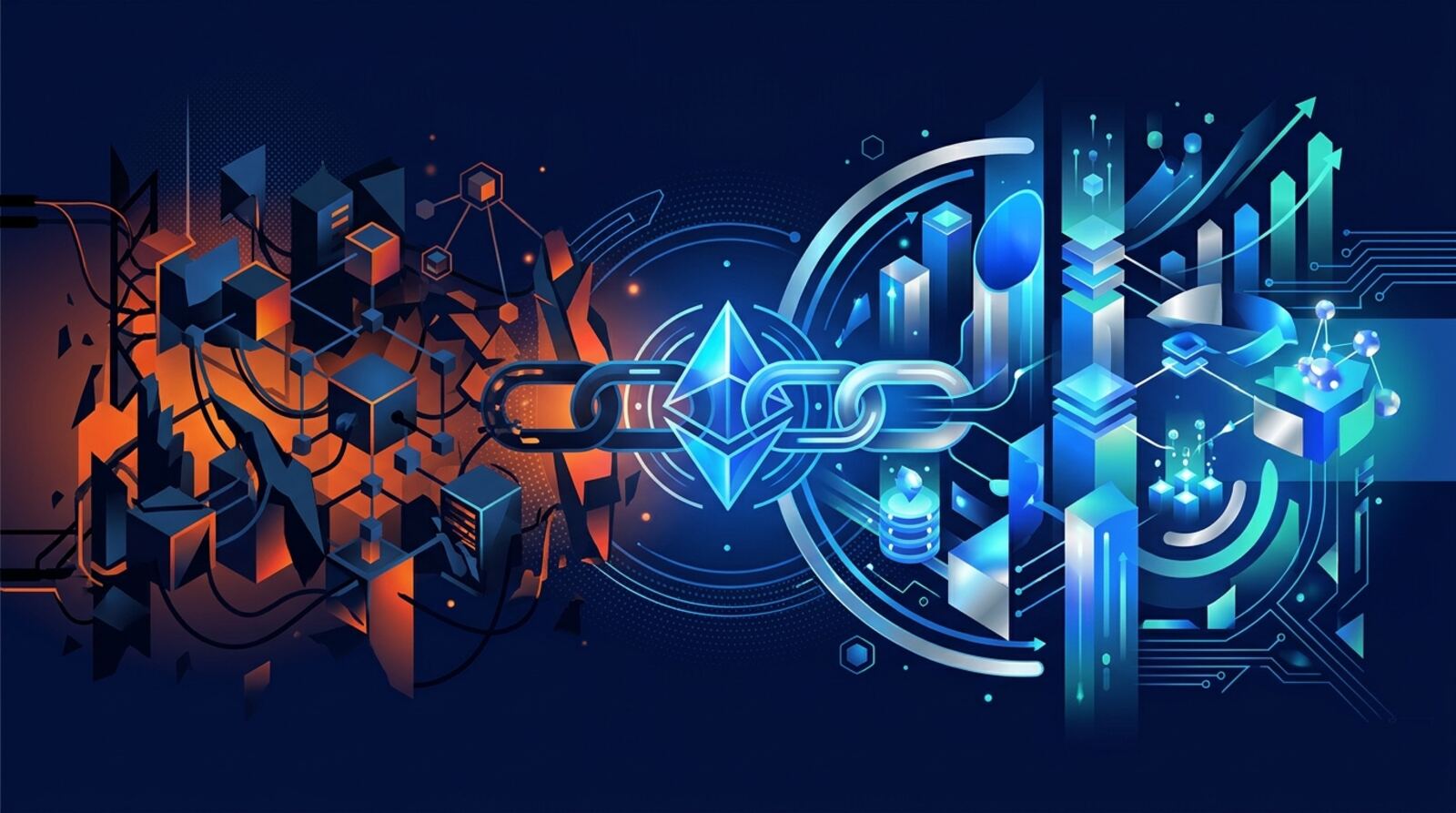
What is the Ethereum Merge?
The Ethereum Merge was the upgrade that changed how the Ethereum network reaches agreement on which transactions are valid. Before it, Ethereum used proof of work, the same mining model Bitcoin uses. After it, Ethereum used proof of stake, where validators lock up ETH as collateral and are chosen to propose and confirm blocks.
It happened on 15 September 2022. At that point Ethereum's original chain, which handled transactions, smart contracts and account balances, started taking its blocks from a separate proof-of-stake chain called the Beacon Chain. That chain had been running in parallel since December 2020 but had not been processing user transactions.
The word "merge" is literal. Two pieces that had been developed side by side were joined:
- The execution layer, which is the original Ethereum mainnet: accounts, smart contracts, the Ethereum Virtual Machine and transaction history.
- The consensus layer, which is the Beacon Chain: validators, attestations and finality.
Nothing was reset. Balances, contract addresses, token holdings and the full transaction history carried straight over, and applications built on Ethereum kept running without redeployment. ETH remained the same asset.
You will still see the Merge called the move to "Ethereum 2.0" in older coverage. That label was dropped because it suggested a brand-new chain and a new coin. In reality it was an upgrade to the existing network, and the terms execution layer and consensus layer are now the standard way to describe the two halves.
Why did Ethereum move from proof of work to proof of stake?
Ethereum launched in 2015 with proof of work, and the plan to move to proof of stake was part of its design from early on. Several motives drove the change.
Energy use. Proof-of-work mining relies on specialised hardware racing to solve puzzles, which consumes large amounts of electricity. Proof of stake replaces that race with economic collateral. The Ethereum Foundation has estimated the network's energy consumption fell by roughly 99.9% after the switch, though exact figures depend on methodology.
Lower issuance. Miners had to be paid enough to cover hardware and power costs, so Ethereum issued a lot of new ETH to reward them. Validators have much lower costs, so the network needs to pay far less. Commonly cited estimates put the reduction in new issuance at around 90%, and combined with the fee-burning mechanism introduced in 2021, net supply growth became very low and can turn negative when activity is high.
Security model. In proof of work, attacking the network requires controlling most of the mining power. In proof of stake, an attacker needs a large share of staked ETH, and misbehaviour can be punished by destroying part of that stake, a penalty called slashing. Attacks also carry a direct financial cost to the attacker.
A base for future upgrades. Proof of stake made it possible to design later scaling work, such as sharding-style data handling, around a validator set rather than miners.
The case against was mostly about risk. A change this large to a live network holding substantial value had to be done without breaking anything, which is why it was delayed several times.
How did the Merge work technically?
The Merge was not a single switch flipped on one machine. It relied on years of preparation and a design in which the two layers talk to each other.
Step 1: The Beacon Chain went live. In December 2020 the Beacon Chain launched as a standalone proof-of-stake chain. Users deposited 32 ETH per validator to take part. It tracked validators and reached consensus on its own state, but it did not process user transactions.
Step 2: Testnets rehearsed it. Developers merged several public test networks first, including Ropsten, Sepolia and Goerli, to find bugs in client software before touching the main network.
Step 3: A trigger point was set. Because there was no fixed date that the old chain could rely on, the upgrade was tied to a mining difficulty threshold called terminal total difficulty. When the proof-of-work chain reached it, mining blocks stopped being valid.
Step 4: The consensus layer took over block production. From then on, each block was proposed by a validator on the Beacon Chain and contained a payload of transactions from the execution layer.
To make this work, every node operator needed to run two pieces of software together: an execution client and a consensus client. They communicate through a local interface called the Engine API. Several independent teams build each type of client, which spreads risk, because a bug in one implementation does not take down the whole network if others are in use.
Proof of work versus proof of stake: what changed on the network?
The table below compares the two models and shows what the consensus change meant in practice.
| Feature | Before the Merge (proof of work) | After the Merge (proof of stake) |
|---|---|---|
| Who produces blocks | Miners using specialised hardware | Validators who stake ETH |
| Cost of participating | Hardware and electricity | 32 ETH per validator, plus a computer and connection |
| Block timing | Variable, around 13 seconds on average | Fixed 12-second slots |
| Finality | Probabilistic, more confirmations means more certainty | Explicit finality after checkpoints called epochs |
| New ETH issuance | High, paid to miners | Much lower, paid to validators |
| Punishment for cheating | Wasted mining work | Slashing of staked ETH |
| Energy use | Very high | Greatly reduced |
Two details are worth highlighting.
Time is now structured. Proof of stake divides time into 12-second slots, with 32 slots forming an epoch. In each slot one validator is selected to propose a block while a committee of others votes on it. Blocks therefore arrive on a regular schedule instead of at random.
Finality is stronger. Under proof of work, a transaction becomes harder to reverse as more blocks pile on top of it. Under proof of stake, the network can formally finalise a checkpoint, after which reversing it would require destroying a very large amount of staked ETH. Exchanges, bridges and other services often use finality when deciding how long to wait before crediting a deposit.
What the Merge changed, and what it did not
A common misunderstanding is that the Merge was the upgrade that fixed high fees and slow transactions. It was not.
What it changed:
- Block production moved from miners to validators.
- Energy consumption dropped sharply.
- New ETH issuance fell by a large margin.
- Block times became a steady 12 seconds.
- Finality became explicit rather than probabilistic.
- Mining hardware lost its role on Ethereum.
What it did not change:
- Gas fees. Fees depend on demand for block space and on block capacity, neither of which the Merge touched. Fees remained high during busy periods after it.
- Throughput. The amount of data each block can hold stayed about the same.
- Smart contracts and tokens. Existing ERC-20 tokens, NFTs and contracts continued to work with no changes.
- Your wallet. Addresses, keys and seed phrases were unaffected.
Scaling was handled by a separate track, built around layer-2 rollups that execute transactions off the main chain and post compressed data back to Ethereum. Later upgrades, notably proto-danksharding in March 2024, added a cheaper type of data space for rollups and pushed layer-2 costs down substantially. Anyone moving assets to a rollup such as Arbitrum can use its canonical bridge, though it is worth checking each bridge's withdrawal times and fees before sending funds.
In short, the Merge changed how Ethereum is secured and how ETH is issued. It prepared the ground for scaling work, but it did not deliver that work itself.
Energy use and ETH issuance after the Merge
Two economic effects are tied to the Merge: lower energy use and lower issuance.
Energy. Before the Merge, Ethereum's electricity demand came mainly from mining farms. After it, the network's energy needs come from ordinary computers running validator software. Estimates from the Ethereum Foundation and independent researchers point to a reduction of around 99.9%. The exact number varies by study, so treat any single figure as an approximation rather than a measured constant.
Issuance. Under proof of work, miners received newly created ETH for each block. Under proof of stake, validators receive a smaller reward, which comes from protocol issuance plus priority fees and, in some cases, MEV (extra value captured from transaction ordering). Issuance fell by about 90%, according to commonly cited estimates.
Fee burning. This is a separate mechanism, introduced in the London upgrade in 2021, which destroys part of each transaction fee. Because the Merge cut issuance, burning became more important to supply. During periods of heavy network use, more ETH can be burned than issued, making supply shrink. In quiet periods, supply grows slightly. Later changes to how rollups post data reduced the fees paid to the base layer, which affected how much ETH gets burned.
Because supply, burn and issuance move with network activity, check a live Ethereum data dashboard if you need a current figure. Any number printed in an article goes stale quickly.
What happened to staking after the Merge?
Staking is now central to Ethereum, and the Merge made it the core of network security.
Running a validator. A solo validator needs 32 ETH, a computer running both an execution and a consensus client, and a reliable internet connection. Validators earn rewards for proposing and attesting to blocks, and they can be penalised for being offline or slashed for provably dishonest behaviour such as signing conflicting blocks.
Withdrawals came later. For several months after the Merge, staked ETH and its rewards could not be withdrawn. The Shanghai and Capella upgrades in April 2023 enabled withdrawals, so validators can now exit and receive their stake, and rewards can be sent to a withdrawal address. This made staking more flexible and less one-way.
Liquid staking grew. Protocols such as Lido and Rocket Pool let users stake any amount and receive a token that represents their position, which can then be used elsewhere in DeFi. ether.fi Stake and Ankr offer similar approaches with different designs. These carry risks that solo staking does not: smart-contract bugs, depegs between the token and ETH, concentration of stake in a single provider and governance risk.
Larger validators. The Pectra upgrade in 2025 raised the maximum balance a single validator can hold, which lets large operators consolidate validators, while the 32 ETH minimum to start remained the same.
Staking yields vary with how much ETH is staked and how busy the network is, so check live figures from the protocol or a data dashboard rather than relying on a quoted rate.
What happened to ETH holders and the proof-of-work fork?
After the Merge, a group of miners and supporters created a proof-of-work fork, usually called Ethereum PoW or ETHW. It was a separate network with its own token, and it did not carry the main Ethereum community, developers or most applications. Holders of ETH at the moment of the fork were able to receive the forked token, but this was a distinct asset, not an upgrade of ETH. Its value, liquidity and activity are far below those of Ethereum, and you should treat it as an independent project with its own risks.
For ordinary ETH holders, the Merge required no action. Wallets, exchanges and custodians handled the technical switch, and nobody had to convert or swap their coins.
That fact is exactly what scammers exploit. Around upgrades, fake messages appear that offer to "migrate" or "upgrade" ETH to a new token. Defensive habits that apply here and to any later network upgrade:
- Never share a seed phrase or private key, no matter who asks or what reason they give.
- Ignore unsolicited direct messages offering migrations, claims or support.
- Do not connect your wallet to sites reached through ads, replies or links in unknown emails.
- Check the official announcements from the Ethereum Foundation and your wallet or exchange for upgrade guidance.
- Read what you sign. A transaction that asks for broad token approvals is not part of any protocol upgrade.
If you use a centralised exchange for ETH, the exchange handles protocol changes, though the terms for staking and withdrawals on each platform differ, so read them before depositing.
Where Ethereum stands after the Merge
The Merge opened the way for a series of upgrades, which the Ethereum community has described as stages in a long roadmap. The names are easier to follow when you see what each did.
- Merge (September 2022): moved consensus to proof of stake.
- Shanghai and Capella (April 2023): enabled staking withdrawals.
- Dencun (March 2024): introduced blobs through proto-danksharding, giving rollups a cheaper way to post data and lowering layer-2 fees.
- Pectra (2025): brought changes to validator balances, wallet functionality and rollup data capacity, among other items.
Further upgrades continue to be planned, and their names and timing shift as developers test them. Check the Ethereum Foundation's roadmap pages for the current list rather than relying on a fixed schedule.
What this means for apps. Most activity has moved to layer-2 networks, while Ethereum mainnet acts as the settlement layer where rollups post data and where high-value applications such as lending markets and exchanges live. Lending protocols like Aave V3, decentralised exchanges like Uniswap V4 and borrowing protocols like Liquity V2 run on the proof-of-stake chain the Merge created, and several support rollups as well.
Risks that remain. Proof of stake brings its own concerns: stake concentration among a few large providers, reliance on a limited set of client software, and the complexity of a large validator set. Developers continue to study these, and they are good reasons to read documentation before committing funds.
How to check current Ethereum data and what to do next
Because numbers about Ethereum change constantly, it helps to know where to check them instead of trusting a snapshot.
Questions and where to look:
- How much ETH is staked and how many validators exist? Use an Ethereum validator dashboard or a beacon chain explorer.
- What is current issuance and burn? Use an ETH supply dashboard that shows issuance, burn and net change over time.
- How decentralised are the clients? Use client diversity trackers, which show the share of the network on each execution and consensus client.
- What are staking yields? Check the staking protocol's own page and a neutral dashboard, and remember that liquid staking tokens have their own market price.
- Is a transaction final? Use a block explorer and look for the finalised status on the block.
A short checklist for anyone new to post-Merge Ethereum:
- Learn the difference between the execution layer and the consensus layer.
- Decide whether you want exposure to ETH only, or also want staking.
- If staking, compare solo staking, liquid staking and exchange staking by custody, fees, withdrawal terms and smart-contract risk.
- Use a hardware wallet for larger holdings and keep seed phrases offline.
- Check the current gas and layer-2 costs before moving funds.
This guide is educational and not financial advice. Staking and DeFi carry risk, including loss of funds, and you should confirm the rules where you live before using any financial product.
Frequently asked questions
When did the Ethereum Merge happen?
The Merge was completed on 15 September 2022. On that date Ethereum's original execution layer began taking its blocks from the proof-of-stake Beacon Chain, and mining stopped securing the network.
Did the Merge make Ethereum cheaper or faster?
No. The Merge did not change gas fees or transaction throughput in any meaningful way, because it replaced the consensus mechanism and left block capacity alone. Later upgrades such as proto-danksharding and the growth of layer-2 rollups are what lowered the cost of using Ethereum.
Did ETH holders have to do anything?
No. Holders did not need to swap, migrate or claim anything. ETH stayed the same asset at the same addresses. Anyone who messages you offering to convert ETH to a new token after the Merge is running a scam.
Is the Merge the same as Ethereum 2.0?
No, that name has been retired. The Ethereum Foundation dropped the Ethereum 2.0 label because it implied a separate new chain, when in fact the Beacon Chain merged into the existing network. Some older articles and exchange pages still use the term.
Could stakers withdraw ETH right after the Merge?
Not immediately. Withdrawals were switched on in a later upgrade in 2023, after which stakers could exit and take out rewards. Before that, staked ETH and rewards were locked, which is one reason liquid staking tokens became popular.
Where can I find current staking and issuance numbers?
Check an independent Ethereum data dashboard and a block explorer for current staked ETH, validator counts, issuance and burn. Figures change daily, so treat any number in an older article as out of date.
Mentioned in this guide
dApps in this guide
Lido is a liquid staking protocol where users stake ETH and receive stETH, a reward-earning token usable across DeFi, governed by LDO holders.
Rocket Pool is a decentralised Ethereum liquid staking protocol offering rETH for stakers and 16 ETH validators for node operators.
ether.fi Stake is a non-custodial Ethereum liquid staking protocol with an app for earning, borrowing and spending, for ETH holders comfortable with DeFi risk.
Ankr is a Web3 infrastructure provider offering multichain RPC, rollup services and liquid staking for stakers, developers and enterprises.
Arbitrum Bridge is the canonical bridge that moves ETH and ERC-20 tokens between Ethereum mainnet and the Arbitrum Layer-2 rollup.
Aave V3 is a non-custodial DeFi lending protocol on 21 chains where users earn interest on deposits or borrow against collateral.
Uniswap V4 is the latest Uniswap DEX version with hooks and concentrated liquidity, running on 22 chains for self-custody token swaps and liquidity provision.
Liquity V2 is an immutable Ethereum borrowing protocol where users set their own interest rate and mint the BOLD stablecoin against ETH, wstETH or rETH.
Foundation was an Ethereum NFT art marketplace for creators; the team took it offline indefinitely on April 27, 2026 after a failed sale.
Keep reading
Related guides
Blockchain · Explainer
Why Ethereum Still Leads and How Its Rivals Compete in 2026
Ethereum still leads in developers, DeFi activity and institutional attention, while rivals such as Solana, BNB Smart Chain and Hyperliquid keep competing hard for users and builders. This guide explains what the lead consists of, how it is measured, and what would have to change for it to narrow.
Token · Explainer
What Is Ether (ETH)? Ethereum's Native Coin Explained for 2026
Ether, written ETH, is the native cryptocurrency of the Ethereum network. It pays for transactions and computation, and it is also held as an investment, staked for rewards, and used as collateral across decentralized finance.
DeFi · Explainer
What Is DeFi 2.0? Models, Examples and Risks in 2026
DeFi 2.0 is an informal label for a later generation of decentralized finance designs that tried to fix liquidity, incentive and capital problems in the first wave. This guide explains the ideas, early examples, trade-offs and how to research a protocol before using it.
Blockchain · Explainer
Ethereum After the Merge: What Comes Next in 2026
Ethereum's core roadmap is now a set of ongoing upgrades rather than one big launch. This guide explains what has already shipped since the Merge, what the roadmap aims to change next, and how to follow progress without relying on price forecasts.
Blockchain · Chain guide
What Is TON? The Open Network Explained for 2026
TON, short for The Open Network, is a layer-1 proof-of-stake blockchain that began inside Telegram and is now run by an independent community. This guide covers how it works, what Toncoin does, how Telegram connects to it and what to check before you use it.
Blockchain · Chain guide
What Is Tezos? How the XTZ Blockchain Works in 2026
Tezos is a proof-of-stake blockchain that can change its own rules through on-chain voting, and XTZ is its native token. This guide explains how the network works, what XTZ is used for, and where to check current data.
Blockchain · Chain guide
What Is WAX? A Guide to the WAX Blockchain and WAXP
WAX, short for Worldwide Asset eXchange, is a blockchain built for NFTs, games and digital collectibles, with the WAXP token at its centre. This guide covers how it works, what WAXP does and what to check before you use it.
Blockchain · Explainer
What Is Telos? A Simple Explanation of the Word and the Blockchain
Telos is an ancient Greek word for purpose or end goal, and it is also the name of a Layer-1 blockchain. This guide explains both meanings in plain terms and shows how to tell them apart.