DeFi · Explainer
What Is HoneyFarm Finance? Yield Farming, Risks and Checks
HoneyFarm Finance is a multi-chain yield farming project on BNB Chain and Avalanche. This guide explains how farms like it work, what the risks are, and how to check a project before depositing any funds.
By the DappsAtlas editorial team · Updated
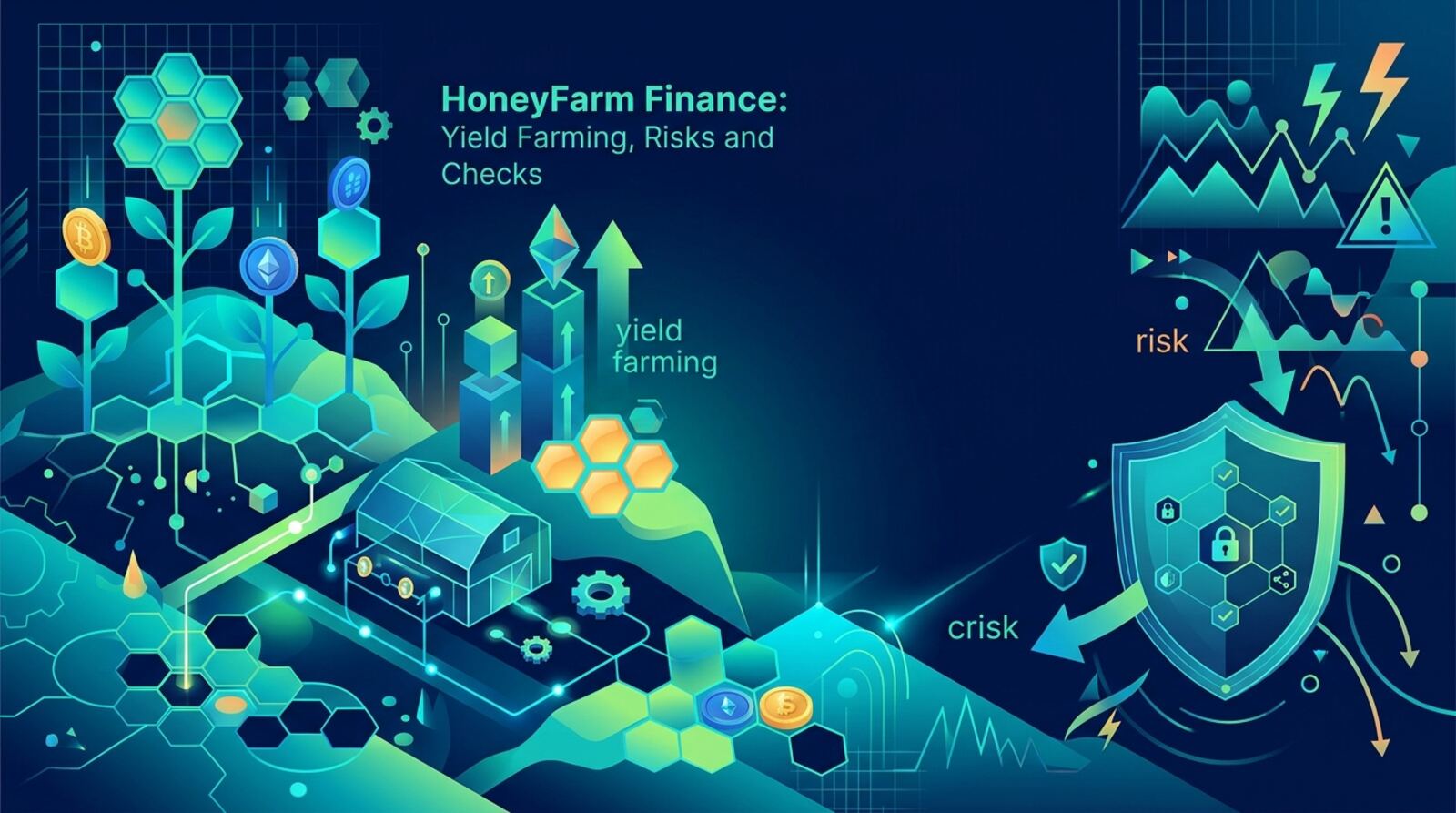
What is HoneyFarm Finance?
HoneyFarm Finance, usually written as HoneyFarm, is a decentralized finance project built around yield farming. Yield farming means depositing crypto tokens into smart contracts, often called pools or farms, so that the platform pays the depositor extra tokens as a reward. In the case of HoneyFarm, the project is described as multi-chain, running on BNB Chain and Avalanche, and it is aimed at users who are looking for high advertised annual percentage rates.
The project has its own token, which is commonly referred to by the ticker HONEY. Because many crypto projects share similar names and tickers, the first step is to confirm which HoneyFarm you are reading about. The public information available for this guide is limited, so treat any single description, including this one, as a starting point. Before relying on a detail such as a chain, a token or a rate, check the project's official site, the contract addresses it publishes and the block explorers for each chain it supports.
It also helps to separate what a project says about itself from what can be checked on chain. A marketing page can describe a farm in positive terms, while the contract code, the token supply and the liquidity records show what the farm actually does. Reading both is the simplest way to form a clear view.
How does yield farming work on a platform like HoneyFarm?
A typical yield farm works in a few steps. The depositor sends tokens to a pool, often a pair of tokens used to provide liquidity on a decentralized exchange. The pool then earns trading fees, and the project may also pay rewards in its own token. The depositor later withdraws the original tokens plus any earnings.
- Deposit. You send one or two tokens to the farm contract, and you may receive a receipt token that represents your share.
- Accrue. Fees and reward tokens build up over time according to the pool's settings.
- Claim or compound. You collect rewards directly, or some interfaces reinvest them automatically.
- Withdraw. You return the receipt token to exit, and the value you receive depends on the pool's current balances and prices.
Rewards paid in a project's own token are the part that needs the most scrutiny. Those tokens may be issued on a schedule, and heavy issuance can push their price down. A rate that looks large can therefore translate into a much smaller real return if the reward token loses value while you hold it. Some farms also set lock-up periods or withdrawal fees, so read the terms before depositing.
Which blockchains does HoneyFarm operate on?
HoneyFarm is described as operating on BNB Chain and Avalanche. A multi-chain project usually means separate deployments on each network rather than one shared pool. That means the farm, its token addresses and your balance on one chain are not the same as the ones on another chain.
Each network also has its own native gas token, which you need to pay transaction fees. Bridges that move tokens between chains add their own risks, because bridge contracts have been targets for exploits in the past. If you use a bridge, confirm the bridge is the one the project recommends and check its status before sending funds.
Wallets can be set to a specific network, and a token address on one chain may not match the address on another. Before you approve or deposit anything, confirm the network name in your wallet and compare the token contract address with the one published by the project. Sending funds to the wrong network can make recovery difficult or impossible.
Why are advertised APRs hard to judge?
Advertised rates are often shown as APR or APY, and the two are not the same. APR is a simple annual rate without compounding. APY includes the effect of compounding. Some pages show one figure and some show the other, so check which measure is being used before comparing two pools.
The rate also depends on what the reward is paid in. If a pool pays out a token that the project controls, the figure is partly a bet on that token's future price. Rates can also change quickly, because they are often tied to the amount of money already deposited, the emission schedule and the market price of the reward token. A figure you saw yesterday may not match what the pool offers today.
A practical approach is to ask three questions. What is the rate measured in? How much liquidity is in the pool? How much of the reward is the project creating, and how much comes from trading fees that users actually pay? Pools that rely mostly on newly issued tokens tend to carry more price risk than pools funded by real trading activity. The current figures should be read on the pool page or in a block explorer, not copied from advertisements.
What are the main risks of a high-rate yield farm?
Yield farming carries several distinct risks, and they can overlap.
- Smart contract risk. Bugs or design flaws in the farm or the underlying exchange can allow funds to be drained. An audit lowers this risk but does not remove it.
- Reward token risk. If the reward token falls in value, the real return can be far below the advertised rate.
- Impermanent loss. When you provide liquidity to a pair of tokens whose prices move apart, the value of your share can end up lower than if you had simply held the tokens.
- Admin and team risk. If one party controls the contract or a large share of the tokens, that party may change settings, pause withdrawals or sell its holdings.
- Liquidity risk. Thin pools can make it hard to exit at a fair price.
- Bridge risk. Moving funds between chains adds exposure to the bridge.
- Scam risk. Fake websites, cloned tokens and unsolicited messages are common around any farm that advertises high rates.
None of these risks can be fully measured in advance, so the safest assumption is that any position in a new or high-rate farm could lose its entire value.
Is the HONEY token the same as Honey Finance?
The HONEY ticker is used by more than one project in the crypto market. Public reporting used for this guide describe Honey Finance as a cross-chain protocol for NFT lending and borrowing, with NFT pools and NFT yield farming that use the $HONEY token. A separate listing describes HoneyFarm Finance as a token that runs on an EVM blockchain and can be added to a wallet such as MetaMask like any other ERC-20 token.
The same name also appears in unrelated areas. Several results in the search set refer to agricultural credit, farm accounting and honey production financing, and a government honey loan program from the late 1990s. These have nothing to do with the crypto project and should be ignored when researching it.
The practical lesson is to identify a token by its contract address and the chain it lives on, not by its name or ticker. A ticker alone does not tell you which project issued it. If a token you are offered does not match the address on the project's official channels, treat it as a different asset.
How can you check a HoneyFarm pool before depositing?
A few checks can be done before any deposit, and none of them guarantees safety.
- Find the official channels. Start from the project's own site and cross-check its links across more than one source. Be cautious of links that appear in direct messages or sponsored posts.
- Compare contract addresses. Find the farm and token addresses on the official channels, then confirm the same addresses on the correct chain's block explorer.
- Read the audit. Look for a named auditor, a date and a scope. Check that the audited code matches the deployed contract. An audit is one input, not a verdict.
- Look at ownership and permissions. Check whether an admin key can change rates, pause withdrawals or mint tokens. Check whether liquidity is locked and for how long.
- Check token distribution. A large share held by a few wallets can increase the risk of sudden selling.
- Review the pool. Note the rate measure, the reward token, the total liquidity and any lock-up or fee terms.
- Ask whether the rate is sustainable. If the reward depends mainly on new token issuance, consider what happens when issuance slows.
If any of these checks cannot be completed, or the answers are unclear, that is a reason to wait or to choose a different product.
What security habits matter when using farming dApps?
Security problems in farming usually start with the user's wallet rather than the protocol. A few habits reduce the risk considerably.
- Keep your seed phrase offline and never type it into a website or give it to anyone, including someone claiming to be support staff.
- Use a hardware wallet for larger balances, and keep a separate wallet for interacting with new contracts.
- Bookmark the official site yourself, and do not rely on search ads or links from messages.
- Read each transaction in your wallet before signing. A request to approve unlimited spending of a token is a permission that can be used later.
- Review and revoke token approvals you no longer need. Many wallets and block explorers have tools for this.
- Do not sign messages you do not understand, because some signatures grant permissions.
- Be suspicious of anyone who offers guaranteed returns, asks you to move funds to recover losses, or pressures you to act quickly.
If you believe a wallet has been compromised, move remaining funds to a new wallet created from a fresh seed phrase, and revoke approvals from the old one where possible. Keep records of transactions in case you need to report the incident to the relevant authority or platform.
What should you do next?
Choosing a farm is only one option. If your goal is to learn how DeFi yield works, it can help to start with established protocols that have longer public track records and more detailed documentation. Aave V3 is a non-custodial lending protocol on many chains where users earn interest on deposits, and Uniswap V3 is a decentralized exchange where liquidity providers earn trading fees. PancakeSwap is a BNB Chain exchange with farming and staking, and vfat.io is a yield aggregator for users who want to track positions across chains.
Whatever you choose, the same questions apply. What is the source of the return? Which chain and which contract are you using? What happens to your funds if the reward token falls or the contract fails? Write down the answers before you deposit.
It is also worth checking the rules that apply where you live. Some jurisdictions restrict or regulate crypto products, and some platforms do not serve every country. This guide is general information and not financial advice. Only commit money you can afford to lose, and consider speaking with a qualified adviser before making a decision that affects your finances.
Frequently asked questions
Is HoneyFarm Finance the same as Honey Finance?
Not as far as the sources show. Honey Finance is described as a cross-chain protocol for NFT lending and borrowing that also has NFT pools and yield farming with its own HONEY token. HoneyFarm is described as a yield farming project on BNB Chain and Avalanche. Both use the HONEY name, so confirm which project a page or token refers to by checking its official site and contract address.
Is HoneyFarm safe to use?
No project can be called safe by default. Farming contracts can contain bugs, admin keys can be misused, and reward tokens can lose most of their value. Before depositing, check the contract addresses on the chain explorer, read any audit reports carefully, and start with an amount you can afford to lose entirely.
Which chains does HoneyFarm run on?
The project is described as operating on BNB Chain and Avalanche. Each chain is a separate deployment, so pools, token addresses and balances on one network do not appear on the other. Confirm the network in your wallet before you approve any transaction.
Can I lose money farming on HoneyFarm?
Yes. You can lose money if the reward token falls in price, if the pool's value shifts against you, if the contract is exploited, or if the project's team or admins withdraw liquidity. A high advertised rate does not reduce any of these risks.
Where can I check the current rate for a HoneyFarm pool?
Open the project's own pool page and read the rate shown there, noting whether it is an APR or an APY and whether it is paid in the native token. Check the current rate on the chain or interface you plan to use, because these figures change often. Treat any rate you see on social media or in third-party listings as a claim to verify, not a fact.
Mentioned in this guide
dApps in this guide
HoneyFarm is described as a delegated yield-farming project on BNB Chain and Avalanche, but its current status and strategies are unclear.
PancakeSwap is a BNB Smart Chain decentralized exchange with swaps, farming, staking and CAKE governance for self-custody DeFi users.
vfat.io is a non-custodial, multi-chain yield aggregator and portfolio manager built on the Sickle smart contract wallet, for active DeFi farmers.
Uniswap V3 is a non-custodial decentralized exchange protocol for token swaps and concentrated liquidity provision across 40+ chains.
Aave V3 is a non-custodial DeFi lending protocol on 21 chains where users earn interest on deposits or borrow against collateral.
Lido is a liquid staking protocol where users stake ETH and receive stETH, a reward-earning token usable across DeFi, governed by LDO holders.
Curve is a decentralized exchange on Ethereum built for low-slippage swaps of stablecoins and similar assets, with CRV governance and a crvUSD stablecoin.
Aave is an Ethereum-based crypto lending protocol for supplying assets and borrowing against collateral.
Uniswap is a self-custody decentralized exchange protocol for swapping tokens through liquidity pools across multiple networks.
Keep reading
Related guides
DeFi · Explainer
MOBOX NFT Yield Farming Explained: How the Twist Works
MOBOX tried to link NFT games with DeFi yield farming, so both tokens and collectibles could earn. This guide explains how that design worked, what it asked of players, and what to verify before treating any similar project as a live opportunity.
DeFi · Explainer
What Is NFT Farming and How Does It Work in 2026?
NFT farming means depositing an NFT into a smart contract to earn token rewards. This guide explains how the process works, where the rewards come from, and what to check before you deposit.
dApp basics · Explainer
App Stores vs dApp Stores: What Is the Difference in 2026?
Traditional app stores are curated marketplaces run by a platform owner, while dApp stores and listings are discovery layers for software that runs on blockchains. The two differ in who hosts the code, who can remove a listing, and what a user must verify before installing or connecting a wallet.
Blockchain · Comparison
Ethereum vs BNB Chain: Key Differences Explained (2026)
Ethereum and BNB Chain are both EVM-compatible networks, but they differ in how they reach consensus, how many validators secure them, what fees look like, and how much they prioritize decentralization versus speed and low cost. This guide explains each difference and what it means for users, developers and stakers.
DeFi · Explainer
What Is Liquid Staking? How It Works and Its Risks
Liquid staking lets you stake proof-of-stake crypto and receive a token representing your staked position. Learn how the tokens work, where rewards come from, and what risks to weigh before using one.
DeFi · Explainer
What Is GMX? A Guide to the Decentralised Perps Exchange
GMX is a decentralised exchange for perpetual futures that lets traders open leveraged positions from their own wallet while liquidity providers act as the counterparty. This guide explains how it works, what its tokens do, what it costs and where the risks sit.
DeFi · Explainer
What Is a Liquidity Pool and a Liquidity Provider?
A liquidity pool is a smart contract holding tokens that anyone can trade against, and a liquidity provider is the person who supplies those tokens and earns fees. This guide covers how pools price trades, how LPs get paid, and the risks to weigh before depositing.
DeFi · Explainer
What Is DeFi Saver? How It Works and Its Risks
DeFi Saver is a non-custodial interface for managing positions across DeFi lending and borrowing protocols. Learn how its dashboard, transaction tools and automation work, what they do not protect you from, and what to check before connecting a wallet.