NFT · How-to
How to Stake Game NFTs for Passive Income Without Selling (2026)
Staking lets you lock a game NFT in a reward contract and earn tokens without selling the item. This guide explains how the process works, what to check before you commit, and how to protect your wallet and your rewards.
By the DappsAtlas editorial team · Updated
What game NFT staking means
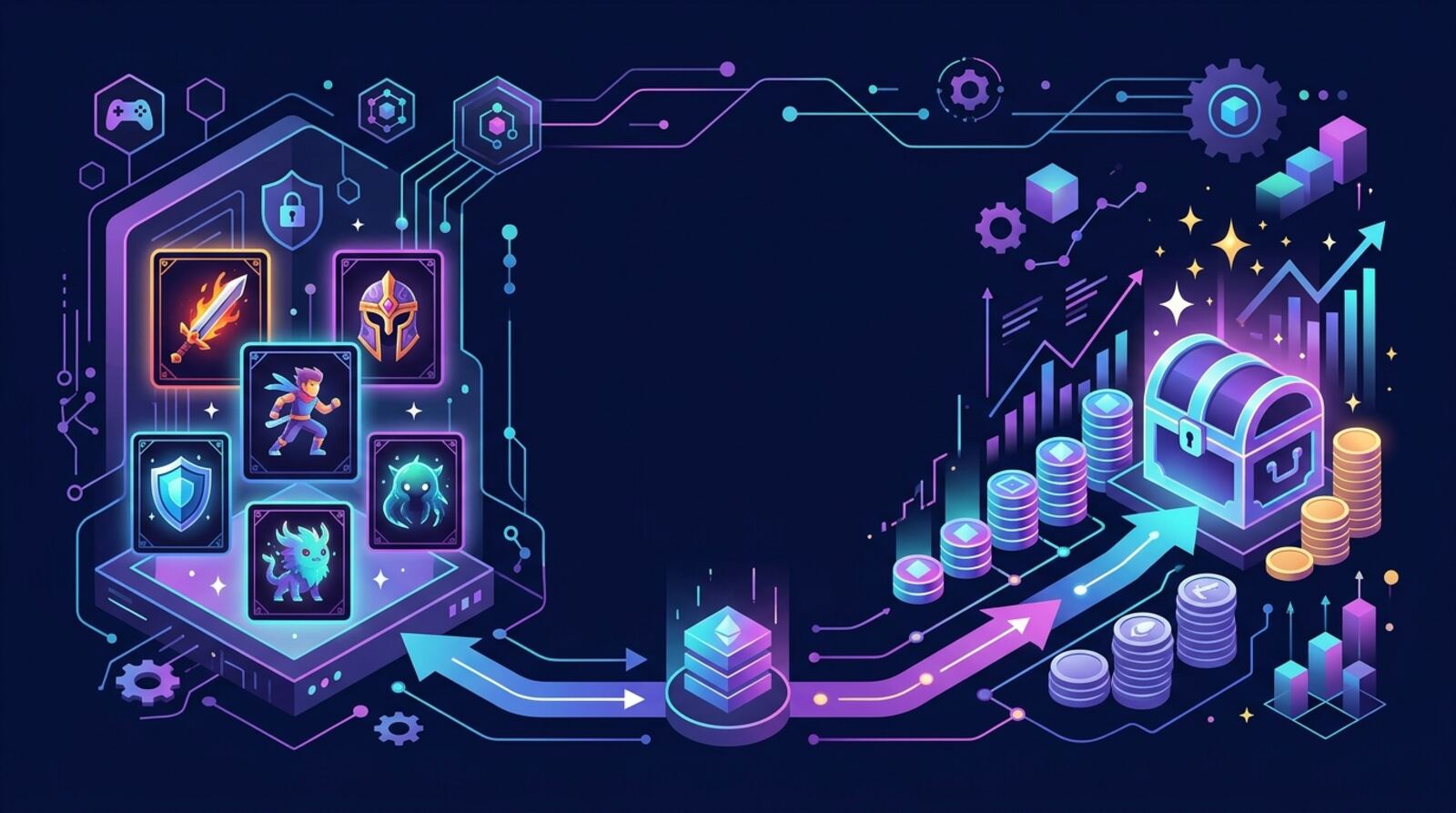
Game NFT staking means depositing an in-game NFT, such as a character, land plot, weapon or creature, into a smart contract run by a game or its partner. While the item is locked there, the contract tracks your deposit and pays you rewards, often in the game's own token or in a second token that the project chooses.
The appeal is simple. You keep the position and the item instead of selling it, so you may still benefit if the game's economy grows. The trade-off is that the item cannot be used or sold freely while it is staked, and the rewards are only as stable as the game's economy and the token that pays them.
Staking is different from a bank deposit. There is no fixed interest rate set by a regulated institution, no deposit insurance, and no guarantee that the game will still be running next year. The reward you see on a dashboard is a snapshot of current settings, not a promise.
Understanding what you are locking, and what you are paid in, is the foundation for every other step in this guide.
Staking compared with selling, renting and holding
Staking is one of several ways to get value from an NFT you already hold. Each option trades off ownership, income and risk differently.
| Option | You keep the NFT | Typical income source | Main risk |
|---|---|---|---|
| Staking | Usually, while locked | Reward tokens from the game or project | Reward token value falls, contract issues, locked liquidity |
| Selling | No | One-time sale proceeds | Selling below your target price, tax on gains |
| Renting | Yes, but you cannot use it | Fees paid by a player | Renter misuse, platform terms |
| Holding | Yes | Price appreciation only | Price falls, no income |
Selling makes sense if you no longer want the item or need the cash. Renting can make sense if you own items that players want but you do not play. Holding is simple but earns nothing on its own. Staking sits in the middle: you keep the item, but your income depends on reward design and on the token's value.
Compare the options against your goals before you commit. If your main aim is income, look closely at what the rewards are paid in. If your main aim is owning a specific item long term, staking may suit you better than selling.
Check the game and the staking design first
Before any deposit, research the game and the staking design. Many game NFTs have no staking option at all, and a staking page can exist for reasons that do not favour holders.
Start with the game itself. Check whether it is still active, whether the developers publish regular updates, and whether players are still in the game. A staking reward is only worth something if there is an economy that uses the token.
Next, look at the reward token. Find out how it is created, how many tokens are scheduled to be released over time, what the token is used for inside the game, and where it trades. A high reward rate paid in a token with weak demand can lose value quickly.
Finally, review the contract. Find the official contract addresses from the project's own documentation or announcements, and confirm them on a block explorer for the relevant chain. Be wary of links from social media replies, direct messages or unofficial sites. Check whether the contract has been audited, but treat an audit as one signal, not a guarantee.
If you cannot answer these questions clearly, wait.
Step-by-step: how to stake a game NFT
The exact steps depend on the game, but the general process is consistent across most staking setups.
- Confirm the staking contract address from the project's official source and check it on a block explorer.
- Use a wallet you control and keep only the assets you need for staking in it. Keep long-term holdings in a separate wallet.
- Make sure the wallet holds enough of the chain's native token to pay network fees.
- Connect your wallet to the official staking page, not to a copy of it. Check the domain carefully.
- Read the transaction request before signing. Confirm the contract name, the NFT being moved and the action being approved.
- If the process needs an approval step first, approve only the NFT collection needed, and consider limiting its scope where the wallet offers that option.
- Submit the deposit, wait for confirmation, and then check that the NFT appears as staked in the official interface and on the block explorer.
- Save the transaction hashes and note the date, the item and the reward terms in your own records.
Do not rush these steps. If a page asks you to sign something unrelated to staking, such as a broad permission or a transfer to a personal address, stop and investigate before continuing.
Understanding rewards and what drives them
Rewards are the part of staking most people focus on, and they are the part that changes most often. A reward figure is only useful if you understand what it is based on.
First, find the reward formula. Some systems pay per period based on the number of items staked, some weight rewards by item rarity or level, and some change with the total amount staked by all players. Each design rewards different behaviour and carries different risks.
Second, check the reward token's supply plan. If rewards come from new token releases, your income depends on how many tokens are released and how many people are claiming them. Ask whether the project publishes a schedule and whether it can change it.
Third, measure rewards in a stable reference. Record how many tokens you receive, their value when received, and the total outcome after accounting for any fees or price changes. A reward that looks large in tokens can be small in dollar terms, or negative once price movement is included.
Where you need current figures for prices, pool sizes or reward rates, use the game's own dashboard, the block explorer and the token's price pages on reputable market-data sites. Those numbers change too often to be stated in a guide like this.
Risks that can cost you the NFT or the rewards
Staking carries several risks that can affect either the NFT or the rewards.
Smart contract risk is the possibility that code contains a bug or can be abused. Audits lower this risk but do not remove it. Contracts can also be upgraded in ways that change reward terms or withdrawal rules.
Game risk is the chance that the game loses players, changes its economy, or closes. An NFT tied to a dead game may keep its record on chain but offer little use or resale demand.
Token risk is the fall in value of the reward token. Rewards paid in a volatile token can lose much of their worth even if you receive a steady number of tokens.
Liquidity risk is the chance that you cannot withdraw or sell when you need to. Some setups have withdrawal delays, and a thin market can make exit prices poor.
Phishing risk is the most common practical threat. Fake staking sites, cloned interfaces and requests for broad token permissions have drained wallets. Treat every unexpected prompt as suspicious.
No staking position should be sized so that losing it would damage your finances.
Security checklist before you approve any transaction
Wallet security matters more than any reward rate. Use this checklist before you sign anything.
- Use a hardware wallet or a dedicated staking wallet for game assets.
- Store your recovery phrase offline and never type it into a website or share it with anyone.
- Bookmark the official staking site and open it from the bookmark, not from a search result or a message.
- Read every signature request in full. Be cautious of requests labelled as claims, verifications or airdrop checks.
- Approve only the collection or token amount needed, and revoke old approvals you no longer need using a reputable approval-management tool.
- Keep your operating system, browser and wallet software updated.
- Do not install browser extensions from links in messages.
- Support staff will not ask for your recovery phrase or ask you to send assets to verify your account.
If you suspect a compromise, move remaining assets to a new wallet from a clean device as soon as you can, revoke approvals, and report the incident to the relevant platform and to local authorities if it involves a loss.
Withdrawal periods, taxes and record keeping
Most staking designs include a withdrawal process. Some let you withdraw at any time, while others use a request step followed by a waiting period. Read the terms for your specific contract before you deposit, because this affects whether you can react to a change in the game or the token price.
Rewards may be claimed separately from the NFT. Some systems let you claim as you go, and others pay out only when you unstake. Check which applies and whether claiming carries a fee on the chain you use.
For tax, the rules differ by country and can be complex for crypto assets. Keep a simple log with the date, transaction link or hash, item name, action taken, token amounts and value in your local currency at the time. Note any fees paid, because many tax systems allow certain costs to be considered.
Before you act on any tax question, speak with a qualified tax professional in your jurisdiction. Rules change, and general guidance cannot account for your full situation.
Where to check current rewards, prices and contract details
Because prices, reward rates and pool sizes change often, a good guide points you to the sources that show current figures rather than quoting numbers that will go stale.
- The game's official documentation, staking page or announcements show the reward rules and any changes. Compare them with what the contract actually does.
- A block explorer for the relevant chain lets you confirm contract addresses, your transaction history and the status of your staked items.
- NFT marketplaces show the current listing and sale history for an item and help you judge its resale value. OpenSea is one example of a marketplace that shows collection activity for many chains, while game-specific marketplaces may cover items better.
- Reputable market-data sites show a token's price and trading volume. Check which exchanges list the token and whether liquidity is deep enough to exit a position.
Record the figures you rely on with the date you checked them. A reward that was accurate last week may no longer apply, so repeat your checks before each decision.
If staking is not available: other ways to earn without selling
If a game does not offer staking, or the staking terms do not suit you, other options can produce income from the same asset.
Renting lets you lend an item to a player for a fee. This needs a platform or contract that handles custody and payment, and it depends on the game allowing rentals. Read the rules about renter access and what happens if the item is lost or misused.
Vault-style protocols can let you deposit an NFT into a shared pool and receive a fungible token that represents it. NFTX is one example of this model for some collections. Vault tokens can be traded without selling the original item, but they add pool-level risk, and the token price may not track the floor price of the collection.
Holding and watching the market is the simplest option. If you hold an item you value, you can still decide later whether to stake, rent, sell or keep it.
Whichever path you choose, apply the same discipline: confirm the contract, understand the terms, and keep only what you can afford to hold through volatility.
Frequently asked questions
Does staking a game NFT mean I lose ownership?
In most staking designs the NFT moves into a contract that records you as the depositor, and you can withdraw it later under the stated terms. Ownership rights inside the game itself depend on the game's terms of service, so read both the contract and the game rules before you deposit.
Can I sell a game NFT while it is staked?
Usually not while the NFT sits in the staking contract. Most staking setups require you to withdraw first, and some also require a waiting period after you request withdrawal. Check the specific rules before you stake an item you may need to sell quickly.
Is staking income guaranteed?
No. Rewards depend on the game's economy, the token's market price and the reward schedule, and any of these can fall or stop. Treat staking rewards as variable and only commit assets you can afford to hold through a downturn.
What happens if the game shuts down while my NFT is staked?
Your NFT may keep its contract address and token ID, but its value and use can fall to almost nothing if the game closes or stops supporting the item. Before you stake, check whether the team is still publishing updates, and avoid placing a large share of your holdings into a single game.
Do I need to pay tax on staking rewards?
Tax treatment depends on where you live and on how your rewards and any disposals are classified. Keep dated records of deposits, withdrawals, rewards received and their value at receipt. Speak with a qualified tax professional in your jurisdiction for advice on your situation.
Mentioned in this guide
dApps in this guide
NFTX turns NFT collections into vault-backed ERC20 tokens so users can buy and sell NFTs instantly at floor price against a pool.
AtomicHub is a multichain NFT marketplace for gaming items, collectibles and digital art, centered on WAX and EOS-family chains.
OpenSea is a peer-to-peer NFT marketplace for buying, selling and minting digital collectibles, aimed at collectors, creators and developers.
Element Market is a multi-chain NFT marketplace and aggregator for collectors and traders buying NFTs, collectibles and GameFi assets across many blockchains.
Save, formerly Solend, is a Solana lending and borrowing protocol where users earn interest on deposits or borrow against collateral.
Stake is an online casino and sportsbook with crypto and local-currency payments, a VIP program and loyalty rewards, for adults where gambling is legal.
Keep reading
Related guides
NFT · Explainer
How to Stake NFTs and Earn in NFT Worlds in 2026
Staking an NFT in an NFT world means locking it in a contract so the project pays rewards, often in its own token. The returns are not guaranteed, and the risks are easy to underestimate, so this guide explains how the mechanics work and what to check first.
NFT · Explainer
Burberry x Blankos NFTs Sold Out in 30 Seconds: A 2026 Guide
Burberry's Blankos collaboration put a branded NFT character into a Mythical Games title in 2021, and its public sale was reported to sell out in about 30 seconds. This guide explains what was sold, how the release worked, and how to check the current status of similar drops.
NFT · Explainer
Apple NFT Tax: Should Crypto Games Be Worried in 2026?
The so-called Apple NFT tax is Apple's standard 30% App Store commission on digital purchases made inside iOS apps, not a government levy. Crypto game studios should pay attention, but the real exposure depends on how their games sell items, unlock features and handle wallets.
NFT · Explainer
Avatars in Virtual Worlds: A Buyer's Guide for 2026
Avatars in virtual worlds can be owned as NFTs, but ownership depends on the contract, the wallet and the world's own rules. This guide explains what you actually buy, how to check it, and how to judge the risks before spending anything.
NFT · Explainer
Square Enix and NFTs: What Happened, and What It Means in 2026
Square Enix moved into NFTs in 2021 and 2022 with collectibles, trading cards and blockchain game plans, then drew fan criticism. This guide explains what it did, why it mattered, and how to check any Square Enix NFT you hold today.
NFT · Explainer
Starry Night Capital 1,300 ETH Dmitri Cherniak NFT Purchase Explained
The results I could access do not confirm the 1,300 ETH purchase of two Dmitri Cherniak NFTs by Starry Night Capital, so treat the headline figure as unverified until you check the transaction yourself. This guide explains how to check it, what the artist's work is, and how to read large NFT sale prices.
NFT · Explainer
Snarkysharkz and Fake Banksy Art: How to Check Authenticity
Banksy's name attracts copies, fakes and speculative NFTs that borrow his style. This guide explains how to check whether a work is authentic, what the recent cases show, and how to evaluate a Banksy-style NFT before you buy or sell.
NFT · Explainer
Steve Aoki's $310,000 BAYC Claim: How to Verify It
A viral-style claim says Steve Aoki paid $310,000 for an eighth Bored Ape Yacht Club NFT. The reporting checked for this guide does not confirm that, so this explainer covers what is documented about his collecting and how to verify any NFT sale price yourself.