DeFi · Explainer
Radar Cross-Chain Token Staking Explained for 2026
Cross-chain token staking usually means locking tokens that sit on one network, or that have been moved between networks, to earn rewards. This guide explains how it works, why the RADAR name causes confusion, and what to check before you deposit anything.
By the DappsAtlas editorial team · Updated
What cross-chain token staking means
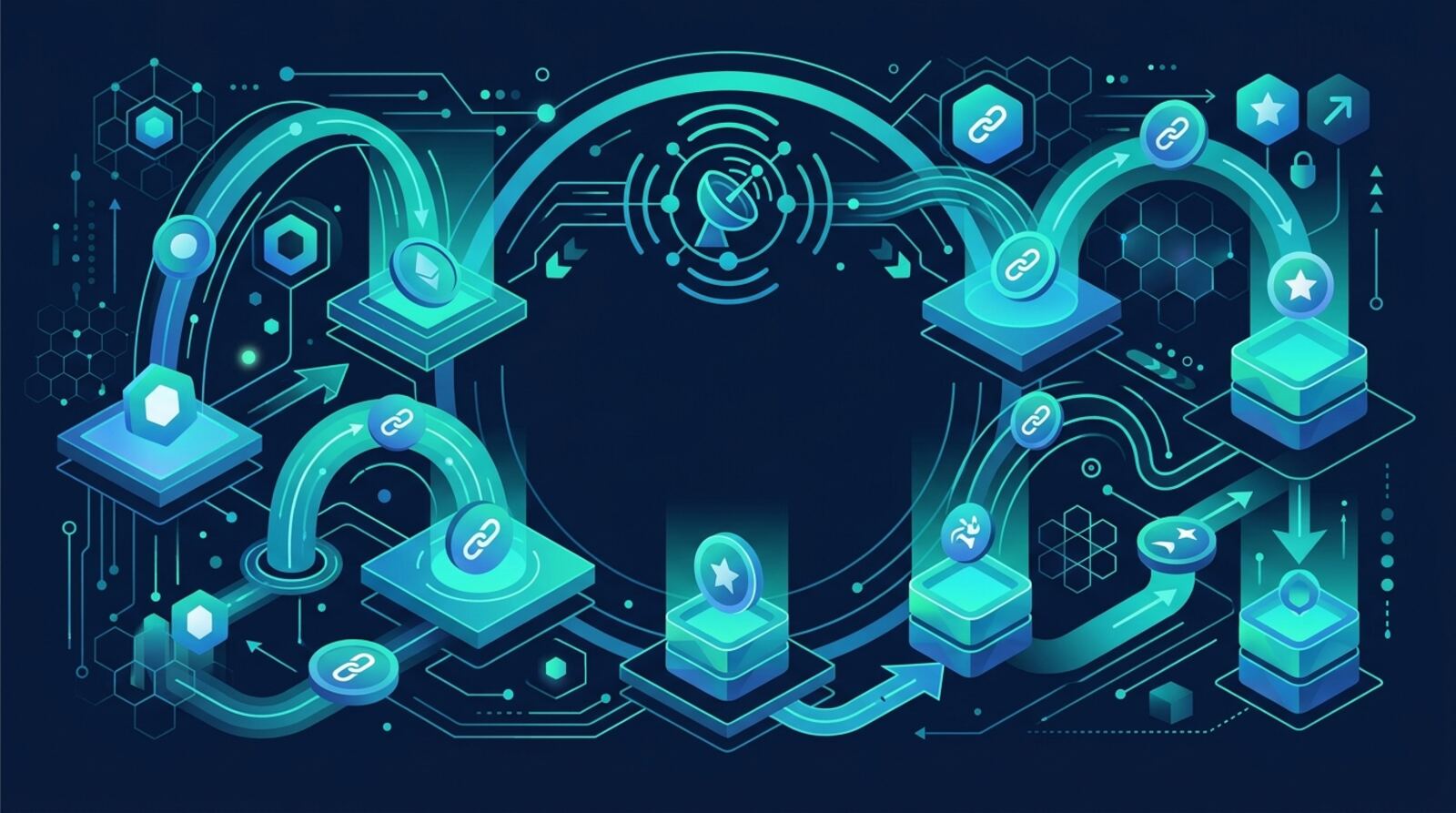
Cross-chain token staking means locking a token so it can earn rewards, where the token or the staking logic spans more than one blockchain. In practice, a user might hold a token on one network, move it to another through a bridge, and then deposit it into a staking contract there. Some programs also accept wrapped versions of tokens that represent an asset held somewhere else.
The term is used loosely. Sometimes it describes a single token that exists on several chains and can be staked on any of them. Other times it describes a system that moves value between chains to pay rewards. The label alone does not tell you who controls the funds, where the rewards come from, or how long your tokens are locked.
Before staking, define what you are actually doing. Identify the asset you hold, the chain it is on, the chain where the staking contract lives, and whether a bridge sits between them. Each step adds a dependency. A simple proof-of-stake deposit on one chain has fewer moving parts than a bridged, multi-chain arrangement, and that difference matters when something goes wrong.
How staking rewards are usually produced
Most staking rewards come from one of three sources. The first is network issuance, where a proof-of-stake chain pays new tokens to validators and delegators. The second is transaction fees or other protocol revenue shared with stakers. The third is token incentives from a project's treasury, which are often temporary and can fall as the incentive program ends.
In a proof-of-stake network, validators lock tokens as collateral and can lose part of their stake if they act maliciously or go offline, a process usually called slashing. Delegators who back a validator share in the rewards after the validator's fee is taken. Some networks have an unbonding period before withdrawals are released.
When staking spans chains, rewards may depend on bridge operations, oracle feeds or a second network's token price. Ask where each reward comes from. If the answer is only that the rate is high or that the project is growing, the explanation is incomplete. Rewards paid in the same token you deposited can look attractive, but their value can fall along with that token's price.
Why the RADAR name causes confusion
The name RADAR appears in more than one context, and that creates confusion. A search for Radar staking can return a token with a tracked vesting schedule, tools that list upcoming token unlocks, and unrelated older articles about a different product from years ago that used the word Radar in its name. A token unlock tracker can show when tokens become transferable, but it does not show whether any staking program exists.
In the results used for this guide, one listing describes an unlock schedule and distribution data for a RADAR token. Another result is a video about a staking project called CROSS, which is described elsewhere as a gaming chain or a cross-chain asset protocol, with details that remain unverified. Neither result proves that a cross-chain staking program named Radar is live.
When a name is shared by several tokens or products, verify the exact contract address and the official source, not the name. Scammers often copy names, logos and wording from legitimate projects, so a convincing page is not evidence of a real program.
What public reporting do and do not confirm
The results used for this guide support a few general points. Unlock and vesting trackers exist for RADAR, which means the token has a published or estimated release schedule. Staking explainers describe staking as a way to earn rewards for locking tokens. Multi-chain yield articles describe how bridges and liquid staking can be combined, and they note the added complexity.
They do not confirm the parameters of a Radar cross-chain staking program. They do not show a reward rate, a lock period, the chains supported, the audit status or the team behind it. Any figure you see elsewhere should be checked against the project's official materials and an on-chain view before you rely on it.
That gap is the honest answer to the question. This guide can explain how cross-chain staking works and how to evaluate it. It cannot tell you that a specific Radar program is safe, active or profitable, and you should treat any claim that it can as a warning sign.
Cross-chain risks: bridges, wrapped assets and contracts
Cross-chain staking adds risks that a single-chain deposit does not carry. A bridge is a set of smart contracts and sometimes off-chain operators that lock tokens on one chain and mint or release representations on another. Bridges have been targeted by attackers in the past, and a compromised bridge can leave a wrapped token with less backing than it claims.
Wrapped and bridged tokens can also trade below the value of the original asset when liquidity is thin or when redemption is uncertain. Your staking position may be worth less than expected even if the rewards accrue correctly. Read how the wrapped asset is backed and who can mint it.
Smart contract risk applies on every chain. Bugs, upgrade keys held by a small group, and admin functions that can change reward rules all matter. Look for independent audits, bug bounty programs, time-locked upgrades and public documentation. Treat the absence of these as a reason to wait, and remember that an audit reduces risk without removing it.
Liquid staking as an alternative
Liquid staking is a different model. Instead of locking a token directly, you deposit it with a protocol and receive a receipt token that represents your stake and accrues rewards. Lido issues stETH for staked ETH, Rocket Pool issues rETH, Jito issues JitoSOL for Solana, Marinade issues mSOL and BlazeStake issues bSOL. These receipt tokens can often be used in other DeFi applications, which gives more flexibility than a locked position.
Liquid staking does not remove risk. The receipt token can trade at a discount to the underlying asset, the protocol's contracts can fail, and the validator set can be concentrated. Some liquid staking tokens also depend on the redemption mechanism, which may be instant through a market or delayed through an unstaking queue.
If you compare a cross-chain staking pool with a liquid staking option, list the same questions for each: where the underlying asset sits, how it is redeemed, what happens to the receipt token in stress, and who controls upgrades. Writing the answers down makes differences easier to see than a headline rate does.
A step-by-step checklist before you stake
Before depositing into any staking program, work through a fixed list. Confirm the asset: the exact token name, symbol and contract address on each chain. Confirm the source: find the link to the staking contract from the project's official website or documentation rather than from social posts, advertisements or direct messages.
Next, check the mechanics. Identify the reward token, the reward rate method, the lock or unbonding period, any early exit fee, and whether rewards are paid in the same asset. Check whether a bridge is required to deposit or withdraw, and how long that takes.
Then review the security picture. Look for audits from named firms, a public record of past incidents, a documented admin key policy and whether upgrades are time-locked. Use a block explorer to confirm that the contract is verified and that the deployer and admin addresses match what the project states.
Finally, size the position. Stake only an amount you could leave locked for the full unbonding period without selling in an emergency. Keep a record of transaction hashes so you can trace each step if you need support.
Red flags in staking offers
Several patterns should make you stop. Guaranteed returns are the most common warning sign, because real staking rewards vary with network activity, validator performance and market prices. Pressure to deposit quickly, claims of limited spots or urgent bonuses are typical of scams.
Be cautious when a project asks for your seed phrase or private key, when a website asks you to connect a wallet to claim a reward you never earned, or when a support contact reaches out first. Legitimate staking interfaces do not need your seed phrase, and no staking contract needs you to approve unlimited spending of unrelated tokens.
Also watch for mismatched details. A logo that looks right but a contract address that does not appear in official documentation is a problem. So is a token whose supply, unlock schedule or team information cannot be found anywhere independent. Check that any named partner or team member has a verifiable public presence before you rely on the claim.
If you find any red flag, do not deposit. You can report suspicious pages to the wallet provider or the relevant chain's community channels.
Where to check current rates, unlocks and token data
Because rates, unlock dates, token supplies and total value locked change often, this guide does not state current figures. Instead, use sources that update continuously and compare them with each other.
For token unlock and vesting data, third-party unlock trackers publish schedules, and you can cross-check them against the token's official tokenomics documents. For on-chain activity, use the block explorer for the chain in question to view contract balances, deposits and withdrawals. For protocol metrics, use the protocol's own dashboard and an independent data aggregator, and note the date you checked.
For staking rates, check the reward figure on the staking interface itself and confirm how it is calculated. Compare it with the network's published staking reward information for proof-of-stake chains. Treat any rate you see on a third-party page as a rough guide until you have verified it.
Keep a dated note of what you checked. Staking conditions change, and a record helps you tell whether something has changed since you deposited. For any question about a specific Radar cross-chain program, start with the official source for the token and the contract address, since public reporting used here do not establish one.
Frequently asked questions
Is cross-chain token staking the same as earning passive income?
Not necessarily. Staking usually means locking tokens to help secure a proof-of-stake network or to support an application, and rewards depend on how that system pays out. Cross-chain staking adds bridge and contract risks on top of that, so a higher advertised rate often reflects higher risk rather than free money.
Is there an official Radar cross-chain staking program?
Public reporting used for this guide do not confirm a specific staking product called Radar cross-chain staking. They show a token named RADAR with a tracked vesting schedule, a video about a separate CROSS staking program, and general staking explainers. Before depositing, look for an official source that names the contract, chains, rewards and lock terms.
How can I verify a staking contract before I use it?
Read the token contract address on each chain, confirm the staking contract is the one linked from the project's official documentation, and check whether the token is a bridged or wrapped version. Look up the chain's block explorer to see whether the contract is verified. If any step is unclear, do not deposit.
Can I withdraw cross-chain staked tokens at any time?
Usually you can unstake, but the process may include an unbonding or cooldown period, a waiting window, or a bridge delay when moving tokens back. Some programs also impose penalties for early exit. Read the withdrawal terms before you stake, because they determine how quickly you can access funds in a price drop.
Should I use liquid staking instead of a cross-chain staking pool?
Prefer a liquid staking token only if you understand how it is redeemed and what protocol risks come with it. Liquid staking protocols such as Lido, Rocket Pool, Jito and Marinade issue receipt tokens that can often be traded or used elsewhere, which offers flexibility but adds smart contract and market risk. Compare fees, redemption paths and audit history rather than relying on the headline yield alone.
Mentioned in this guide
dApps in this guide
Lido is a liquid staking protocol where users stake ETH and receive stETH, a reward-earning token usable across DeFi, governed by LDO holders.
Rocket Pool is a decentralised Ethereum liquid staking protocol offering rETH for stakers and 16 ETH validators for node operators.
Jito Liquid Staking lets Solana users stake SOL for JitoSOL, a liquid token that accrues staking and MEV rewards.
Marinade is a Solana staking protocol offering native and liquid staking (mSOL) via an auction where validators bid for delegated SOL.
BlazeStake is a non-custodial Solana liquid staking protocol that issues bSOL, for SOL holders wanting staking yield and DeFi use.
Lombard issues LBTC, a yield-bearing Bitcoin token backed 1:1 by BTC, for holders and institutions who want to use Bitcoin in DeFi.
Aave V3 is a non-custodial DeFi lending protocol on 21 chains where users earn interest on deposits or borrow against collateral.
Stake is an online casino and sportsbook with crypto and local-currency payments, a VIP program and loyalty rewards, for adults where gambling is legal.
Wrapped is an enterprise blockchain platform, listed as a cross-chain bridge, offering tokenized equities, RWAs and stablecoin transfers to businesses.
Keep reading
Related guides
DeFi · Explainer
Benefits of Staking Crypto: Rewards, Risks and Who It Suits (2026)
Staking means locking crypto to help secure a proof-of-stake network in return for rewards. This guide covers the real advantages, the trade-offs, and how to compare staking options before committing funds.
DeFi · Explainer
StakeADA and DeFi Staking: How the Platform Mechanics Work
StakeADA is used here as a case study in how DeFi staking platforms work, because the sources available did not document its contracts, fees or reward rates. This guide explains the mechanics you should understand and verify before depositing.
DeFi · Explainer
What Is Crypto Staking and How Can You Earn Passive Income?
Staking means locking tokens to help secure a proof-of-stake network in return for rewards. This guide explains how rewards are paid, the main ways to stake, and the risks that matter more than any headline rate.
DeFi · Explainer
Liquid Staking Explained: How the DeFi Yield Works in 2026
Liquid staking lets you earn Proof-of-Stake rewards while keeping a tradable token, and that token can be used across DeFi. This guide explains how the yield is made, how it stacks with lending and trading, and where the risks sit.
DeFi · Explainer
How Radix's Web3 Stack Could Make DeFi Mainstream in 2026
Radix argues that building asset rules and wallet safety into its base layer could make DeFi easier for ordinary users. This explainer covers the design ideas behind that claim, what they do and do not solve, and how to check the ecosystem's progress yourself.
DeFi · Explainer
Quokka Finance on Polygon: How to Verify a New DeFi App in 2026
Quokka Finance is the name behind a recent buzz around new DeFi activity on Polygon, but the sources available for this guide do not confirm its details. This explainer shows how to verify a new Polygon protocol, what past exploits teach, and what to check before depositing.
DeFi · Explainer
Rari Capital and RGT: What a Billionaire-Driven Price Move Means
Headlines about a billionaire pushing Rari Capital's RGT token higher are easy to share but hard to verify. This guide explains what Rari Capital is, how RGT works, why a single large holder can move a small token, and how to check any such claim on-chain before you act.
DeFi · How-to
How to Boost LP Mining on QuickSwap V3 With Gamma (2026)
Gamma is a liquidity manager that automates concentrated positions on QuickSwap V3, which can simplify LP mining but does not remove impermanent loss or smart contract risk. This guide explains how the setup works, what to check before depositing, and how to measure your results honestly.