Web3 gaming · Explainer
MOBOX Explained: How Its Games, Yield Farming and NFTs Connect
MOBOX was a BNB Chain gaming platform that tried to combine game play, DeFi yield farming and NFT assets in one loop. This explainer covers how that model worked, where it carried risk, and how to check what the project looks like today.
By the DappsAtlas editorial team · Updated
What MOBOX is and where it came from
MOBOX launched as a GameFi project on the BNB Chain, which is the network Binance operates. Its pitch was that it combined three things that were usually separate: free-to-play or play-to-earn games, DeFi yield farming, and NFT assets used inside the games. Mentions in public reporting from 2021 onward, including exchange educational posts and community AMAs, describe it in these terms.
The project was promoted heavily by exchanges during the GameFi boom of 2021 and 2022, so you will still find many articles about it. Some of that coverage is promotional, and older posts may describe features that have since changed. The useful way to read MOBOX today is as a case study in how early play-to-earn projects were designed, and what happened when their economics depended on constant new activity.
If you are researching it now, separate the original design from the current state of the project. The first question is what the team built and promised. The second is what is actually live, funded and used.
How the MOBOX model combines three ideas
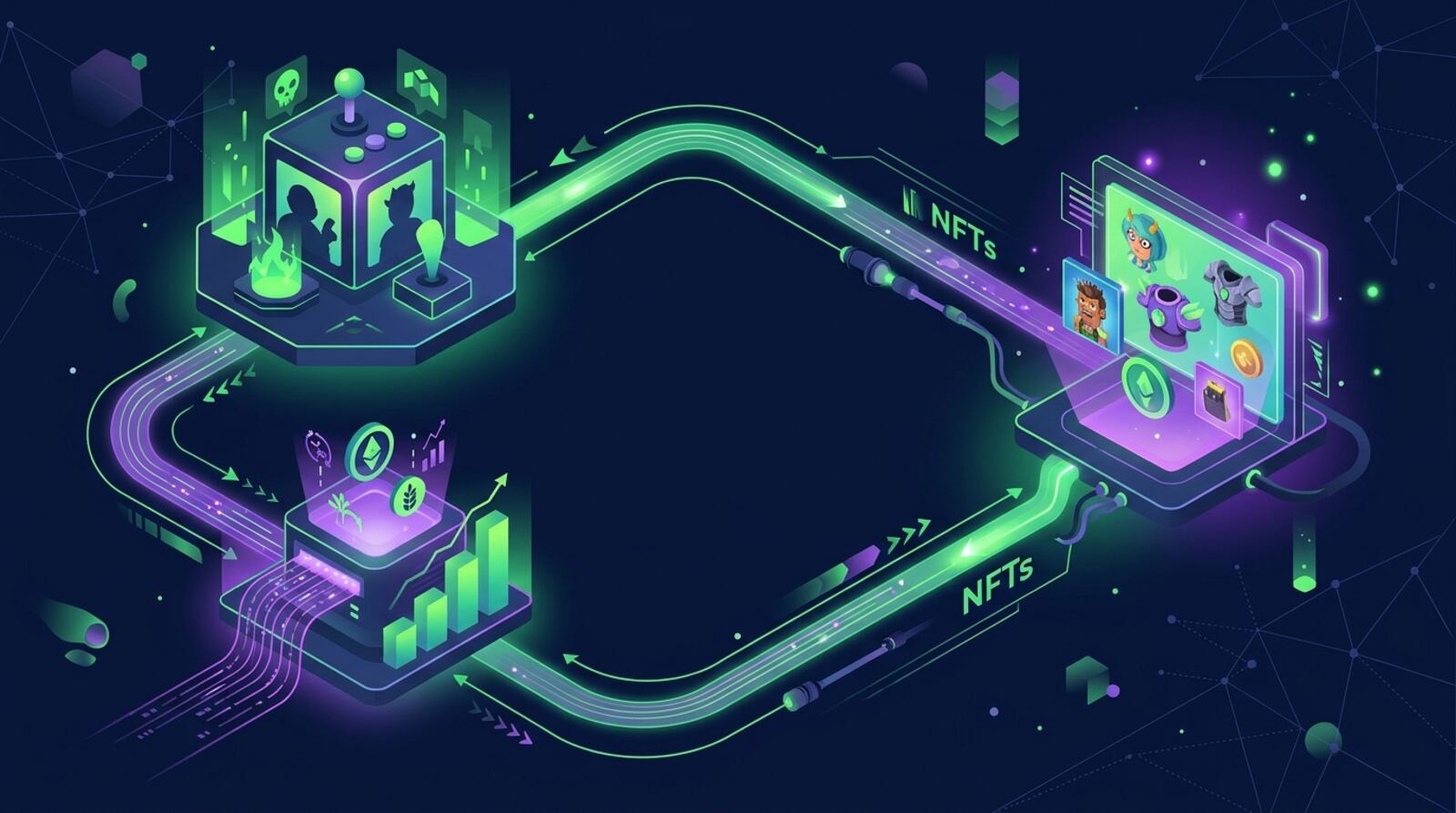
The core idea of MOBOX was a loop. Players could take part in games and earn in-game rewards. Those rewards and related tokens could be put to work in DeFi-style farms to earn more. NFTs were meant to tie the parts together by representing items, characters or boxes that had value inside the ecosystem.
In practice, each piece depends on the others:
- Gaming gives users a reason to hold assets and stay active.
- Yield farming rewards users for providing liquidity or locking tokens.
- NFTs represent items that can be used, traded or upgraded.
- The native token MBOX links the pieces and is used for rewards and governance-style decisions.
This design sounds coherent on paper. The weak point is that rewards from farming and gameplay must come from somewhere. If they come mainly from new buyers entering the system, the model depends on continued growth. Evaluating any similar project means asking where the rewards originate.
How yield farming worked on MOBOX
Yield farming generally means depositing crypto into a smart contract pool so the depositor earns rewards, often paid in the protocol's own token. Liquidity providers usually deposit a pair of tokens into a decentralised exchange pool and receive a token that represents their share. That token can then be staked in a farm to earn extra rewards.
The risks in these setups are well understood:
- Smart contract bugs or exploits can drain pools.
- Token prices can fall, reducing the dollar value of rewards.
- Impermanent loss can reduce the value of a liquidity position when the paired tokens move apart in price.
- Reward rates often fall over time as token emissions decline or more capital enters the pool.
The advertised yield in a farm is a moving figure, not a fixed return. Whatever number you see on a project page or in an old article may no longer apply. Check the live pool, the reward token's market data and the contract's audit history before you deposit anything.
What NFTs and mystery boxes did in the ecosystem
NFTs in the MOBOX design were tied to the game. Mystery boxes were one way to acquire them, and the boxes were promoted as containing game assets whose value could vary with rarity and demand. Buyers were not guaranteed to receive any particular item, which is the same uncertainty found in many collectible sales.
NFT value in games is not fixed. It depends on whether the game is still played, whether there are enough buyers, and whether the item has a useful role in the game. Many NFTs from early GameFi projects fell well below their purchase price as activity declined.
If you want to understand the NFT side of MOBOX, look at what the asset does inside the game, how it can be transferred, and whether the marketplace still shows active trading. Check the contract address on a block explorer rather than trusting a listing or a social media post. Avoid signing any transaction from a link you did not reach yourself.
How play-to-earn rewards were meant to flow
Play-to-earn promised that active players could earn tokens or items that had real-world value. In the MOBOX design, rewards could come from gameplay, from farming and from token emissions. The exact split and rates changed over the project's life, so older guides may describe a different structure than what exists today.
Two questions help frame the reward flow:
- Where does the money come from? Rewards that depend on new deposits or new buyers are more fragile than rewards backed by real usage fees.
- Who holds the tokens? A small number of large holders can move prices sharply when they sell.
If you are a casual user, the honest expectation is that rewards may be small, irregular or lower than the cost of your time and any fees. Many players in similar games found that the earnings did not cover their costs once token prices fell. Track your own costs, including gas fees and any amounts you put in, before judging whether the model works for you.
Risks you should understand before getting involved
Several risks are common to this type of project, and some are specific to MOBOX's design:
- Token price risk: MBOX and other reward tokens can lose most of their value.
- Liquidity risk: a thin market can make it hard to sell at a fair price.
- Smart contract risk: farming contracts can have bugs or be exploited.
- Dependence on the team: if development slows or funding runs out, the game may stop receiving updates.
- Concentration risk: a few wallets may hold a large share of tokens or NFTs.
- Regulatory risk: rules on tokens, NFTs and gambling-like mechanics vary by country and are changing.
The bigger risk for most readers is the pull of quick returns. Projects that combine games, farms and collectibles can make the path look simpler than it is. Decide in advance how much you are willing to lose, and do not borrow money to participate.
What to check about MOBOX's status today
Because the MOBOX story is several years old, the most important step is to verify its current status. Look for these signals:
- The project's official website and social accounts, checked for recent posts rather than old pinned announcements.
- Whether the game and farms are live and playable, and whether any promised features are still listed as upcoming.
- The token's contract on the BNB Chain block explorer, including total supply changes and the largest holders.
- Live market data for MBOX, which shows trading volume and liquidity. Do not treat any price in this article as current.
- Independent coverage from the last 12 months, rather than promotional posts from exchanges.
If the game has stopped, that tells you something important. If it is still active, check the activity levels and read the terms of any farm before depositing. Keep records of every transaction for tax purposes.
Similar games to compare if you want the same mix
If you want the same mix of play and collectibles, compare projects on the same terms: how the game works without earning, whether rewards come from real usage, and how easily you can exit. Several games on this site illustrate different approaches to Web3 gaming, from card battlers to city builders.
For example, Axie Infinity and Splinterlands are long-running blockchain games that show how a collectible-based economy changes over time. Pixels and Heroes of Mavia are farming and strategy titles built around earnable tokens. The Sandbox and Alien Worlds show how metaverse projects approach land, creators and token economies. Illuvium covers a broader game franchise with its own token.
None of these is a recommendation, and each has its own risks. Use them to compare the model, not as a shortcut to returns.
Practical safety steps before you connect a wallet
Whether you use MOBOX or any similar project, basic wallet hygiene prevents most losses:
- Use a hardware wallet or a dedicated wallet for Web3 activity, and keep only the funds you can afford to lose in it.
- Never share your seed phrase or private keys with anyone, including people claiming to be support staff.
- Review what each contract approval allows before signing, and revoke approvals you no longer need using a reputable revocation tool.
- Bookmark official sites rather than clicking links from messages or ads.
- Be cautious of offers that promise guaranteed returns, urgent deadlines or free tokens for connecting your wallet.
Gambling and speculation rules also apply. Check your local laws before buying tokens or NFTs, and keep to any age requirements where you live. The safest approach is to treat any Web3 game as a speculative activity and to set a firm limit before you start.
Frequently asked questions
What does yield farming mean in the MOBOX context?
Yield farming is the practice of depositing crypto into a pool or farm, usually as a pair of tokens, to earn rewards. On MOBOX, the idea was that farming rewards and in-game assets could feed into the game economy. Farming still carries smart contract, price and impermanent loss risk whatever project it sits in.
Is MOBOX a reliable way to earn money?
Not necessarily. Play-to-earn models depend on new players, token demand and in-game activity, and these can fall sharply. Earnings also get taxed in many countries, and the value of any token or NFT can drop to near zero. Treat any rewards as uncertain and never rely on them as income.
How can I check MOBOX's current status?
Start with the project's official channels and its current documentation. Then check the token's status on a reputable block explorer for the BNB Chain and a live market data site, which will show trading activity and supply changes. Compare the team's latest announcements with what older articles describe, since many GameFi projects change their products over time.
Should I look for other games with the same design?
Many readers want the same mix of play, farming and collectibles. Wallet security and a clear budget matter more than the specific project. Read the contract permissions before connecting a wallet, and never share your seed phrase or approve unknown spending requests.
What legal and tax issues should I consider?
Gaming and crypto rules differ by country, and some jurisdictions restrict or treat token rewards and NFT sales in specific ways. Check your local laws before buying tokens or NFTs, and remember that tax treatment of farming rewards can be complex. Only use these services if you meet the minimum age and legal requirements where you live.
Mentioned in this guide
dApps in this guide
Axie Infinity is a Ronin-based NFT game where players collect, combine and battle creatures called Axies, with its own AXS token.
Splinterlands is a blockchain collectible card game on Hive where players battle with NFT cards and earn or stake the SPS governance token.
Pixels is a web3 farming and exploration game with a PIXEL token, guilds and ecosystem staking, aimed at gamers who are comfortable with wallets and token risk.
Alien Worlds is a community-built play-to-earn metaverse on WAX where players mine and play to earn TLM tokens and NFTs.
Heroes of Mavia is a mobile Web3 base-building strategy game with an earnable Ruby currency and a MAVIA governance token on Ethereum and Base.
The Sandbox is a blockchain-linked virtual gaming world on Polygon and Ethereum, with token SAND and a new AI game engine in beta for creators.
Illuvium is a franchise of interconnected NFT games from Illuvium Labs, including Arena and Overworld, with the ILV token for governance.
Yield Guild Games is a web3 gaming guild that now connects its community to AI companies for human feedback, data and model evaluation work.
Infinity is a DeFi lending and borrowing protocol offering floating and fixed rates and yield curve trading, still shown as testnet or beta on its homepage.
Keep reading
Related guides
Web3 gaming · Explainer
GAM3 Awards 2024 Nominees: What They Were and How Voting Worked
The GAM3 Awards 2024 nominees were announced in October 2024 for 21 awards chosen by a jury. This guide explains what the awards are, how nominations and voting usually work, where to find official results, and how to avoid confusing them with other gaming awards.
Web3 gaming · Explainer
Game Guilds in Web3 Gaming: Is the Model Sustainable in 2026?
Game guilds pooled capital to lend in-game assets to players, and their survival depends on whether those players' earnings come from real play or from new buyers joining. This explainer shows how guilds earn, where the model has struggled, and how to judge whether a guild is sustainable.
Web3 gaming · Explainer
How to Read an October Blockchain Gaming Report in 2026
A monthly blockchain gaming report can show where activity is heading, but only if you know which numbers to trust. This guide explains the metrics, the common traps in market data, and how to check any October edition yourself.
Web3 gaming · Best list
Top 5 Play-to-Earn Guild Models Compared for 2026
Play-to-earn guilds pool players, capital and management so members can join blockchain games they could not afford alone. This guide sets out five guild models, how each one shares rewards and risk, and a checklist for judging any guild before you commit time or money.
Web3 gaming · Explainer
Mobox Explained: Seasons, MBOX Token and What to Check in 2026
Mobox is a blockchain gaming platform built around its MBOX token, mystery boxes and DeFi farming. This guide explains what it is, how its seasons and user-growth claims work, and what to verify before you act on a headline.
Web3 gaming · Explainer
Mobox and ChainZ Arena Season 2: What the User Numbers Show
Mobox is a long-running GameFi platform with several NFT games, and its ChainZ Arena updates have drawn attention. This guide separates what the sources confirm from the 142-user headline and shows how to check any new user figure yourself.
Web3 gaming · Explainer
MOBOX Explained: What the GameFi Platform Is in 2026
MOBOX is a GameFi platform that combines free-to-play games, play-to-earn rewards and its MBOX token. This guide explains how it works, what its history shows, and how to check its current status before you commit time or money.
Web3 gaming · Explainer
Mobox on BSC: How Its Play-to-Earn Model Works in 2026
Mobox is a GameFi platform on BNB Smart Chain (BSC) that combines game play with NFT farming and yield farming. This guide explains how its play-to-earn model works, why it drew attention, and what to check before you take part.