Token · Best list
Major Cryptocurrency Types: List and Examples
Cryptocurrencies include more than payment coins. This guide groups the major types by what they do, gives familiar examples, and explains the risks and checks that matter before you use them.
By the DappsAtlas editorial team · Updated
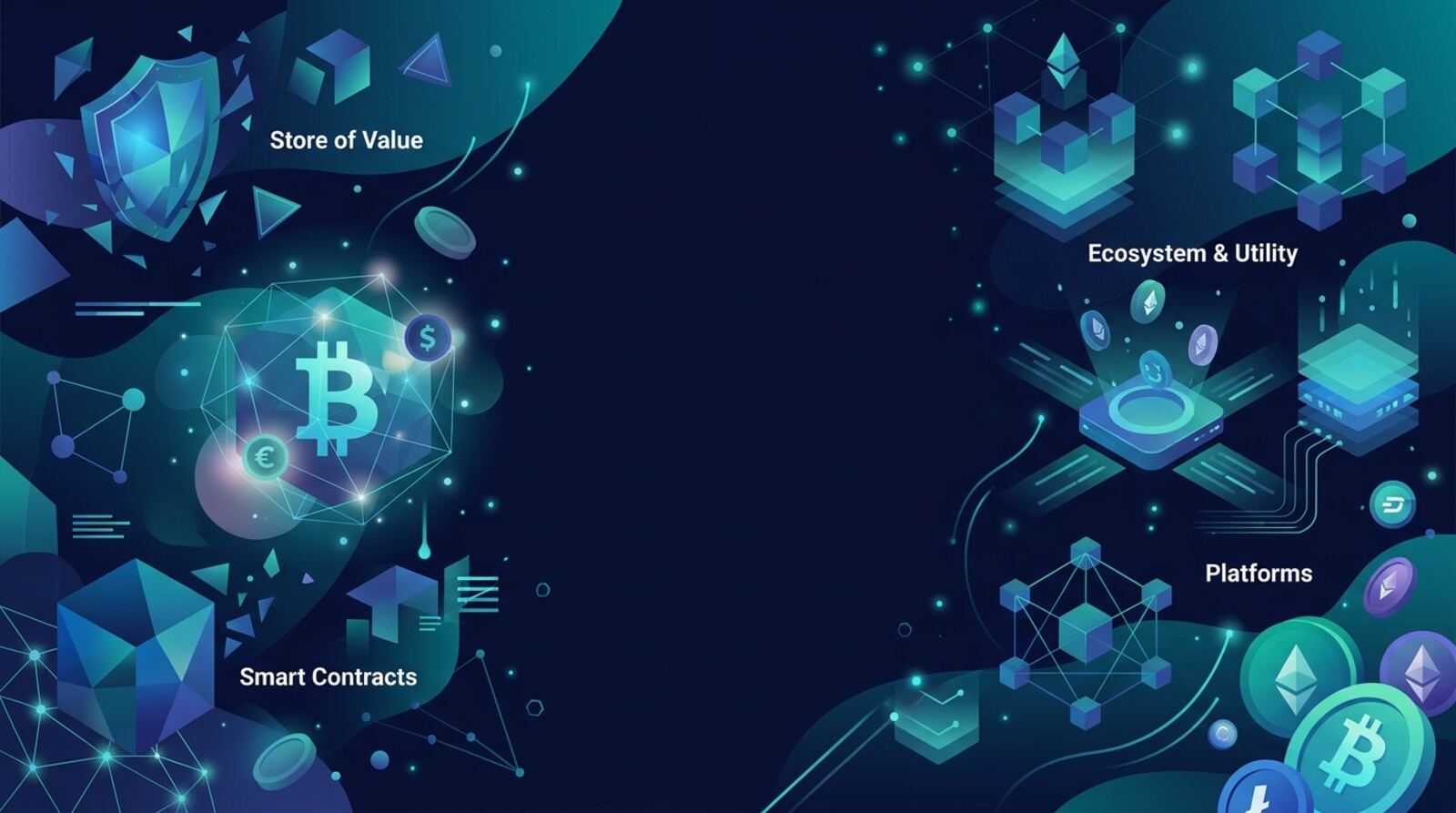
What are the major types of cryptocurrency?
Cryptocurrency is a broad label for digital assets that use cryptography and blockchain networks. The assets do not all serve the same purpose: some are used to pay network fees, some aim to hold a steady value, and others represent access to a service or a claim defined by an issuer.
A useful starting distinction is coins versus tokens. A coin is native to its own blockchain. Bitcoin (BTC) belongs to the Bitcoin network, while ether (ETH) is the native asset of Ethereum. A token is issued on top of an existing blockchain. Many stablecoins, governance tokens, and digital representations of other assets are tokens.
These categories can overlap. ETH is both a network coin and an asset people may hold or trade. A liquid-staking token represents a claim related to staked coins, while a tokenized fund may represent rights set out by its issuer. The label alone does not tell you whether an asset is safe, useful, liquid, or legally redeemable.
The sections below group widely known examples by their main function. Treat the groups as a guide, not a ranking: a project can fit more than one category, and its features may change. Always check the asset’s official documentation and the exact network before sending or buying it.
1. Payment and store-of-value coins
Payment and store-of-value coins are among the earliest cryptocurrency categories. Bitcoin (BTC) is the best-known example. It runs on its own blockchain, has a publicly specified issuance schedule, and caps the total supply at 21 million BTC. People use it for transfers and as a scarce digital asset, though its market price can fluctuate substantially. Litecoin (LTC) is another established network coin designed for peer-to-peer transfers.
These assets are not the same as digital cash issued by a bank or government. Transactions are recorded on their respective blockchains, and users generally control access through private keys or a custodial service. A payment can be difficult or impossible to reverse once confirmed, so the recipient address and network need careful checking.
“Payment coin” describes a use, not a promise that merchants will accept it or that its value will remain steady. Bitcoin’s limited issuance does not prevent price declines, and Litecoin’s presence on an exchange does not guarantee liquidity everywhere. Network fees and confirmation times can also vary.
For any coin, verify the ticker, official network, wallet compatibility, and deposit or withdrawal instructions. Similar tickers and imitation tokens can exist. If you want to spend crypto, also check whether the recipient supports that specific asset on that specific network.
2. Smart-contract and network coins
Smart-contract network coins pay for activity on blockchains that run programmable applications. Ether (ETH) is Ethereum’s native coin; it is used to pay transaction fees, often called gas, and can be used in staking. Solana (SOL) is the native coin of Solana and is used for network fees and staking there. Other blockchain networks have their own native assets and fee systems.
These coins are sometimes called “Layer 1” assets because they belong to the base network. They differ from tokens that use the network. For example, an application token may be issued on Ethereum and require ETH to pay for transactions, even if the token itself has a separate purpose.
A network coin’s usefulness depends partly on the network’s activity, design, security, and adoption. It may also be used in applications for lending, trading, or staking, but those uses add risks beyond the coin’s own price changes. A busy network can have changing transaction costs, and an application can have separate technical or financial vulnerabilities.
Before transferring a network coin, select a wallet and exchange route that support the same blockchain. Sending an asset to an incompatible network or address can result in a loss. Check the live fee estimate and the network’s official documentation; fees and performance are variable, not fixed properties.
3. Stablecoins
Stablecoins are tokens designed to track the value of another asset, most commonly a fiat currency such as the U.S. dollar. Familiar examples include USDC and USDT, which are issued by companies, and DAI and USDS, which are associated with the Sky ecosystem. Stablecoins can be used for transfers, trading, or on-chain applications, but their value is not guaranteed to stay exactly at a target price.
The backing model matters. Some issuers say they hold reserves such as cash or short-term government debt and provide disclosures about those reserves. Other stablecoins rely more on crypto collateral, protocol rules, or market incentives. Each approach has different risks, including reserve shortfalls, a loss of market confidence, collateral volatility, or an inability to redeem directly.
A token’s name does not tell you whether you can redeem it for cash. Redemption may be limited by eligibility, minimum amounts, fees, or location. Some stablecoins are available on multiple blockchains, and versions with the same ticker may not be interchangeable.
Before using one, check the issuer or protocol’s current reserve information, redemption terms, supported networks, and contract address. Sky illustrates a protocol-based stablecoin ecosystem; it is an example, not a guarantee that every stablecoin model has the same backing or protections.
4. Utility and governance tokens
Utility and governance tokens are issued by blockchain applications or organizations. A utility token may be used to access a service or pay for a feature. A governance token may let holders vote on particular protocol proposals. Some tokens combine these roles, but a token’s label does not prove that it has meaningful utility or voting power.
Examples include UNI, associated with Uniswap governance; AAVE, associated with the Aave protocol; and JUP, associated with Jupiter’s Solana-based ecosystem. Their practical functions depend on the rules in force for each project. Holding a token does not automatically mean you own the company, receive a share of profits, or can control every decision.
Governance can involve delegated voting, proposal thresholds, or decisions limited to certain protocol parameters. A token may also have a large supply held by a small number of addresses, which can affect voting outcomes. Utility can be limited if the related service changes, loses users, or stops supporting the token.
Read the project’s documentation and governance forum materials to find out what holders can actually do. Check token supply and distribution information, too. Token contracts can be copied or imitated, so verify the official contract address rather than relying on a ticker or a search result.
5. Staking and liquid-staking tokens
Staking tokens relate to the process of helping secure a proof-of-stake blockchain. A user who stakes a network coin may receive protocol rewards, subject to the network’s rules, validator performance, and any lockup or withdrawal conditions. Staking does not remove the coin’s market risk, and rewards are not guaranteed at a fixed rate.
Liquid staking protocols issue a separate token that represents a position associated with staked assets. For example, Lido issues stETH in connection with staked ETH, while Rocket Pool issues rETH. These tokens can be easier to transfer or use in other applications than a directly staked position, but their market price can differ from the value of the underlying asset. Redemption may take time or depend on protocol and network conditions.
Liquid staking adds risks beyond ordinary staking. These can include smart-contract vulnerabilities, validator or operator failures, changes to protocol rules, and reduced liquidity. Using a staking token as collateral in another application adds further exposure: a problem in either protocol can affect the position.
Before staking, check how rewards are generated, what fees apply, how withdrawals work, and whether the token is accepted by the applications you plan to use. Compare the protocol’s documentation with the blockchain’s own staking rules; a liquid token is not the same thing as a direct deposit or a bank account.
6. Asset-backed and real-world-asset tokens
Asset-backed and real-world-asset tokens represent an interest connected to something outside a blockchain, such as government securities, real estate, or a fund. The blockchain records token ownership or transfers, but the underlying asset and legal rights are governed by an issuer, custodian, fund documents, and applicable law.
BlackRock BUIDL is an example of a tokenized fund backed by U.S. Treasury-related assets and issued through Securitize. Access is subject to eligibility requirements; it is not a general-purpose token that every wallet holder can necessarily redeem. Other tokenized products may have different terms, jurisdictions, and transfer restrictions.
Do not assume that owning a token gives you direct title to a physical asset or an unconditional right to cash. The exact claim depends on the legal documents and structure. Issuer, custodian, settlement, operational, and regulatory risks remain relevant. A blockchain transfer may also be restricted by the token contract or the issuer’s rules.
Before considering an asset-backed token, find the offering documents, identify who holds the underlying assets, and check who is eligible to buy, hold, transfer, and redeem it. Look for current disclosures and the process for handling insolvency or disputes. Tokenization changes how a record is represented; it does not by itself eliminate the risks of the underlying investment.
7. Wrapped and bridged tokens
Wrapped tokens represent another asset in a form that can be used on a different blockchain or in a different application. A wrapped bitcoin token on Ethereum, for example, is intended to track BTC while using an Ethereum-compatible token format. The exact design varies: some versions rely on a custodian holding the underlying asset, while others use a bridge or another mechanism.
The wrapper introduces an extra link in the chain of trust. You may depend on the custodian, bridge operators, smart contracts, or redemption process as well as the underlying asset. If the backing is insufficient, the bridge is compromised, or redemptions stop, a wrapped token may trade below the value of the asset it represents.
Wrapped assets are not the same as native coins, even when they share a ticker or similar name. They can have distinct contract addresses and may only be accepted by certain networks and applications. Sending a wrapped token to a service that expects the native asset can cause a failed transfer or loss of access.
Check the wrapper’s official documentation for its backing, custody or bridge model, proof and redemption process, and supported networks. Confirm that the receiving wallet or application supports that exact token contract. The word “wrapped” describes a representation, not a guarantee of one-to-one redemption.
8. Privacy coins and meme coins
Privacy coins are designed to make some transaction details less visible on a public blockchain. Monero (XMR) uses privacy features to obscure transaction participants and amounts. Zcash (ZEC) supports both transparent and shielded transaction options. Privacy designs differ, and using one does not guarantee that every activity or identity is untraceable. Exchanges may also restrict these assets under their own policies or local rules.
Meme coins are tokens or coins built around internet culture, jokes, or community identity. Dogecoin (DOGE) began as a joke-inspired cryptocurrency and developed a broad community. Shiba Inu (SHIB) is a token that became widely associated with meme-coin culture. Popularity, online attention, or a large community does not establish a coin’s utility or protect its price.
Both groups require attention to the asset’s actual design. Privacy features can be optional or configured differently, while meme assets can be especially sensitive to changing attention and liquidity. A token with an entertaining name may also be an imitation or an unrelated contract.
Check the official project documentation, network, and contract address. For privacy-focused assets, review the laws and exchange policies that apply where you live. For meme coins, be prepared for sharp price moves and check whether you can sell or transfer the asset on the network you intend to use.
9. How to compare and check a cryptocurrency
A category name is only a starting point. Before buying, receiving, or using any cryptocurrency, ask what the asset does, who controls its important features, and what could prevent you from transferring or redeeming it. Review the official documentation rather than relying only on a token name, social-media post, or market listing.
Use this checklist:
- Verify the asset and network. Confirm the official ticker, contract address, and chain. Check that the wallet or exchange supports that exact version.
- Understand the claim. Is it a native coin, a stablecoin, a staking receipt, a governance token, or a claim on an off-chain asset?
- Check supply and control. Look for issuance rules, administrator permissions, upgrade controls, and concentration of ownership or voting power.
- Review exit options. Find out whether the asset can be sold, redeemed, unstaked, or bridged, and what conditions or fees may apply.
- Consider separate risks. Smart-contract, issuer, custody, liquidity, market, and regulatory risks do not disappear because a token is popular.
Prices, fees, available networks, reserve disclosures, and project rules can change. Check the project’s official documentation, issuer disclosures, and the relevant blockchain or exchange interface immediately before acting. Never share a seed phrase or approve a transaction you do not understand.
Frequently asked questions
What is the difference between a coin and a token?
A coin is the native asset of its own blockchain, such as bitcoin on Bitcoin or ether on Ethereum. A token is created on an existing blockchain, such as a stablecoin or a governance token on Ethereum. In everyday conversation, people often use “coin” for both.
Which type of cryptocurrency is best?
There is no single best type for everyone. The right category depends on what you need: a network coin to pay blockchain fees, a stablecoin for a value designed to track a currency, or another token for a specific service or right. Each type has different risks, so learn how it works before using it.
Are stablecoins risk-free?
A stablecoin is designed to keep a relatively steady value against an asset such as the U.S. dollar, but its price is not guaranteed. It can lose its peg because of reserve, liquidity, issuer, market, or technical problems. Check how it is backed and what redemption options are available.
Do governance tokens give holders ownership?
A governance token may give holders voting rights on some protocol decisions, but it does not automatically provide ownership, income, or control over every part of a project. Read the token’s governance rules and documentation to see what holders can actually vote on.
How can I check whether a cryptocurrency is legitimate?
Check the project’s official documentation for the token’s purpose, network, supply rules, and contract address. For stablecoins and asset-backed tokens, also review issuer disclosures, reserve information, redemption terms, and eligibility rules. These details can change, so check them again before a transaction.
Mentioned in this guide
dApps in this guide
Sky is the rebranded MakerDAO, a DeFi protocol issuing the USDS and DAI stablecoins, governed by SKY token holders, for DeFi users and stablecoin holders.
Lido is a liquid staking protocol where users stake ETH and receive stETH, a reward-earning token usable across DeFi, governed by LDO holders.
Rocket Pool is a decentralised Ethereum liquid staking protocol offering rETH for stakers and 16 ETH validators for node operators.
BlackRock BUIDL is a tokenized U.S. Treasury-backed fund issued via Securitize, paying daily dividends to eligible, mostly institutional investors.
Uniswap V4 is the latest Uniswap DEX version with hooks and concentrated liquidity, running on 22 chains for self-custody token swaps and liquidity provision.
Jupiter is a Solana DEX aggregator for traders who want routed swaps, limit orders, DCA, perps and token launches, with its own JUP token.
Aave is an Ethereum-based crypto lending protocol for supplying assets and borrowing against collateral.
Dogecoin is a proof-of-work cryptocurrency used for payments, tipping and charity, aimed at people who hold or spend DOGE.
Shiba Inu is an Ethereum-based dog-themed meme token with a small ecosystem including ShibaSwap, LEASH and BONE, aimed at speculators and community members.
Keep reading
Related guides
Token · Explainer
Types of Cryptocurrency: Coins, Tokens, Stablecoins and More
Cryptocurrencies include native blockchain coins, smart-contract tokens, stablecoins, governance assets, meme coins and more. Learn how these categories differ, where they overlap, and what to check before using or buying an asset.
Token · Explainer
DeFi Governance Tokens and the Next Hype Cycle in 2026
Governance tokens give holders a say in how DeFi protocols run, but their value depends on rights, fee flows and risks that differ from project to project. This guide explains what these tokens do and how to judge them when hype returns.
Token · Explainer
Governance Tokens Explained: How Voting Works in 2026
A governance token gives its holder a say in how a protocol is run, such as fees, listings and treasury spending. This guide explains how the voting works, where it falls short, and what to check before you vote or buy.
Token · Explainer
Is Crypto Dead? How to Judge Its Future in 2026
“Crypto is dead” can mean a market crash, fading public interest, or a technology no one uses. Learn how to tell a painful downturn from a lasting collapse by looking beyond prices at activity, products, risks, and practical signs of demand.
Token · Explainer
MEE Token Explained: Medieval Empires and Its Bybit Listing
MEE is the token of Medieval Empires, a blockchain strategy game whose token was promoted through a Bybit spot listing and trading competitions. This guide explains what the token is, how to check its current status on Bybit and elsewhere, and what to weigh before trading it.
Token · Explainer
Luxxfolio Litecoin Treasury: How It Works, Risks and Data in 2026
Luxxfolio Holdings is a Canadian public company that holds Litecoin as its main reserve asset and has started mining LTC. This explainer covers how a Litecoin treasury company works, what the reported figures do and do not tell you, and what to check before forming a view.
Token · Explainer
MegaCryptoPolis MEGA Token Explained: What It Is and What to Check
MegaCryptoPolis is an Ethereum city-building strategy game whose in-game assets are NFTs. The name MEGA is also used by an unrelated network, so this guide explains what the game is, what the sources confirm about a MEGA token, and how to verify any MEGA token before you buy or trade it.
Token · Explainer
ISO 20022 and Cryptocurrency: What It Means in 2026
ISO 20022 is a standard for structuring financial messages, not a certification for cryptocurrencies. Learn what it does, why some tokens are associated with it, and how to assess claims about crypto adoption.