DeFi · Explainer
How Decentralized Oracle Networks Work
Smart contracts cannot independently check what is happening outside their blockchain. Decentralized oracle networks gather external data, compare reports and deliver results on-chain, but they add their own assumptions and risks.
By the DappsAtlas editorial team · Updated
Why do smart contracts need oracles?
A blockchain can reliably record transactions and run smart contracts according to its rules, but it cannot independently confirm facts from the outside world. A contract cannot directly call a weather service, inspect a bank database or know the current dollar value of an asset. This gap is often called the oracle problem: a contract needs outside information, yet importing it creates a new point where errors, manipulation or outages can enter.
An oracle is the bridge that supplies this information. A decentralized oracle network, or DON, distributes parts of that job across multiple independent data sources, node operators or both. For example, a lending contract might need an asset price to decide how much a user can borrow or whether collateral must be liquidated. The oracle network obtains price observations and makes a value available to the contract.
The important distinction is that an oracle does not make external data inherently true. It provides a process for collecting and reporting it. A network can make it harder for one source or operator to disrupt the result, but users still need to consider where the data comes from, how reports are combined and what happens when the data is late or wrong.
What happens between a data request and an on-chain answer?
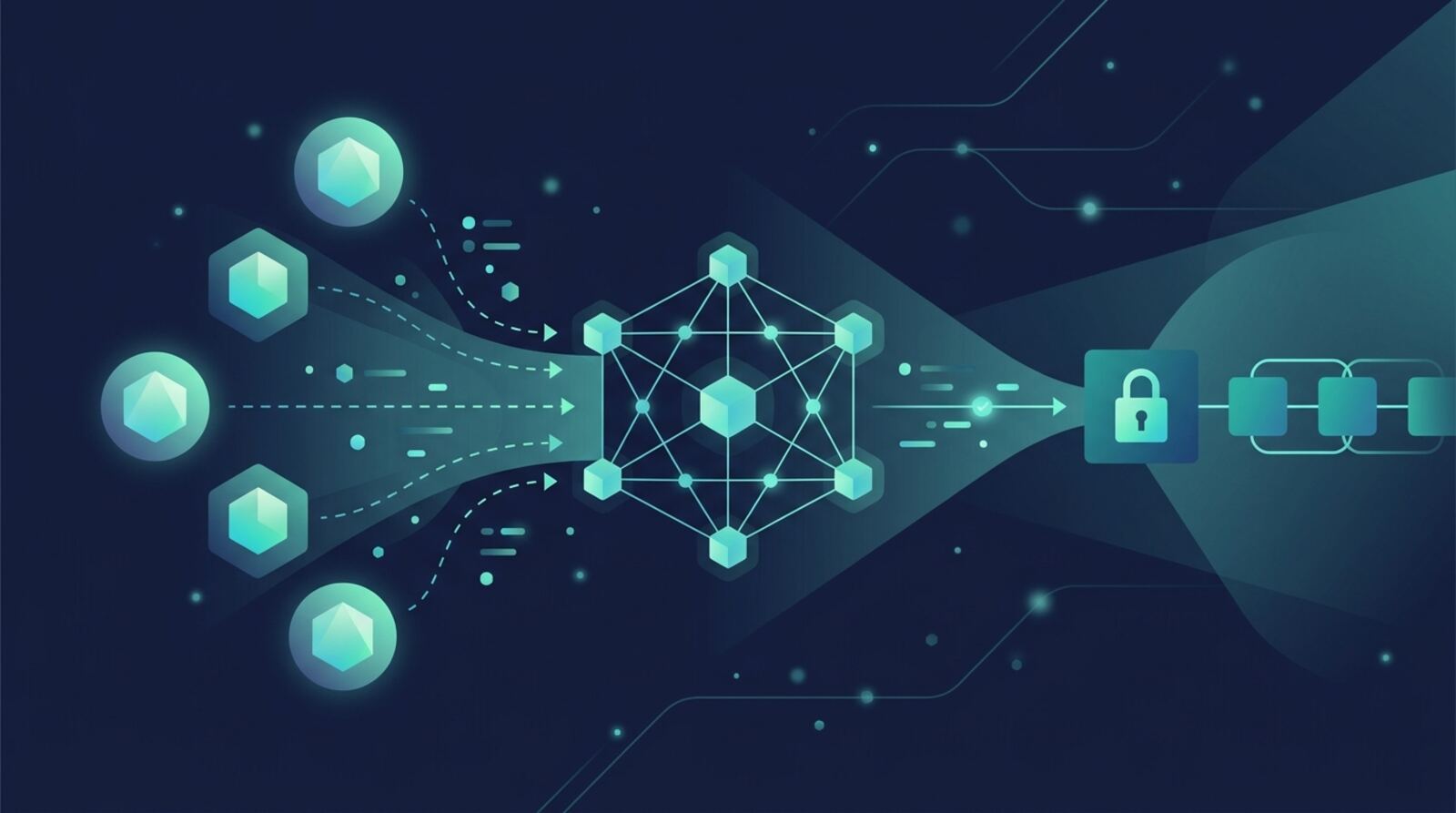
A typical oracle workflow has four parts: a requesting application, data sources, oracle nodes and an on-chain contract. The application defines the information it needs, such as the exchange rate of an asset or the outcome of a specified event. Oracle nodes retrieve observations from configured sources, process them according to the network’s rules and submit reports to the blockchain. A smart contract then reads the report and uses it in its own logic.
For a price feed, sources might include market data services or trading venues. Nodes can query more than one source, check that the response is in the expected format and reject values that fail basic validation. The reports are then combined or checked against a consensus rule. A contract can read the resulting value from an oracle contract rather than asking every data provider itself.
This arrangement separates work that is difficult or impossible to do directly on-chain from the on-chain decision. The oracle handles data acquisition and reporting; the application contract decides what to do with the information. A lending protocol, for instance, may use a reported price to calculate collateral value, while its own code determines borrowing limits. The oracle’s output is only one input into that decision, not a guarantee that the application is safe.
How do oracle nodes reach agreement?
Decentralization can apply to several different layers. A network may use many independent node operators, several data providers, or both. More operators can reduce dependence on one party running the reporting software; more data providers can reduce dependence on one underlying source. These are related but separate protections. Ten nodes querying the same faulty API may still produce ten copies of the same bad observation.
Networks also need a rule for deciding which reports to accept. For numeric data, reports may be compared and combined using a method such as a median or another aggregation rule. A consensus threshold can require enough participating nodes to agree before a report is accepted. The exact design varies: some networks prioritize a robust central estimate, while others may use signatures, thresholds or additional validation steps.
Consensus among oracle nodes does not prove that an external fact is correct. It shows that reports met the network’s acceptance rules. If sources are correlated, manipulated or out of date, nodes may agree on a misleading result. When assessing a network or application, ask how many independent sources and operators contribute, whether they have shared dependencies, and what happens when too few reports arrive or they disagree.
What are push, pull and off-chain oracle designs?
Oracle designs differ in when they send information and where they perform computation. In a push model, a network publishes updates to a blockchain on a schedule or when a configured condition is met. Applications can then read the latest on-chain value. This can be useful when many contracts need a common feed, but updates consume blockchain resources and a published value can become stale if no new report arrives.
In a pull model, an application or user requests or submits a report when it is needed. This can avoid publishing every possible update, but the application must obtain a valid report at the right time and follow the network’s verification rules. Some systems combine approaches or support different services for different data types.
Oracles can also perform off-chain computation, such as aggregating observations or producing a result from multiple inputs, before sending a compact answer on-chain. That can be cheaper than doing all the work in a smart contract, though it shifts some trust to the computation process and its operators. These labels describe broad patterns, not universal standards. To understand a particular feed, check its update conditions, verification method, on-chain contract and what the consuming application does if it cannot obtain a fresh report.
How do oracle networks keep data fresh?
A feed’s usefulness depends on more than the number it reports. It also depends on when the value was observed, how often it is updated and what conditions trigger an update. A scheduled feed may publish at regular intervals. A deviation-based feed may update when the reported value moves enough from its previous value. Networks and applications can use other conditions as well.
These choices involve trade-offs. Frequent updates can make data more current but may cost more to publish, particularly on busy or expensive blockchains. Less frequent updates can reduce costs, but leave a contract using an older value during fast market changes. A feed can also stop updating because of an outage or because conditions for a new report were not met. Applications should check timestamps or other freshness indicators and define what to do with an old value, rather than assuming that the latest stored number is current.
Market prices deserve special care. A token’s last trade on one venue may not represent a broad or fair market price, especially if liquidity is thin. Oracle systems can use multiple sources and validation rules, but the sources and methodology matter. A displayed price in a wallet or on a trading interface is not necessarily the same value, or update schedule, used by a DeFi contract.
What can go wrong with decentralized oracles?
Oracle security is a chain of dependencies, not just a count of nodes. Risks include a compromised data provider, operators sharing the same software or infrastructure, a bug in aggregation code, a vulnerable on-chain oracle contract, or an attacker manipulating a market used as a source. Even a correctly delivered value can be dangerous if the application interprets it incorrectly or fails to handle an outage.
Networks may use independent sources, operator diversity, cryptographic signatures, monitoring, economic incentives or penalties to make attacks more difficult. Some designs allow participants to stake assets or face penalties for certain behavior; this is not universal, and staking does not make bad data impossible. A sufficiently valuable target may still attract attempts to manipulate sources, exploit code or disrupt reporting.
Applications can add safeguards, such as rejecting stale reports, limiting how quickly a value can change, pausing sensitive actions or using fallback procedures. Those protections also involve trade-offs: a restrictive limit might block legitimate updates, while a weak fallback can create another vulnerability. For users, practical checks include reviewing the protocol’s oracle documentation, the feed’s data sources and update rules, and the protocol’s stated response to stale or unavailable data. No oracle setup removes all trust assumptions.
Where are decentralized oracles used in DeFi?
DeFi uses oracle data wherever a contract must act on information it cannot calculate from its own blockchain state. Lending markets need asset values to assess collateral and manage liquidations. Stablecoin systems may use external prices to support collateral accounting or risk controls. Derivatives can depend on reference prices for settlement. Insurance and prediction applications may need a verifiable report about an event or claim.
For example, lending applications such as Aave V3 and Compound V3 use price information as part of risk management, though the exact oracle configuration can differ by asset, market and deployment. Sky’s stablecoin system is another kind of application where external information can be relevant to collateral and system parameters. These examples do not mean that every market has identical feeds or protections; users should inspect the documentation for the specific chain and asset they plan to use.
Decentralized exchanges also generate prices through trades, but an exchange’s spot price is not automatically a robust oracle. A thin pool can be moved by a large trade, and a contract that reads a momentary price may be exposed to manipulation. Some applications use observations over time or external feeds instead. The right design depends on the decision being made, how quickly it must respond and the cost of a wrong answer.
How can you assess an oracle used by a DeFi protocol?
When reviewing a DeFi application, identify what its oracle reports and which actions depend on that report. A collateral price used to trigger liquidation has different consequences from a display-only estimate. Check whether the application documents the feed for the particular asset and network, and whether it uses the same configuration across all markets. Similar token names or assets on different chains may not share the same oracle setup.
Look for these practical details:
- Sources and operators: Are there multiple independent contributors, and might they rely on the same underlying data or infrastructure?
- Freshness: How can you tell when a report was updated, and what does the contract do with stale data?
- Failure handling: Is there a pause, fallback or other documented response if reports stop or diverge?
- Market quality: Does the feed cover a sufficiently liquid market, and are unusual values checked?
- Application controls: Can governance change the feed, its parameters or the assets that depend on it?
A protocol’s interface may show a balance or price without explaining these details. Read its technical documentation and risk disclosures before relying on that value. If key information is not published, treat the uncertainty as a risk rather than assuming that decentralization alone provides protection.
What can oracles solve, and what risks remain?
An oracle network is useful when an application needs information that is not already available in its blockchain state, but it cannot eliminate the need for trust and judgment. It introduces an external-data path and the possibility of failures at each stage: source selection, node operation, reporting, aggregation, on-chain delivery and application logic. The goal is to distribute and manage those risks, not to make them disappear.
Some applications avoid external price feeds for particular functions or use on-chain market data instead. That can reduce reliance on an oracle operator, but it does not make the design automatically safer. On-chain data may be thin, temporary or vulnerable to manipulation, and a protocol still has to decide how to interpret it. Other applications combine multiple feeds or use conservative controls, adding complexity as well as potential resilience.
For a user, the central questions are straightforward: What fact does the contract need? Who or what supplies it? How does the system decide that the report is acceptable? How old can it be before the application reacts? What happens if it is wrong or missing? Understanding those answers helps distinguish a well-documented risk-management design from a claim that an oracle is simply “decentralized.”
Frequently asked questions
What is a decentralized oracle network?
A blockchain oracle is a system that brings information from outside a blockchain to smart contracts, or sends blockchain information to external systems. A decentralized oracle network uses multiple data sources, node operators or both to reduce reliance on a single point of failure.
Are decentralized oracles trustless?
No. Multiple independent sources and operators can make manipulation or outages harder, but the network still relies on software, data providers, economic incentives and governance choices. Decentralization reduces certain risks; it does not guarantee that every report is correct.
Why do DeFi protocols need oracles?
Many DeFi applications use oracle data to value collateral, assess borrowing positions or trigger liquidations. The specific data sources, update rules and fallback mechanisms depend on the application and market, so check the protocol’s documentation rather than assuming every protocol uses the same setup.
What is the difference between push and pull oracles?
A push feed publishes updates to a blockchain when configured conditions are met, while a pull design lets an application request or submit a signed update when needed. Which is suitable depends on factors such as update frequency, transaction costs and how quickly the application needs fresh data.
Can I rely on a token’s displayed price as its oracle price?
Not necessarily. The price shown in a wallet or on a trading interface may reflect a recent trade or estimate, while a DeFi protocol can rely on a distinct oracle feed with its own sources and update rules. Check the protocol’s documentation and the feed’s timestamp and methodology.
Mentioned in this guide
dApps in this guide
Aave V3 is a non-custodial DeFi lending protocol on 21 chains where users earn interest on deposits or borrow against collateral.
Compound V3 is a lending protocol on Ethereum and nine other chains where users supply a base asset for yield or borrow it against collateral.
Sky is the rebranded MakerDAO, a DeFi protocol issuing the USDS and DAI stablecoins, governed by SKY token holders, for DeFi users and stablecoin holders.
Uniswap V3 is a non-custodial decentralized exchange protocol for token swaps and concentrated liquidity provision across 40+ chains.
Aave is an Ethereum-based crypto lending protocol for supplying assets and borrowing against collateral.
Compound is a decentralized lending protocol where users earn interest on deposited crypto or borrow against collateral, governed by COMP holders.
Keep reading
Related guides
DeFi · Explainer
Do People Know What DeFi Is? A Plain Guide for 2026
Many people have heard the term DeFi without a clear picture of what it covers. This guide explains the idea in plain terms, what public evidence suggests about how well people understand it, and what to check before using any DeFi service.
dApp basics · Explainer
2018 Crypto Winter vs 2022 Crash: Key Differences Explained
The 2018 crypto winter was mostly a slow unwinding of the 2017 boom, while the 2022 crash spread through leveraged lenders, a failed stablecoin and collapsing exchanges. This guide explains how the two downturns differ and what each one teaches crypto users.
Token · Explainer
USDC vs USDT: How the Stablecoin Race Is Changing in 2026
USDC and USDT are the two largest dollar-pegged stablecoins, and their rivalry now shapes how traders, lenders and payment firms choose a digital dollar. This guide explains what each token is, why USDC has been gaining ground, and how to check the latest numbers yourself.
DeFi · Explainer
What Is Yield Farming? How DeFi Returns Work
Yield farming means putting crypto to work in DeFi protocols to earn interest, trading fees or token rewards. Learn how the main strategies work, what advertised returns leave out, and how to assess risks before depositing.
DeFi · Explainer
How DeFi Projects Build Stablecoins: Designs, Risks and Examples
DeFi projects use several designs to keep a token near one dollar, including crypto-collateralized vaults, yield-bearing savings tokens and tokens backed by tokenized government debt. Each design fails in different ways, so the mechanism matters as much as the label.
DeFi · Explainer
How Cryptocurrency Staking Works in 2026
Crypto staking supports proof-of-stake networks by putting tokens behind validators that help confirm transactions. Learn how rewards, lockups and liquid staking work, and how to weigh the risks before choosing a method.
DeFi · Explainer
How People Use DeFi to Their Advantage in 2026
DeFi lets people lend, borrow, trade and stake crypto through public blockchain protocols instead of banks or brokers. This guide explains the main ways people use these tools for an advantage, what each one requires, and the risks to weigh first.
DeFi · How-to
How Coinbase Staking Works in 2026
Coinbase staking lets eligible customers delegate supported crypto through a custodial account and receive network rewards, less any applicable Coinbase commission. Learn how to start, what affects rewards, how unstaking works, and the risks to weigh first.