NFT · How-to
Ether NFTs Guide: How to Buy, Mint and Sell on Ethereum
A practical walkthrough of how Ethereum NFTs work, what you need to buy, mint and sell one, which costs to expect, and how to avoid the most common scams.
By the DappsAtlas editorial team · Updated
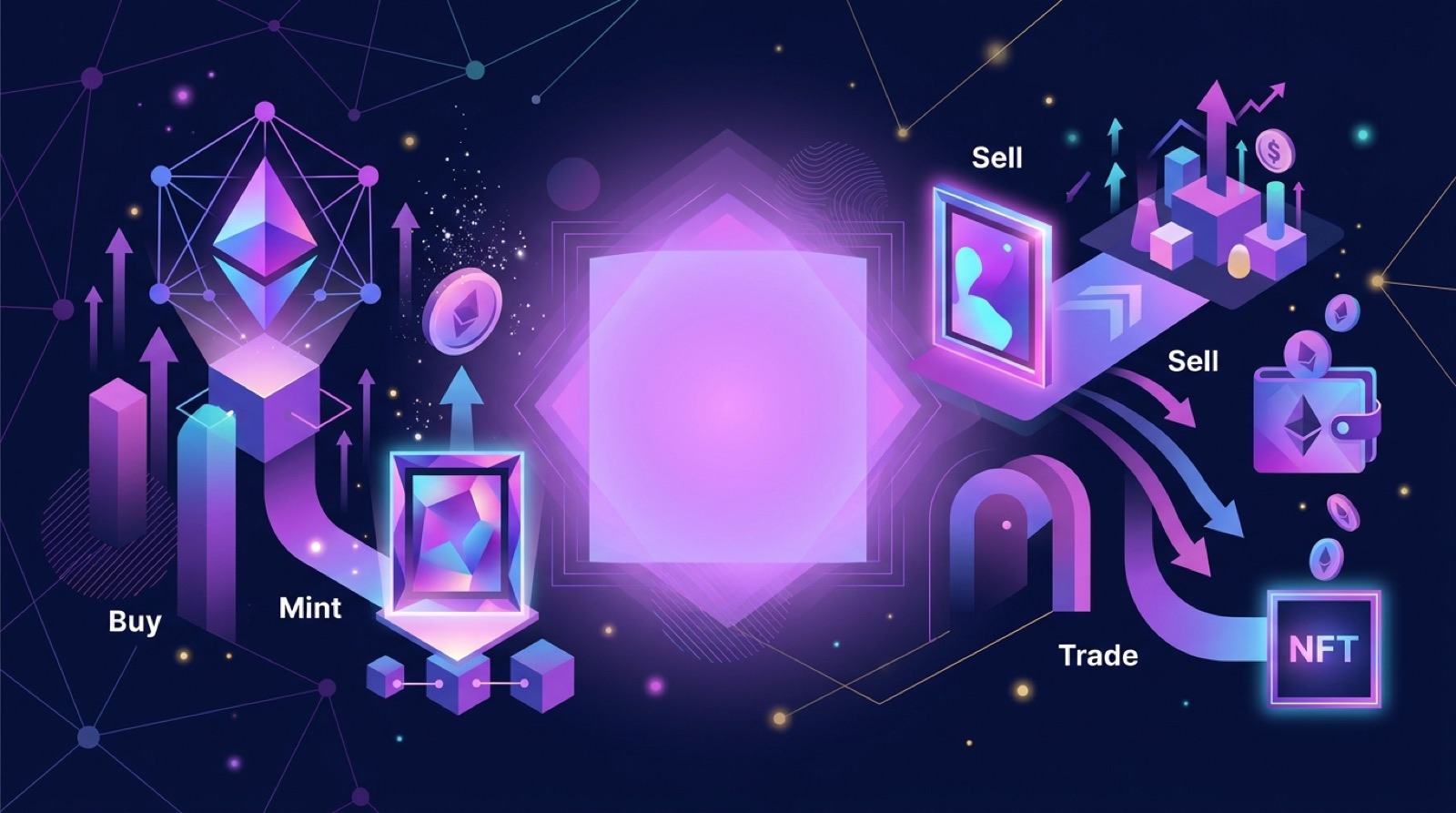
What are Ethereum NFTs and how do they work?
An NFT, or non-fungible token, is a record on a blockchain stating that a specific address owns a specific, unique token. On Ethereum, most NFTs follow one of two standards. ERC-721 gives every token a unique ID inside a contract. ERC-1155 lets a single contract hold many token types, including unique items and multiple identical copies, which suits games and edition-based art.
What you own is the token entry in the contract, not automatically the image, video or file attached to it. Most tokens store a pointer to metadata: a name, description, attributes and a media link. That metadata may live on IPFS, on an ordinary web server, or fully on-chain. The difference matters, because if a server goes offline the token still exists but its picture may stop loading.
Three details identify any NFT:
- Contract address: the smart contract that issued it.
- Token ID: the number of the specific item.
- Network: Ethereum mainnet or another chain.
Names and artwork can be copied, but a contract address cannot be faked. Scam collections often reuse the art of popular projects, so the contract address is the real proof of authenticity.
"Ether NFTs" usually means NFTs on Ethereum mainnet, where Ether (ETH) pays the network fees and prices most listings. Layer 2 networks built on Ethereum have their own NFTs, and a token on one network is not automatically visible on another. Owning an NFT also rarely transfers copyright. Rights to use the artwork depend on the licence the creator publishes.
What do you need before buying an NFT on Ethereum?
Before spending anything, set up the basics properly. Mistakes made at this stage are the hardest to undo.
1. A self-custody wallet. An Ethereum wallet such as a browser extension or mobile app creates an address that holds your ETH and NFTs. When you create it, you receive a recovery phrase of 12 or 24 words. Write it down offline. Anyone who has it controls your assets, and no legitimate marketplace, support agent or project will ever ask for it.
2. ETH for the purchase and for gas. You need enough ETH to cover the NFT price and the network fee. Buy ETH through a regulated exchange available in your country and withdraw it to your wallet address. Send a small test amount first and confirm it arrives, since transfers on Ethereum cannot be reversed.
3. A second wallet for risky activity. Many experienced collectors keep a main wallet, or a hardware wallet, for valuable NFTs and a separate low-balance wallet for minting and trying new sites. If the second wallet is compromised, the loss is limited.
4. Basic checks on yourself. Confirm you meet the minimum age to use these services, usually 18, and that buying and trading NFTs is permitted where you live. Some platforms restrict certain regions or require identity checks, and you should follow those rules rather than look for ways around them.
How do you buy an NFT on Ethereum, step by step?
The process is similar on most Ethereum marketplaces. Here is the sequence, whichever platform you use.
- Find the collection from a trusted source. Start from the project's official channels or a well-known marketplace listing, not from a search ad, direct message or random link.
- Verify the contract address. Open the collection page and compare the contract address with the one published by the project. Check that the collection is flagged as verified, though that badge alone is not a guarantee.
- Connect your wallet. Choose your wallet in the site's connect menu. Connecting only shares your public address. It should not ask for a seed phrase.
- Choose a listing or place an offer. You can buy at a fixed price, bid in an auction, or make an offer below the asking price that the owner may accept.
- Review the transaction in your wallet. Check the total cost, the network, the receiving contract and the gas fee. Reject anything you do not understand.
- Confirm and wait. Once the transaction is confirmed on-chain, the NFT appears in your wallet. This can take from seconds to several minutes.
- Check ownership. Open the token's page and confirm your address is listed as owner.
If a transaction fails, you may still pay a gas fee. Avoid repeatedly resubmitting a purchase without checking the cause.
What does an Ethereum NFT really cost?
The listed price is rarely the whole cost. Budget for each layer before you confirm.
- Gas fees: every on-chain action, including buying, listing, approving and transferring, costs gas paid in ETH. Fees rise when the network is busy and fall when it is quiet, so the same action can cost very different amounts on different days.
- Marketplace fees: most platforms take a percentage of the sale price, usually from the seller. Some charge buyers too, and fees differ by platform.
- Creator royalties: many collections define a royalty paid to the creator on resales. Whether it is enforced depends on the marketplace and the contract, so check the terms on the sale page.
- Slippage and spread: in pool-based markets, the price you pay can differ from the quoted floor, and selling usually returns less than buying costs.
- Currency fluctuation: an NFT priced in ETH changes in fiat value whenever ETH moves.
Gas changes constantly, so do not rely on a number from an article. Your wallet shows an estimate before you sign, and public gas trackers show current network conditions. If the fee looks out of proportion to the purchase, wait.
A useful habit is calculating your break-even. Add the purchase price, both gas fees (buy and later sell), and marketplace and royalty percentages. The result is the minimum sale price needed to avoid a loss.
How do you check an NFT collection is genuine?
Most losses come from buying the wrong thing, not from technical failure. Run through these checks before paying.
Contract and collection
- Compare the contract address across the marketplace, the project's official site and a block explorer. They should match.
- Look at the contract's creation date and deployer. A collection claiming a long history from a brand-new contract is a warning sign.
- Check whether the contract is verified on the block explorer, which lets anyone read its code.
Market activity
- Review trade history. A few wallets trading the same item back and forth at rising prices can be wash trading meant to fake demand.
- Look at the number of unique holders against total supply. Heavy concentration in a few wallets makes the floor price fragile.
- Compare the floor to recent real sales, not to asking prices.
The project itself
- Check who is behind it and whether the roadmap makes specific, verifiable claims.
- Read the licence to see what rights holders actually get.
- Look at where metadata is stored. IPFS or on-chain storage is more durable than a private server.
Red flags
- Pressure to buy immediately.
- Promises of guaranteed returns or airdrops.
- Links arriving by direct message.
- Prices far below the real collection floor.
If you cannot verify a collection, skip it. Missing one opportunity costs far less than a drained wallet.
How do you mint an NFT on Ethereum?
Minting means creating a new token or claiming one from a collection's contract for the first time. There are two main routes.
Minting from an existing collection. Projects open a mint on their own site, often with an allowlist phase followed by a public phase. The steps:
- Confirm the mint page address using the project's official channels.
- Connect the wallet you intend to use, preferably a low-balance mint wallet.
- Check the price, supply limit and per-wallet cap.
- Read the transaction preview, then confirm and pay the mint price plus gas.
Popular mints can see heavy demand, and fees can spike. Fake mint sites are a frequent trick, so never open a mint link from a direct message.
Creating your own NFT. Creators have a few options:
- Use a creator tool or marketplace that deploys a standard ERC-721 or ERC-1155 contract on your behalf.
- Use a lazy-minting service, where the token is only written to the chain when someone buys it, shifting the gas cost to the buyer.
- Deploy your own contract if you have technical skill or a developer, and have it reviewed before launch.
Whichever you choose, upload the artwork and metadata to durable storage such as IPFS with a pinning service, decide on royalties and supply, and keep a backup of the original files. Once a token is minted, its contract logic generally cannot be changed.
How do you list and sell an NFT?
Selling is straightforward but includes a step that surprises newcomers: approval. Before a marketplace can transfer your NFT to a buyer, your wallet must give its contract permission to move that token or collection.
- Open your NFT in the marketplace while your wallet is connected.
- Choose a sale type. A fixed-price listing sells at your price. An auction accepts bids over a set time. You can also accept offers from buyers, including offers across the whole collection.
- Set the price and duration. Check the floor and recent sales so your price is realistic. Remember to account for marketplace fees and royalties.
- Approve the marketplace. The first listing usually requires an on-chain approval that costs gas. Some listings are then signed off-chain and cost nothing until sold.
- Sign the listing. Read the signature request carefully before approving it.
- Wait for a buyer. When someone buys, the transfer happens on-chain and ETH reaches your wallet minus fees.
Two cautions apply. First, a listing is a signed order, so if you move the NFT elsewhere without cancelling, stale orders can cause confusion. Cancel old listings when you change your mind. Second, liquidity varies enormously. Some NFTs sell within minutes, while others never receive a bid. A listed price is not a guaranteed value.
What are the alternatives to a standard marketplace?
Not every NFT trade follows the classic one-buyer, one-seller model. Several protocols try to make NFTs easier to trade, each with its own trade-offs.
Vault and pool markets. NFTX turns NFT collections into vault-backed ERC-20 tokens. You deposit an NFT and receive a fungible token, or use tokens to buy NFTs from the vault. It offers instant trades against a pool, usually at or near the floor, which suits quick exits. The trade-off is that you give up the ability to name a premium for a rare item, and pool fees and pricing apply.
Domains as NFTs. Doma is a DomainFi protocol that fractionalizes web3 domains into tradable tokens on its own layer 2. Domains are a different asset class from art or collectibles, and their value depends on naming, demand and registry rules.
Automated strategies. TokenWorks runs NFTStrategy, an Ethereum protocol of tokens whose trading fees are used to buy, relist and burn NFTs. These products are aimed at experienced, risk-tolerant users. The tokens are speculative, and their performance depends on trading volume and market conditions, not on guaranteed mechanics. Read the documentation and contract details first.
Art marketplaces. Platforms for creators can close. Foundation, an Ethereum art marketplace, is listed in our directory as taken offline indefinitely. Because your NFT lives in your wallet, it still exists, but listings, metadata hosting and creator tools tied to a platform may be affected. Check a platform's current status directly before relying on it.
How do you keep your NFTs safe from scams and drainers?
Self-custody gives you control, and it also makes you the one responsible for security. These are the habits that matter most.
- Protect your recovery phrase. Never type it into a website, send it in chat or store it in a photo or cloud note. Support teams will never ask for it.
- Use a hardware wallet for valuable assets. It keeps keys offline and requires physical confirmation for every transaction.
- Read what you sign. Wallets show warnings for risky requests. Be especially careful with signatures that grant permission over all your NFTs, and with blind signing prompts you cannot read.
- Review and revoke approvals. Each marketplace you use gets a standing permission. Use a token approval checker or your wallet's built-in tools to remove permissions you no longer need.
- Verify every link. Bookmark official sites. Fake minting pages, cloned marketplaces and fake support accounts are the leading cause of drained wallets.
- Be suspicious of unsolicited NFTs. Unexpected tokens in your wallet can carry malicious links. Do not interact with them.
- Separate wallets by purpose. Keep valuable items away from the wallet that connects to new sites.
If you suspect compromise, move remaining assets to a fresh wallet created on a clean device, revoke approvals, and stop using the old address. Act quickly, because attackers often drain wallets within minutes.
How do you store, record and manage NFTs after buying?
Owning an NFT in a wallet is only part of looking after it. A few practical points save trouble later.
Storage and permanence. Know where your NFT's metadata and media live. IPFS and fully on-chain storage are more durable than a centralized server, which can disappear. For NFTs you create, use a pinning service and keep your own copy of the files.
Backups. Back up your recovery phrase offline in more than one secure location. Losing it means losing access, and there is no password reset on a blockchain.
Record keeping. Save transaction hashes, dates, prices in ETH and the fiat value at the time, including gas fees. This helps with tax reporting and with working out your real profit or loss.
Tax and legal basics. Rules differ by country and by activity, such as buying, selling, minting or receiving royalties. Check local requirements and consult a qualified tax professional. Nothing in this guide is tax or legal advice.
Realistic expectations. NFT prices can fall sharply, trading volume can dry up, and many collections lose almost all their value. Only spend money you can afford to lose. Treat NFTs as high-risk collectibles, not as savings.
Where to check current information. Prices, floor values, fees and platform status change constantly. Use a block explorer for on-chain facts, a gas tracker for fees, and a marketplace's own pages for live listings.
What is a safe checklist for your first Ethereum NFT?
Use this as a quick routine before every purchase or mint.
- Wallet ready: recovery phrase stored offline, a test transfer completed, and a separate wallet used for unfamiliar sites.
- Source verified: link reached from official channels, with the contract address matched across at least two sources.
- Collection checked: real trade history, reasonable holder spread, a clear licence and durable metadata storage.
- Costs calculated: price, gas, marketplace fee and royalties added up, with a break-even sale price in mind.
- Transaction reviewed: correct network, correct contract, no unexpected permissions in the wallet prompt.
- Exit considered: a plan for how and where you could sell, accepting that you may not be able to.
- Approvals cleaned up: unused marketplace permissions revoked after you finish.
Common mistakes to avoid:
- Buying because of social media hype or fear of missing out.
- Clicking links in direct messages or replies.
- Paying inflated gas during a crowded mint.
- Confusing an asking price with real demand.
- Putting everything in one wallet.
- Assuming a platform will always exist.
Ethereum NFTs reward patience and verification. If a deal feels rushed, unclear or too good to be true, step back, and remember that you are never obliged to buy.
Frequently asked questions
Are Ether NFTs and Ethereum NFTs the same thing?
No. Ether is the currency used to pay for gas and to price most NFTs on Ethereum mainnet, while the NFT is a separate token held in a smart contract. You can own ETH without owning any NFTs, and you can hold NFTs priced in other tokens.
How much ETH do I need to buy an NFT?
You need enough ETH to cover the NFT price plus the network fee, which varies with network demand. Check the gas estimate in your wallet right before confirming, and keep a buffer for approvals and any failed attempts.
Does owning an NFT mean I own the copyright?
Not necessarily. Owning the token usually means you control that entry in the contract. Rights to the artwork, such as commercial use, depend on the licence the project publishes, so read it before assuming anything.
Can I lose money on an NFT even if it is genuine?
Yes. If the NFT has a listing or a collection offer, you can sell it on a marketplace, but liquidity varies widely. Many NFTs sit unsold for long periods, so do not assume you can exit at the price you paid.
What is the biggest security risk with NFTs?
Both are common scam routes. Never share your seed phrase, be wary of unexpected signature requests, and revoke token approvals you no longer need. Using a separate wallet for minting and a hardware wallet for valuable items reduces risk.
Do I have to pay tax on NFT trades?
Tax treatment of NFTs differs by country and by activity, such as buying, selling, minting or earning royalties. Keep a record of transactions and ask a qualified tax professional in your jurisdiction.
Mentioned in this guide
dApps in this guide
NFTX turns NFT collections into vault-backed ERC20 tokens so users can buy and sell NFTs instantly at floor price against a pool.
TokenWorks runs NFTStrategy, an Ethereum protocol of tokens that use trading fees to buy, relist and burn NFTs, aimed at experienced, risk-tolerant users.
Foundation was an Ethereum NFT art marketplace for creators; the team took it offline indefinitely on April 27, 2026 after a failed sale.
Doma is a DomainFi protocol that fractionalizes web3 domains into tradable tokens on its own L2, for traders and domain owners.
Common is a non-custodial ZK privacy dapp on Arbitrum and Aleph Zero EVM that lets users shield funds and withdraw to a new, unlinkable wallet.
Save, formerly Solend, is a Solana lending and borrowing protocol where users earn interest on deposits or borrow against collateral.
Keep reading
Related guides
NFT · Explainer
How to Buy an NFT and Get Apartment Access in Ethereum Towers
Owning an NFT that is linked to an apartment can grant access rights, but the link between the token and the unit depends entirely on the project's own contract and terms. This guide explains how that setup usually works and what to verify before you pay for an Ethereum Towers token.
NFT · Explainer
Prism NFT Marketplace: How to Create and Collect Curated NFTs
Prism is positioned as a marketplace for creating and collecting exclusive, curated NFTs. This guide explains how that model works, the steps to collect or create, and the checks to run before connecting a wallet.
NFT · Explainer
Ghxsts vs Art Blocks: Reading Top 10 NFT Sales Lists
A headline about Ghxsts taking the spotlight from Art Blocks in a top 10 NFT sales list raises a bigger question: how are these rankings built, and what do they actually tell you? This guide explains the mechanics and how to check any such claim yourself.
NFT · Explainer
Global NFT Financial Regulations Explained for 2026
NFTs do not have one global rulebook. Whether an NFT is treated as a collectible, a security, a payment tool or property depends on how it is built, sold and marketed, and on where buyers and platforms are located.
NFT · Explainer
Ethereum Towers and Its Community: What the Emphasis Means
Ethereum Towers is an Ethereum NFT project whose published materials put shared spaces and social life at the center of its design. This guide explains what that emphasis means, how to test community claims before you buy or join, and what the public sources do and do not confirm.
NFT · Explainer
Does an ETH Price Pump Lift Bored Ape NFT Trading Volume?
A rise in ETH's price can make Bored Ape trading look bigger in dollar terms even when the number of apes changing hands stays flat. This guide explains the mechanics behind the claim of a 100% jump and how to check the numbers yourself.
NFT · Best list
EtherRock, Axie Infinity and The Sandbox in Top 10 NFT Sales
Top NFT sales lists rank single transactions, so an early pixel-art collection like EtherRock can sit beside game-linked and virtual-land assets that work very differently. This guide explains how to read those rankings and verify any sale yourself.
NFT · Explainer
ENS Registration Surges: Why Demand Spikes and How to Register
Ethereum Name Service registrations often jump when a notable sale or event draws attention to.eth names. This guide explains why that happens, how registration, renewal and resale work, and what to check before you pay.