Web3 gaming · Explainer
DeFi Kingdoms in 2026: What the Game Is and How It Works
DeFi Kingdoms is a pixel-art fantasy RPG that combines heroes, quests and a built-in decentralized exchange in one game. This guide explains how it works, what has changed across chains, and what to weigh before you play or hold its tokens.
By the DappsAtlas editorial team · Updated
What DeFi Kingdoms is and why it stands out
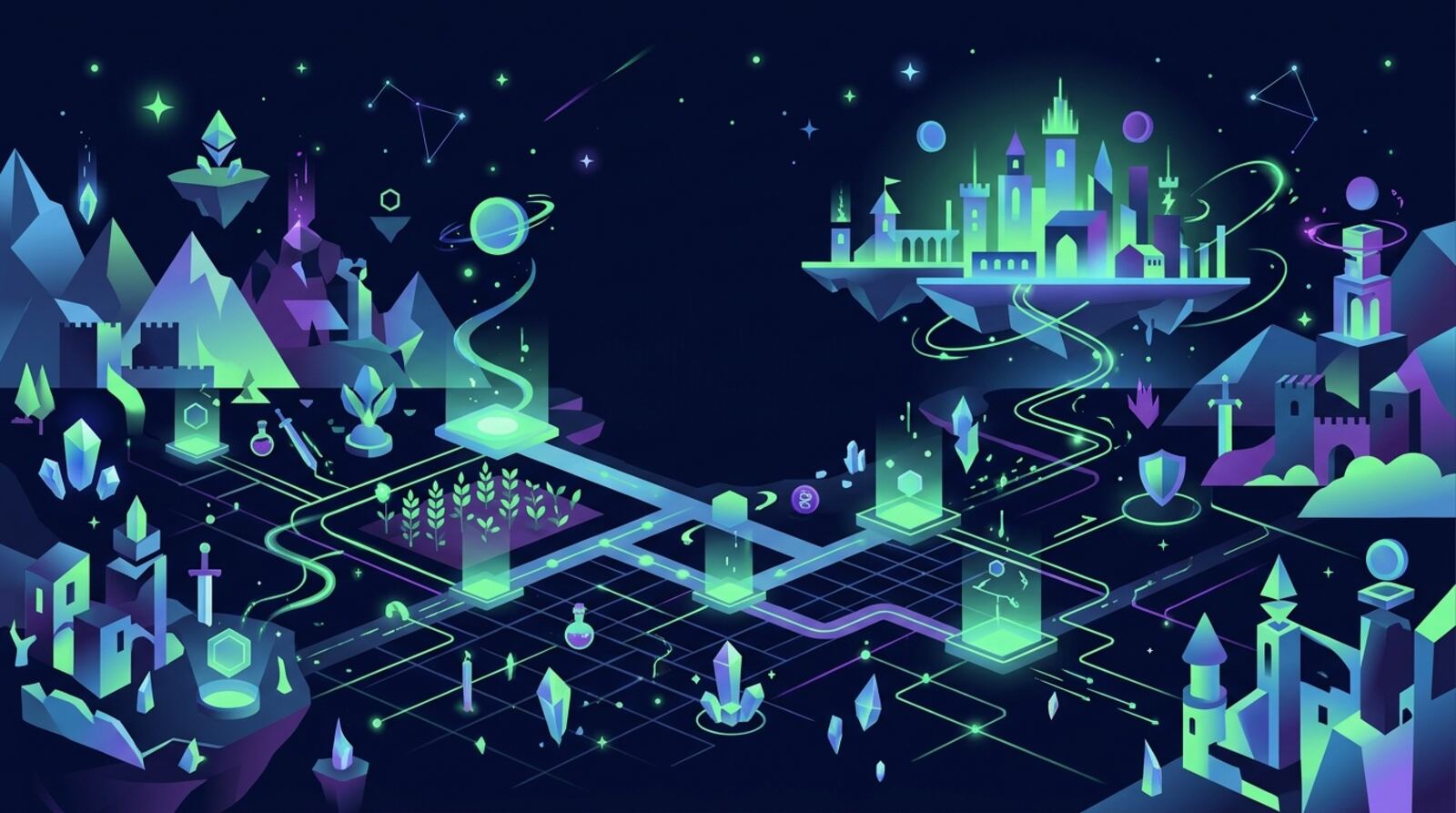
DeFi Kingdoms is a blockchain game set in a pixel-art fantasy world. It borrows the look of a classic 2D role-playing game, with towns, quests, heroes and monsters, and places that familiar layout on top of decentralized finance tools. Instead of a single in-game wallet controlled by the publisher, players connect their own crypto wallet and make each move as a transaction on a public blockchain.
The game is often grouped with other play-to-earn titles, but its core is closer to a decentralized exchange with a game attached. Players can trade tokens, supply liquidity to pools and earn rewards, while also sending characters on adventures. That mix is the reason the project draws both gamers and people who already use decentralized finance.
The term GameFi is used for this category of games, which combine blockchain ownership, financial incentives and gameplay. The label describes a design approach rather than a quality rating. A GameFi title can be well made or poorly made, and its economy can be sustainable or fragile.
For a reader new to the subject, the important point is that DeFi Kingdoms asks you to manage your own wallet, approve transactions and accept network fees. Those features are part of the design, not add-ons, and they shape both the fun and the risk of the game.
How the game works: heroes, quests and the DeFi layer
The game is built around a few connected parts. Heroes are character NFTs that go on quests and gain stats over time. Quests produce rewards, usually in the game's own tokens and items. Crafting and trading happen in a marketplace and a decentralized exchange built into the project. Liquidity pools let players supply tokens to earn fees and reward shares.
A typical session involves checking which heroes are available, choosing a quest or a profession task, and paying the network cost to send the hero out. Once the task finishes, the player collects rewards and decides whether to sell, craft, keep or stake them. Each step is a separate transaction, so a single play session can generate several fees.
The DeFi layer is what separates the project from a conventional fantasy RPG. Token swaps, pool deposits and staking all work like they do on other decentralized exchanges. Players who understand those tools may find the economy easier to read. Players who do not may need time to learn what each button actually does with their assets.
Before you start, read the in-game guides and the official documentation. Confirm which items are tradable, which actions require approval from your wallet, and which fees apply to each one. Small misunderstandings about approvals are a common source of lost value.
Heroes and NFTs: what you own and what it is worth
Heroes are non-fungible tokens, meaning each one is a unique entry on the blockchain. A hero can be bought, sold or transferred like other digital collectibles. Some heroes have rarer traits or better stats, which can affect how well they perform on quests and how much they are worth to other players.
Hero value is driven by supply, demand and the economy around quests. When rewards from quests are strong, heroes that perform well may be in demand. When rewards fall or costs rise, the same heroes can lose appeal. Because prices move with the market, a hero bought at one moment may be worth more or less later.
NFTs in games like this carry the same risks as other digital collectibles. Liquidity can be thin, listing prices may not reflect a real buyer, and a project's direction can change. You should treat a hero as an in-game asset with uncertain value, not as a store of savings.
If you are considering buying a hero, compare recent sale history on the blockchain explorer and on the marketplace you plan to use. Check whether the listing is for the same chain you plan to play on, because assets do not always move freely between networks.
The token economy and what drives value
The project uses its own token, commonly referred to as JEWEL, as a central currency for trades, crafting and rewards. Tokens can be held, swapped or staked in pools, depending on the features available at a given time. Because the token is traded openly, its price reflects market sentiment as well as in-game demand.
A healthy in-game economy needs a balance between rewards that players earn and sinks that remove tokens from circulation, such as crafting costs and fees. When rewards grow faster than sinks, prices often fall. When sinks dominate, players may leave. Designing that balance is hard, and any blockchain game can struggle with it.
This is a good reason to be cautious about any claim that a token will rise. Market prices depend on many factors outside the game, and past activity is not a guide to what happens next. If you hold tokens, consider how much of your total funds they represent and how much you could lose.
To see current figures, use a reputable market data service for price and trading volume, and the blockchain explorer for total supply and recent transfers. Those sources update constantly, so any number in an article like this should be checked before you act on it.
Gas fees and whether playing can pay
Every action on a blockchain requires a network fee, often called gas. Fees vary with network demand and the complexity of the transaction. In a game with frequent actions, such as sending heroes on repeated quests, fees can add up quickly. Several players have publicly said that gas costs made some activities unprofitable, especially when reward values were low.
The practical question is simple: does the expected reward exceed the total cost of fees, time and the value of any assets at risk? Answering it requires current data on fees, token prices and reward rates. Those numbers change, so a fixed answer from an older article is unlikely to help you today.
To estimate your own break-even point, list the transactions you expect to make in a session. Multiply each by the current network fee. Add the cost of any token you spend in crafting or entry. Then compare that total with the rewards you expect to receive at current market prices. Include the time you spend, because that cost is real even if it is not paid in tokens.
Many players find that the game is more about exploration, collecting and social play than about income. If you enjoy the world and its systems, you may accept the costs. If your only goal is profit, the arithmetic may not support it, and you should be prepared for that outcome.
Multi-chain expansion and Crystalvale on Avalanche
DeFi Kingdoms began on one blockchain and has since announced expansion to other networks. The Avalanche expansion, a realm called Crystalvale, is an example of the project taking its game beyond its original home. Cross-chain expansion can bring new players, new assets and new liquidity, but it also adds complexity.
When a game exists on several chains, your assets may be split across them. A hero or token on one network may not be usable on another without a bridge or a specific transfer process. Bridges have their own security risks, and fees for moving assets can be significant. Always confirm where each asset lives before you act.
The official announcements explain which realms are live, which features are available on each chain and what steps are needed to move assets. Read those notes rather than relying on secondhand summaries, since features can be added, paused or changed.
If you play across chains, keep a record of where your assets sit and which wallet controls them. A simple spreadsheet with chain name, asset type and wallet address can prevent costly mistakes, such as sending a token to a network that cannot read it.
Player versus player combat and recent updates
Player versus player combat has been one of the features the project has added over time. Adding competitive modes can change how heroes and items are valued, because some traits matter more in combat than in questing. Launch notes are the place to see how a mode works, what rewards it offers and whether it is still active.
Updates in games like this can alter balance quickly. A hero that was strong last season may be weaker after a patch, and item prices can shift as players react. Following official release notes helps you avoid buying into a meta that has already changed.
The project's history also includes periods of reset and redesign. Commentary on those moments varies widely, and some of it is speculation. Rely on official communication and verifiable on-chain data rather than videos or posts that present forecasts as facts.
A sensible habit is to read the latest notes before each play session, check whether any feature you rely on has changed, and avoid making large purchases right after a major announcement. Hype cycles around game updates often fade, and prices can move sharply in both directions.
Risks to weigh before you play
Blockchain games carry risks that are different from those of ordinary games. Some of the most common are these:
- Asset value can fall to near zero, and there may be no buyer at your expected price.
- Smart contracts can contain bugs, and a contract issue can affect deposited assets.
- Fake websites and phishing messages often copy the look of official pages.
- Network fees can exceed rewards, especially during busy periods.
- Bridges that move assets between chains add their own failure points.
- Project decisions, team changes or shutdowns can alter or end features.
These risks do not mean the game is a scam, and they do not mean it is safe. They mean that the outcome depends on factors you cannot fully control. Treat any funds you put in as possibly lost, and avoid borrowing money to play.
The same caution applies to any game that involves real money or tradable value. Set a budget before you start, decide in advance when you will stop, and keep play separate from your essential finances. If the activity starts to feel compulsive, step back and seek support from a trusted person or a professional service.
How to protect yourself: wallet and account safety
Protecting your wallet matters more than any in-game strategy. Several practical steps reduce the chance of loss:
- Use a dedicated wallet for games, separate from savings.
- Write your recovery phrase on paper and store it offline. Never type it into a website or share it with anyone, including people claiming to be support staff.
- Bookmark the official site and check the address before connecting your wallet.
- Read every transaction prompt. Look at what you are approving, which contract it targets and how much it can spend.
- Revoke token approvals you no longer need, using a reputable approval management tool that reads from the blockchain.
- Keep a small balance in the game wallet rather than your full holdings.
- Be wary of unsolicited direct messages offering help, free tokens or early access.
If you suspect a compromise, move remaining funds to a new wallet you control, using a newly created recovery phrase, and revoke any approvals linked to the old one. Report the incident through official channels and to the platform involved.
None of these steps guarantees safety, but they reduce common failure points. A careful habit now is more useful than a quick fix after something goes wrong.
Where to check current status, prices and rules
Because the game changes, a guide like this should point you to the places where current facts are published. Start with the official project channels for release notes, expansion announcements and changes to heroes, quests and tokens. Official posts are the primary source for what features are live.
Next, use the blockchain explorer for the relevant chain to check token supply, transfer activity and contract addresses. Verify that the contract address you interact with matches the address published by the project. Scam tokens often imitate the names of real ones.
For prices and trading volume, use a market data service that aggregates from multiple exchanges. Compare figures across sources and note the time of each reading. Liquidity matters as much as price: a quoted value may be hard to realize if few buyers exist.
Finally, check the game's own documentation for fees, reward rates and rules. Combine these sources before forming a view. If you cannot verify a claim from at least one primary source, treat it with skepticism.
The most useful habit is to recheck regularly. What was true when you started may not be true next month, and a short review before each session costs little compared with the potential losses from relying on outdated information.
Frequently asked questions
What is DeFi Kingdoms in simple terms?
DeFi Kingdoms is a blockchain game with a pixel-art fantasy world. Players send their Hero NFTs on quests, trade items and tokens, and provide liquidity to pools. The game uses decentralized finance tools, so each action is a blockchain transaction that costs a network fee.
Can you make money playing DeFi Kingdoms?
Not reliably. Earnings depend on token prices, quest rewards, network fees and how much time you spend. Players often report that gas costs can exceed the value of common drops, especially when the network is busy. Treat any play as a cost you may not recover and compare the numbers with current data before you commit funds.
How should a new player approach DeFi Kingdoms safely?
Start with a small amount you can afford to lose. Use a separate wallet for games, write down your recovery phrase offline, and check every transaction before you sign it. Review token approvals regularly and revoke any you no longer need. Confirm that you are on the official site rather than a copy, because fake sites are common in blockchain gaming.
Does DeFi Kingdoms run on more than one blockchain?
The game began on one blockchain and has expanded to others, including an Avalanche-based realm called Crystalvale. Asset values, bridging options and which features are live can change. Check the official announcements and the game's documentation for the current list of supported chains before you move assets.
Where can I check the latest game status and token data?
Check the official project channels for release notes, the blockchain explorer for token supply and transaction activity, and a reputable market data service for prices and trading volume. Those sources change daily, so any figure in an article like this one should be treated as a snapshot and verified before you rely on it.
Mentioned in this guide
dApps in this guide
DeFi Kingdoms is a pixel-art fantasy RPG that wraps a DEX, liquidity pools and Hero NFTs into one game.
Pixels is a web3 farming and exploration game with a PIXEL token, guilds and ecosystem staking, aimed at gamers who are comfortable with wallets and token risk.
Aavegotchi is an NFT collectibles game with a GHST token, originally DeFi-staked and powered by Aave, now moving to Base for players and builders.
Axie Infinity is a Ronin-based NFT game where players collect, combine and battle creatures called Axies, with its own AXS token.
Illuvium is a franchise of interconnected NFT games from Illuvium Labs, including Arena and Overworld, with the ILV token for governance.
Yield Guild Games is a web3 gaming guild that now connects its community to AI companies for human feedback, data and model evaluation work.
Splinterlands is a blockchain collectible card game on Hive where players battle with NFT cards and earn or stake the SPS governance token.
Alien Worlds is a community-built play-to-earn metaverse on WAX where players mine and play to earn TLM tokens and NFTs.
Crystalvale is the Avalanche realm of DeFi Kingdoms, a fantasy RPG with a DEX, liquidity pools and Hero NFTs for crypto-curious players.
Keep reading
Related guides
Web3 gaming · Explainer
DeFi Kingdoms on Harmony: How the GameFi Model Works
DeFi Kingdoms is a pixel-art fantasy RPG that started on the Harmony blockchain and mixes a token exchange, liquidity pools and Hero NFTs into one game. This guide explains how the GameFi model works, what players actually do, and what to check before spending any money.
Web3 gaming · Explainer
DeFi Kingdoms and the 2022 Gaming Token Rally: What Happened
DeFi Kingdoms drew attention in March 2022 when its JEWEL token rose sharply in a weekly ranking of gaming tokens. This guide explains what the game is, what that rally did and did not show, and how to check its current status yourself.
Web3 gaming · Explainer
GameFi 2.0 Explained: Who Leads the Crypto Gaming Battlegrounds
GameFi 2.0 is a loose label for newer blockchain games that put gameplay and sustainable in-game economies ahead of quick token payouts. This guide explains what the term means, how it differs from the first play-to-earn wave, and what to check before you spend time or money on any project.
Web3 gaming · Explainer
CryptoBlades Comeback: What GameFi Players Should Know in 2026
CryptoBlades is a play-to-earn NFT role-playing game that drew attention again, and this guide explains what it is, how its SKILL token rewards work, and how to judge any GameFi revival before you commit time or money.
Web3 gaming · Chain guide
DeFi Kingdoms' DFK Chain: Why the Game Runs Its Own Blockchain
DeFi Kingdoms moved its game to a dedicated chain, DFK Chain, built on Avalanche's subnet technology. This guide explains why a game would run its own blockchain, how it works, what it costs players in trade-offs, and how to use it safely.
Web3 gaming · How-to
Deadrop Game Guide: Access, Gameplay and Safety Tips
Deadrop is Midnight Society's vertical extraction shooter, played so far through limited playtest builds called Snapshots. This guide explains how access works, how a run plays out, and how to avoid scams while you wait for the next build.
Web3 gaming · Explainer
DeFi Kingdoms on Harmony: What the Chart Run Meant in 2026
DeFi Kingdoms became one of the most talked-about blockchain games when it posted strong activity on the Harmony network. This guide explains what drove that attention, what it meant for players, and how to check where the game stands today.
Web3 gaming · Explainer
Dark Country WAX Land Sale: What to Know Before It Opens
Dark Country is a blockchain collectible card game linked to the WAX network. This guide explains what a public land sale usually involves, what the sources available for this topic do and do not confirm, and how to check sale details yourself before spending anything.