dApp basics · Explainer
How to Use a DeFi dApp Discovery Widget Safely in 2026
A dApp discovery widget can help you find decentralized apps, but its rankings are snapshots, not endorsements. This guide explains what these widgets show, how to read their data, and the checks to run before you connect a wallet.
By the DappsAtlas editorial team · Updated
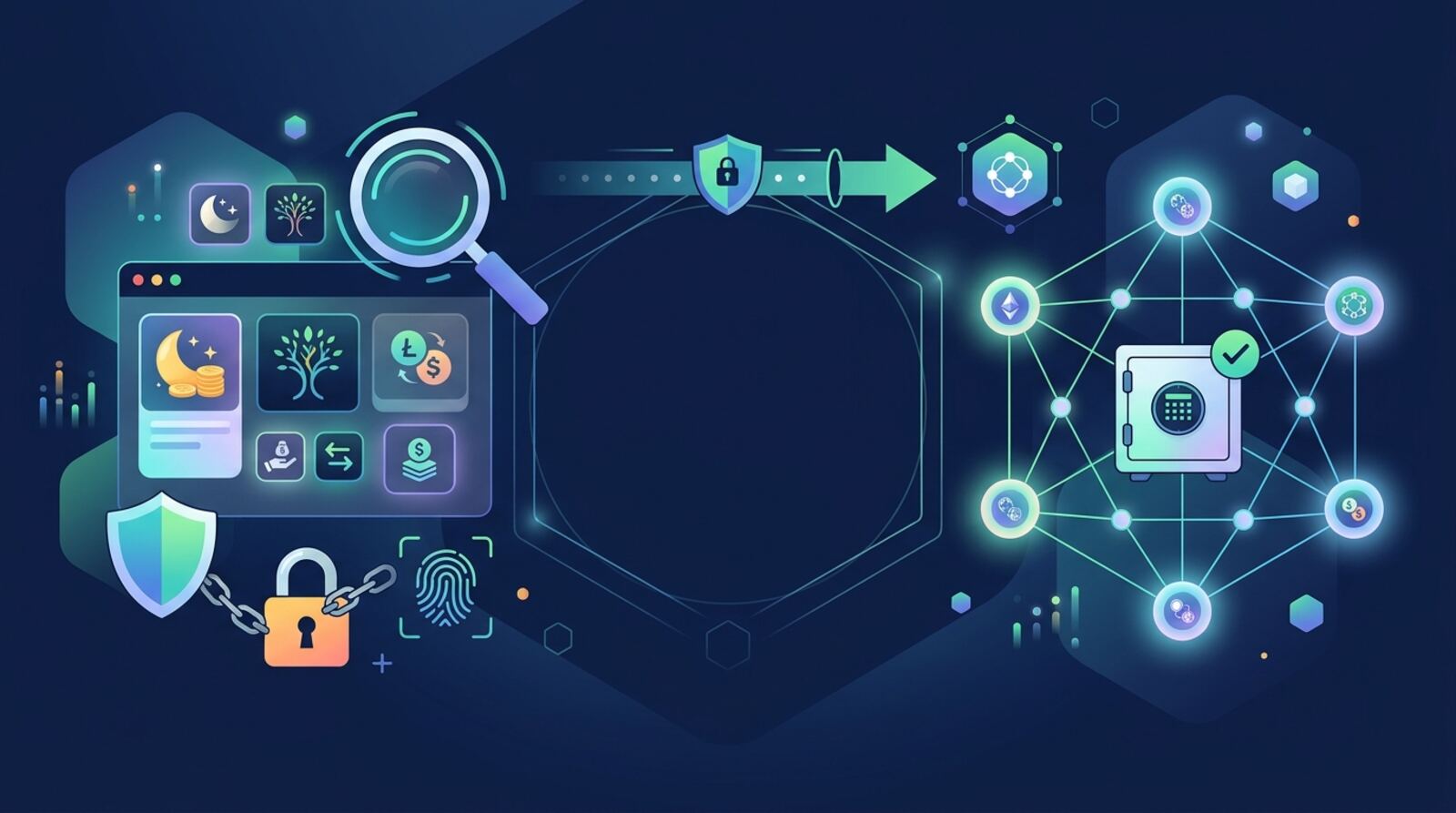
What a DeFi dApp is and where a discovery widget fits
A decentralized application, or dApp, is software that runs on a public blockchain through smart contracts rather than on a company's own servers. Most DeFi dApps are non-custodial, which means you interact with them from your own wallet and keep control of your assets, unless you choose to deposit them into a contract that holds them as part of the protocol's design.
DeFi is the umbrella term for lending, borrowing, trading, staking and similar financial services built this way. A single DeFi product might be a lending market, a decentralized exchange, a liquid staking protocol or an aggregator that routes trades. Each one has its own rules, fees, risks and supported networks.
A dApp discovery widget is a small embedded tool, usually placed on a website, that lists or ranks decentralized applications. It can help you see which products exist in a category, which chains they run on, and roughly how much activity they attract. It does not verify that a product is safe, that its code is sound, or that it fits your goals. Think of it as a starting index for research, and then move on to primary sources.
What a dApp discovery widget actually shows
Widgets differ, but most present a few common fields for each listed application. You will typically see the name, a category such as lending or decentralized exchange, the blockchain or chains it runs on, and one or more activity measures.
The activity measures need careful reading. Users may mean unique wallet addresses, which can include the same person using several wallets. Volume may describe trades routed through a product, not money held by it. Total value locked, often shortened to TVL, measures assets deposited in a protocol's contracts at a given moment, and the price of those assets changes the figure even when the number of deposits does not.
Some widgets also show sorting and filtering options, such as filtering by chain or category. These controls are useful for narrowing a search, but they only change what is displayed. They do not change the underlying risks of any product. Before you rely on a column, find out how the widget defines it, and whether the figure is live, delayed, or a historical snapshot.
Why past rankings are snapshots, not guides
Public reporting sometimes surface older articles that rank decentralized apps by popularity at a particular time. One such result is a July 2020 ranking that named 1inch as the most popular DeFi dApp of that week and noted that 1inch launched in May 2019. The article is useful as a record of what people were using then, but it does not describe the market today.
DeFi activity moves quickly. Incentive programs end, new chains attract users, competitors launch improved versions, and older products lose volume. A protocol that led a list several years ago may be far less used now, or it may have changed substantially in ways the old article could not capture.
When you find a ranking, check three things. First, look for the date the data was collected. Second, confirm whether the product still exists in the same form, using its official documentation. Third, compare against a current source. An old ranking can help you learn what categories exist and how people have used them, but it should not drive a current decision on its own.
How to read popularity without over-trusting it
Popularity measures answer one narrow question: how much activity a product attracted. They do not answer whether the product is well built, well governed, or suitable for your risk tolerance. Keep that distinction in mind as you read any list.
For each product you are considering, look at several independent signals. Check whether the code has been reviewed by independent auditors and whether the audit reports are published. Look at how long the contracts have run without a major security incident, while recognising that a clean history is not a guarantee. Read the governance model to see who can change parameters, pause the system, or upgrade contracts.
Also consider the liquidity and depth of the market you plan to use, the fees you will pay, and how the product behaves when prices fall sharply. A widget can show you which applications are active, but it cannot show you how those applications will handle stress. That assessment comes from documentation, public incident reports and your own careful reading.
A step-by-step way to use a discovery widget
Follow these steps to use a discovery widget as a research starting point rather than a shopping list.
- Note the date and time of the data. If the widget does not show one, treat the figures as unverified.
- Filter by the category that matches your goal, such as lending, swapping or staking, before comparing names.
- Check which blockchains each product runs on, and confirm you have a wallet and assets on that network.
- Open the product's official documentation from a source you trust, not from a link in an advertisement or a direct message.
- Find the contract addresses the project publishes and verify them on the chain's block explorer.
- Review audits, governance details, and any published risk parameters such as collateral requirements or liquidation rules.
- Start with an amount you can afford to lose, and test the process with a small transaction before committing more.
- Record your reasons for choosing a product, so you can review the decision later when conditions change.
This approach takes longer than browsing a ranking, but it reduces the chance that a popular listing leads you into a product you do not understand.
Understanding the main DeFi categories
Discovery widgets often group products into categories. Understanding what each category does makes it easier to judge a listing.
Lending protocols let depositors earn interest and borrowers take loans against collateral. Examples include Aave V3, Morpho and Compound V3. Borrowing against collateral carries liquidation risk if prices move against you, so read how each protocol sets collateral factors and liquidation thresholds.
Decentralized exchanges let you swap tokens from your wallet. Uniswap V3 and V4, Curve and PancakeSwap are examples, and they use different designs, such as concentrated liquidity or pools tuned for similar assets. Liquidity provision carries impermanent loss, which means your position can be worth less than simply holding the assets.
Liquid staking protocols issue a token representing staked assets, such as Lido's stETH or Rocket Pool's rETH. Aggregators, including 1inch and CoW Swap, route or batch trades to seek better execution. Each category has distinct risks, so compare products within a category before drawing conclusions across categories.
Security checks before you connect a wallet
Before you connect a wallet to any decentralized application, run a short security routine. Most losses in this space come from phishing, malicious approvals and compromised devices rather than from a single dramatic exploit.
Use a dedicated browser profile or wallet for DeFi activity, and keep only the funds you need there. Check the domain carefully before signing in. Be cautious of search ads and social media posts that link to lookalike sites.
Read every transaction request in your wallet. Pay attention to the spender address and the amount in any token approval. Unlimited approvals can let a contract move tokens later, so prefer approving only the amount you need and revoke old approvals you no longer use. Revocation tools are available through reputable wallet and block explorer features.
Never share a seed phrase or private key, and never type it into a website or chat. Keep your device updated, use a hardware wallet for larger balances where practical, and enable every security option your wallet offers.
Risks no discovery widget can show you
No widget can tell you whether a smart contract will behave as intended under unusual conditions. Code can contain bugs even after audits, oracles can report wrong prices, and governance can change parameters. Each of these can cause losses.
Market risk is also significant. Collateral can fall quickly, triggering liquidations. Stablecoins can lose their peg. Liquid staking tokens can trade below the value of the underlying asset during periods of stress. Yields can drop to near zero or change because incentives end.
Regulation adds another layer. Rules for crypto assets and DeFi services vary widely by jurisdiction, and some services are restricted in certain places. Check the rules that apply where you live before you use any protocol, and seek qualified advice if you are unsure. DeFi activity is intended for adults, and you should only use funds you can afford to lose. Nothing in a discovery widget is financial advice.
Building your own shortlist from the widget
A practical way to finish your research is to build a short, written shortlist. Start with one goal, such as earning interest on a stablecoin or swapping a token with low fees. Then identify two or three products in the matching category and compare them on the same criteria.
Use a simple table with the columns you care about, such as chains supported, audit status, governance model, fees, and the specific risks you would take on. Fill it in from primary sources and note the date you checked each one. Where a figure changes often, such as TVL or yield, record where you checked it rather than a number that will be stale tomorrow.
Revisit the list on a regular schedule. Protocols change their parameters, add or remove chains, and occasionally sunset products. A discovery widget can prompt you to look at new names, but the decision should rest on the documentation, your own risk limits, and the current state of the market.
Frequently asked questions
Does a high ranking mean a DeFi dApp is safe?
No. A widget shows what a data source has counted, such as users, volume, or total value locked, over a set period. Popularity does not mean a protocol is safe, audited, or suitable for you. Check the protocol's own documentation, audit history, and risk disclosures before using it.
Why do old rankings still appear in public reporting?
Snapshot rankings from a past date reflect that moment only. Activity on decentralized apps can rise or fall quickly as incentives end, new chains launch, or users move to other products. Treat any old list as historical and look for a current timestamp on the data before relying on it.
How can I confirm I am on the real version of a dApp?
Check the protocol's official documentation and the chain's block explorer. Confirm the contract address matches what the project publishes, and be cautious of copies or look-alike names. Typing the official address yourself, rather than following a link from an ad or a message, reduces the chance of landing on a fake site.
Should I ever share my seed phrase with a dApp or widget?
No. A legitimate dApp or support team will never ask for your seed phrase or private keys. Anyone asking for them is attempting to take your funds. Keep these secret, and only approve transactions you have read and understood in your wallet.
Do I need to check local laws before using DeFi?
Rules for crypto and DeFi activity vary by country and region, and some places restrict or prohibit it. Check the rules that apply to you before using any protocol. DeFi use is intended for adults who can afford to lose the funds they put at risk.
Mentioned in this guide
dApps in this guide
Aave V3 is a non-custodial DeFi lending protocol on 21 chains where users earn interest on deposits or borrow against collateral.
Uniswap V3 is a non-custodial decentralized exchange protocol for token swaps and concentrated liquidity provision across 40+ chains.
Lido is a liquid staking protocol where users stake ETH and receive stETH, a reward-earning token usable across DeFi, governed by LDO holders.
Curve is a decentralized exchange on Ethereum built for low-slippage swaps of stablecoins and similar assets, with CRV governance and a crvUSD stablecoin.
1inch is a non-custodial DEX aggregator that routes swaps across many exchanges for better prices, with its own wallet and 1INCH token.
CoW Swap is a DEX aggregator that settles trades in batch auctions, matches opposing orders directly and aims to protect traders from MEV.
Morpho is a decentralized lending protocol with isolated markets, curated vaults and fixed-rate loans for crypto lenders, borrowers and developers.
Jupiter is a Solana DEX aggregator for traders who want routed swaps, limit orders, DCA, perps and token launches, with its own JUP token.
Compound V3 is a lending protocol on Ethereum and nine other chains where users supply a base asset for yield or borrow it against collateral.
Keep reading
Related guides
dApp basics · Explainer
How dApp Detail Pages Improve Web3 Discovery in 2026
A dedicated page for each dApp puts its purpose, networks, activity and risks in one place, which makes it easier to decide whether an app is worth using. This guide explains what to check on those pages and how to read them with care.
DeFi · Explainer
DeFi Aggregators and the Multichain Open Financial Ecosystem, 2026
DeFi aggregators compare routes, prices and yields across many exchanges and blockchains at once. This guide explains how they work, where cross-chain risk comes from, and how to check an aggregator before you use it.
Token · Explainer
How Social Media Moves DeFi Token Prices in 2026
Social media can move DeFi token prices within hours, often before any change in what a protocol actually does. This guide explains the mechanics, the warning signs of manufactured hype, and the checks to run before you act on a post.
dApp basics · Explainer
Crypto Education Sessions: How to Learn DeFi Safely in 2026
Crypto education sessions range from free community talks to paid courses run by exchanges and projects. This guide explains what they usually cover, how to judge one before you commit time or money, and how to practise the basics of self-custody and DeFi without taking on avoidable risk.
dApp basics · Explainer
How to Design Your Own Crypto Economy: Tokens, Incentives and Launch
Building a custom token economy means deciding what the token is for, how much exists, who receives it, and what keeps it useful over time. This guide covers those decisions in order, with the security and legal checks that should come before any launch.
dApp basics · Explainer
Which Dapps Stayed Clear of the FTX Contagion?
The FTX collapse hit centralized lenders, trading desks and some tokens hardest, while non-custodial protocols were affected in different ways. This guide explains how to judge which dapps were exposed and how to check a protocol's current risk yourself.
dApp basics · Review
Diffusion 2019 Highlights: What the Sources Confirm in 2026
Public reporting for this topic do not describe a crypto event called Diffusion 2019, so this guide explains what the sources actually show and how to verify any recap of a past event before you rely on it.
dApp basics · Explainer
DappLaunch and Growth Hubs for Early Web3 Projects: A 2026 Guide
This guide covers DappLaunch as a growth hub for early web3 projects, but the sources reviewed for it did not confirm its current features, so the advice focuses on how to evaluate any launch and growth hub before sharing a dapp, token, contract or community.