dApp basics · Explainer
Blockchain Oracles: The Path to Real Decentralization in 2026
Blockchain oracles bring outside data such as prices and event results onto blockchains. This guide explains how they work, where single-source feeds fail, and the stages that move oracle networks toward real decentralization.
By the DappsAtlas editorial team · Updated
What a blockchain oracle does
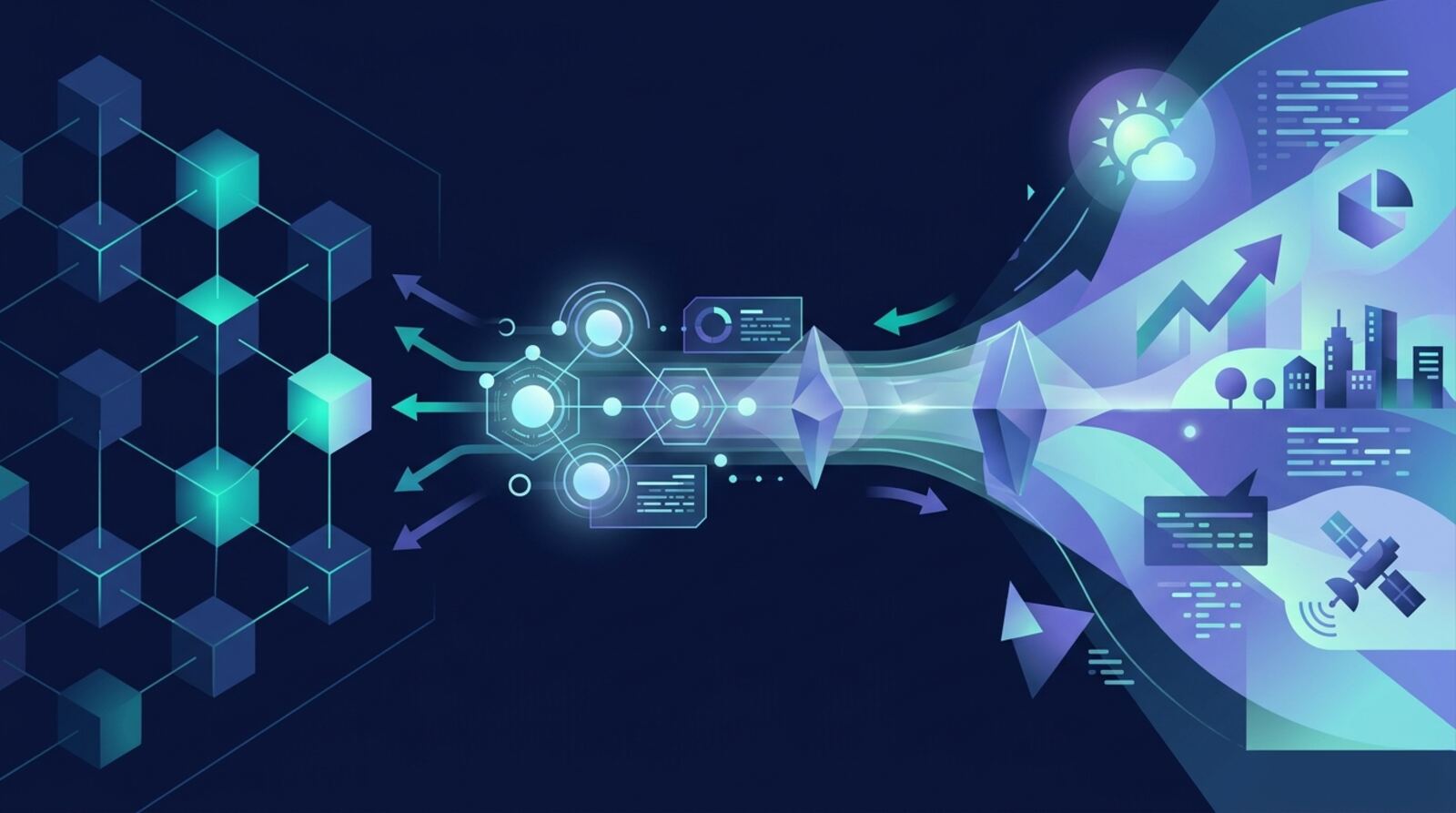
A blockchain is a closed system. Its nodes agree on the state of their own ledger, and a smart contract can read balances, storage and past transactions on that chain. It cannot open a web page, query a stock exchange or check the outcome of a football match on its own. Anything that happens outside the chain is invisible to the contract until someone delivers it.
An oracle is the mechanism that delivers that information. It takes a fact from an outside source, such as an exchange price, an interest rate or a weather reading, and writes it to a contract that other contracts can use. The oracle is therefore a data pipe with a trust decision built in. Whoever controls the pipe decides which values reach the chain, when they arrive and how they are formatted.
This makes oracles central to many decentralized applications. Lending markets use them to value collateral, stablecoin systems use them to check that loans remain over-collateralized, and derivatives platforms use them to settle positions. Insurance and prediction products use them to learn whether a claimed event occurred. Each of these applications inherits the reliability of the oracle behind it, which is why the design of that data layer matters as much as the smart contract code.
Why smart contracts cannot see outside data on their own
Smart contracts are deterministic. Every node that runs the same code on the same inputs must reach the same result, which is what allows a blockchain to reach consensus without trusting any one computer. Fetching an external value breaks that rule, because two nodes might query a web service at slightly different times and receive different answers.
Oracle designs solve this by moving the outside call off the consensus path. A set of reporters fetches the value, signs it and submits it on-chain as a transaction. The chain then treats the submitted number as a fact, since it was recorded and agreed upon. The contract only sees the recorded value, not the original source.
This arrangement creates the core question for every oracle: why should the chain believe the reported value? The answer depends on who the reporters are, how many there are, what they risk if they lie, how their reports are combined and how quickly bad data can be detected and challenged. Each of these choices shapes how decentralized the final feed really is.
How centralized oracles create a single point of failure
The simplest oracle is a single server operated by one company or one developer. It fetches a price from an API and writes it to a contract. This design is easy to build and cheap to run, and early projects often used it. It also creates a single point of failure. If the server goes down, the feed stops. If the API is wrong, the chain receives a wrong value. If the operator is compromised or dishonest, every application that relies on the feed is exposed at once.
A centralized oracle can also be quietly changed. The operator may update the source, adjust the rounding or pause the feed, and users may not notice until a loss has already happened. Readers should treat any feed that cannot be inspected, audited or replaced by the community as a dependency with unknown trust assumptions.
Centralization is not only a technical issue. When a single party controls the data, the apps built on that data inherit its governance, its jurisdiction and its operational risks. A protocol that claims to be permissionless can still depend on a feed that only one team can change. For that reason, mapping which parts of a protocol are centrally controlled is a basic step in judging how decentralized it really is.
Decentralized oracle networks: how they work
A decentralized oracle network spreads the job of reporting data across many independent node operators. Each operator fetches the value from one or more sources, submits its own report and, in most designs, puts something at risk, such as a stake, a reputation or a deposit that can be penalized. The network then combines the reports into one value that becomes the on-chain answer.
The main goal is to make false data expensive. If a single node lies, its report is outvoted by the others. If a majority colludes, the attack is costly and often visible. Many networks also publish the identity of their node operators, their reporting history and their aggregation rules, which lets outsiders check the setup.
Chainlink is one of the best-known examples of a decentralized oracle network and is used by many lending, derivatives and stablecoin systems. Other networks, such as Pyth and API3, take different approaches to sourcing and delivering data. The differences matter in practice. A network with many nodes that all draw from the same upstream API is less decentralized than its node count suggests, because the data source itself is a single point of failure.
Push and pull feeds, and what they cost
Oracle feeds deliver data in two main ways. In a push model, the oracle network writes updates to the chain on a schedule or when the value moves past a set threshold. Applications read the latest stored value whenever they need it. This is convenient for lending markets, because a current price is always available, but it costs gas each time the feed updates, and the stored value can be slightly stale between updates.
In a pull model, the application or user requests a fresh signed value when it needs one, and the signed data is verified on-chain at the moment of use. This can give more current prices and lower routine costs, because updates are only paid for when they are used. The tradeoff is that the application must handle the pull step correctly, and a poorly designed integration can accept stale or unverified data.
Neither model is automatically safer. Readers should look at how a protocol handles update frequency, how it defines a stale price, and what happens if updates stop. A protocol that accepts very old prices during volatile periods can be exploited even when its oracle network is otherwise strong.
Aggregation, first-party feeds and on-chain price sources
Aggregation is where a feed turns many raw inputs into one answer. Common methods include taking a median, which resists a few outliers, and weighting sources by liquidity or by the reputation of the reporter. Good aggregation also rejects reports that deviate too far from the group, and it may fall back to another source when too few reports arrive.
First-party oracles take a different route. Instead of relying on third-party reporters, the data provider runs the node that publishes its own data. This removes one intermediary and can make it clearer who is responsible for a value. The tradeoff is that the reader must trust the provider's own integrity and uptime, so first-party designs are usually strongest when the provider is well known and its data can be cross-checked.
Some protocols also use on-chain sources, such as time-weighted average prices from decentralized exchange pools. These are built from transactions on the chain itself, which avoids an external reporter. However, they can be moved by large trades if the pool is shallow, and a short time window is easier to manipulate than a long one. An on-chain price is only as strong as the liquidity and the averaging period behind it.
The main attack patterns and how they are mitigated
Oracle failures have caused real losses in DeFi. The most common pattern is manipulation: an attacker moves a thin market price, often with borrowed funds in a single transaction, so the oracle reports a distorted value. A protocol that trusts that value may then allow the attacker to borrow too much or liquidate positions unfairly. A widely discussed 2022 incident on a Solana perpetuals platform involved an attacker inflating the price of a thinly traded token used as collateral, which shows how a feed that is technically accurate about its source can still mislead a protocol.
Other patterns include stale data, where updates stop and an application keeps using an old value, and outages, where a single feed becomes unavailable and markets freeze or misprice. Compromised keys, faulty upgrades and bad configuration changes also appear in post-incident reviews.
Mitigations are well understood. Protocols use multiple sources, median or deviation checks, maximum age limits, circuit breakers that pause markets during abnormal moves, conservative loan-to-value settings for thin assets, and time delays on governance changes. None of these removes risk entirely, but together they make attacks more expensive and failures easier to contain. When reading a protocol's risk documentation, check whether these safeguards are present and whether they cover every collateral type, not only the largest one.
What the path to real decentralization looks like in stages
Decentralization in oracles is best understood as a set of stages rather than a yes or no label. An early stage uses one source and one operator, with a team controlling every setting. A second stage adds several operators or several data sources, but the team still controls the list of nodes and the upgrade keys. A third stage places node selection, parameter changes and dispute handling in the hands of a broader group, often through token-holder governance or an open staking system.
A more mature stage includes economic penalties for bad reports, transparent reporting histories, independent monitoring and clear rules for what happens during a dispute. Data sources themselves are diversified, so a single exchange outage cannot distort the feed. Upgrades go through public review and time delays, and users can exit or switch to another feed when they disagree with a change.
The path is not linear, and no network is fully decentralized in every dimension. Readers should ask which layer is the weakest: the sources, the operators, the aggregation, the upgrade keys or the governance. A system that is strong in one layer and weak in another is still exposed through the weak point. The most useful question is not whether an oracle is decentralized, but which parts of it could still fail or be changed by a small group.
How to judge an oracle setup in a DeFi app
A practical review of an oracle setup can be done with a short set of questions. First, which sources feed the price, and are they independent of each other? Second, how many operators report, and are they run by different parties in different places? Third, what aggregation rule is used, and what happens when reports disagree or fall silent? Fourth, is there a maximum age for a price, and does the protocol reject old values?
Fifth, who can change the feed, the list of sources or the risk settings, and is there a time delay or public process? Sixth, does the protocol have circuit breakers, borrowing caps or conservative settings for volatile collateral? Seventh, has the protocol published audits and an incident history, and how did it respond to past issues?
For a lending app such as Aave V3, Morpho or SparkLend, these questions are usually answered in the risk documentation and governance records. For a stablecoin borrowing system such as Liquity V2 or Frankencoin, the collateral and price handling are described in their own documentation, and the answers can differ from a standard lending market. For a decentralized exchange such as Uniswap V3, the relevant question is how pool liquidity and trade size affect the prices other apps might read from it. Answers change as protocols upgrade, so check the current documentation before relying on any of them.
Frequently asked questions
What is a blockchain oracle in simple terms?
A blockchain oracle is a service or network that delivers data from outside a blockchain to smart contracts. Typical data includes asset prices, interest rates, sports results, weather readings and proof that an event happened on another chain. Smart contracts can only read data that is already on their own chain, so an oracle is the bridge that makes outside information usable on-chain.
Does a decentralized oracle always mean the data is trustworthy?
Not necessarily. A feed can be decentralized in how many nodes report data, yet still depend on one data provider, one API or one governance key. True decentralization covers the data sources, the operators, the way values are aggregated and combined, the upgrade controls, and the ability of the community to respond when something goes wrong. Readers should check each of these layers rather than relying on a single label.
How can I find out which oracle a DeFi app uses?
Start with the protocol's documentation or governance forum, which usually names the oracle provider and the price sources it uses. Check whether the feed has multiple independent sources, whether there is a fallback, and who can change the feed settings or pause the market. Public audit reports and incident histories also show how the team responded to past problems. Look for current details rather than relying on older articles, since oracle configurations change over time.
Which types of dApps depend on oracles the most?
Oracle design affects lending, borrowing, stablecoins and derivatives most directly, because these apps liquidate or price positions based on external values. Lending protocols such as Aave V3, Morpho and SparkLend depend on price feeds to value collateral. Liquity V2 and Frankencoin are examples of borrowing or stablecoin systems that handle collateral values differently and should be read on their own terms. A decentralized exchange such as Uniswap V3 is a different case, because its prices come from its own pools rather than an external feed.
What should a user do to reduce oracle-related risk?
Oracle risk can cause losses, forced liquidations or stuck positions, even when the underlying smart contracts work as written. Use only amounts you can afford to lose, read the risk documentation of each market you use, and understand that some protocols can pause markets or change parameters through governance. Gambling and prediction-style products also rely on outside results, so check the rules and the terms before you commit funds. Always check the laws that apply where you live, and remember that crypto products may be restricted or unavailable in some places. You must be 18 or older where the product allows it.
Mentioned in this guide
dApps in this guide
Aave V3 is a non-custodial DeFi lending protocol on 21 chains where users earn interest on deposits or borrow against collateral.
Morpho is a decentralized lending protocol with isolated markets, curated vaults and fixed-rate loans for crypto lenders, borrowers and developers.
Liquity V2 is an immutable Ethereum borrowing protocol where users set their own interest rate and mint the BOLD stablecoin against ETH, wstETH or rETH.
Frankencoin is an over-collateralized, oracle-free Swiss franc stablecoin (ZCHF) on Ethereum for borrowing, saving and payments.
SparkLend is a stablecoin lending market on Ethereum and Gnosis with governance-set rates, backed by Sky's Liquidity Layer, for borrowers and savers.
Uniswap V3 is a non-custodial decentralized exchange protocol for token swaps and concentrated liquidity provision across 40+ chains.
Lido is a liquid staking protocol where users stake ETH and receive stETH, a reward-earning token usable across DeFi, governed by LDO holders.
Chainlink is a decentralized oracle network that supplies real-world data to smart contracts, with the LINK token used to pay for services.
Common is a non-custodial ZK privacy dapp on Arbitrum and Aleph Zero EVM that lets users shield funds and withdraw to a new, unlinkable wallet.
Keep reading
Related guides
DeFi · Explainer
How Bitcoin Halvings Affect Ethereum DeFi Dapps in 2026
A Bitcoin halving does not change Ethereum's supply, but it can still reach Ethereum DeFi through prices, collateral values and market activity. This guide explains the chain of effects and how to check them.
DeFi · Explainer
DeFi Stablecoins After Terra, Tornado Cash and the Ethereum Merge
The 2022 collapse of Terra, the sanctions on Tornado Cash and Ethereum's move to proof of stake reshaped how DeFi stablecoins are designed, collateralized and judged. This guide explains what happened, which designs held up and what to check before you rely on any dollar token in DeFi today.
Blockchain · Comparison
Ethereum vs Cardano: How the Two Blockchains Compare
Ethereum and Cardano are both proof-of-stake smart contract blockchains, but they differ in design history, developer tools, fee models, staking mechanics and ecosystem depth. This guide explains those differences and shows how to check current figures before you choose.
Blockchain · Comparison
Ethereum vs Ethereum Classic: Key Differences Explained for 2026
Ethereum and Ethereum Classic share a history up to 2016 but have followed different paths since then. This guide explains where they split, how they differ on consensus, supply, upgrades and apps, and what to check before you use or hold either one.
dApp basics · Explainer
CBS Ghosts and Decentraland: How to Enter and What to Check
Public reporting found no confirmed CBS Ghosts tie-in with Decentraland, so this guide explains what Decentraland is, how to enter it safely, and how to check for any official Ghosts event there.
dApp basics · Explainer
Blockchain Life Dubai: Who Attends, Past Editions and How to Plan
Blockchain Life is a long-running October forum in Dubai that draws founders, investors, exchanges and regulators from many countries. This guide explains what the event is, how past editions were structured, and how to plan a visit or follow it remotely.
dApp basics · Explainer
What Is a Centralized Crypto Exchange?
A centralized crypto exchange is a company-run marketplace that lets customers buy, sell, and trade digital assets through accounts managed by the platform. Learn how custody, order matching, fees, and risks work before choosing one.
dApp basics · Explainer
Blockchain Life Dubai, October 2025: What It Was and What's Next
Blockchain Life's 15th anniversary forum took place in Dubai on October 28–29, 2025. This guide covers what the event was, how its attendance figures compare, what the 2026 edition looks like, and how to attend a crypto conference safely.