NFT · Explainer
Banksy AAChoo NFTs on Solana: What Sold Out and What to Know
A sold-out Banksy AAChoo NFT drop on Solana through the VooVoo marketplace raises questions about what was sold, how the sale works, and what buyers can check now. This guide explains the process and the verification steps that apply to any artist-linked NFT drop.
By the DappsAtlas editorial team · Updated
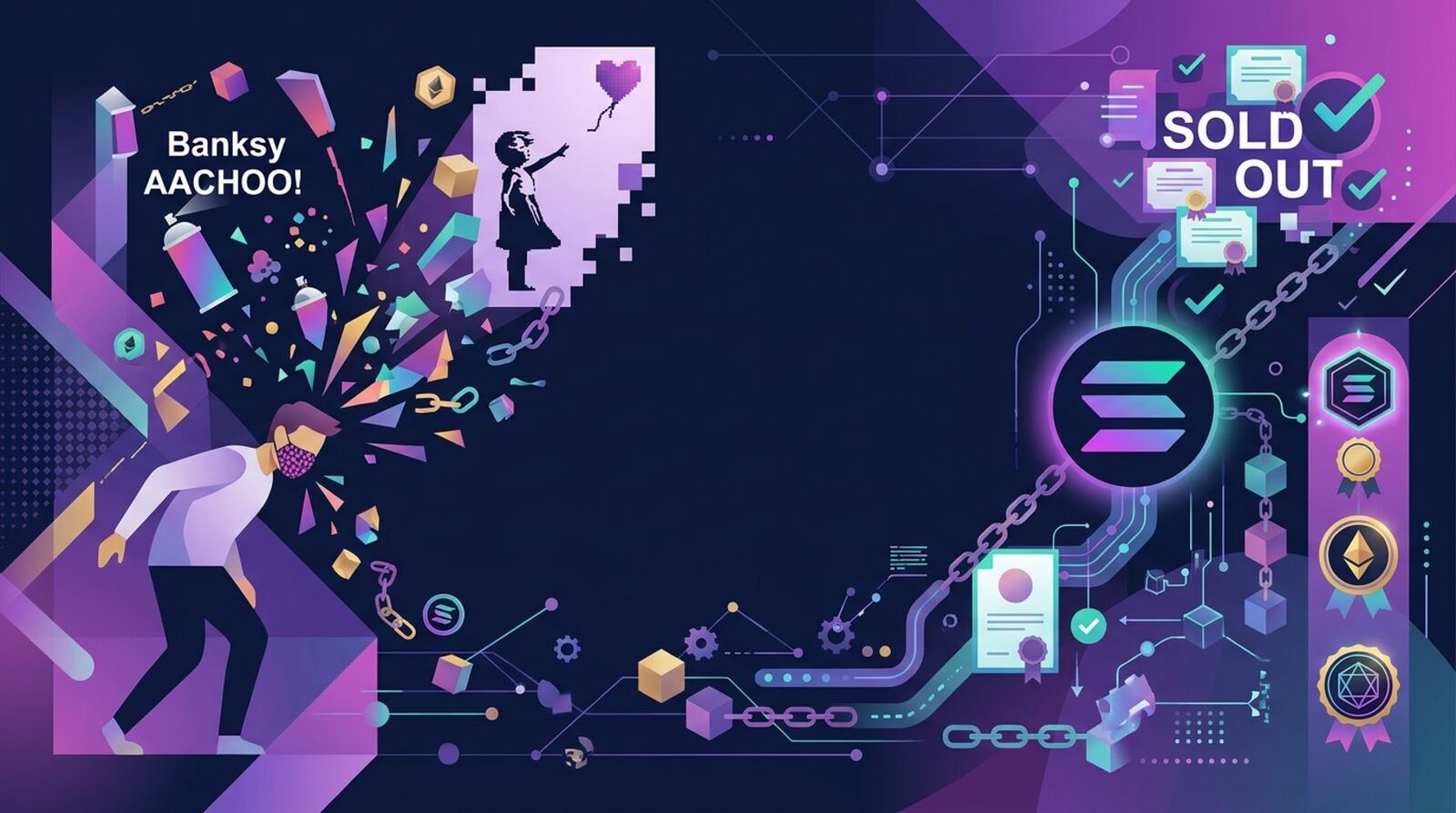
What the Banksy AAChoo sell-out on Solana was
The Banksy AAChoo drop refers to an NFT sale of an artist-linked digital item on the Solana blockchain, offered through the VooVoo marketplace, that sold out. Banksy is an anonymous British street artist whose physical works are widely known, and his name is often used in digital collectibles that have no direct involvement from the artist. Any NFT that uses an artist's name needs verification before buying.
The details available for this guide did not clearly confirm the drop's total supply, mint price, exact sale date or the precise rights attached to each token. Because those facts can change or may be reported differently across sources, this guide does not state them as settled. Instead, it explains what a sold-out Solana NFT sale usually means and how a reader can confirm public sources directly.
A useful way to read the event is to separate three questions. First, was the sale run by the artist or an authorized party? Second, what does each token actually give the holder, such as a digital image, a licence, or nothing beyond a record of ownership? Third, is the sale still the only source of supply, or does a secondary market now set the price? Answering these questions gives a clearer picture than the phrase sold out alone.
How a sold-out NFT drop on Solana works
A sold-out Solana NFT sale usually means the total number of tokens offered in the primary mint was purchased. The mint is the initial sale where the collection's tokens are created and sold to buyers. Once the supply is exhausted, new tokens cannot be minted unless the project has built in a further release.
Solana NFTs commonly follow a set of steps:
- The creator deploys a collection, often using a metadata standard that links each token to an image or file.
- A sale page opens, and buyers pay with SOL or another accepted token from a connected wallet.
- Each purchase creates or transfers a token to the buyer's wallet address.
- Once the supply runs out, the sale closes, and the tokens can then trade on secondary markets.
Solana sales can sell out quickly because transaction costs are low and many buyers try to purchase at the same moment. Quick sell-outs do not confirm the value of the items or the reputation of the seller. Some drops are heavily promoted, and some sell out with little public attention. Check the seller's history and the collection's stated purpose before reading meaning into the speed of a sale.
Where VooVoo fits among Solana NFT marketplaces
VooVoo is named in this guide as the marketplace where the sale took place. Public reporting used for this article did not provide enough verified detail about its fee structure, listing rules or how it handles disputes, so this section does not describe those features as fact. Readers should read the platform's own terms and fee schedule directly.
When assessing any NFT marketplace, several questions are useful to ask. Does the platform show the collection's contract or mint address clearly? Are the seller's and creator's details shown, and are they consistent with the artist's official channels? How are royalties handled on resales, and are they enforced? Does the platform give clear records of each sale? What happens to listed items if the marketplace stops operating?
Marketplaces change. The Foundation Ethereum art marketplace, for example, was taken offline indefinitely by its team on April 27, 2026, after a failed sale, which shows that a platform's status can change quickly. Before depositing funds or relying on a marketplace for future trades, check its current status through its own announcements and independent sources. Keep a record of your purchases, including transaction hashes, so you can prove ownership if a platform closes or changes its systems.
Why a sold-out drop does not set the price
A sold-out label does not set a value. Prices on secondary markets depend on what buyers are willing to pay, how many tokens are listed, the rights attached to each item, and the fees charged by the platform. A token that sold out at a certain price may trade higher or lower later, and some sell well below its original price.
To understand a collection's trading activity, look at several sources that show recent sales, listing counts and floor prices. The floor price is the lowest listed price for any item in a collection at a given time, and it can move sharply when supply is thin or demand drops. Check the platform's own sale history and independent data tools, and note the date of each figure because these numbers change often.
Royalties are another factor. Some marketplaces enforce creator royalties on resales, while others make them optional. If royalties are not enforced, the creator may receive less from later trades, and that can change how the project is run. Read the marketplace's royalty policy before relying on any expected income from a resale.
No figures in this guide describe current prices. Anyone considering a purchase should check live data on the day of the trade, and should treat NFT trading as a high-risk speculative activity in which losses are possible.
Wallet and transaction safety for drops
Buying NFTs on any chain involves wallet security risks. Scammers often copy real project names, create fake sale pages and send urgent messages that push buyers to sign transactions quickly. The safest approach is to slow down and check each step.
Practical defensive steps include:
- Use a separate wallet for NFT purchases and keep only the funds needed for the trade in it.
- Never share your seed phrase or private key with anyone, including people claiming to be support staff.
- Type or bookmark the marketplace address yourself rather than following links from messages or ads.
- Read every signing prompt. Be cautious of requests to approve unlimited token spending or to sign a message you do not understand.
- Revoke token approvals you no longer need using a reputable wallet permission tool.
- Keep your device and wallet software updated and avoid installing unknown browser extensions.
If you suspect a compromise, move remaining assets to a new wallet created on a device you trust, and report the incident to the platform and your wallet provider. Do not send funds to anyone offering to recover lost assets, since recovery scams are common after a loss.
Tools and marketplaces for comparing NFT sales
Several tools and marketplaces can help readers compare NFT sales and understand trading activity. The candidates below cover different parts of the market, and none of them is a guaranteed source of accurate pricing. Use more than one source and check dates on every figure.
Sudoswap V2 is a decentralized NFT marketplace on several networks, with on-chain royalties and ERC-1155 support, aimed at NFT traders. NFTX turns NFT collections into vault-backed ERC20 tokens so holders can trade at a floor-based price against a pool, which is a different model from a fixed-price drop. Courtyard is a marketplace and tokenization service for vaulted, insured physical collectibles, which may be useful for readers interested in tokenized assets rather than digital art.
Foundation was an Ethereum NFT art marketplace for creators. The team took it offline indefinitely on April 27, 2026, after a failed sale, so it should not be treated as an active venue. If you hold assets tied to a closed platform, check the team's official announcements for any instructions about access or withdrawal.
When using any marketplace, confirm that it supports the token standard of the collection, understand its fee structure, and keep your own records of each transaction.
What to do now if you missed the drop
If you missed the sale, the most useful step is to check whether any official follow-up exists. Some collections release further editions, reveals or additional mints, and those would appear on the artist's or project's official channels. Subscribe to those channels rather than relying on secondary market listings or unverified accounts.
After that, review the secondary market with a cautious approach. Compare the listing price with recent sales, consider the rights that come with the token, and check whether the seller is a verified holder. Avoid rushed decisions based on urgency messages, because pressure is a common scam tactic.
If you decide to buy, limit the amount you spend, use a dedicated wallet, and keep proof of the purchase. If you decide not to buy, you can still learn from the event. Note how the verification process worked, which questions you asked, and where the information was unclear. Those habits apply to every future NFT drop.
NFT trading and collecting carry significant financial risk, and you could lose the full amount spent. Check your local laws on digital assets and speculation before taking part, and only spend money you can afford to lose.
Frequently asked questions
What does sold out mean for an NFT drop?
A sold-out label means every unit offered in that sale was purchased, so no more can be bought from the original sale. Secondary markets may still list items, and resale prices depend on what other holders accept. Check the collection's official channels for any later mint or reissue before assuming the supply is closed.
How can I check whether a Banksy-linked NFT is genuine or licensed?
Verify the artist's or estate's official announcements and confirm the collection contract address on a Solana explorer. Compare that address against what the marketplace lists. Be wary of listings that exist only on social media or in direct messages.
Does a sold-out drop mean the NFTs will rise in value?
Not necessarily. Resale prices depend on demand, the rights attached to the item, and the marketplace fees. Look at recent sale history on several sources and compare it with the original mint price before deciding.
What wallet safety steps matter when buying a sold-out drop?
Use a dedicated wallet for NFT purchases, keep only the funds you need in it, and never share your seed phrase or approve signatures you do not understand. Read each transaction prompt before signing, and check the site address carefully. Phishing sites often copy real marketplace names.
Which other NFT marketplaces could I compare with VooVoo?
Explore Sudoswap V2 or NFTX for general NFT trading, and Courtyard if you are interested in tokenized collectibles. Foundation was a creator-focused Ethereum marketplace that the team took offline indefinitely in April 2026, so it should not be used for new purchases. Always check current status before depositing funds anywhere.
What can I do now if I missed the sale?
Check whether the NFT is listed on secondary markets, verify the current sale history, and sign up for official collection announcements in case of a later mint. Keep your expectations realistic and treat any purchase as a speculative decision. Gambling and speculation rules vary by location, so check your local laws before trading.
Mentioned in this guide
dApps in this guide
Sudoswap V2 is a decentralized NFT marketplace on Ethereum, Base, Berachain and Arbitrum with on-chain royalties and ERC-1155 support, for NFT traders.
NFTX turns NFT collections into vault-backed ERC20 tokens so users can buy and sell NFTs instantly at floor price against a pool.
Courtyard is a marketplace and tokenization service for vaulted, insured physical collectibles such as graded trading cards, sold via digital packs.
Foundation was an Ethereum NFT art marketplace for creators; the team took it offline indefinitely on April 27, 2026 after a failed sale.
Keep reading
Related guides
NFT · Explainer
How Banksy NFT Drops Sell Out on Solana: A 2026 Guide
Banksy-linked NFT drops that sell out quickly raise questions about authenticity, marketplace rules and buyer protection. This guide explains how Solana sellouts work, what public sources do and do not confirm about AAChoo and Voovoo, and how to verify any Banksy-related sale before you spend money.
NFT · Explainer
Why a Bear Market Can Delay an NFT Music Drop in 2026
A bear market can push back an NFT music launch even when the brand is strong, because lower prices, thinner trading and weaker demand all change the economics of a drop. This guide explains the mechanics, what the public record does and does not confirm about the BAYC Music Group delay, and how readers can check status safely.
NFT · Explainer
Beeple's $69 Million Christie's NFT Sale: What It Shows in 2026
Beeple's 2021 Christie's sale was a single JPG-style digital file sold as an NFT for $69.3 million. Here is what was sold, why the price drew so much attention, and what the sale does and does not show about NFTs.
NFT · Explainer
Beeple's $28.9M Christie's Sale: What Human One Was
Beeple's $28.9 million Christie's sale in the 21st Century Evening Sale was for Human One, a physical sculpture tied to an NFT, not a plain digital file. This guide explains what was sold, how it differs from his 2021 Everydays sale, and what buyers and collectors should check before paying for a similar piece.
NFT · Explainer
BAYC Music Group and the Delayed First Drop: What to Know
A bear market can push back an NFT project's first release even when the team has a plan. This guide explains how that happens with BAYC Music Group, what public records do and do not confirm, and how holders and fans can check a launch date for themselves.
NFT · Explainer
Azuki NFTs Explained: What They Are and How They Work
Azuki is a 10,000-piece anime-styled NFT collection on Ethereum from Chiru Labs. This guide covers its origins, the Beanz and Elementals spin-offs, what ownership means, and how to approach buying one safely.
NFT · Explainer
Azuki and Floor-Priced NFT Launches Explained for 2026
Azuki's 2023 Elementals launch and the price drop that followed show how new NFT drops can pull down the floor of an existing collection. This guide explains the mechanics and gives a checklist for judging launches priced near the floor.
NFT · Explainer
What the Azuki Elementals Crash Teaches About Blue-Chip NFT Risk
Azuki's June 2023 Elementals launch is the best-documented recent case of a blue-chip NFT sell-off, and the sources here do not confirm the same weekend for The Captainz. This guide explains what happened to Azuki, why floor prices fell so fast, and how to check current market data yourself.