Web3 gaming · Explainer
How Aavegotchi NFT Owners Farm GHST Tokens in 2026
Aavegotchi owners can earn GHST, the game's token, through staking and in-game play. This guide explains how those routes work in general, what costs and risks to weigh, and where to check current rates and network status.
By the DappsAtlas editorial team · Updated
What Aavegotchi is and where GHST fits
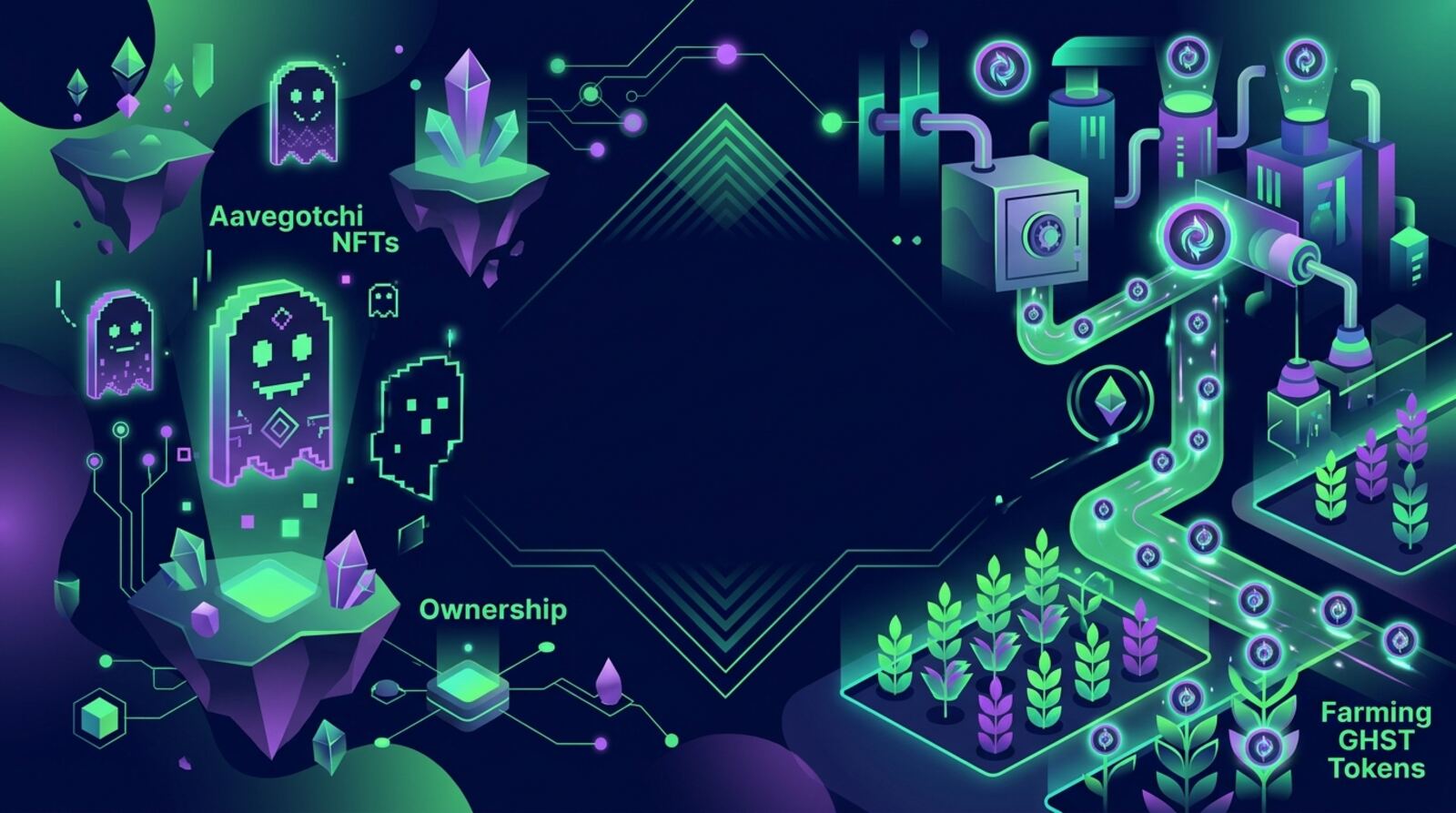
Aavegotchi is an NFT collectibles game in which each playable character, called a Gotchi, is a unique digital asset that its owner holds in a crypto wallet. The game is built around a token called GHST, which players use in the ecosystem and which holders can earn through several routes. The project began with a link to decentralised finance, and its early design used collateral and lending concepts tied to Aave. That history still explains why many owners think of their Gotchis as productive assets rather than only as collectibles.
For a reader new to the topic, the key idea is that owning a Gotchi is not the same as owning a token. The Gotchi is an NFT, and GHST is a fungible token that moves between wallets and can be traded on exchanges. Farming GHST means receiving new tokens from the game in return for owning, staking, or playing with Gotchis. Those rewards are set by the project and can change over time, so the details described here should be read as general guidance rather than a fixed schedule.
The project has also announced a move toward the Base network for players and builders. Network changes can affect fees, bridges, wallet setup, and where you need to hold your assets, so check official channels before you move anything. The rest of this guide covers the general mechanics, costs, risks, and security steps that apply whichever network you use.
How GHST is earned: staking and gameplay
GHST rewards generally come from two broad activities. The first is staking, where a Gotchi or its collateral is locked in a contract that pays rewards according to rules the project publishes. The second is gameplay, where taking part in in-game activities can produce rewards or resources that have value inside the ecosystem. Each route has different requirements, and the reward mechanics can be revised, so the official documentation is the authority on what applies to you.
A simple way to think about the routes is to ask what you are putting at risk and what you are doing with your time. Staking usually asks you to commit assets for a period and accept contract risk. Gameplay usually asks for time, attention, and sometimes spending on fees or consumables. Some owners combine both, while others choose one and avoid the other.
Before you start, write down your own goal. If you want to hold GHST long term, you may care most about how much you receive in tokens compared with the fees you pay. If you want to play actively, you may care more about the game's enjoyment and whether the activities are worth your time. Clear goals make it easier to judge whether a reward is worth the effort and risk.
Staking Gotchis and collateral: how the yield works
Staking in Aavegotchi involves depositing assets into a contract so that they can earn rewards according to the project's rules. The original design used collateral in a DeFi-style pool, and later versions of the game have changed how staking and Gotchi ownership interact. Because the rules are set by the project and may change, your first step should be to read the current staking page and the associated documentation.
When you evaluate a staking option, look at four things. First, what asset you must lock and whether you can withdraw it at any time. Second, how rewards are calculated and paid, including whether they are fixed, variable, or dependent on total participation. Third, what fees apply to deposits, withdrawals, and claims. Fourth, what happens if the contract is upgraded or paused.
For a clear comparison, write down the amount you would lock, the expected reward based on the current published figures, and the fees for entering and leaving the position. Then subtract the costs and consider the price risk of both the locked asset and the GHST you earn. If the result is small or uncertain, you may decide that staking is not worth the commitment. Never stake more than you are prepared to leave locked.
Playing for rewards: activities, Kinship and Alchemica
Gameplay is the other route to GHST rewards. Aavegotchi includes in-game activities that can produce tokens or resources, and the value of those resources depends on demand inside the game and on the wider market. Players often talk about collecting in-game materials and using them to improve their Gotchis, but the exact activities, their rewards, and the costs to take part can change, so check the game's current guide before you plan.
Gotchi traits and in-game features can affect how a character performs in activities and how buyers value it. Some features are tied to Kinship, which is a game concept that reflects how a Gotchi is cared for and how it develops over time. Others relate to crafting or improving items using in-game materials often described as Alchemica. These mechanics have changed in the past, so treat any description, including this one, as a starting point and confirm the details in official sources.
If you play for rewards, track your time and costs honestly. Note the gas fees for each action, the time spent, and the value of what you receive. If your rewards are mostly absorbed by costs, the activity may be better as a hobby than as a source of income. Many players use a simple spreadsheet to compare their results over several weeks before deciding whether to continue.
Costs, fees and what to subtract from returns
Farming GHST is not the same as receiving GHST. Before you judge any reward, subtract the costs that come with it. These can include network transaction fees, fees on swaps or bridges, the cost of buying or maintaining a Gotchi, and any consumables or materials used in play. A reward that looks attractive on paper can be much smaller once these costs are removed.
Network fees vary with congestion and with the network you use, so the amount you pay for a single action can change from day to day. Bridging assets between chains can add both fees and waiting time. If you swap GHST for another asset to reduce price exposure, the swap itself may carry a spread or slippage. Build these into your estimate instead of treating them as minor details.
A simple method is to list each cost, estimate it using current figures from your wallet or the network's fee tracker, and compare the total with the value of the tokens you expect to receive. Repeat the exercise after a month, because both the rewards and the fees can move. Keep records for tax purposes as well, since the rules on crypto income and disposals depend on where you live. Check your local regulations or speak with a qualified adviser.
Risks: smart contracts, token price and NFT liquidity
The main risks in farming GHST fall into four groups. The first is smart contract risk. Staking and gameplay run on code, and bugs, exploits, or upgrades can affect funds. Look for the project's published audit history and any security disclosures, but understand that an audit does not remove risk.
The second is price risk. GHST and the Gotchis you own can fall in value, sometimes quickly. If you earn tokens and hold them, your total return depends on the token's price when you sell, not only on the number of tokens you received. The third is liquidity risk. NFTs and some tokens can be hard to sell at a fair price during quiet markets, so the value you see on a listing may not be the value you can realise.
The fourth is project risk. Games change their rules, reward schedules, and network choices. The project's announced move toward Base is an example of a change that can affect how you hold and use your assets. Read official announcements regularly, and be ready to reduce your exposure if the project's direction no longer fits your plan. Only use money you can afford to lose.
Security checklist for Aavegotchi owners
Good security habits matter more than any reward. Start by using a wallet you control, ideally a hardware wallet for significant holdings. Store your recovery phrase offline, never in a screenshot, email, or cloud note, and never share it with anyone, including people who claim to be support staff. A legitimate team will not ask for your seed phrase or private keys.
Next, confirm every site and contract you use. Type the official address yourself or open it from the project's verified channels, rather than following links from messages or advertisements. Phishing sites often copy game interfaces and ask you to sign approvals that give them control of your assets. Before you sign anything, read what the transaction does, and only approve the amount you need.
Revoke token approvals you no longer use with a reputable approval-management tool, and keep your devices updated with current software. Consider using a separate wallet for active gameplay and a more secure wallet for long-term holdings. If you suspect a compromise, move assets to a new wallet you set up on a clean device and report the incident through official support channels. Speed matters, so act as soon as you notice anything unusual.
How the move to Base affects farming
The project has announced a move toward the Base network for players and builders. For a farmer, the practical questions are simple: which network your Gotchis and GHST live on, what it costs to move assets, and whether any rewards or features will be available in the same way on the new network. Each of these answers can change, so confirm them using the project's current announcements and documentation before you act.
If you hold GHST or Gotchis on a network that is being phased out or changed, plan your moves carefully. Check which bridge the project recommends, confirm the bridge address through official sources, and send a small test amount first. Keep track of the transaction hashes and confirmations so you can prove where your assets went if something goes wrong. Do not rush because someone online says the window is closing.
Also check whether your wallet supports the new network and whether you need a different gas token. Missing a network setting or sending assets to the wrong chain are common and costly mistakes. If the migration affects staking, read the terms about lock periods, claims, and any changes to fees. The safest approach is to wait for official guidance and follow the steps exactly as published.
Where to check current rates, rules and network status
Several figures in this guide change often, and you should check them yourself rather than rely on any number written here. Current GHST reward rates, staking terms, and gameplay activity details are best found on the official Aavegotchi website and in the app. The project's official announcement channels, including its documentation and community updates, will show which network is active and whether any rules have changed.
For token prices and market data, use a reputable market tracker and compare more than one source. For network fees, use the fee estimate in your wallet or a block explorer for the network you use. For the health of the wider market, look at a broad set of indicators rather than one headline figure. Write down the date and time you checked each number so you can compare it later.
If you are unsure about the terms of any activity, pause and read the full documentation first. If the information you find conflicts across sources, trust the official project documents and treat unofficial summaries with caution. Finally, review your position regularly, and be prepared to step back if your costs rise, the rules change, or your goals no longer match the project.
Frequently asked questions
Does farming GHST with an Aavegotchi guarantee a profit?
Usually not, because the amount you earn depends on the reward schedule, the collateral you use, and the costs of your activity. Treat any earnings as variable, and check the official app and documentation for current figures before you make decisions.
Where can I check current GHST rewards and network status?
Start with the official Aavegotchi website, app, and documentation, which describe current staking options, rewards, and fees. The project's official announcement channels are the best place to learn about network changes, including any move to Base. Avoid relying on third-party posts for numbers.
Can I lose money by owning Aavegotchi NFTs and GHST?
Yes, you can usually lose value on both the token and the NFT. GHST can fall in price, Gotchis can sell for less than you paid, and some assets may be hard to sell quickly. Only use funds you can afford to lose, and check your own local laws on crypto assets and gaming.
What is the safest way to manage an Aavegotchi wallet?
Never share your seed phrase or private keys, and do not approve contracts or signatures you do not understand. Confirm that any site or link you use is the official one, because fake sites often copy the look of game apps. Consider using a hardware wallet for larger holdings.
Does a Gotchi's rarity change how much GHST I can earn?
Not directly, but a Gotchi's traits, rarity, and in-game use can affect what it is worth to buyers and how well it performs in activities. Market value depends on supply, demand, and the state of the wider market, so look at recent sales with care.
Mentioned in this guide
dApps in this guide
Aavegotchi is an NFT collectibles game with a GHST token, originally DeFi-staked and powered by Aave, now moving to Base for players and builders.
Warp is a GameFi project where NFT starships earn daily WARP credits and play battles, expeditions and minigames across several chains.
DeFi Kingdoms is a pixel-art fantasy RPG that wraps a DEX, liquidity pools and Hero NFTs into one game.
Alien Worlds is a community-built play-to-earn metaverse on WAX where players mine and play to earn TLM tokens and NFTs.
The Sandbox is a blockchain-linked virtual gaming world on Polygon and Ethereum, with token SAND and a new AI game engine in beta for creators.
ImmutableX is a web3 gaming platform on Ethereum whose IMX token covers fees, staking, governance and gas on Immutable zkEVM, aimed at gamers and token holders.
Current is a Sui-based lending protocol with isolated markets and one-click yield multiply, focused on tokenized real-economy yield.
Aave is an Ethereum-based crypto lending protocol for supplying assets and borrowing against collateral.
Keep reading
Related guides
Web3 gaming · Explainer
Aavegotchi's Gotchiverse Launch on March 31 Explained
Aavegotchi's Gotchiverse game went live on March 31, 2022, and this guide explains what that launch was, how the game and its tokens worked, what has changed since, and how to check its current status before you take any action.
Web3 gaming · Best list
Best Play-to-Earn Games: Then, Now and How to Judge Them
Play-to-earn games were the headline trend in 2021, and September 2021 lists focused on a handful of titles. This guide explains what those games were, what has changed since, and how to judge any play-to-earn game today.
Web3 gaming · Explainer
Is Aave Launching Aavegotchi? What the Game Is in 2026
Aavegotchi is a collectibles game made by Pixelcraft Studios, not a product of the Aave lending protocol, and the sources reviewed here don't confirm a new Aave-branded launch. This guide explains what the game is, how it works, and how to check launch news yourself.
Web3 gaming · Review
Aavegotchi AMA and DappDays Highlights: What to Know in 2026
Aavegotchi has run community AMAs and event sessions, and this guide explains how to find accurate highlights from them, what the game is built on, and how to check current details before acting on anything you read. It separates what the sources confirm from what changes often, such as prices, rewards and event schedules.
Web3 gaming · Explainer
Aavegotchi Explained: How This Play-to-Earn Game Works in 2026
Aavegotchi is a pixel-art NFT game where each character is a token you own, backed by collateral and played through minigames, wearables and seasonal reward events. This guide explains how the pieces fit together, how players earn, and what to check before spending money.
Web3 gaming · Explainer
Aavegotchi Rarity Farming Explained: How Play-to-Earn Works in 2026
Aavegotchi rarity farming is a play-to-earn mechanic where owners stake their NFT characters and earn GHST based on how rare the characters are. This guide explains how the loop works, what affects rewards, and what to check before taking part.
Web3 gaming · Explainer
Aavegotchi Gotchiverse Land Release Explained (2026 Guide)
Aavegotchi's Gotchiverse land release put player-owned REALM parcels on sale as NFTs in a Polygon-based game world. This guide explains what was sold, how parcels work, and how to check the current status and risks before acting.
Web3 gaming · Review
Alien Worlds AMA and DappDays Highlights: A 2026 Guide
Alien Worlds is a play-to-earn metaverse on the WAX blockchain, and its community AMA and DappDays sessions are where many players learn about token mechanics and roadmap changes. This guide explains what those sessions are, how to find and check their highlights, and what to weigh before acting on anything you hear.