Web3 gaming · Explainer
Aavegotchi Farming Hype: How the Game Works and What to Check
Aavegotchi farming is a staking and in-game earning model built around NFT pets, and its sales spikes often drive hype. This guide explains how the mechanics work, what a sales-growth headline does and does not show, and which stable risks to check before you commit funds.
By the DappsAtlas editorial team · Updated
What Aavegotchi is and how it works
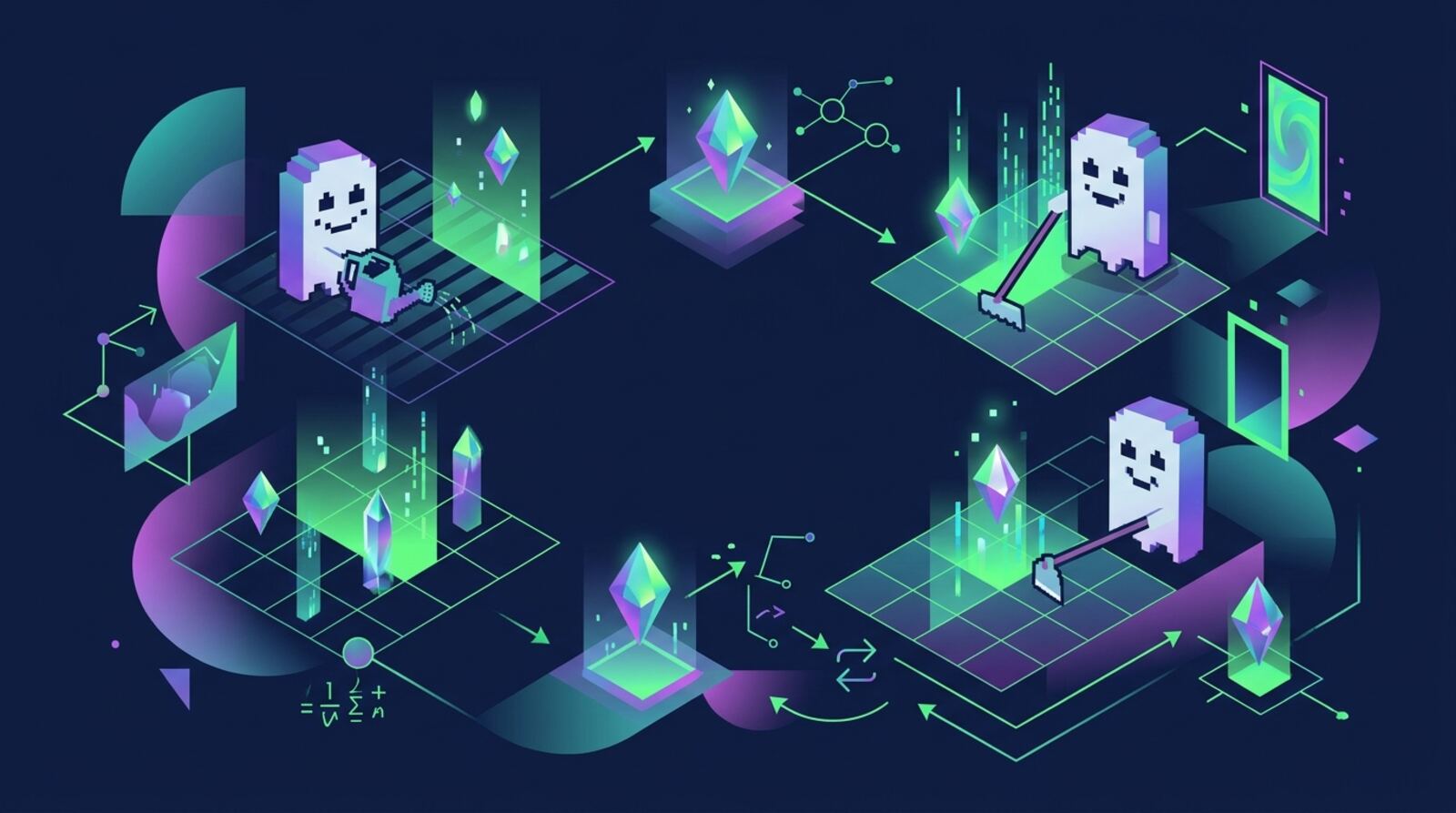
Aavegotchi is an NFT game in which each player owns a digital pet, called a gotchi, that is an ERC-721 token. Gotchis have traits such as rarity, backs, eyes and body types, and their traits can affect how they perform in the game. Owners can equip wearables, take part in the game world and interact with other players.
The project is built on blockchain infrastructure and uses its own in-game token, GHST, along with other in-game resources. Because the gotchi itself is an NFT, its value depends on rarity, demand, the state of the market and the activities the owner chooses. Gotchis can be bought and sold on NFT marketplaces, which is where most sales figures in headlines come from.
For readers new to the topic, the key idea is simple. Aavegotchi combines collectible NFTs with a game economy. Owners can earn in-game rewards by using their gotchis, and that activity is often described as farming. Whether those rewards have real value depends on token prices, the cost of playing, and how many people are competing for the same resources.
Before you go further, confirm the current chain or chains the project runs on, the contract addresses you need, and the official rules. Those details can change, so the official documentation and announcement channels are the best sources. Treat any third-party summary, including this one, as a starting point rather than a final reference.
What farming means in Aavegotchi
In crypto games, farming usually means repeating an activity to collect rewards. In Aavegotchi, the term is used for several activities. Players may stake tokens, use gotchis to gather in-game resources, complete tasks, or lend their gotchis to other players who want to use them without owning them.
The basic loop is to put something in, such as a token, an NFT or time, and get back a reward that can be sold, reinvested or used in the game. The reward is only worth what someone else will pay for it, so the loop depends on the health of the wider market.
Farming is different from trading. A trader buys an asset hoping its price will rise. A farmer uses an asset to produce a stream of rewards. Many people do both at once, which makes it harder to tell whether a gain came from play or from a price change.
When you read about farming in an article or on social media, ask which activity is meant, what the reward is, and whether the reward is paid in a token with a market price. Those three questions set the framework for any calculation of return.
Why sales spikes create farming hype
Headlines about sales increases often use a percentage to describe growth from one period to another. A large percentage can come from a small starting number, so it does not tell you how many players or how much money are involved. Always look for the absolute figures as well.
Sales spikes can be caused by many things. New features, collaborations, limited drops, changes to rewards, or a broader rise in crypto markets can all bring more buyers into the ecosystem. Speculation also plays a part, because buyers sometimes purchase assets in the expectation that prices will go up.
Hype cycles tend to follow a pattern. Early buyers see rising prices and share their results. New buyers arrive hoping to join the gains. Prices may then stall or fall as the supply of new sellers grows, especially if rewards are less generous than expected.
A useful habit is to separate three questions. Did activity increase? Did the rewards change? Did the value of the rewards change in the market? A sales spike can answer only the first question. The other two determine whether a farmer's income moved in a useful direction.
How the main farming loops work
Farming mechanics in Aavegotchi have been adjusted over time, so treat the following as a general map rather than a current rulebook. Always check the official docs for the exact rules, reward rates and any requirements that apply to you.
Staking is one common approach. Players lock a token in a contract to earn a return, often in the same token or a related one. The main questions are how long the lock lasts, whether you can withdraw early, and whether the reward is paid in a token that holds value.
Gotchi-based activity is another approach. Owners can use gotchis to take part in game activities that produce resources. Those resources may be used to craft items, upgrade wearables or trade with other players. The more useful the resource is in the game, the more demand it may have, but demand can shift when the rules change.
Lending is a third approach. An owner lends a gotchi to another player, who uses it for a share of the rewards. The owner earns a fee, and the borrower gets access to a character they would otherwise have to buy. Lending agreements carry counterparty risk, so read the terms and understand what happens if the borrower stops playing.
In every case, ask who creates the reward, how often it is paid, and what the reward is worth in your local currency after fees.
Working out the real costs and return
A farming result is the reward minus all of your costs. Many people miss the costs, so start a simple worksheet before you commit.
Include the price you paid for the NFT or token, network fees for every transaction, marketplace fees if you sell, and any cost of the time you spend managing the position. Also include tax obligations where they apply, since the rules differ between countries.
Then estimate reward income over a period you can measure, such as a month. Use a conservative value for the reward token and assume it may fall. If the position only works when the token price rises, it is a bet on price, not a farming return.
Think about opportunity cost as well. The money used to buy an NFT or lock a token could have been held elsewhere, and that choice carries its own risk and return. Compare the expected result with simpler alternatives and make sure you understand the trade-off.
Finally, decide what you will do if the numbers move against you. Setting a loss limit before you start makes it easier to avoid decisions driven by hype.
The risks behind farming hype
The main risks in NFT farming fall into a few groups. Each one can cause a loss even when the game itself is well made.
Market risk is the most visible. Token prices and NFT prices can fall quickly, and liquidity may be thin, which means you may not be able to sell at the price you see on the screen.
Smart contract risk is the possibility that a bug or exploit in the code causes funds to be lost. Audits reduce this risk but do not remove it. Check whether audit reports exist, read them, and understand that an audit describes a point in time.
Rule risk is the chance that the game changes its reward structure, token supply or access requirements. Changes can be announced with little notice, and they can alter the economics of a position you already hold.
Security risk includes phishing sites, fake support accounts and malicious approvals. Many losses happen because a user signs a transaction they did not understand. Read every signature request, check the contract you are interacting with and avoid links from unsolicited messages.
Regulatory and tax risk varies by location and can change. Keep records of every transaction and seek professional advice if you are unsure of your obligations.
A checklist for evaluating a farming claim
Before you commit funds, run through a short set of checks. None of them guarantees a good outcome, but they help you spot weak claims.
First, confirm the source. Is the information from the official project, a reputable data provider or a block explorer? Be cautious with posts that promise returns or push urgency.
Second, look at the on-chain data. Check how many active wallets interact with the contracts, how much value is locked, and whether reward payouts are visible and consistent. Explorers and analytics tools make this possible without relying on a single claim.
Third, read the reward terms. Find out what rewards are paid, how often, in which token, and whether the rate can be changed by the team or by governance decisions.
Fourth, check liquidity. Can you sell the asset you receive without a large price impact? Look at order book depth or trading volume on established venues rather than relying on a headline percentage.
Fifth, ask what happens in a downturn. If prices halve, does the activity still make sense? If not, the position depends on continued growth, which is not something a reader can rely on.
Sixth, confirm that your wallet and approvals are configured safely before you start.
Where to check current numbers
Figures and rules change often, so the most useful thing this guide can do is point you to the right places to check. Keep a short list of sources and review them before you act.
The official Aavegotchi documentation and announcement channels describe the current chains, contract addresses, reward mechanics and any planned changes. Verify the links you use by comparing them with the project's own published references, and be wary of links sent to you directly.
Block explorers show transactions, token balances, contract activity and holder data. They are the most direct way to verify what has happened on chain.
NFT marketplaces and token data sites show recent sales, floor prices and trading volume. Use several sources, because each one may count sales differently or lag behind the others.
Community channels can be useful for context, but they can also spread rumours and paid promotion. Treat anything you read there as a claim that needs independent checking.
Keep a dated record of the figures you rely on. Prices, volumes and reward rates can look very different a few weeks later, so a note of when you checked helps you make sense of changes.
If you decide to try it: a cautious approach
If, after reviewing the costs and risks, you still want to take part, keep the first step small and controlled.
Start with a wallet you use only for this purpose. Keep the bulk of your crypto elsewhere, and store your seed phrase offline. Never type it into a website or share it with anyone.
Buy the minimum needed to learn the interface and then observe how the rewards behave over several cycles. Record every transaction and every fee so you can measure the real result rather than an estimate.
Review token approvals regularly and revoke any you no longer need. Approvals that give a contract unlimited access to your tokens are a common source of loss when a contract is compromised.
Set a predefined exit plan, including the amount you will accept losing and the conditions under which you will sell or stop playing. Write it down before you start so that the plan is not changed by a price move.
Review the position on a fixed schedule, not in response to social media posts. A calm review cycle is one of the most effective ways to keep farming decisions based on facts.
Key takeaways for readers
Aavegotchi farming is a mix of game design, NFT ownership and token economics. Sales growth can reflect real interest in the game, but it can also reflect speculation, promotion or temporary conditions. A headline percentage alone does not show whether a farming position will earn a return after costs.
The most useful habit is to separate activity from value. Ask whether more people are playing, whether the rewards are stable, whether the reward tokens can be sold at a fair price and whether your own costs are covered. Each of those questions has a different source of evidence.
Check official documentation and on-chain data for facts, and treat promotional claims as a prompt for further checking. Keep your funds safe with careful wallet practices and avoid pressure to act quickly.
This guide is general information and not financial advice. Crypto assets and NFTs can lose most or all of their value. If you are unsure, speak with a qualified adviser and make sure you understand the rules where you live.
Frequently asked questions
Does a big rise in sales mean farming will be profitable?
No. Sales growth shows how much activity happened in a period, not whether a position will make money. Volume can rise because of new listings, promotions or speculation, and the price of tokens and NFTs can fall just as fast. Use sales figures as one input and compare them with on-chain data, your own costs and your risk tolerance.
Where should I check current Aavegotchi sales and token data?
Check the official Aavegotchi documentation and announcement channels for current chains, token details and game rules. For prices and volume, use block explorers and established NFT or token data sites, and compare several sources. Figures for sales and token prices change often, so any number in an article should be treated as a snapshot.
What costs should I expect before farming?
Most farming costs come from network fees, the price you pay for NFTs or tokens, and the time you spend managing positions. There can also be a loss in value if the token you earn or hold drops in price. Before you start, estimate each cost in your local currency and write down the amount you can afford to lose.
What security risks are specific to NFT farming games?
Yes. Phishing sites that copy game interfaces, fake support accounts and approval requests that give a contract access to your tokens are common in Web3 games. Only use links you have verified from official sources, read what each signature allows, and keep your seed phrase offline. Never share it with anyone, including people claiming to be support staff.
Are there legal or age considerations for farming?
Crypto farming and NFT trading are high risk and may be illegal or restricted where you live. Check local laws and tax rules before you buy, stake or sell tokens. Do not use a VPN or any other method to get around geographic restrictions or age checks. Never invest money you cannot afford to lose, and this article is general information, not financial advice.
Mentioned in this guide
dApps in this guide
Warp is a GameFi project where NFT starships earn daily WARP credits and play battles, expeditions and minigames across several chains.
Alien Worlds is a community-built play-to-earn metaverse on WAX where players mine and play to earn TLM tokens and NFTs.
The Sandbox is a blockchain-linked virtual gaming world on Polygon and Ethereum, with token SAND and a new AI game engine in beta for creators.
ImmutableX is a web3 gaming platform on Ethereum whose IMX token covers fees, staking, governance and gas on Immutable zkEVM, aimed at gamers and token holders.
Big Time is a free-to-play multiplayer action RPG for Windows PCs with NFT collectibles and a $BIGTIME token, aimed at gamers curious about Web3 economies.
Aavegotchi is an NFT collectibles game with a GHST token, originally DeFi-staked and powered by Aave, now moving to Base for players and builders.
Crypto.com is a centralized crypto exchange and app for buying, trading and spending 400+ coins, with a Visa card, staking and a separate self-custody wallet.
Keep reading
Related guides
Web3 gaming · Review
Upland Review: How the Blockchain Property Game Works in 2026
Upland is a blockchain property trading game where players buy, sell and develop virtual plots mapped to real-world locations. This review explains how it works, what earning and spending involve, and what to check before putting money in.
Web3 gaming · Explainer
Axie Infinity Lunar New Year Event: What Ended and What to Check
Axie Infinity ran a limited-time Lunar New Year event with a new burn mechanic, but the sources available here do not confirm the February 20 end date in the query. This guide explains what the event was, how to verify its end date from official channels, and what players should do now.
Web3 gaming · Explainer
Animoca Brands' $30 Million Guild Accelerator: What the Record Shows
A $30 million figure linked to Animoca Brands appears in 2021 funding reports, but the public record we could check ties it to a venture accelerator round, not a guild accelerator pledge. This guide explains what is confirmed, what is not, and how to verify any similar claim.
Web3 gaming · Explainer
Axie Infinity Lunar Event Ending February 20: What to Know
Axie Infinity runs limited-time in-game events, and a lunar-themed event that closes on February 20 is a common example. This guide explains how these events work, how to confirm the deadline for your own account, and what to do before the cutoff.
Web3 gaming · Explainer
Aavegotchi Gotchiverse Farming: How Rarity Farming Works in 2026
Aavegotchi's Gotchiverse farming lets players use their NFT Gotchis to gather Alchemica and earn GHST, with Rarity Farming seasons paying out rewards. This guide explains how the system works, what has changed, and how to check the current season before you commit.
Web3 gaming · Review
Aavegotchi AMA and DappDays Highlights: What to Know in 2026
Aavegotchi has run community AMAs and event sessions, and this guide explains how to find accurate highlights from them, what the game is built on, and how to check current details before acting on anything you read. It separates what the sources confirm from what changes often, such as prices, rewards and event schedules.
Web3 gaming · Explainer
Aavegotchi Gotchiverse Land Release Explained (2026 Guide)
Aavegotchi's Gotchiverse land release put player-owned REALM parcels on sale as NFTs in a Polygon-based game world. This guide explains what was sold, how parcels work, and how to check the current status and risks before acting.
Web3 gaming · How-to
How to Earn Alchemica and Craft the Golden Aaltar in Aavegotchi
Aavegotchi players earn Alchemica by channeling their Gotchis at Aaltars, then spend those resources on crafting. This guide explains the core loop, what the Golden Aaltar is, and how to verify current recipes and chain details before you spend anything.