Web3 gaming · Explainer
What Is Move-to-Earn? How M2E Apps Work and What to Check
Move-to-earn (M2E) is a model where apps pay small rewards for physical activity such as walking or running. This guide explains how the model works, where it came from, and what to check before you use any M2E app or wallet.
By the DappsAtlas editorial team · Updated
What does move-to-earn mean?
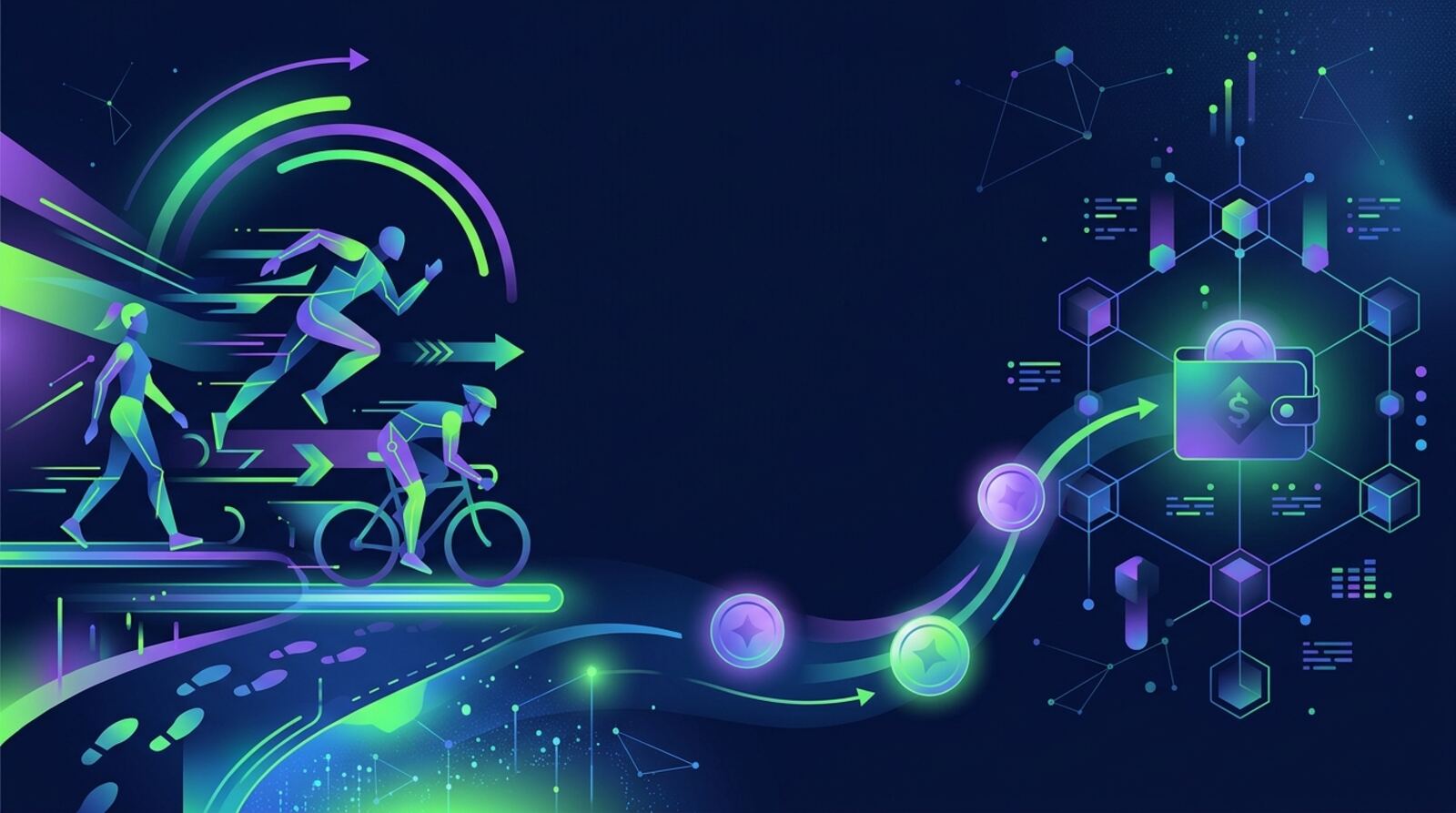
Move-to-earn, often shortened to M2E, is a model in which an app pays you a reward for physical activity. The most common activity is walking, running or cycling, but some apps also reward workouts, sleep or general movement.
The basic idea is simple. You carry a phone or wearable, the app records how much you move, and it turns that activity into points, coins or tokens. Some of those rewards can be spent inside the app. Others can be exchanged for vouchers, discounts or, in blockchain-based versions, crypto assets.
The term describes a business model more than a single product. A traditional fitness app that gives you badges is not usually called move-to-earn. An app that pays you something of monetary value for moving is. The line can blur, because some apps offer both points and crypto-linked rewards.
It is also useful to know that M2E is not a health treatment or a guaranteed income. The payments are incentives. They are designed to encourage activity, and their value depends on the app's rules, its funding and the market for any token it uses.
How do move-to-earn apps track activity and pay rewards?
Most M2E apps work through the sensors already in your phone, such as an accelerometer and, in some cases, GPS. Some also connect to fitness trackers or smartwatches. The app counts steps or tracks distance, then applies its own formula to decide how many rewards you receive.
A typical reward process looks like this:
- You install the app and create an account, which may include a crypto wallet.
- The app requests access to motion or location data, so you can control those permissions in your phone settings.
- Your activity is logged, often in daily or weekly totals.
- The app converts that activity into points, coins or tokens based on its rules.
- You can usually claim rewards after they reach a minimum amount, and some apps add daily caps.
Rules differ widely. Some apps reward only outdoor walking, others count indoor steps, and some reward only when your activity meets a minimum threshold. Many apps also limit how often you can earn, to reduce cheating.
Because the reward formula is set by the developer, it can change. Before you rely on any app, read its reward rules and look for a section that explains how and when the rate can be adjusted.
What role do tokens and NFTs play in M2E?
Blockchain-based M2E apps often use tokens, which are digital assets recorded on a blockchain, and sometimes NFTs, which are unique digital items. A token is usually fungible, meaning each unit is interchangeable with another. An NFT is one-of-a-kind and can represent something such as a pair of virtual shoes or a character.
The best-known example is STEPN, which launched in 2022 and required users to own virtual sneakers, represented as NFTs, before they could earn. Earnings were paid in tokens, and users had to buy or upgrade sneakers to earn more. That structure drew large attention, and it also showed a major weakness. If new players stop buying into the ecosystem, the rewards and the value of the sneakers can fall sharply.
Some newer apps have moved away from requiring expensive NFTs, and many offer free tiers. Others still use tokens or NFT items as part of their economy. When you see a token, ask what it is used for inside the app, who controls its supply, and whether there is a clear reason people would hold it beyond earning more of it.
Tokens can also be listed on exchanges, but a listing does not mean the value is stable or that the app is secure. Check the token's current market information from reputable sources rather than relying on any figure in an article, because prices change quickly.
What happened to move-to-earn during the crypto boom and bust?
Move-to-earn drew wide attention during the 2021 and 2022 crypto market period. Many apps promised that walking could produce a meaningful income. Some attracted large numbers of users, and their native tokens rose in value during that time.
That growth was followed by a sharp decline in many projects. Token prices fell, user numbers dropped in several cases, and some apps reduced rewards or changed their models. A recurring problem was that rewards depended on new users buying in, so the economy weakened when fewer people joined.
The lesson for readers is that M2E was never a stable earnings model by default. Some apps survived, some were restructured, and some stopped operating. If you read older articles about move-to-earn, check the date and whether the app still exists, because a guide written in one market period can be out of date in another.
If an app you find online was popular in the past, look for its current status on its official channels. Ask whether it is still updating its product, whether its rewards are still being paid, and whether its team has communicated any major changes. A quiet website or a long gap between updates can be a warning sign.
How is move-to-earn different from play-to-earn and fitness apps?
Move-to-earn sits within a wider group of reward models. It helps to separate the main terms, because they are often used loosely.
The table below compares them in plain terms:
| Model | What you do | What you may earn | Typical main risk |
|---|---|---|---|
| Fitness app with points | Walk, run or train | Points, badges or vouchers | Limited value, and rules can change |
| Move-to-earn | Move or exercise | Coins, tokens or crypto-linked rewards | Token value and app sustainability |
| Play-to-earn | Play a game | Game tokens, items or NFTs | Game economy and asset prices |
| Play-to-earn with NFT assets | Play and own in-game items | Tokens and tradable NFTs | Costs of entry, asset value and market swings |
Move-to-earn is a subset of the broader play-to-earn idea, where the activity is gameplay rather than physical movement. Some blockchain games mix both approaches. Alien Worlds, for example, is widely described as a play-to-earn metaverse, while Sweatcoin is a movement-based app that rewards steps.
When you compare options, ask what the reward is worth outside the app, what you must pay to take part, and how easily you can stop without losing money you cannot recover.
What are the main risks of move-to-earn?
Move-to-earn carries several risks that are worth understanding before you start.
- Token value: The value of a token can rise or fall sharply, and it can fall to very little. Earnings paid in a volatile token may be worth much less when you try to sell.
- App sustainability: An app may stop updating, change its reward rules, or close. Rewards that were available last month may not be available next month.
- Upfront costs: Some apps require you to buy items, NFTs or in-app currency before you can earn. Those costs can exceed what you earn.
- Health: Pushing too hard can cause injury. Walking or running in unsafe conditions, including on roads or at night without visibility, is a real risk.
- Privacy: Movement and location data are sensitive. Read what the app collects, how long it keeps the data, and who it shares it with.
- Scams and imitations: Fake apps and copycat websites often copy the look of real projects. Scammers may ask for your recovery phrase or ask you to approve a transaction you do not understand.
No legitimate app should ask for your wallet recovery phrase, and you should never enter it into a website or give it to a person. If you are asked to send crypto to unlock rewards, treat that as a strong warning sign.
Tax rules for crypto rewards also vary by country, so keep records of what you receive and speak with a qualified adviser where needed.
How do I evaluate a move-to-earn app before I join?
Before you join any M2E app, go through a short checklist. It takes a few minutes and can prevent avoidable losses.
- Confirm the developer. Look for a named company or team, a clear website and a privacy policy that matches the app.
- Read the reward rules. Check how rewards are calculated, whether there are caps, and whether the developer can change the rules.
- Check the costs. Find out whether you must buy anything, and what happens if you stop using the app.
- Find the token's role. Ask what the token does inside the app, how new tokens are issued, and what limits exist on supply.
- Review permissions. Allow only the motion and location access the app needs, and check your phone settings.
- Set a budget. Decide in advance how much you are willing to lose, and do not add more because of short-term gains.
- Look at recent activity. Check whether the app has released updates and whether users are reporting that rewards are being paid.
- Keep your wallet secure. Use a wallet you control, store your recovery phrase offline, and never share it.
If an app fails several of these checks, you do not need to use it. Choosing not to join is a valid decision.
Where does move-to-earn fit in web3 gaming today?
Move-to-earn is now one part of a much wider web3 gaming and fitness-app landscape. Some apps still focus on walking or running. Others have shifted toward general wellness, while many blockchain games have moved to gameplay-based rewards.
If your interest is mainly fitness, a free app that rewards steps without requiring you to buy anything may be a simpler place to start. Sweatcoin and Growfitter are examples of apps that reward activity with points or coins, though their reward systems differ, and you should read each app's terms for current details.
If your interest is gaming, you may prefer a play-to-earn title. Alien Worlds is a community-built metaverse on WAX, Axie Infinity is a Ronin-based game that uses its own token, and Pixels is a farming and exploration game with a token. Each has its own costs, rules and risks.
Whatever you choose, treat any token earnings as uncertain. Set a limit on what you put in, keep your activity safe, and review the app's status regularly. Move-to-earn can be a way to get more active, but it works best when you treat the rewards as a small bonus rather than a plan for income.
Frequently asked questions
Is move-to-earn free to use?
Not always. Many move-to-earn apps are free to download and let you earn points or small rewards without buying anything. Some blockchain-based versions ask you to buy in-app items such as virtual shoes or NFTs before you can earn, and those purchases can lose value. Read the cost structure before you spend anything.
Can you make a steady income from move-to-earn?
Usually they are not. Most M2E apps track steps or distance through your phone's motion sensors or a connected device, then convert that activity into points or tokens. Rewards can be capped, and an app can change its rules or reward rates at any time. Treat any earnings as uncertain until you can withdraw them.
Do I need to be fit to try a move-to-earn app?
Start with the basic health advice you would follow anyway. Check your own health before starting a new exercise routine, especially if you have a medical condition. Use the app's own safety guidance, avoid walking or running in unsafe places or while distracted, and stop if you feel unwell.
How do I protect myself when an M2E app uses a crypto wallet?
Use a dedicated wallet only for the assets you can afford to lose, keep your recovery phrase offline and never share it, and be wary of anyone who asks for it. Download apps only from official app stores or the developer's own verified channels, and check that you are not being directed to a copy of a real app. Avoid signing transactions you do not understand.
Where can I check whether a move-to-earn app is still active?
Check local laws on crypto assets and fitness rewards in your country, since rules vary and can change. Read the app's terms, privacy policy and any reward rules. Ask a qualified financial or tax adviser before you rely on token earnings. Keep in mind that token prices and app rules can change quickly, so check current information from the project's official sources.
Mentioned in this guide
dApps in this guide
Sweatcoin is a free move-to-earn smartphone app that rewards daily steps with coins, linked to the SWEAT token, for casual users interested in fitness rewards.
Growfitter is a free fitness app that rewards walking and workouts with points redeemable for brand rewards, with a GFIT token planned.
Alien Worlds is a community-built play-to-earn metaverse on WAX where players mine and play to earn TLM tokens and NFTs.
Axie Infinity is a Ronin-based NFT game where players collect, combine and battle creatures called Axies, with its own AXS token.
Pixels is a web3 farming and exploration game with a PIXEL token, guilds and ecosystem staking, aimed at gamers who are comfortable with wallets and token risk.
Infinity is a DeFi lending and borrowing protocol offering floating and fixed rates and yield curve trading, still shown as testnet or beta on its homepage.
Ronin is an EVM-compatible gaming blockchain, home to Axie Infinity and Pixels, with RON as its token, aimed at Web3 gamers and developers.
Keep reading
Related guides
Web3 gaming · How-to
How to Make Money Playing Games Online in 2026: Realistic Options
Most ways to earn from games pay modest amounts, and some require time, skill, or upfront costs. This guide sorts the realistic options from the scams and shows how to start with low risk.
Web3 gaming · Explainer
Play to Earn vs Move to Earn: Key Differences in 2026
Play-to-earn and move-to-earn both attach crypto rewards to everyday activity, but they reward different things and carry different costs. This guide explains how each model works, where the money comes from, and what to check before you spend time or money on either.
Web3 gaming · How-to
How to Play and Earn in WorldWideWebb in 2026
WorldWideWebb's current reward terms could not be confirmed from the sources used here, so this guide explains how to check any win-and-earn game's rules, set up a wallet safely, weigh rewards against risk, and avoid common scams.
Web3 gaming · Best list
Top 5 Simple Play-to-Earn Games to Try in 2026
Simple play-to-earn games let you start with a phone or browser and little or no upfront spending. This guide compares five options on how they work, what they cost to start, and where token rewards can fall in value.
Web3 gaming · How-to
What Is NFT Worlds? A Guide to Playing and Building
NFT Worlds is a Minecraft-inspired web3 project where each world is an NFT and owners run their own server. This guide covers how it works, how to join as a player or a builder, and what to check first.
Web3 gaming · Explainer
What Is Mooi Network? A Plain Guide to Web3 Gaming Claims
Mooi Network is presented as a gaming and Web3 project, but the sources available for this guide do not confirm its features, token model or user numbers. This explainer covers what the claim means, how to check it yourself, and what to look for before you join or spend anything.
Web3 gaming · How-to
What Is Orbcity and How to Play and Earn in 2026
Orbcity is a land-based metaverse where players collect NFTs, farm resources and use the ORB token for governance and utility. This guide explains how the game works, how to get started, and how to think about earning before you commit any money.
Web3 gaming · Explainer
What Is MOBOX? The MBOX Gaming Platform, Explained
MOBOX is a crypto gaming platform built around the MBOX token, and the name is also shared by an unrelated Android emulator and other apps. This guide explains what the platform was designed to do, how its token fits in, and how to check its current status before you spend any money.