Web3 gaming · Explainer
What Is Goblin Town? The NFT Collection, Explained
Goblin Town is best known as a crude-looking, free-to-mint Ethereum NFT collection from 2022, but the name also means a place in Tolkien and a slang term for a bear market. This guide sorts out which is which and what it means for web3 gaming.
By the DappsAtlas editorial team · Updated
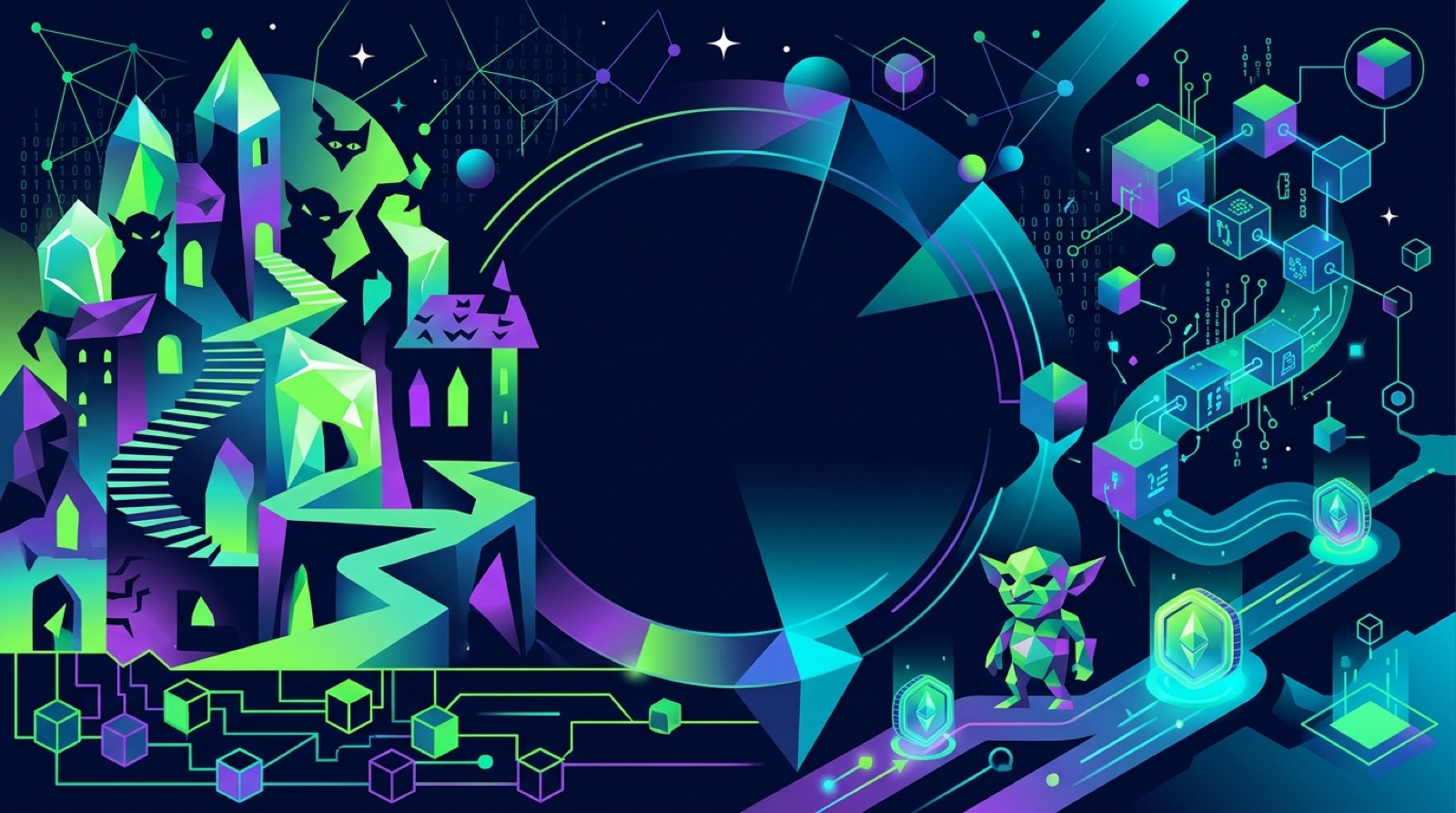
What is Goblin Town?
Goblin Town can mean three different things depending on where you meet the phrase, and public reporting for it mix all of them together.
- The NFT collection. Goblin Town (also written Goblintown) is an Ethereum NFT collection of roughly 10,000 deliberately rough, lo-fi goblin portraits. It launched in May 2022 as a free mint and quickly became one of the most talked-about collections of that period.
- The Tolkien location. Goblin-town is the orc stronghold under the Misty Mountains in The Hobbit, ruled by the Great Goblin. Bilbo and the dwarves are captured there before Gandalf rescues them.
- Crypto slang. Some traders use "goblin town" as shorthand for a prolonged bear market or a deep slump in prices.
On a crypto and web3 gaming site, the first meaning is almost always the one people want. Goblin Town is not a game, but it sits in the same culture as many blockchain games. It is a community-driven NFT project, built around art, memes and shared ownership rather than a game loop.
The rest of this guide covers the NFT collection first, because that is where most of the interest lies. It then explains how the name relates to Tolkien and to market slang, so you can tell which meaning a given article, tweet or listing is using. It also covers what to check before buying anything, and where to look next if what you really want is a playable web3 game.
How did the Goblin Town NFT collection launch?
Goblin Town arrived in May 2022, near the end of the 2021-22 NFT boom. Its launch broke from the typical pattern of that era. There was no polished website, no staged roadmap, no allowlist drama and no mint price beyond network gas fees.
Key features of the launch, as widely reported at the time:
- Free mint. Minters paid only Ethereum gas. That drew heavy demand and a rush of transactions, and gas costs rose sharply during the mint.
- Anonymous creators. The team stayed pseudonymous and communicated in a deliberately crude "goblin" voice.
- No promised utility. There was no roadmap of future perks, game features or token airdrops at launch. The appeal was the art, the humour and the community.
- Fast secondary trading. Once minting ended, the collection traded actively on secondary marketplaces and ranked among the most traded collections in its early weeks.
Because the supply was fully distributed so quickly, it became a reference point for debates about fair launches. Supporters argued that a free mint with no insider allocation was the cleanest way to start a community. Critics pointed out that free mints still reward bots and well-resourced collectors who can submit many transactions.
Prices have moved a great deal since 2022, as they have for most NFT collections. For anything about current value, check live marketplace data rather than relying on figures quoted in older articles.
What makes the artwork and community different?
Most NFT collections of the time competed on polish: clean line work, rare trait tiers and carefully built brands. Goblin Town went the other way. The goblins look hand-drawn and grotesque on purpose, with mismatched features, wonky proportions and a gritty, low-fidelity finish.
Several things made the project stand out:
- Anti-polish style. The rough look became its identity. It read as a joke at the expense of overproduced projects, and that made it memorable.
- Goblin-speak. Official posts used broken, shouty goblin language. Fans copied it, and the voice became part of the community's identity.
- Meme-first community. People shared, remixed and made jokes about their goblins rather than waiting for roadmap updates.
- Low barrier at launch. Because minting was free, many people who would not usually spend on NFTs joined in.
Traits still exist, and some goblins are valued above others by collectors. But the draw was the whole-collection identity rather than a hunt for a single rare attribute.
This matters for web3 gaming because it shows a model that games sometimes borrow: start with a strong community and a recognisable look, and let creators and fans build outward. It does not prove that approach works for every project, and many NFT communities of the same era faded once attention moved on.
What does CC0 mean for Goblin Town?
CC0 stands for Creative Commons Zero. A creator who releases work under CC0 gives up their copyright claims as far as the law allows, which means anyone can copy, remix, build on or sell derivative work without asking permission or paying a fee.
Goblin Town was released under this kind of open licence, and that shaped its growth. Under a typical NFT licence, the owner can display the specific artwork they hold but cannot freely make merchandise or products from it. With CC0, anyone can create things from the goblin art, whether or not they own an NFT.
What that makes possible:
- Fan-made art, memes and comics
- Community-created derivative collections
- Merchandise or media built on the goblin look
- Experiments in games or apps that reuse the characters
What it does not mean:
- Owning a goblin NFT does not give you exclusive rights to the image, since everyone has the same rights to it.
- Derivative projects are not official unless the original team says so.
- A CC0 image can be copied by scammers, so a lookalike collection may be trying to pass as the original.
For collectors, the practical value of an NFT in a CC0 collection comes from provenance, community and culture rather than legal exclusivity. That is a key point to weigh before buying, and it is the reason to read the licence terms of any collection you are considering.
Is Goblin Town a web3 game?
Goblin Town is not a game. It has no core gameplay loop, no in-game economy and no native token at launch. If you came here looking for a playable title, this is the wrong collection.
It still matters to web3 gaming in three ways:
- Community-first model. Many blockchain games try to build a community before or alongside gameplay. Goblin Town showed how fast a community can form around identity and humour alone.
- Open IP. CC0 art can be reused by game developers and modders. Any game that uses the goblin look is a community or third-party project unless stated otherwise.
- A caution about hype. Collections with no utility depend on attention. Games that rely on NFT sales to fund development face the same risk when attention fades.
When you evaluate any blockchain game, ask a different set of questions from the ones you would ask of a collectible:
- Is there a working, playable product today?
- How does the in-game economy create and remove tokens or items?
- What happens to your assets if the studio stops supporting the game?
- Which chain does it run on, and what are the fees?
Collectible NFTs and games share infrastructure such as wallets, marketplaces and tokens, but they are judged on different grounds. A collectible is mostly about culture and scarcity. A game has to be fun and economically sustainable.
What is Goblin-town in Tolkien's The Hobbit?
The phrase has an older and larger life outside crypto. In The Hobbit, Goblin-town is a network of caves beneath the High Pass in the Misty Mountains. It is the home of a tribe of goblins (orcs) led by the Great Goblin. Bilbo, Gandalf and the thirteen dwarves are captured there; Gandalf slays the Great Goblin, and the party escapes with Bilbo separated from the group, which leads to his encounter with Gollum.
The location appears in the book, in Peter Jackson's film The Hobbit: An Unexpected Journey (where the Goblin Town song is a well-known scene), in Tolkien reference sites and in fan guides. It has also appeared in games and trading cards, which is why public reporting for the phrase include game maps and a Magic: The Gathering land card.
How it relates to the NFT collection:
- The NFT project took the goblin theme and the phrase, but it is a separate creative work.
- It is not an official Tolkien product, and nothing about it implies an affiliation with the Tolkien estate or the film studios.
- Searching for the name returns both, so check which one a source means.
If you want the literary meaning, look at Tolkien reference works and the book itself. If you want the NFT meaning, look at the collection's marketplace page and community channels. The two share a name and a mood, not a connection.
What does goblin town mean as crypto slang?
A third use shows up in crypto glossaries: "goblin town" as slang for a prolonged bear market or a major downturn in asset prices. It is informal and not a technical term.
The phrase is used loosely. Some people use it for a sharp crash, others for a long grinding slump. There is no agreed definition, threshold or index, so treat it as a mood rather than a measurement.
You are most likely to meet it in:
- Social posts during market sell-offs
- Informal glossaries that collect crypto slang
- Memes that play on the goblin theme
It is likely that part of the slang's popularity comes from the NFT collection's culture of crude humour and goblin imagery, but the phrase is not tied to any single price level or event. If a source says the market is "in goblin town," read it as an opinion about conditions, not a data point.
If you want facts about a downturn, look at measurable things: price changes over a stated period, trading volume, and the number of active users or wallets. For NFTs and games, marketplace volume and daily active wallets from analytics dashboards give better evidence than slang does. When prices and activity are down, the useful questions are whether a project still has users, whether it is still shipping updates and whether its treasury or revenue can sustain it.
Goblin Town meanings compared
The same words point to different things, so use this quick reference to tell which meaning you are dealing with.
| Meaning | What it is | Where you meet it | What to check |
|---|---|---|---|
| Goblin Town NFTs | Ethereum collection of roughly 10,000 lo-fi goblin images, released free to mint in 2022 | NFT marketplaces, crypto social media | Verified contract, live floor price, licence terms |
| Goblin-town (Tolkien) | Orc stronghold under the Misty Mountains in The Hobbit | Book, film, wikis, fan guides | Tolkien reference works |
| Goblin town (slang) | Informal term for a long bear market | Glossaries, memes, trader chat | Real market data, not the phrase |
| Goblin-town (games and cards) | Locations and cards inspired by Tolkien | Game maps, card databases | The specific game or card set |
Quick ways to tell them apart:
- If the text mentions OpenSea, minting, wallets or floor price, it means the NFT collection.
- If it mentions Bilbo, Gandalf, the Great Goblin or the Misty Mountains, it means the Tolkien location.
- If it talks about prices falling or a bear market, it is slang.
- If it lists game maps, quests or card rarity, it is about a game or trading card.
Search engines mix all of these because they share a name. Adding a qualifier such as "NFT," "Hobbit" or "bear market" to your query narrows results quickly.
What is Goblin Town's status today and how do I check it?
The right way to check how Goblin Town is doing today is to look at live data instead of trusting any article, including this one. Prices, volume and holder numbers all change, and older write-ups go stale quickly.
Where to look:
- NFT marketplaces. The collection page on a major marketplace such as OpenSea shows the current floor price, recent sales, listed items and total volume. Look for the verified badge and compare the contract address with the one the project publishes.
- The project's official channels. Announcements about the community, derivative projects or any official collaborations come from the project's own accounts.
- Analytics dashboards. Independent trackers show volume and unique buyers over time, which helps you see whether activity is rising or fading.
What to read carefully:
- A floor price is the cheapest listing, not what you could get if you sold. Thin trading can make exits hard.
- Volume can be inflated by wash trading, where the same party trades with itself.
- A large drop from earlier prices is common across NFTs from the 2021-22 era.
Goblin Town has no roadmap of promised features that you could check off, so its status is mostly about community activity and market interest. That also means there is no team deliverable to hold anyone to. If you are thinking of buying, treat it as a collectible with uncertain value, not as an investment with a defined return. This guide is not financial advice.
What risks should you know about before buying?
Popular collections attract imitators and scammers. Defensive habits matter more than market timing.
Common risks:
- Lookalike collections. Because the art is CC0, anyone can copy it. A fake listing may use identical images under a different contract.
- Fake mint and claim sites. Pages promising a free goblin, an airdrop or a "claim" often exist to steal wallet permissions.
- Wallet-draining approvals. A malicious site may ask you to sign a blanket approval for your NFTs or tokens.
- Direct messages and fake support. Unsolicited messages offering help or deals are a standard scam pattern.
Practical protections:
- Verify the contract address from the project's official channels and the marketplace's verified badge.
- Use a separate wallet for experiments and keep valuable assets in a wallet you do not connect to unfamiliar sites.
- Read every signature request. Be wary of approvals for all items in a collection or unlimited token spending.
- Never share your seed phrase with anyone, including people claiming to be support staff.
- Review and revoke old approvals periodically using a reputable approvals checker.
- Only spend money you can afford to lose. NFT prices can fall sharply and may not recover.
If you have any doubt about a link or listing, leave it and navigate to the marketplace directly instead. A missed opportunity costs nothing, while a drained wallet cannot be undone.
Where to go next if you want web3 games
If Goblin Town sparked your interest in web3 but you want something playable, a few categories are worth looking at. None of the following are connected to Goblin Town, and each has its own risks, so read up before you spend.
- ImmutableX. A web3 gaming platform on Ethereum. Its IMX token is used for fees, staking and governance, and it hosts games and an NFT marketplace for gaming assets. It is useful if you want to see how in-game NFTs are traded.
- Alien Worlds. A community-built play-to-earn metaverse on WAX where players mine and play to earn TLM tokens and NFTs. It shows how a token-driven game economy works in practice.
- Warp. A GameFi project where NFT starships earn daily WARP credits and take part in battles, expeditions and minigames across several chains.
- Defi Kingdoms. A GameFi title that blends decentralised finance mechanics with fantasy gameplay.
What to check for any of them:
- Is the game live and playable now?
- What does it cost to start, including fees and any NFT purchase?
- How are tokens earned, and what drives demand for them?
- Is there recent development activity?
- Which chain does it run on, and what are the transaction costs?
Earnings from play-to-earn games are variable and can fall to nothing. Treat them as entertainment with a financial risk, not as income.
Frequently asked questions
Is Goblin Town a web3 game?
No. Goblin Town is an NFT collection with no built-in game, token or promised gameplay. Its importance to web3 gaming is cultural: it showed how a community can form around open-licensed art without a roadmap. Games that use NFTs are a separate category.
Was Goblin Town really free to mint?
The collection launched as a free mint, so early minters paid only network gas fees. Anyone who wants one now has to buy it on a secondary marketplace such as OpenSea at whatever the market price is. Check the live floor price there, because it changes constantly.
What does CC0 mean for Goblin Town?
CC0 means the creators waived their copyright claims as far as the law allows. Anyone can reuse, remix or sell work based on the art without asking permission or paying royalties. This is why many fan projects, memes and derivative works exist.
Is Goblin Town the same as the Goblin-town in The Hobbit?
They are separate uses of the same word. Goblin-town in The Hobbit is a cave stronghold of orcs ruled by the Great Goblin. The NFT collection borrowed the goblin theme but is not an official Tolkien product. In crypto slang, goblin town can also describe a long bear market.
Is buying a Goblin Town NFT a good investment?
Not necessarily. NFT prices are volatile and can fall sharply, and a floor price shows only the cheapest listing, not guaranteed resale value. Nothing here is financial advice, and you should only spend money you can afford to lose.
How do I avoid fake Goblin Town collections?
Verify the collection's contract address through the official project channels and the marketplace's verified badge. Beware of lookalike collections, fake mint sites and unsolicited direct messages. Never sign a transaction or approval you do not understand.
Mentioned in this guide
dApps in this guide
ImmutableX is a web3 gaming platform on Ethereum whose IMX token covers fees, staking, governance and gas on Immutable zkEVM, aimed at gamers and token holders.
Alien Worlds is a community-built play-to-earn metaverse on WAX where players mine and play to earn TLM tokens and NFTs.
Warp is a GameFi project where NFT starships earn daily WARP credits and play battles, expeditions and minigames across several chains.
DeFi Kingdoms is a pixel-art fantasy RPG that wraps a DEX, liquidity pools and Hero NFTs into one game.
Common is a non-custodial ZK privacy dapp on Arbitrum and Aleph Zero EVM that lets users shield funds and withdraw to a new, unlinkable wallet.
Crypto.com is a centralized crypto exchange and app for buying, trading and spending 400+ coins, with a Visa card, staking and a separate self-custody wallet.
Keep reading
Related guides
Web3 gaming · Best list
Best NFT and Crypto Games in Web3: The 2025 Class, Reviewed for 2026
Web3 gaming is smaller and more selective than the 2021 boom. This guide covers the NFT and crypto games from the 2025 wave that are worth knowing, how each one earns, and what to check before you spend anything.
Web3 gaming · Explainer
Game World Token Economies Explained for 2026
Crypto game worlds tie in-game items, land and rewards to tokens, and the way those tokens are created, used and removed decides whether the economy holds up. This guide explains the core mechanics and the main models used across six named worlds, with a checklist for judging any project.
Web3 gaming · How-to
How to Join Sunflower Land: Open Beta Access Guide (2026)
Sunflower Land is a browser-based farming game with blockchain features. This guide covers what the open beta was, what you need, how to create a farm, and how to avoid the scams aimed at new players.
Web3 gaming · How-to
How to Play and Win Nine Chronicles: A Practical Guide
Nine Chronicles is a fully on-chain RPG where gear, progress and trading all live on a public blockchain. This guide covers setup, the core loop, gear strategy, competitive modes and the risks to watch.
Web3 gaming · Explainer
What Is Goblin Town 2? What the Name Refers To and How to Check (2026)
Goblin Town 2 does not appear as a verified crypto product in the sources we checked, so this guide explains which goblin-named projects and events the name could refer to, how to confirm which one you mean, and what to check before you buy, connect a wallet or spend money.
Web3 gaming · How-to
What Is Gameta and How Do You Use It? A Step-by-Step Guide
Gameta is a Web3 gaming project, and details such as chains, games and token terms change over time. This guide explains how platforms like it work, how to confirm you are on the real one, and how to get started with limited risk.
Web3 gaming · How-to
What Is HV-MTL? How to Play and Earn in Yuga Labs' Game
HV-MTL, pronounced Heavy Metal, is a Yuga Labs game built around a 30,000-piece mech NFT collection in the Bored Ape universe. This guide covers how Forge and The Hunt work, how amps drive evolution, and what to check before you play.
Web3 gaming · How-to
What Is DeHeroGame? A Plain Guide to Its NFT Hero Card Game
DeHeroGame is a blockchain card game built around NFT hero cards and the AMG governance token, aimed at players interested in GameFi. This guide explains how it is meant to work, what to verify before you take part, and how to avoid the fake giveaways that often surround similarly named projects.