Web3 gaming · Explainer
What Is Axie Infinity? How the Game, Tokens and Economy Work
Axie Infinity is a blockchain game where players collect creature NFTs called Axies, battle with them, and earn tokens. This guide explains the mechanics, the tokens, the Ronin network, and the risks.
By the DappsAtlas editorial team · Updated
What is Axie Infinity?
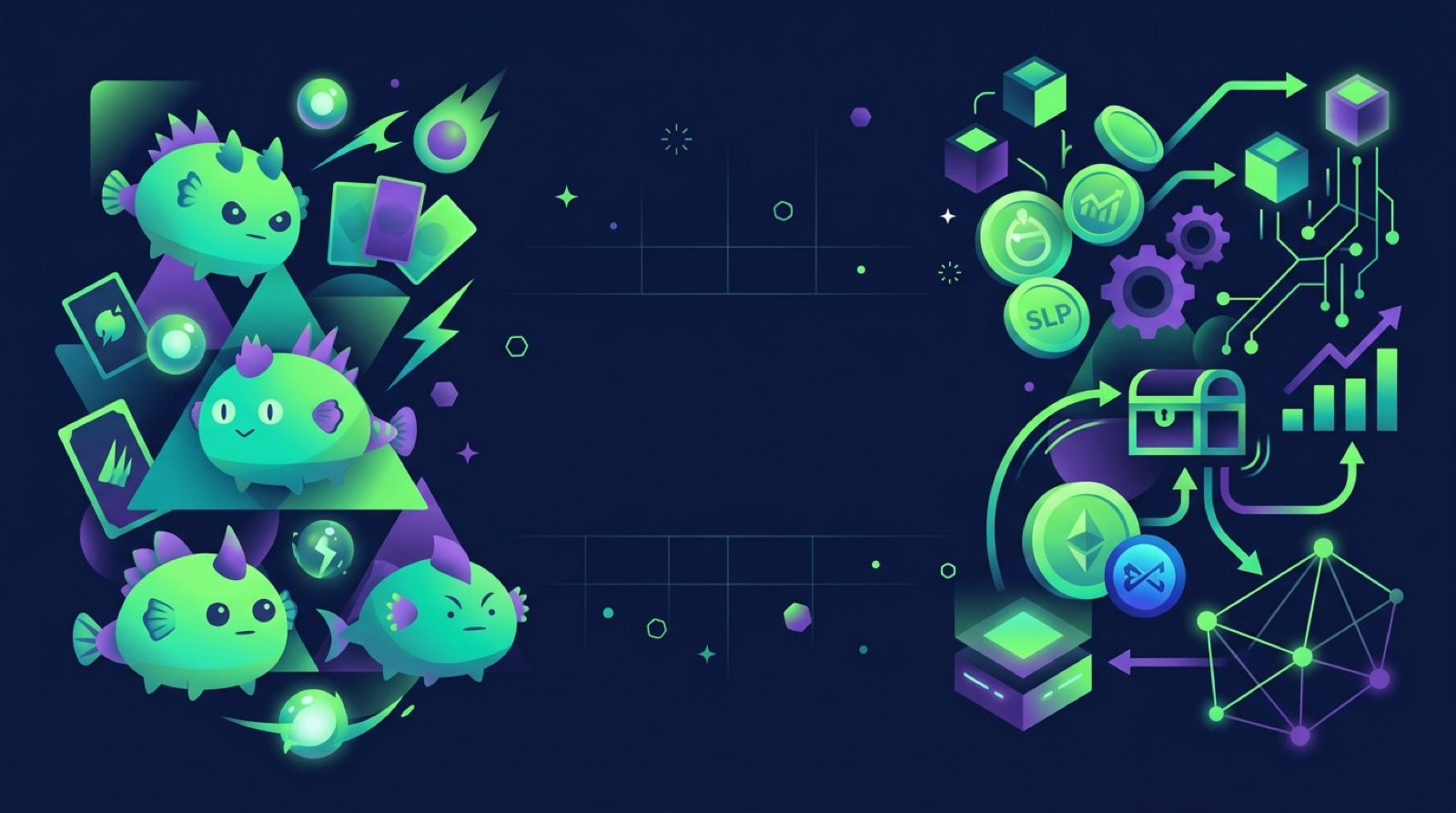
Axie Infinity is a blockchain-based game developed by Sky Mavis, a studio founded in Vietnam. Players collect, raise, breed, and battle fantasy creatures called Axies. Each Axie is an NFT, which means the player owns it in a crypto wallet rather than only in a game account, and can in principle sell or transfer it on a marketplace.
The game is often compared to Pokémon because of the creature collecting and team battles, though it is its own title with its own rules. What set it apart was the economic layer. Players could earn crypto tokens by playing, which led to the term play-to-earn. During 2021 the game drew millions of players, and it became the best-known example of a web3 game.
It is helpful to think of Axie Infinity as three things at once:
- A game: turn-based card battles with teams of Axies.
- A marketplace economy: Axies, land, and items are traded as NFTs.
- A token system: tokens such as AXS and SLP reward play and govern the project.
The game has gone through several versions and redesigns since launch, including a classic mode and a later version often called Origin. Specific features and reward rules change, so use the official game and documentation for the current details.
What are Axies and what makes each one different?
An Axie is a digital creature with a class, body parts, and stats. Each body part is linked to a battle card, so an Axie's appearance determines the moves it can use. Axies also carry stats such as health, speed, skill, and morale, which shape how they perform in combat.
In the classic version, Axies belong to one of nine classes: Beast, Aquatic, Plant, Bird, Bug, Reptile, Mech, Dawn, and Dusk. Classes have strengths and weaknesses against each other, a bit like a rock-paper-scissors system. Body parts can come from classes different from the Axie's own, which is why two Axies of the same class can play very differently.
Rarity matters too. Some parts are more common than others, and certain combinations of parts are more useful in competitive play. Because each Axie is an NFT with its own history of parts and breeding, prices on the marketplace vary widely. They depend on how useful the card set is, how rare the parts are, and how popular the current strategies are.
A player is not just collecting looks. They are picking a team whose cards work well together, so understanding the parts is the core skill of the game.
How do battles work?
The main mode is a turn-based battle between teams of three Axies. Each round, players spend energy to play cards drawn from their team's deck. Cards come from the Axies' body parts, so the team's cards depend on which Axies you brought.
A typical turn follows this pattern:
- Both players gain energy and draw cards.
- Players choose which cards to play, spending energy.
- Axies act in order of speed, so faster Axies often strike first.
- Damage is resolved, with class matchups affecting how much is dealt.
- The battle continues until all Axies on one side are defeated.
There are also adventure modes against computer opponents and ranked ladder play against other players. Rewards are linked to progress and results, though the specific tokens and amounts have changed over time.
Success depends on team composition, understanding card combos, and reading what your opponent is likely to do. A team of strong but mismatched Axies can lose to a well-built team with cheaper parts, which is why strategy guides and community tools are popular in the game's player base.
How does breeding work?
Breeding lets two Axies produce a new one. The offspring inherits parts from its parents, with some chance of passing on recessive traits, so breeding is partly a matter of planning and partly luck. Each Axie can only be bred a limited number of times, and each breeding costs tokens, which creates a cost to producing new Axies.
Historically, breeding required AXS and SLP, linking the in-game economy to the two main tokens. Newly bred Axies can be used by the player or sold on the marketplace. Breeding can be profitable when the offspring are worth more than the breeding cost, but that depends on token prices and demand at the time.
This cost structure was part of how the game removed tokens from circulation. SLP, which players earned in large amounts from battles, was spent on breeding. When more SLP was earned than spent, its price came under pressure. That dynamic is a key part of understanding why the economy has been volatile.
Breeding rules, costs, and Axie versions have changed over time. Check the current breeding rules in the official game before planning around them.
What are AXS, SLP, and the other assets?
Several tokens and assets make up the Axie economy.
| Asset | Role |
|---|---|
| Axies | NFT creatures used to battle and breed |
| AXS | Governance and staking token, also used in breeding and some purchases |
| SLP | In-game reward token earned through play and spent on breeding |
| Land | NFT plots in the game's world, historically called Lunacia, used for building and resource gathering |
AXS is tied to the project's governance, which means holders can participate in decisions about the ecosystem, and staking has been a feature. SLP was designed as an unlimited-supply reward token, which is part of why its value fell sharply after the 2021 peak when many more players were earning it than spending it.
Prices of AXS, SLP, and Axies change constantly. For current figures, check a market tracker such as CoinGecko or CoinMarketCap for token prices, and a marketplace for current Axie listings. The details of token utility have been revised several times, so the project's official documentation is the best place to confirm the latest design.
What is the Ronin network and why does it matter?
Axie Infinity runs on Ronin, a blockchain created by Sky Mavis for the game. Originally the game used Ethereum, but transaction fees there made small in-game actions too costly. Ronin was built to handle many low-fee transactions, and Axies and the main tokens were moved there.
To use it you need a Ronin wallet. Players typically keep their Axies and tokens in this wallet, move assets onto Ronin through a bridge, and trade on marketplaces that support the network. A decentralized exchange called Katana has been used to swap tokens on Ronin.
Ronin's bridge was exploited in March 2022 in a hack of more than 600 million dollars, which the FBI linked to the Lazarus Group, a North Korean hacking group. Sky Mavis later reimbursed users, reopened the bridge, and rebuilt the security model. The incident remains a standard example of bridge risk in crypto.
Ronin's technical setup has continued to evolve, and the project has discussed moving to a different architecture. Check the current Ronin documentation for how the network is run today and which wallet and bridge options are supported.
What is the scholarship system?
The scholarship system became one of Axie's most talked-about features. Because a competitive team needed three Axies that could be expensive, owners sometimes lent teams to other players called scholars. The scholar played and earned tokens, then split the earnings with the owner. The arrangement was especially popular in the Philippines during 2021, where some players treated the income as meaningful.
The system relied on off-chain agreements and manager tools, and terms varied between guilds. It worked while rewards exceeded costs, but when token prices fell the earnings shrank. Many scholars found the income was no longer worth the time.
If you come across scholarship offers today, treat them carefully. Check what share you would keep, who controls the wallet and the Axies, and whether any upfront payment is requested. Scams that use the word scholarship are common in play-to-earn communities, and a legitimate arrangement should not require you to share your recovery phrase or send money first.
Is Axie Infinity still worth playing, and what are the risks?
Axie Infinity rose quickly in 2021, then lost much of its player base and token value as the reward economy came under strain. The game was redesigned, with later versions attempting to reduce reliance on endless token emissions and make play more fun in itself. That history matters because it shows the main risk of play-to-earn: rewards depend on new money and sustained interest.
Before getting involved, consider these points:
- Price risk: Axies, AXS, and SLP can lose value quickly. Do not spend money you cannot afford to lose.
- Smart contract and bridge risk: the 2022 exploit shows that infrastructure can fail.
- Scams: fake wallets, phishing links, and fake scholarship offers target players. Only download the official wallet from verified sources, and never share your recovery phrase.
- Tax and legal rules: token rewards and NFT sales may be taxable, and rules differ by country. Check your local laws and rules for crypto, and note that the game may not be available in every region.
The safest way to try the game is to learn the mechanics first, start small, and treat any earnings as a bonus rather than income. This article is educational, not financial advice.
Frequently asked questions
Is Axie Infinity free to play?
The game itself can be played for free in some forms, but historically you needed a team of three Axies, each an NFT bought on a marketplace, to play the main battle mode. Newer versions have offered ways to start with less. Check the current onboarding options in the official game before spending anything.
Can you still make money playing Axie Infinity?
Some players earned meaningful income during the 2021 boom, but returns depend on token prices, the cost of Axies, and how many people are playing. Earnings have been volatile and can be zero or negative once costs are included. Treat it as a game with an uncertain token reward, not a job or an investment.
What is the difference between AXS and SLP?
AXS is the governance and staking token of the Axie ecosystem and is used in breeding and in-game purchases. SLP (Smooth Love Potion) was the in-game reward token earned in battles and spent on breeding. Their roles and reward structure have been revised over time, so check the official documentation for the current setup.
What is the Ronin network and do I need it?
Ronin is a blockchain built by Sky Mavis for Axie Infinity, designed for faster and cheaper transactions than Ethereum mainnet. You need a Ronin wallet to hold Axies and tokens on it. Its bridge was exploited in March 2022, so it is worth understanding how bridges and wallets work before moving funds.
Is Axie Infinity a safe investment?
Not necessarily. Any asset whose price depends on player demand carries risk, and Axie prices fell sharply after the 2021 peak. Only spend money you can afford to lose, check the rules in your country, and never share your wallet recovery phrase with anyone.
Mentioned in this guide
dApps in this guide
Axie Infinity is a Ronin-based NFT game where players collect, combine and battle creatures called Axies, with its own AXS token.
Infinity is a DeFi lending and borrowing protocol offering floating and fixed rates and yield curve trading, still shown as testnet or beta on its homepage.
Katana was a Solana options vault protocol that sold covered calls and puts weekly; its app has been offline since about 2023.
Ronin is an EVM-compatible gaming blockchain, home to Axie Infinity and Pixels, with RON as its token, aimed at Web3 gamers and developers.
Keep reading
Related guides
Web3 gaming · Explainer
What Is Axie Infinity and How Does It Work? A 2026 Guide
Axie Infinity is a blockchain game where players collect, breed and battle creature NFTs called Axies. This guide explains the assets, tokens, game modes, the Ronin network and the risks, so you can judge it before spending anything.
Web3 gaming · Explainer
Axie Infinity Breeding Economy Changes Explained (2026)
Axie Infinity changed how breeding costs and token rewards work after its early growth, and those tokenomics adjustments reshaped what players could earn. This guide explains what changed, why it hit earnings, and how to check the game's current economics yourself.
Web3 gaming · How-to
7 Ways to Earn in the Axie Infinity Economy (2026 Guide)
Axie Infinity pays players through several separate activities, not just one. This guide explains seven of them in general terms, what each requires, and what to check before you commit time or money.
DeFi · Explainer
Katana DEX on Ronin: Why It Ranks Up and What to Check
Katana was a native decentralized exchange on Ronin, the gaming chain built for Axie Infinity. This explainer covers what it was, what drives a DEX up ranking tables, and how to check a Ronin-based exchange's current status and liquidity before you use it.
Web3 gaming · Explainer
What Is Big Time and How Can You Play It?
Big Time is a free-to-play, loot-driven action RPG with tradable NFT items and a native token. Here is how it works, what you need to start, and what to verify first.
Web3 gaming · Explainer
What Is Crabada? The Avalanche Play-to-Earn Game Explained
Crabada was a play-to-earn battle game on Avalanche where players used NFT crabs to battle and earn tokens. Its marketplace and battles closed in May 2023, so this guide explains how it worked, what changed, and what to look at instead.
Web3 gaming · Explainer
What Is Avalon? The Social Deduction Board Game Explained
Avalon is most often the social deduction board game The Resistance: Avalon, not a blockchain game. This guide explains how it works, how to tell it apart from any crypto project with the same name, and where to learn more.
Web3 gaming · How-to
What Is Crypto Unicorns and How Do You Play It? (2026 Guide)
Crypto Unicorns is a web3 farming and breeding game from Laguna Games built around Unicorn and Land NFTs. This guide covers what it is, how the pieces fit together, and how to start without avoidable mistakes.