DeFi · Explainer
What Is a Perp DEX? How Perpetual Trading Works
A perpetual decentralized exchange lets you trade crypto price exposure through contracts with no expiry, using blockchain-based infrastructure instead of a conventional exchange account. Learn how margin, funding payments, liquidations and different trading designs work—and what to check before using one.
By the DappsAtlas editorial team · Updated
What is a perp DEX?
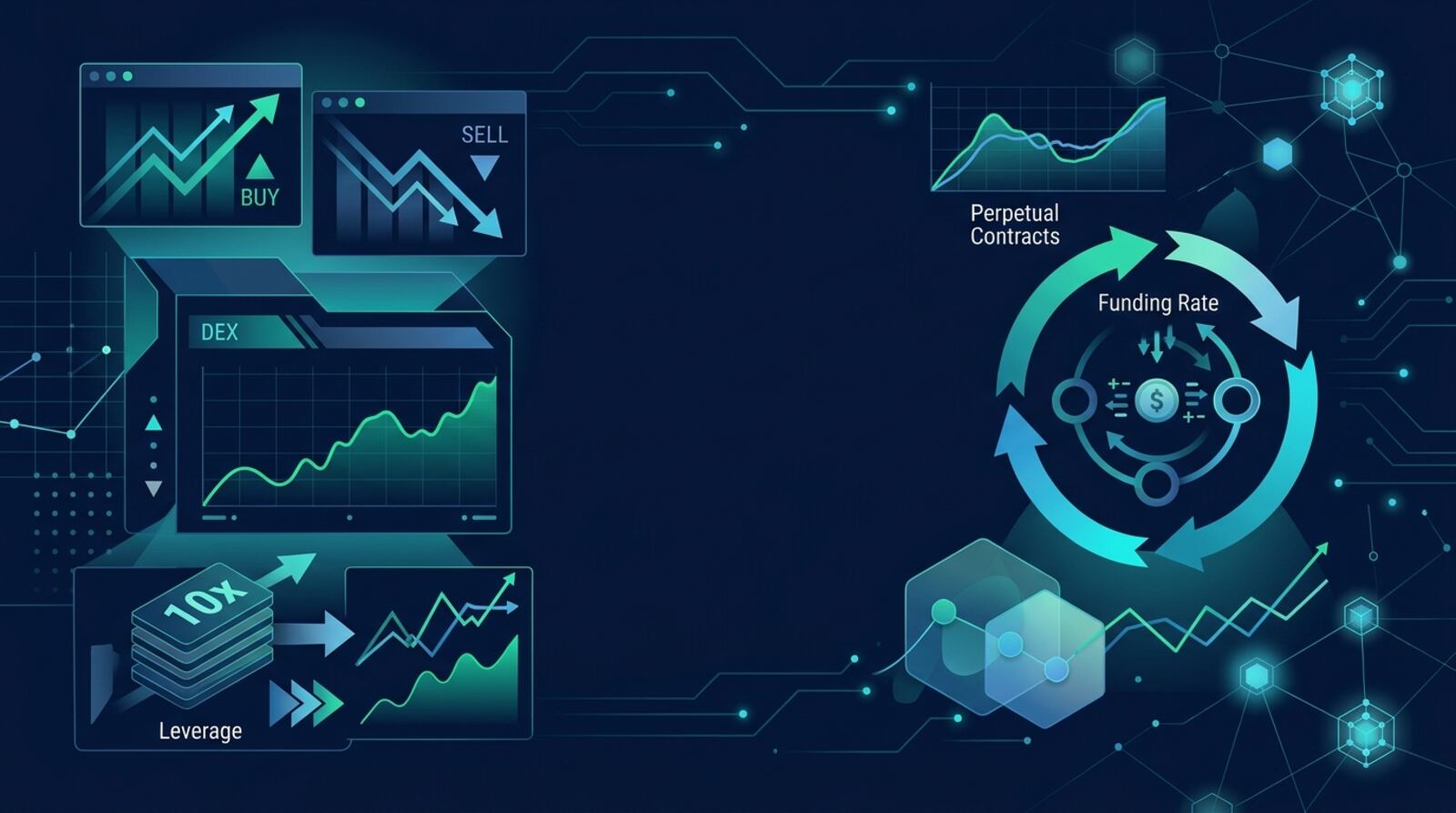
A perp DEX, short for perpetual decentralized exchange, is a crypto trading venue for perpetual futures contracts. A perpetual contract, often called a “perp,” follows the price of an asset such as Bitcoin or Ether but has no fixed expiry date. Instead of buying the underlying token, you take a position whose value changes as the market price moves.
Perps commonly allow two directions of trade:
- Long: you benefit if the contract’s price rises, but lose if it falls.
- Short: you benefit if the price falls, but lose if it rises.
A perp DEX combines this derivative with blockchain-based infrastructure. Depending on its design, smart contracts may handle collateral, position accounting, settlement or parts of trade execution. Some platforms use an onchain order book; others use liquidity pools or a hybrid system. “Decentralized” does not mean every component is necessarily run onchain or controlled by users.
Perp DEXs are mainly used for short-term speculation, hedging or expressing a view on an asset’s price. They are not the same as buying and holding the asset: a trader may never receive the token itself. Perpetuals also involve margin, funding payments and liquidation rules, so understanding the contract is essential before opening a position.
How is a perp DEX different from spot trading and futures?
The main difference is what you trade and what you own. In a spot trade, you exchange one token for another. If you swap stablecoins for ETH and keep it in your wallet, you own ETH and can transfer or use it. In a perpetual trade, you hold a derivative position tied to an asset’s price. You may profit or lose as the price moves, but you do not necessarily own the underlying asset.
Traditional futures contracts usually have a settlement or expiry date. A perpetual contract has no scheduled expiry, so it needs a mechanism to keep its price close to the underlying market. Funding payments are the best-known mechanism, though platforms can use different pricing and risk systems.
| Feature | Spot trading | Perpetual trading |
|---|---|---|
| What you hold | The asset you buy | A derivative position |
| Expiry | Not applicable | No fixed expiry |
| Short exposure | Usually requires borrowing or another product | Often available directly |
| Leverage | Usually none unless borrowed | Common, subject to platform rules |
| Main extra risks | Token, market and custody risks | Margin, liquidation, funding and contract risks |
A perp DEX is also different from a centralized derivatives exchange. A DEX may let users interact through a wallet and blockchain protocols, while a centralized exchange manages accounts and trading infrastructure itself. The actual custody and control model varies by platform.
How do margin, leverage and profit or loss work?
Perp traders usually provide margin, which is collateral supporting a position. The position’s notional value—the total exposure—is often larger than the collateral. That difference is leverage. For example, a position with exposure several times larger than its margin will gain or lose value more quickly, as a proportion of the margin, than an unleveraged position.
A simplified example: if a trader puts up $100 of margin to open a $500 long, the position has $500 of exposure. A 1% move in the asset’s price corresponds to roughly $5 of profit or loss before fees and funding. That is 5% of the original $100 margin. This example leaves out maintenance margin, changing collateral value and platform-specific calculations; it is not a prediction of an actual trade outcome.
The exchange tracks unrealized profit and loss while the position is open. Closing the position realizes that result, subject to the contract’s rules and costs. Collateral may be in a stablecoin or another supported asset. If the collateral itself changes in value, the trader’s capacity to support the position can change too.
Leverage is not a separate bonus or free capital. It increases exposure and makes a position more sensitive to price moves. A small adverse move can consume a large share of the margin, while fees and funding can further affect the position. Always check whether a platform uses isolated margin, cross margin or another model, because that determines how collateral is allocated and what funds are at risk.
What is funding, and why do perp traders pay it?
A perpetual contract has no expiry date to pull its price toward the spot market, so exchanges commonly use funding payments. These payments pass between traders on opposite sides of a market, rather than necessarily going to the exchange. The aim is to make holding the more crowded side less attractive and encourage the contract price to move closer to the underlying market price.
When a perp trades above its reference market, the funding mechanism may make longs pay shorts. When it trades below, shorts may pay longs. The exact formula, rate, interval and payment direction depend on the platform and market conditions. Funding can change over time, and a displayed rate should not be treated as a guaranteed ongoing cost or return.
Funding matters most to traders who hold positions for longer periods, but it can affect short-term trades too. A position that appears profitable from price movement may have a smaller net result after funding and trading fees. Conversely, a trader receiving funding can still lose overall if the price moves against the position.
Before entering a trade, look for the current rate, how often it is applied, how the platform estimates it, and whether the displayed figure is historical, projected or currently applicable. Read the platform’s rules for unusual market conditions as well. Funding is a price-balancing tool, not a guarantee that the perp will always match spot or that a position will be profitable.
How does a perp DEX execute and price trades?
Perp DEXs can use different systems to match traders and manage liquidity. The design affects pricing, execution, transparency and the kinds of risks a user should investigate.
- Order book: Buyers and sellers submit limit orders at chosen prices. A matching system pairs compatible orders. Some order-book exchanges process matching or settlement onchain; others use offchain components for speed and write key actions to a blockchain.
- Liquidity pool or AMM: Trades interact with a pool or pricing formula rather than matching directly with another user’s resting order. The pool, a market-making vault or another counterparty may take the other side of the exposure.
- Hybrid model: A platform may combine an order book, onchain settlement, offchain matching, external market makers or other components.
A perp DEX also needs prices for the underlying asset. It may use oracle feeds, market data from multiple venues, or a combination. These inputs help set reference prices and trigger risk controls. If a feed is delayed, disrupted or manipulated, the effects can reach traders through pricing, funding or liquidation decisions.
Fast execution does not by itself tell you how decentralized or safe a platform is. Ask which parts are onchain, who can pause or upgrade contracts, how the system handles oracle failures, and whether the exchange publishes clear rules for matching and settlement. Architecture is a practical user concern: it shapes what can go wrong and what recourse is available.
Are funds on a perp DEX self-custodied?
The user experience may resemble a trading app, but the way funds are held and positions are settled depends on the platform. Some perp DEXs ask you to connect a self-custody wallet and deposit collateral into a protocol. Others may use smart-contract accounts, a dedicated blockchain or a different account model. A wallet connection alone does not prove that every trade or asset remains directly under your control at every stage.
Check the full path your funds take: which network receives the deposit, whether a bridge is involved, what contract or account holds the collateral, and how withdrawals work. If funds move through a bridge, there is an additional bridge risk. If the platform uses a custom chain, consider that chain’s validators, availability and security assumptions. Read the withdrawal and settlement rules rather than assuming a wallet connection means instant access to all funds.
There is a further distinction between self-custody and decentralized operation. A user may retain control of a wallet while relying on a centrally operated interface, sequencer or matching service. Conversely, a protocol may use smart contracts for settlement but still rely on governance or administrators with upgrade powers.
Look for documentation that explains custody, contract permissions, upgrade controls, withdrawal conditions and any emergency procedures. If these details are unclear, treat the uncertainty as a risk. Do not deposit funds you cannot afford to have temporarily inaccessible or lose.
What causes liquidation on a perp DEX?
A position may be liquidated when its remaining margin falls below a platform’s required maintenance level. Liquidation is a risk-control process intended to limit the chance that a losing position leaves insufficient collateral to cover its losses. The platform’s exact trigger and process vary, and liquidation can occur before the collateral appears to have reached zero.
A simplified sequence is:
- The platform marks the position against a reference price.
- An adverse price move reduces the account’s available margin.
- The position reaches a maintenance threshold.
- The platform or its liquidation mechanism reduces or closes some or all of the position.
- Fees, penalties or other settlement rules may affect the remaining balance.
The reference price used to determine liquidation may differ from the last traded price shown on a chart. That difference is one reason a position can be liquidated even if a brief chart wick appears not to have crossed the expected level. Fast markets, thin liquidity, oracle disruption or network congestion can add complications.
Cross margin may put a broader pool of collateral behind several positions, while isolated margin generally assigns a defined amount to one position. The details differ by venue, and neither approach removes liquidation risk. Check the platform’s maintenance requirements, mark-price method, liquidation fee, partial-liquidation rules and what happens if the system cannot close positions normally. A stop order is not a guarantee against liquidation or execution at a particular price.
What are the main risks and costs?
Perpetual trading combines market risk with costs and technical risks. The most visible risk is leverage: losses grow relative to the margin as exposure increases, and liquidation can close a position during an adverse move. Prices can jump, liquidity can thin and orders may execute at a worse price than expected. A profitable price move can also be offset by funding and trading fees.
Other risks depend on the platform’s design:
- Oracle risk: incorrect, delayed or unavailable price data can affect pricing and liquidations.
- Smart-contract risk: a bug or exploit can threaten deposited funds or position settlement.
- Market and liquidity risk: there may not be enough depth to enter or exit near the displayed price.
- Operational risk: outages, congestion or a failure in a matching system can disrupt trading.
- Governance and control risk: upgrade keys, emergency powers or rule changes may affect users.
- Bridge and chain risk: these apply when assets or activity depend on a bridge or another network.
Fees may include trading fees, funding payments, deposit or withdrawal costs, and liquidation-related charges. Not every platform uses every fee type, and fee schedules can change. Review the current terms for the specific market and network before trading.
A protocol’s smart contracts being public, or a project describing itself as non-custodial, does not eliminate these risks. Look for clear technical documentation, independent security reviews where available, transparent incident disclosures and understandable risk rules. Treat any missing information as an unknown, not as proof of safety.
How should you compare perp DEXs?
Perp DEXs differ in the assets they list, available collateral, execution model, supported networks and account controls. A useful comparison focuses on how the exchange works, not just trading volume or a headline leverage limit. Consider whether the order book or pool design suits your needs, how liquid the specific market is, and what price source governs funding and liquidation.
For example, Hyperliquid is a blockchain-based venue for onchain perpetual and spot trading. Jupiter is a Solana-based trading platform with perps among its broader set of trading tools. These examples illustrate that a perp product can sit within a dedicated trading environment or alongside other DEX functions. Their current markets, fees, interface features and operating details can change, so check each platform’s own current documentation before acting.
Use a structured checklist:
- Confirm the exact contract, underlying reference asset and settlement currency.
- Read the margin, funding, liquidation and fee rules.
- Identify where collateral is held and how withdrawals work.
- Check the price source, order type behavior and market liquidity.
- Review contract audits, upgrade permissions, incident history and any chain or bridge dependencies.
- Confirm that the platform is available to you under local rules and its access policies.
A familiar interface is not a substitute for understanding the product. If you cannot explain how the position is priced, what can trigger liquidation and how you can withdraw, pause before depositing collateral.
What should you know before using a perp DEX?
If you are new to perpetuals, start by learning the mechanics rather than looking for a trade. Read the exchange’s documentation and test the interface without depositing funds where a non-trading preview or simulation is available. Understand the difference between order size and collateral, and how the platform calculates unrealized profit and loss, funding and liquidation price.
Before any real transaction, verify the network and the destination for collateral. Use the official interface, check token and contract details carefully, and beware of fake sites, impersonators and messages asking for seed phrases. Never share a recovery phrase or approve an unfamiliar wallet request. A test transaction may help confirm that you are using the intended network, but it does not prove a protocol is safe.
If you decide to trade, limit exposure to an amount you can afford to lose, avoid relying on maximum leverage and account for fees and funding. A stop order can help manage a plan but may not execute at the intended price during sharp moves or technical disruption. Monitor open positions and know how to reduce or close them, including what to do if the interface is unavailable.
Perp DEXs are derivatives, not savings products or a substitute for owning an asset. Regulations and access restrictions vary by jurisdiction, and platforms may impose eligibility checks. Do not bypass local laws, age requirements, identity checks or geographic restrictions. If the risks or rules are not clear, do not deposit funds.
Frequently asked questions
What is a perp DEX?
A perp DEX is a decentralized exchange where users trade perpetual futures contracts: derivatives that track an asset’s price but do not have a set expiry date. Trades typically use margin, and the contract’s price is kept near the underlying market price through funding payments or other mechanisms.
Is a perp DEX the same as a spot DEX?
No. Spot trading exchanges one asset for another, so you own the asset you receive. A perpetual contract gives you price exposure without necessarily owning the underlying asset; it can also let you take a short position. Both spot and perpetual trades can lose money, but perps add leverage and liquidation risk.
What is a funding rate in perpetual trading?
Funding is a periodic payment between traders holding opposite sides of a perpetual market. It helps encourage the contract price to stay near the underlying asset’s price. The rate and payment direction vary, and funding is not guaranteed to be positive or negative for a particular position.
Are perp DEXs non-custodial?
A perp DEX may be non-custodial in the sense that trades or settlement use smart contracts and users connect their own wallets. That does not make every design equally decentralized: order matching, price feeds, risk controls and interfaces may rely on different combinations of onchain and offchain infrastructure.
Can you lose money using a perp DEX?
A perp DEX does not remove the financial risks of derivatives. Leverage magnifies losses, a sharp price move can trigger liquidation, and traders may pay funding and trading fees. Smart-contract, oracle, liquidity, bridge and platform risks can also apply, depending on how the exchange is built.
Mentioned in this guide
dApps in this guide
Hyperliquid is a Layer-1 blockchain with a non-custodial onchain exchange for perpetual futures and spot trading, aimed at active crypto traders.
Jupiter is a Solana DEX aggregator for traders who want routed swaps, limit orders, DCA, perps and token launches, with its own JUP token.
Common is a non-custodial ZK privacy dapp on Arbitrum and Aleph Zero EVM that lets users shield funds and withdraw to a new, unlinkable wallet.
Keep reading
Related guides
DeFi · Comparison
Decentralized Perpetual Exchanges Explained
Decentralized perpetual exchanges let traders take leveraged long or short positions without an expiry date, usually by connecting a wallet and posting collateral. Learn how funding, pricing, liquidation and different trading models work—and what to compare before choosing a platform.
DeFi · Explainer
Is Ethereum DeFi Gaining an Unbeatable Lead? A 2026 Explainer
Ethereum still holds a large share of DeFi activity, but no chain has an unbeatable lead, and the answer depends on which metric you use. This explainer shows what the data can and cannot prove, and how to check the picture yourself.
dApp basics · Explainer
How dApp Metrics Can Guide Crypto Investments in 2026
On-chain numbers can show how a dApp is used, but they do not show whether a token is a good buy. This guide explains which metrics to read, where to check them and where they mislead.
dApp basics · Explainer
How to Gain dApp Market Insights With Data in 2026
Public blockchain activity can be counted, but the numbers only help when you know what each metric measures and where it can mislead. This guide explains the core metrics, reliable sources, and a simple routine for reading dApp market data in 2026.
DeFi · Explainer
What Is a Stablecoin? How It Works and Its Risks
Stablecoins are crypto tokens designed to track the value of another asset, often the US dollar. Learn how they work, where their pegs can fail, and what to check before using one.
DeFi · Explainer
What Is a DEX in Crypto? How Decentralized Exchanges Work
A decentralized exchange lets you swap crypto through blockchain software rather than depositing funds with a conventional exchange. Learn how DEX trades work, what they cost, how they differ from centralized exchanges, and what to check before connecting a wallet.
DeFi · Explainer
What Is Aave Crypto Lending? How It Works in 2026
Aave is a non-custodial lending protocol where depositors earn interest and borrowers post collateral to take loans. This guide explains how the mechanics work, what the main risks are, and where to check live rates instead of relying on fixed numbers.
DeFi · Explainer
What Is a DEX? How Decentralized Exchanges Work
A decentralized exchange (DEX) lets you swap crypto through blockchain-based software instead of depositing funds with a conventional exchange. Learn how DEX trades, prices, fees and liquidity work, and what to check before connecting a wallet.