Token · Explainer
Tokenomics Explained: How Crypto Token Economics Works
Tokenomics is the design of a crypto token’s supply, distribution, uses and incentives. Learn how to read those mechanics, what they can and cannot tell you about value, and which risks to check before buying.
By the DappsAtlas editorial team · Updated
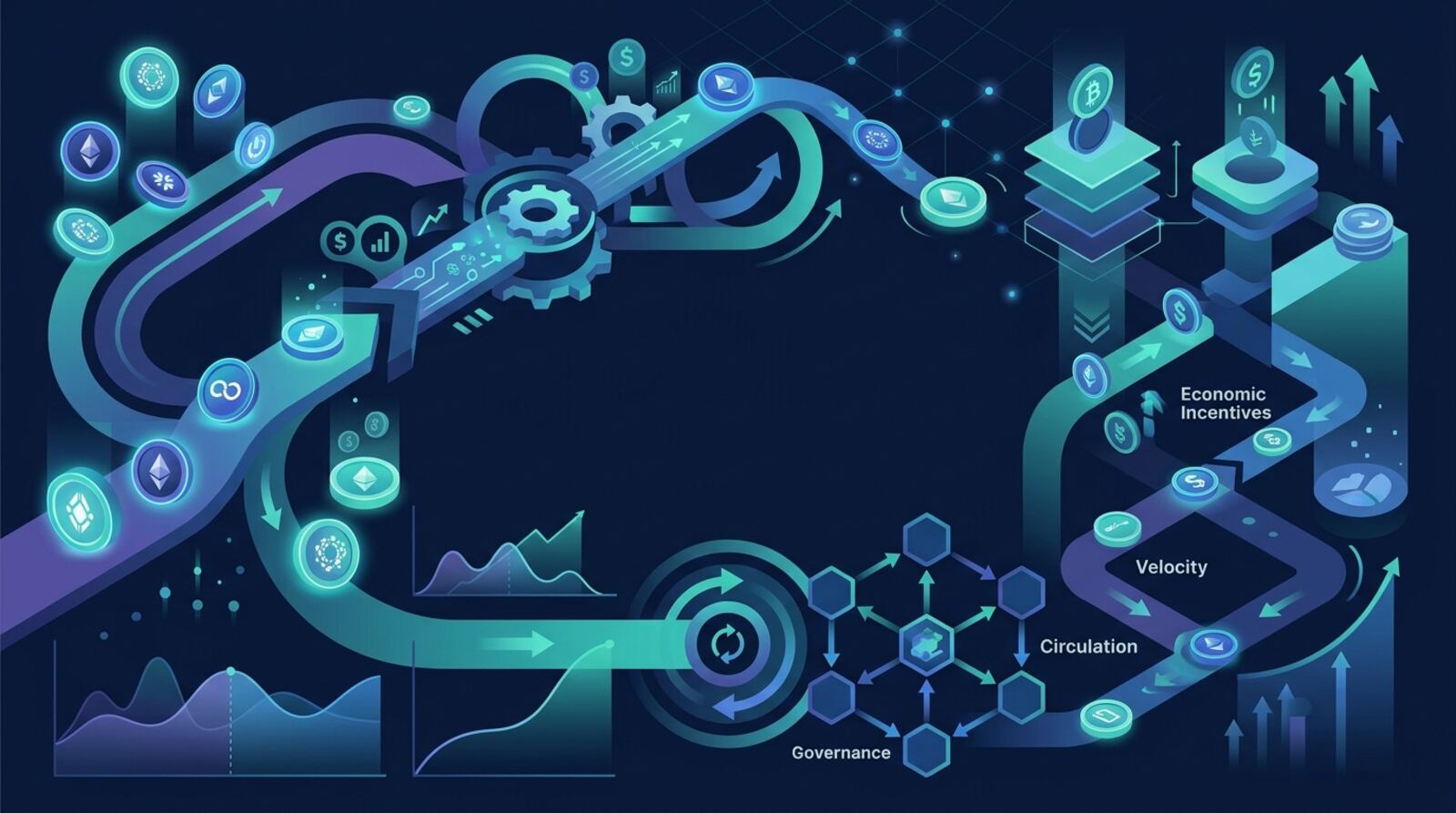
What is tokenomics in crypto?
Tokenomics is the economic design of a crypto token: the rules and incentives shaping how it is created, distributed, used and potentially removed from circulation. The term combines “token” and “economics,” but it is not a single formula or a guarantee of a token’s future price. It is a way to examine how a token fits into a project and what could affect its supply and demand.
A useful analysis separates three questions:
- What are the rules? Look at supply limits, issuance, burns, allocations and unlock schedules.
- What is the token for? It may be used for payments, access, staking, governance or as a claim on an on-chain service.
- Who has an incentive to hold or use it? Users, validators, investors and a project’s treasury may have different reasons and time horizons.
Tokenomics is not the same as a project’s technology, business model or overall security. A protocol may be useful while its token captures little of that usefulness. Conversely, a token can have a compelling story without a durable source of demand. Treat tokenomics as one part of research, alongside the project’s operation, risks and market conditions.
How do supply, circulating tokens and FDV differ?
Supply figures describe different things, so check what each number means before comparing tokens. Total supply usually refers to tokens already created, minus any that have been permanently removed, although providers may calculate it differently. Circulating supply is an estimate of tokens available to the market. Maximum supply is a cap, if the token has one. Some projects have no fixed maximum and can continue issuing tokens under defined rules or governance decisions.
A low circulating supply can make a token look scarce, but it can also mean substantial future issuance is still ahead. Fully diluted valuation (FDV) is generally calculated by multiplying the current token price by the maximum supply, or by another estimate of eventual supply when no cap exists. It is a comparison tool, not a prediction of what the token will be worth once all units circulate.
When reviewing supply, ask:
- Can the supply grow, and who can authorize changes?
- Are tokens burned, and under what conditions?
- Are some units locked, reserved or controlled by a treasury?
- Do different data sources define circulating supply consistently?
Use the project’s token documentation and contract information to verify the rules. A headline supply number without its definition can be misleading.
How are tokens distributed and unlocked?
Distribution shows who received or may receive the token. Common allocations include early investors, founders and contributors, community programs, ecosystem grants, liquidity incentives and a treasury. A token allocation is not necessarily in circulation when announced: it may be subject to vesting, lockups or conditions. The schedule matters because it indicates when recipients become able to transfer tokens, not what they will choose to do with them.
Look for the allocation breakdown and the rules behind it. Check whether team and investor tokens vest gradually, whether cliffs create a large release at one point, and whether the treasury can distribute tokens at its discretion. Also ask if the project explains how community allocations are earned. “Community” can cover many different programs and does not by itself establish broad ownership.
A practical way to assess distribution is to compare current circulating supply with expected releases over the period you care about. Then consider concentration: a small number of large holders may be able to influence voting or market liquidity. Wallet balances can be difficult to interpret because one address may represent a treasury, exchange or custody service, so do not assume every large wallet belongs to one individual.
Transparent allocations and schedules make the design easier to assess. They do not eliminate the risk of future dilution or concentrated control.
What does token utility mean?
A token’s utility is what holders can actually do with it under current rules. Some tokens are used to pay for a service or transaction. Others provide access to an application, can be staked to support a network, or confer voting rights. A token can serve several roles, but each one should be checked separately: a feature described in marketing materials may not yet be live or may depend on governance changes.
Ask whether the token is necessary to use the product. If users can access the service without buying or holding the token, the product’s adoption may not automatically create token demand. If a token is required, examine whether users must keep holding it or only acquire it briefly to pay a fee. Those patterns can have different effects on demand.
Staking also has more than one meaning. It may involve helping secure a network, depositing tokens in a protocol, or locking tokens to receive incentives or voting power. Each arrangement has its own risks, including lockup conditions, changing rewards and smart-contract exposure. For example, Lido’s stETH represents staked ETH and can be used in DeFi; it is a different kind of token role from a governance token.
A useful test is to map each claimed use to a live product feature and identify who needs the token, how often, and under what conditions.
How do token incentives and emissions work?
Demand is influenced by who wants to use, hold or obtain a token, while incentives are the rewards and costs that may shape that behaviour. Protocols can issue tokens to attract users, liquidity providers, validators or contributors. Those rewards can help an early network get started, but they are not automatically evidence of lasting demand. If participants mainly earn tokens to sell them, the program may create continuing sell pressure.
Check the reward source and duration. Are rewards newly issued, taken from a treasury, funded by fees, or tied to some other mechanism? Is the incentive temporary or open-ended? What must a recipient do to qualify, and can the terms change through governance? A high advertised reward is not the same as a guaranteed return: token prices, eligibility, lockups and protocol rules can change.
Incentives can also cause activity to fade when rewards fall. Compare activity during reward programs with activity when rewards are lower, where that information is available. Look for signs that users have reasons to stay beyond emissions, such as a useful service, reliable liquidity or a real need to hold the token.
The central question is whether incentives help create durable use or simply pay people to participate for a while. That distinction is important when evaluating a token whose current activity depends heavily on distributions.
Do token burns and fee sharing create value?
A burn permanently removes tokens from the supply when the mechanism and accounting genuinely make them inaccessible. A project might burn tokens from a treasury or use a share of fees to buy and burn tokens, but these are distinct designs and their details matter. Some tokens have no burn mechanism at all. A burn can reduce supply relative to what it would otherwise have been, but it does not ensure that demand will rise or that price will increase.
“Value capture” describes how activity in a protocol may create a benefit for token holders. That benefit could be a practical use, governance influence, or a defined share of fees—but these are not interchangeable. Fee revenue going to a protocol does not mean it goes to token holders. A governance vote might change fee allocation in the future, but a possible future decision is not the same as an existing holder right.
When a project claims its token captures value, verify the mechanism:
- Who receives fees today?
- Is the allocation automatic, discretionary or subject to a vote?
- Does holding the token create an enforceable on-chain right?
- Can the mechanism be changed, paused or removed?
Read the token rules and current implementation rather than relying on shorthand such as “deflationary” or “revenue sharing.” A mechanism can be real and still be too small, changeable or uncertain to support a valuation by itself.
What rights do governance tokens give holders?
Governance tokens can let holders vote on proposals such as parameter changes, spending from a treasury or protocol upgrades. The scope varies: some votes are advisory, some decisions are carried out by smart contracts, and some still depend on people or administrators to implement them. A right to vote is not necessarily a right to control every part of a project, nor does it imply a claim on its assets or income.
Review how participation works. Check who can submit proposals, what voting power is based on, whether tokens must be locked, how long votes last and what threshold is needed for a decision to pass. Delegation can make voting easier, but it may concentrate influence in a small number of delegates. Large token holders can also have an outsized role, especially when turnout is low.
Consider the practical limits. Can a proposal be vetoed or delayed? Are there emergency controls? Who can change the voting rules? A governance system may balance speed and safety differently, and neither token voting nor decentralization should be assumed from a project’s branding.
For example, Jupiter describes JUP as a token used for DAO governance. That tells you one stated function, but it does not by itself answer how much influence an individual holder has, what proposals are in scope or whether holding JUP creates other economic rights. Those details require checking the project’s current governance rules.
How do tokenomics vary by token type?
Different tokens can play very different economic roles, even when they are all traded on crypto markets. A governance token may focus on voting. A staking-related token can represent a position in a network or protocol. A payment token may be intended for transfers or fees. A stablecoin aims to track an external unit of account, though its design and backing determine its risks. These categories can overlap, and names alone do not tell you the full mechanics.
Lido’s stETH illustrates a receipt-like role: it represents staked ETH and is described as reward-earning and usable across DeFi. That is not the same as owning a project’s governance token. Curve’s CRV and PancakeSwap’s CAKE are described as governance tokens, while Jupiter’s JUP is used for DAO governance. These examples show why it is important to ask what a particular token does instead of assuming every token is a share in a company or a claim on protocol revenue.
A token’s role can also change through upgrades or governance decisions. Read the current rules, then distinguish existing functionality from proposed or potential uses. If a token is used as collateral or paired in a liquidity pool, consider the added risks of liquidation, price movements and smart contracts. A useful comparison starts with rights and mechanics, not just ticker, price or market capitalization.
How can you evaluate a token’s tokenomics?
A focused tokenomics review can start with a one-page checklist. First, find the project’s documentation describing supply, contract controls, distribution, vesting and token uses. Then compare those claims with the token’s current contract and on-chain activity where you can interpret it. If a key fact is not published or cannot be verified, treat it as unknown rather than filling in the gap with an assumption.
Next, consider supply over time. Record the current circulating amount, any maximum supply, scheduled unlocks and ongoing emissions. Note who receives new tokens and whether governance can alter the schedule. Then assess demand: identify which live features require the token, who uses them and whether users have reasons to hold it. If the project makes claims about fee sharing or burns, trace the mechanism to its current implementation.
Finally, look at distribution and market access. Concentrated ownership, thin liquidity or a large share of tokens due to unlock can make it harder to trade without affecting the price. Market-capitalization figures and circulating supply estimates may differ across platforms, so understand the calculation before comparing projects.
This process does not produce a precise fair value. It helps you spot unanswered questions, dependencies and potential sources of dilution. Tokenomics should be considered alongside technical, governance, legal and market risks—not treated as a substitute for them.
What can tokenomics not tell you?
Tokenomics can help explain a project’s incentives, but it cannot predict how markets will behave. A useful token may still lose value if demand falls, confidence weakens or market conditions change. A scarce token may remain unwanted. A large user base may not translate into demand for a separate token. And an advertised utility can be altered, restricted or discontinued if the rules allow it.
Smart-contract and governance risks matter too. Token contracts may have administrative controls, upgrade paths or other permissions that affect supply and transfers. Governance may change incentives or introduce new risks. If you cannot understand an important control, look for a clear explanation of who can use it, how it is protected and whether changes require a public process. Do not assume that a token’s distribution is decentralized simply because it runs on a blockchain.
Treat projections, “fully diluted” comparisons and reward rates as assumptions, not promises. Verify when schedules and parameters were last updated, since token rules can change. Keep your research proportional to the decision: for a token you do not understand, pausing is more sensible than relying on a catchy supply claim.
The most useful question is not “Is this token deflationary?” It is “What creates real, continuing demand, who receives new supply, and what rights do holders actually have?” Clear answers do not remove risk, but they make it easier to judge what you are taking on.
Frequently asked questions
What does tokenomics mean?
Tokenomics describes a token’s economic design: how many units exist, who receives them, what they can be used for and how those rules may change. It also covers incentives that influence how people acquire, hold or spend the token.
Does a limited supply mean a token will become more valuable?
No. A fixed or limited supply does not ensure demand, usefulness or a rising price. A token’s price also depends on factors such as market conditions, liquidity, trust and whether people want to use or hold it.
What is the difference between circulating and maximum supply?
Circulating supply estimates how many tokens are available in the market now. Maximum supply is the most that can exist under the token’s rules, while fully diluted valuation estimates the market value if the full supply were circulating at the current price.
What is a token unlock?
A token unlock makes previously restricted tokens eligible to move or be sold. An unlock does not mean holders will sell, but a large release can increase the amount available on the market and may affect price or liquidity.
Do governance tokens give holders a share of protocol revenue?
No. Governance tokens may provide voting rights, but that does not automatically give holders a claim on revenue, assets or a share of profits. Check the token’s documented rights and how governance decisions are implemented.
Mentioned in this guide
dApps in this guide
Lido is a liquid staking protocol where users stake ETH and receive stETH, a reward-earning token usable across DeFi, governed by LDO holders.
Jupiter is a Solana DEX aggregator for traders who want routed swaps, limit orders, DCA, perps and token launches, with its own JUP token.
Curve is a decentralized exchange on Ethereum built for low-slippage swaps of stablecoins and similar assets, with CRV governance and a crvUSD stablecoin.
PancakeSwap is a BNB Smart Chain decentralized exchange with swaps, farming, staking and CAKE governance for self-custody DeFi users.
Common is a non-custodial ZK privacy dapp on Arbitrum and Aleph Zero EVM that lets users shield funds and withdraw to a new, unlinkable wallet.
Crypto.com is a centralized crypto exchange and app for buying, trading and spending 400+ coins, with a Visa card, staking and a separate self-custody wallet.
Keep reading
Related guides
Token · Explainer
OpenOcean OOE Token: Utility and Governance Explained
OOE is the token tied to OpenOcean, a multi-chain DEX aggregator. This guide explains what the token is meant to do, how governance works in principle, and what to check before relying on either.
Token · Best list
Cryptocurrency Coin List: Coins to Know in 2026
Use this practical cryptocurrency coin list to compare major networks, stablecoins and app tokens by what they do—not by a ranking that can change overnight. You’ll also learn what to check before buying, including token supply, network support and risk.
dApp basics · Explainer
How Radar Governance Works in the Ecosystem (2026 Guide)
Radar is a name that appears in many unrelated contexts, so this guide explains how governance works in a dApp ecosystem and how to verify who decides what for any project called Radar. It also shows how to compare governance models across the DeFi protocols readers use most.
dApp basics · Explainer
What Is a dApp Discovery Site and How Its Data Works (2026)
A dApp discovery and analytics site is an independent guide that tracks decentralized apps across blockchains and reports activity such as users, volume and transactions. This guide explains what these sites show, how to read their numbers, and where their data can mislead.
Token · Best list
Top 100 Cryptocurrencies by Market Cap in 2026
A top-100 crypto ranking is a moving snapshot, not a recommendation. Learn what market capitalization measures, how to check a current list, and what to investigate before comparing tokens.
Token · Explainer
The Sandbox SAND Token Explained: Uses, Supply and Risks
SAND is the ERC-20 token behind The Sandbox, a user-generated virtual world built around LAND, creator tools and a marketplace. This guide covers what SAND does, how supply and governance work, and what to verify yourself.
Token · Best list
Top 50 Cryptocurrencies by Market Cap: 2026 Guide
Market-cap rankings move with prices and circulating supply, so the top 50 is a live list rather than a permanent set. Learn how to check the current order, interpret the numbers and compare crypto assets beyond rank.
Token · Explainer
Tether USDT Reserves Explained: What the Proof Shows in 2026
Tether says its USDT stablecoin is backed by more than enough reserves, but the strength of that claim depends on what the reserves are, who checks them, and when the figures were measured. This guide explains how to read a reserve report and what to verify before relying on USDT.