NFT · Explainer
Sotheby's COVID Alien CryptoPunk Sale: The $11.8M NFT Explained
In June 2021, Sotheby's sold CryptoPunk #7523, known as the COVID Alien, for about $11.8 million. This guide covers what the NFT is, why it sold for so much, and how to check NFT sales claims yourself.
By the DappsAtlas editorial team · Updated
What is the COVID Alien CryptoPunk?
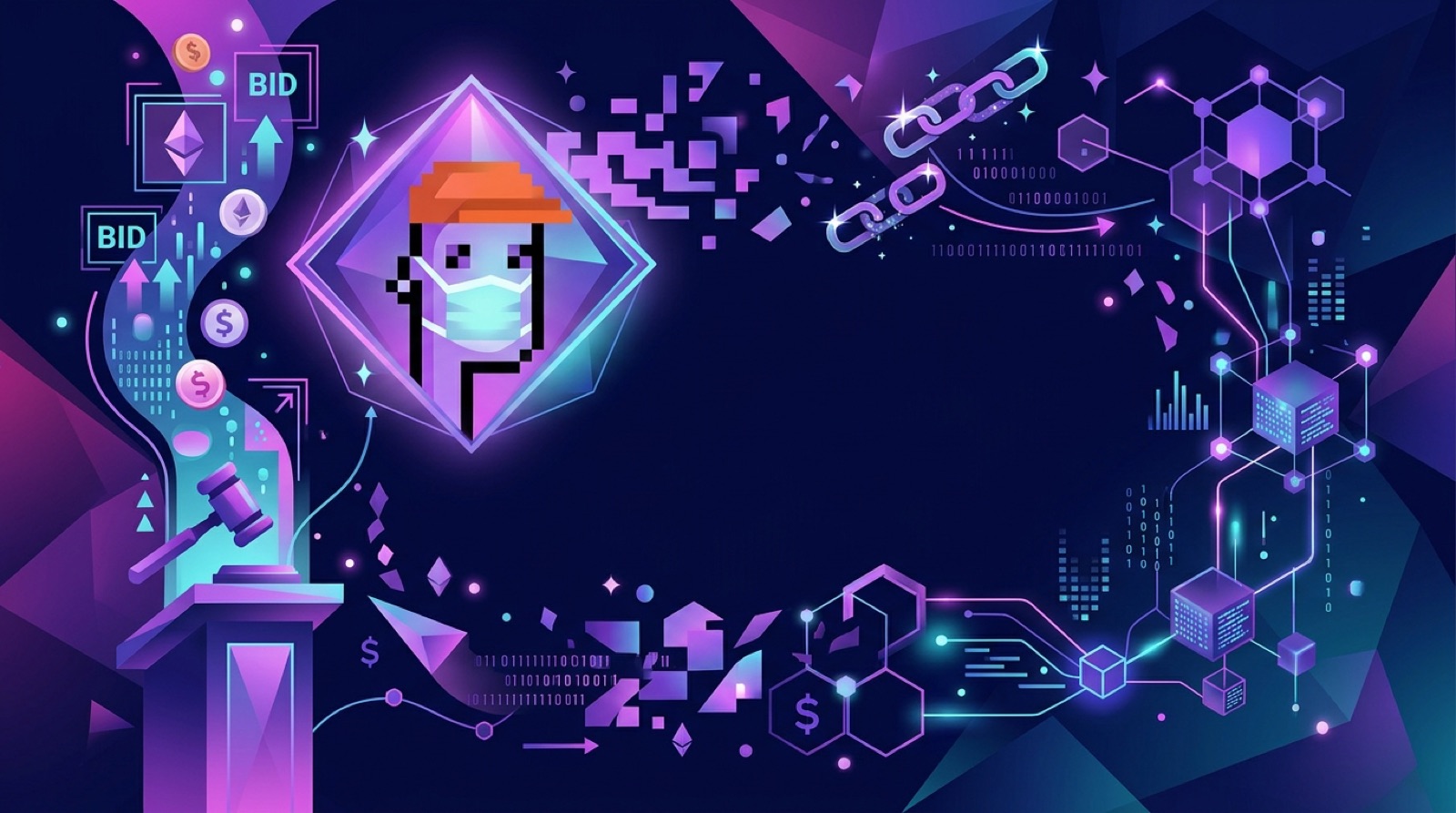
The COVID Alien is the nickname for CryptoPunk #7523, a pixel-art character from the original CryptoPunks collection on Ethereum. It is an Alien Punk, the rarest type in the set, and it wears a light-blue face mask. In June 2021 it was offered by Sotheby's, the auction house founded in the 18th century, and sold for a reported $11.75 million, which is usually rounded to $11.8 million.
Three things made the sale notable at the time:
- The buyer's price. It was one of the highest prices paid for a CryptoPunk up to that point.
- The venue. Sotheby's is best known for fine art, jewellery and rare objects. Selling a 24 by 24 pixel image there signalled that traditional auction houses were treating NFTs as a serious collecting category.
- The timing. The sale came during the 2021 NFT boom, shortly after Beeple's record sale at Christie's earlier that year, when media attention on digital collectibles was very high.
The Punk is not a photo or a video. It is a token on a blockchain that points to a tiny image, with the image data and ownership record tied to the Ethereum network through the original CryptoPunks contract. Whoever controls the wallet holding the token is the owner of record.
The name is a label from collectors, not an official title. The mask resembles the surgical masks that became common during the pandemic, and that story helped the piece stand out even among the other eight Aliens.
What are CryptoPunks, and why are Aliens so rare?
CryptoPunks were created by Larva Labs, the studio of Matt Hall and John Watkinson, and launched in 2017. The set contains 10,000 unique characters, each generated from a small pool of traits such as hairstyles, hats, glasses and accessories. Each Punk is a 24 by 24 pixel image.
The collection was originally free to claim for anyone with an Ethereum wallet, apart from the network transaction fee. That early, informal launch is part of why Punks are often described as one of the earliest NFT projects and a reference point for later collections. They also helped inspire the later token standards used across the NFT market, even though the Punks contract itself predates those standards.
The rough breakdown by type is:
| Type | Approximate count |
|---|---|
| Male | about 6,000 |
| Female | about 3,800 |
| Zombie | 88 |
| Ape | 24 |
| Alien | 9 |
Because Aliens make up under 0.1% of the set, they have long been the most sought-after type. Collectors tend to treat type as the main driver of rarity, followed by unusual accessories and the count of attributes. The COVID Alien combines the rarest type with a distinctive accessory, which is why it attracted so much attention.
In March 2022, Yuga Labs, the company behind Bored Ape Yacht Club, acquired the CryptoPunks and Meebits intellectual property from Larva Labs. Owners hold the token, and the rights position around the artwork is a separate question worth checking if you want to use an image commercially.
How did the Sotheby's auction work?
Sotheby's ran the sale as a curated online auction of NFTs rather than a live room auction. Online sales of this kind typically work in a few steps:
- Registration. Bidders create an account with the auction house and complete the identity and compliance checks that the house requires.
- Bidding period. Lots are open for a set window, with bids rising in set increments, and a final extension period if bids arrive near the close.
- Hammer price and premium. The winning bid is the hammer price, but the buyer pays a buyer's premium on top. That is why reported totals for auction-house sales can differ slightly from the final bid.
- Payment. Sotheby's accepted cryptocurrency for its digital sales, with terms set by the house for each auction.
- Transfer. After payment clears, the NFT is moved on-chain from the seller's wallet to the buyer's wallet.
The key difference from buying on a marketplace is the intermediary. The auction house handled vetting, presentation, marketing and settlement, and it took fees for that role. On an open marketplace, a buyer connects a wallet and trades directly with the seller through a smart contract.
The terms of a given sale, including the premium schedule and accepted payment methods, are published in the auction's conditions of sale. If you want exact details for this lot, the auction house's archive of the sale is the primary source, not news summaries.
Why did it sell for about $11.8 million?
No single factor explains an eight-figure price, but several stand out.
Scarcity within a famous set. With only nine Aliens among 10,000 Punks, supply of the top rarity tier is tiny. A buyer wanting the most prized type has very few options, and each one is a one-of-one in practice.
Provenance and history. CryptoPunks date back to 2017 and are widely seen as a cultural landmark of early NFTs. Collectors often pay a premium for items they see as historically important.
A memorable detail. The face mask tied the Punk to a global event and made the piece easy to describe and remember, which matters for press coverage and bidder interest.
Market conditions in 2021. The sale took place in a period of intense interest in NFTs, with rising crypto prices, new buyers and heavy media coverage. High prices in boom markets do not necessarily hold when conditions change.
The platform effect. A well-known auction house adds credibility and a spotlight. Marketing and a curated catalogue can draw bidders who would never browse an NFT marketplace.
It is also worth remembering that one record price reflects a single buyer's willingness to pay, not a market-wide valuation. Thin markets in very rare items can produce prices that are hard to compare with anything else.
How does this fit into Sotheby's wider NFT activity?
By 2021, NFTs had already moved from niche crypto circles into the mainstream art conversation. Christie's sold a Beeple work for tens of millions of dollars earlier that year, and Sotheby's followed with its own NFT sales, including curated offerings from digital artists and collectors.
Auction houses entered the space for several reasons:
- New collectors. NFT buyers were younger and more crypto-native than typical auction clients, and houses wanted to reach them.
- Authentication and trust. Many newcomers were nervous about fakes and scams, and a recognised name offered reassurance.
- Fees. Buyer's and seller's premiums on very high prices are a significant revenue line.
Sotheby's later built a dedicated digital platform and continued to hold NFT and digital art sales. The details of its current programme change over time, so check its own site for what is on offer rather than relying on older coverage.
Two things differ from how physical art is traded. First, the object itself is a token whose image and metadata may be stored in different places, depending on the project. Second, resale can happen instantly on public marketplaces, which makes price history visible to anyone. That transparency is useful, but it also means sales between related wallets can distort the apparent price.
What happened after the sale?
A few developments are stable enough to state without checking prices.
Other Punks sold for more. In early 2022, another Alien Punk, #5822, sold for a price well above the Sotheby's result, ranking among the highest CryptoPunk sales ever recorded. Records can change, so use a live sales tracker to confirm the current top sales.
The market cooled after 2021 and early 2022. Trading volumes and prices across NFTs fell sharply from their peaks. Many collections lost most of their value, though top-tier collections such as CryptoPunks have generally been treated as a separate segment. Current floor prices and volumes move daily and should be checked on a marketplace or analytics site.
Ownership of the brand changed. As noted earlier, Yuga Labs acquired the CryptoPunks intellectual property in 2022.
Ownership of individual Punks can move without announcement. Whether the COVID Alien is still with the Sotheby's buyer, was sold, or sits in a different wallet is something you can only confirm from on-chain records, because owners are not obliged to disclose transfers.
If you want the current status of this specific Punk, check the token's page on a CryptoPunks explorer or marketplace and read the full transaction history. Avoid secondhand claims that give no wallet address or transaction.
How can you verify a Punk's sale history?
One of the best things about public blockchains is that the history of a token can be checked directly. For a Punk, you can do the following:
- Find the token ID. For this piece, it is #7523.
- Look it up on a CryptoPunks listing page or Ethereum block explorer. These show the current owner address, past owners, bids and sale events.
- Compare wallet addresses. If a listing says a Punk sold for a particular price, confirm that the buyer and seller wallets are not obviously the same person or linked by earlier transfers.
- Check the payment asset. Prices are often quoted in ETH, and the dollar value depends on the exchange rate at the time. A figure like $11.8 million is a conversion, not a number stored on-chain.
- Cross-check with the auction record. For off-chain auction sales, the auction house's published results are the main source, since the on-chain transfer shows only the movement of the token and not the premium or terms.
- Be wary of lookalikes. Many copycat collections reuse Punk-style artwork. Always confirm the contract address against the official CryptoPunks contract before bidding or paying.
These steps also protect against fake screenshots and scams that use famous sales to build trust. A real sale leaves an on-chain or auction-house record you can verify yourself.
Auction house or marketplace: how do the routes differ?
The choice between a traditional auction and an on-chain marketplace affects cost, speed and risk.
| Factor | Auction house | On-chain marketplace |
|---|---|---|
| Vetting | Curated by the house | Open listings, buyer checks |
| Fees | Buyer's and seller's premiums | Marketplace fee plus creator royalties on some collections |
| Speed | Fixed bidding windows | Instant or near-instant |
| Identity checks | Usually required | Often wallet-only |
| Price visibility | Published results | Public on-chain history |
A few tools in the NFT space are relevant to related ideas. NFTX turns NFT collections into vault-backed tokens so that an NFT can be bought or sold against a pool, rather than waiting for a single buyer. Which collections have active vaults and how deep they are changes over time, so check the app before relying on it. AtomicHub is a marketplace focused on gaming items and collectibles on WAX and related chains, a very different segment from blue-chip art Punks. Courtyard handles vaulted physical collectibles, such as graded trading cards, which shows how the idea of digitally traded collectibles has spread beyond art.
Foundation, an art marketplace for creators, was taken offline by its team, according to the information available when this guide was written. Confirm the status of any platform before connecting a wallet or sending funds.
What should readers take from the sale today?
A record sale makes a good story, but it is a poor guide for buying decisions. Keep these points in mind.
Prices are volatile. NFT markets swing hard, and even blue-chip collections can lose a large share of their value. Selling can be difficult if few buyers are active.
Fees add up. Auction premiums, marketplace fees, royalties and network gas costs all reduce what a seller receives and raise what a buyer pays.
Scams use famous names. Fake mint pages, fake auction pages, phishing links and copycat contracts often use headline sales as bait. Never sign a wallet approval you do not understand, and keep your seed phrase offline and private.
Check the contract and the seller. Compare contract addresses against official sources, and use a separate wallet with limited funds for experiments.
Rights matter. Owning a token does not always mean owning the copyright or full commercial rights to an image. Read the terms published by the project's current rights holder.
Only spend what you can afford to lose. NFTs are speculative collectibles, and none of this is financial advice. Local rules on taxes and reporting of crypto assets differ by country, so check your own jurisdiction's guidance.
Frequently asked questions
How much did the COVID Alien CryptoPunk sell for at Sotheby's?
CryptoPunk #7523, the COVID Alien, sold through Sotheby's in June 2021 for a reported $11.75 million, usually rounded to $11.8 million. Exact dollar figures depend on how fees and the crypto exchange rate are counted. Check the auction house's records and on-chain data for details.
Why is it called the COVID Alien?
It is an Alien-type CryptoPunk wearing a light-blue medical-style face mask. Only nine of the 10,000 Punks are Aliens, and this is the one with a mask. The mask, which resembles pandemic-era face coverings, gave it the nickname and added to its story.
Is the COVID Alien still the most expensive CryptoPunk ever sold?
No. A later sale in early 2022 of another Alien Punk, #5822, reached a higher price than the Sotheby's result. Records change, so check a current sales tracker or the Punks' on-chain history for the latest top sales.
Was the sale a normal auction or an on-chain sale?
Sotheby's ran it as a curated online sale of NFTs with registered bidders. The Punk itself is an Ethereum token, so ownership moved by an on-chain transfer once the sale settled. Terms such as buyer's premium and accepted payment methods were set by the auction house for that sale.
Can anyone check who owns a CryptoPunk and its sale history?
Yes, in principle, because Punk ownership is recorded on Ethereum and every transfer is public. Look up the token ID on the CryptoPunks site or a block explorer. Private sales and wallet changes can make it harder to match an owner to a person.
Does one record NFT sale mean NFTs are a safe investment?
No. A famous result does not predict future value, and NFT prices can fall sharply and be hard to sell. Rare, established collections trade very differently from new or obscure ones. Only use money you can afford to lose, and be careful with fake listings and copycats.
Mentioned in this guide
dApps in this guide
NFTX turns NFT collections into vault-backed ERC20 tokens so users can buy and sell NFTs instantly at floor price against a pool.
Courtyard is a marketplace and tokenization service for vaulted, insured physical collectibles such as graded trading cards, sold via digital packs.
AtomicHub is a multichain NFT marketplace for gaming items, collectibles and digital art, centered on WAX and EOS-family chains.
Foundation was an Ethereum NFT art marketplace for creators; the team took it offline indefinitely on April 27, 2026 after a failed sale.
Current is a Sui-based lending protocol with isolated markets and one-click yield multiply, focused on tokenized real-economy yield.
Keep reading
Related guides
NFT · Explainer
Beeple's $69 Million Christie's NFT Sale: What It Shows in 2026
Beeple's 2021 Christie's sale was a single JPG-style digital file sold as an NFT for $69.3 million. Here is what was sold, why the price drew so much attention, and what the sale does and does not show about NFTs.
NFT · How-to
How to Sell an NFT: A Step-by-Step Guide for 2026
Selling an NFT takes a few steps, but the choices you make about marketplace, price format and wallet permissions decide how much you keep and how safe the sale is. This guide covers each stage, from checking ownership to recording the sale for tax.
NFT · Explainer
Global NFT Financial Regulations Explained for 2026
NFTs do not have one global rulebook. Whether an NFT is treated as a collectible, a security, a payment tool or property depends on how it is built, sold and marketed, and on where buyers and platforms are located.
NFT · Explainer
NFT.Storage Explained: Decentralized Storage for NFT Data
NFT.Storage is a service from the IPFS and Filecoin ecosystem built to keep NFT images and metadata available without relying on one company's server. This guide covers how it works, what to upload, and what collectors and creators should check.
NFT · Explainer
Sotheby's Web Source Code NFT Sale: What Happened and Why It Matters
In June 2021 Sotheby's sold an NFT tied to Tim Berners-Lee's original World Wide Web source code for $5.4 million. This guide explains what was sold, how the auction worked, and what the sale means for buyers today.
NFT · Explainer
Sorare Volume Spike Explained: What a 45% Jump Really Means
A single-day jump of over 45% in Sorare trading volume is a headline worth understanding, but a short spike tells you little on its own. This explainer covers what volume measures, what usually drives a one-day rise in fantasy football NFT activity, and how to check the figure yourself.
NFT · Explainer
Soulbound Tokens Explained: Buterin's Wallet Credential Idea
Soulbound tokens are non-transferable blockchain tokens tied to one wallet. They are often described as a digital passport, but they are closer to wallet-bound credentials, and this guide explains what they can and cannot do.
NFT · Explainer
Sorare Soccer NFTs: How the Fantasy Game Works in 2026
Sorare is a fantasy soccer game built on NFT player cards, and its licensing deals with leagues and clubs are the main reason it stands out in sports collectibles. This guide explains how it works, what its partnerships mean in practice, and what to weigh before you spend money.