Web3 gaming · Explainer
Raving Rabbids in The Sandbox: A Plain Guide for Players in 2026
Ubisoft's Raving Rabbids characters are coming to The Sandbox, a blockchain-linked virtual world. This guide explains what a crossover like this means for players, how the underlying platform works, and what to check before you spend time or money on it.
By the DappsAtlas editorial team · Updated
What the Raving Rabbids crossover into The Sandbox means
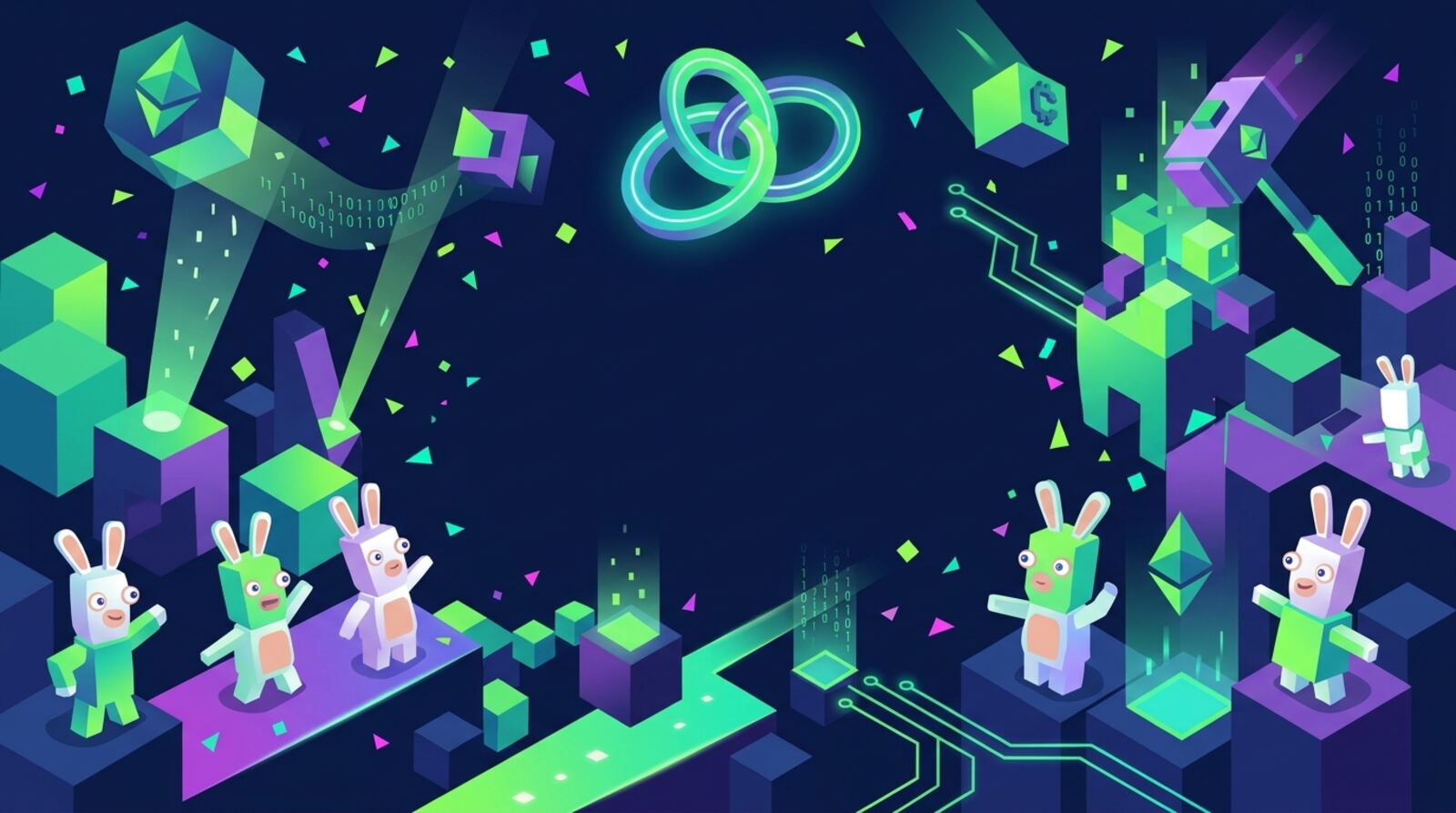
The crossover brings Ubisoft's Raving Rabbids characters into The Sandbox, a virtual world built on blockchain technology. In practice, this means Rabbids-themed content that players can visit, explore, or interact with inside a world that also runs its own economy, land system, and token.
The main thing to understand is that a brand crossover in a virtual world is a licensed presence rather than a standalone game. Ubisoft provides the characters and brand, and The Sandbox provides the environment, the tools, and the infrastructure. The exact features, locations, and mechanics of any Rabbids experience can change after launch, so the most reliable source for what is live today is the official announcement from each company.
For most readers, the question is simple: is this worth my time, and what do I need to know first? The sections below answer that by explaining the franchise, the platform, how brand experiences usually work in virtual worlds, and the practical and security steps that apply whether you play for fun or just want to look around.
Who the Rabbids are and why the franchise fits a virtual world
Raving Rabbids is a comedy franchise from Ubisoft. The Rabbids are chaotic, rabbit-like characters who first appeared in 2006 in a game that grew out of the company's Rayman series. Their humour is physical and silly, and the franchise has since spanned party games, mini-game collections, and spin-off titles across several generations of consoles.
That background matters for a crossover because the characters are recognisable and family-friendly. A brand like this tends to suit light, social, short-session experiences more than complex economic systems. When you evaluate a Rabbids experience, ask whether it is built around play, exploration, or events, since that tells you more about what you will actually do inside it than any token or marketplace feature.
If you already know the franchise, you will likely recognise the characters and tone. If you do not, you do not need prior knowledge to enjoy a casual visit, but it helps to know that the brand is a lighthearted one and that any official content should reflect that.
How The Sandbox works in plain terms
The Sandbox is a virtual world where users can build, play, and host experiences, often called games or lands. It runs on blockchain networks, which means certain assets such as land plots and some items are recorded on-chain. The platform uses its own token, SAND, which is used within the ecosystem for transactions and governance, and its underlying networks include Polygon and Ethereum.
In general, the platform's features are not fixed. Developers and the company add tools, change how creators earn, and launch new seasons or events. Because of this, any specific detail in this guide about token use, supported networks, or creator tools should be checked against the official documentation before you act on it.
For a player, the important points are these. Some content is free to access with an ordinary account. Some features ask you to connect a crypto wallet. Land and certain assets may be bought, sold, or traded. Each of these carries different risks, and you can choose how deeply to engage. Treat the platform as a place to explore first, and only add wallet-based features after you understand what they do.
Common formats for brand experiences in virtual worlds
Brand crossovers in virtual worlds usually take one of a few forms. A company might build a themed space that visitors can walk through. It might run a time-limited event with quests or collectible items. It might offer avatar outfits or decorative objects that carry the brand's look. Or it might create a playable mini-game inside a larger world.
Each format has different implications. A visitable space is typically the simplest to access, since it asks little of you beyond a client or browser session. Event-based content is often short-lived, so you may miss it if you do not check in during the window. Collectibles and wearables can carry value in a secondary market, and their worth can rise or fall without notice.
When you read an announcement, look for three things: what you actually do in the experience, whether any part of it requires buying something, and whether the content is permanent or temporary. If an announcement is vague on these points, that is a good reason to wait for more detail from the official source rather than assuming the feature is ready.
How to explore a Rabbids experience step by step
If you want to try a Rabbids experience once it is live, start with the official route. Find the link from Ubisoft or The Sandbox's own channels, not from a post in a comment thread or a direct message. Check that the experience is open to your region and account type, and read any age or content guidance on the page.
Next, decide whether you need a wallet at all. Many visitors can look around without one. If a step asks you to connect a wallet, pause and confirm the request is for a feature you intend to use. Start with a small amount of any asset you need, and avoid buying items on impulse because a limited window seems to be closing.
Finally, keep notes on what you spent, what you received, and where. Virtual-world assets are not a savings product, and their value can change quickly. Treating the visit as entertainment with a small, fixed budget keeps the experience enjoyable whether or not the crossover becomes a long-term feature.
Security habits that protect you in a crypto virtual world
Blockchain-based virtual worlds carry specific security risks, and most losses come from social engineering rather than technical breaks. Scammers often impersonate well-known brands, copy official pages, or send direct messages claiming to offer free items, support, or prizes.
Follow these defensive habits. Type or bookmark the official website rather than clicking links from messages. Never share your recovery phrase, seed phrase, or private keys with anyone, including people who claim to be support staff. Be wary of any request to approve a transaction you do not understand, and check what permissions a connection grants before confirming. Keep your wallet software updated and use a separate wallet for activity you do not fully trust.
If you think you have been targeted, disconnect the wallet from the site, change any compromised passwords, and move remaining assets to a new wallet you control. Report the message through the platform's official support channel. Ignore any follow-up that promises to recover losses for a fee, since that is a common second scam.
How to check the current status of the crossover
Because the crossover is a recent development in a fast-moving area, several details are likely to change. Those include which experiences are live, what they contain, which networks and tokens are involved, and what the platform's economic rules are. This guide deliberately does not state current figures or dates for those items.
To check the latest information, start with the official announcements from Ubisoft and The Sandbox. Their newsrooms and social accounts are the most likely places to confirm launch status and any terms. For blockchain activity, a public block explorer for the relevant network lets you verify transactions and token contracts yourself, and this is a good habit before you interact with any unfamiliar address.
When you read third-party coverage, compare it with the official source and note the publication date. A detail that was accurate at launch may no longer apply, and a detail that appears only on one unofficial site should be treated with caution until it is confirmed elsewhere.
How this compares with other blockchain virtual worlds
Players interested in virtual worlds often compare several platforms before choosing where to spend time. Some focus on land ownership and property development, others on casual or social play, and others on earning mechanics. Comparing them helps you see what a Rabbids-themed experience is likely to offer.
Upland is a city-building game where players buy, develop, and trade virtual properties, which makes it a useful reference for how land economies work. Megaworld is an on-chain city-building project that has been around since 2018 and is rebranding with AI agents, so it shows how a long-running world changes over time. Alien Worlds is a play-to-earn metaverse on WAX, which illustrates how reward systems differ from pure exploration.
These comparisons are not recommendations. Each platform has its own rules, risks, and current status, and those should be checked independently. Use them to ask better questions about any virtual world: what you do, what it costs, what you own, and what happens if the platform changes.
Setting realistic expectations as a player
A crossover can make a virtual world feel more familiar, but it does not change the underlying economics. Assets in blockchain worlds can lose value, and some features may be tied to tokens whose prices move sharply. Treat any spending as you would any entertainment purchase, and never borrow money to take part.
A useful rule is to decide your budget before you start and stop when it is spent. Avoid chasing limited-time items out of fear of missing out, since urgency is a common sales tactic. Also consider the time cost. A short visit to explore a themed space can be enjoyable, while a long grind for rewards may not be worth the effort.
The Rabbids crossover is most useful as a window into how brand partnerships work in virtual worlds. Watch how the experience develops, read the official terms, and form your own view before committing. If you decide the world is not for you, leaving it is a perfectly reasonable choice.
Frequently asked questions
Do I need to buy crypto to visit a Raving Rabbids experience in The Sandbox?
Not necessarily. Virtual-world experiences can be free to visit, but some parts of The Sandbox involve wallets, land ownership, or token purchases. You can explore a free experience without buying anything, and you never need to buy a token to take part in general gameplay.
Where can I confirm whether the Rabbids experience is live?
Check the official Ubisoft newsroom and The Sandbox's own channels for announcements about any Rabbids experience, including whether it is open, what it contains, and which platforms it supports. Third-party news and social posts can be out of date, so treat them as leads rather than confirmation.
Is a Rabbids experience in The Sandbox official?
Ubisoft's franchise characters are licensed for use in the virtual world, so a company-backed experience is different from a random fan creation. Still, anyone can create content in a user-built world, so look at who published an experience before you give it a wallet connection or personal details.
What is the biggest security risk for players in a blockchain virtual world?
Never enter your recovery phrase on a website or in a chat, and never approve a transaction you do not understand. Be cautious of free-token offers, urgent messages from people claiming to be support staff, and links that ask you to connect your wallet to claim a prize.
Do I need a crypto wallet to play?
A wallet is one way to hold blockchain assets, and some virtual worlds ask you to connect one for certain features. Keep the amount you hold small, use a wallet only for what you need, and never share your recovery phrase with anyone.
Mentioned in this guide
dApps in this guide
The Sandbox is a blockchain-linked virtual gaming world on Polygon and Ethereum, with token SAND and a new AI game engine in beta for creators.
Upland is a mobile and browser city-builder game where players buy, develop and trade virtual properties tied to real addresses, using the UPX token.
MegaWorld, formerly MegaCryptoPolis, is a 2018 on-chain city-building game now rebranding as MCPOLIS with AI agents playing alongside humans.
Alien Worlds is a community-built play-to-earn metaverse on WAX where players mine and play to earn TLM tokens and NFTs.
Chainers is a free-to-start browser multiplayer NFT game with farming and missions, running on a Polygon Edge sidechain with a CHU token.
Pixels is a web3 farming and exploration game with a PIXEL token, guilds and ecosystem staking, aimed at gamers who are comfortable with wallets and token risk.
Common is a non-custodial ZK privacy dapp on Arbitrum and Aleph Zero EVM that lets users shield funds and withdraw to a new, unlinkable wallet.
Keep reading
Related guides
Web3 gaming · Best list
Top 10 Best Gaming Metaverse Worlds in 2026
Ten persistent gaming worlds in 2026 that combine shared spaces, things to do and, in most cases, optional blockchain features. Each entry explains what the world offers and what to check before you join.
Web3 gaming · Best list
Top 10 Best Gaming Metaverse Worlds to Explore in 2026
A guide to ten gaming worlds that call themselves metaverses, what each one offers, and how their token and wallet features differ. Blockchain elements, token economies and current status change often, so each entry points you to where to verify the latest details.
Web3 gaming · Explainer
Easter Events in Blockchain Metaverse Games: A 2026 Guide
Public reporting do not confirm a blockchain Easter event in a metaverse called Nemesis, so this guide explains how to check any seasonal event claim and how to prepare safely for Easter-style events in virtual worlds. It also covers which established metaverse games readers can compare.
Web3 gaming · Explainer
How to Evaluate New Game Worlds Like Blocktopia and XOTH
Genesis Worlds has announced Blocktopia and XOTH planets for April, but public reporting gathered for this guide did not include the announcement itself. This explainer covers what new Web3 game worlds usually involve and how to check claims before you buy land, join or spend tokens.
Web3 gaming · Explainer
Raijin on Xai: What the Launch Means and How to Check It
Public reporting do not document a project called Raijin or any gaming launch on Xai, so this guide cannot confirm the headline. It explains what Xai-linked gaming launches usually involve and gives a checklist for judging any new Web3 game claim.
Web3 gaming · Explainer
Proxcity Game Guide: How This Base City Simulator Works
Proxcity is described as a city simulator on Base, the Ethereum layer 2 network. This guide explains how games of this type generally work, how to set up safely, and how to check the details that change over time.
Web3 gaming · How-to
RavenQuest Guide: Earn QUEST With Bounties, Guild Wars, Silver
A practical walkthrough of how players approach earning in RavenQuest through bounties, guild wars and silver trading, plus what to verify before you spend time or money.
Web3 gaming · Review
Prospectors Blockchain Game Review: Gameplay, Economy, Risks
Prospectors is a Wild West-themed blockchain strategy game built around resource gathering, NFTs and a token economy. This review covers how it plays, what you own, where the money risk sits and what to verify before you spend anything.