Web3 gaming · Review
Prospectors Blockchain Game Review: Gameplay, Economy, Risks
Prospectors is a Wild West-themed blockchain strategy game built around resource gathering, NFTs and a token economy. This review covers how it plays, what you own, where the money risk sits and what to verify before you spend anything.
By the DappsAtlas editorial team · Updated
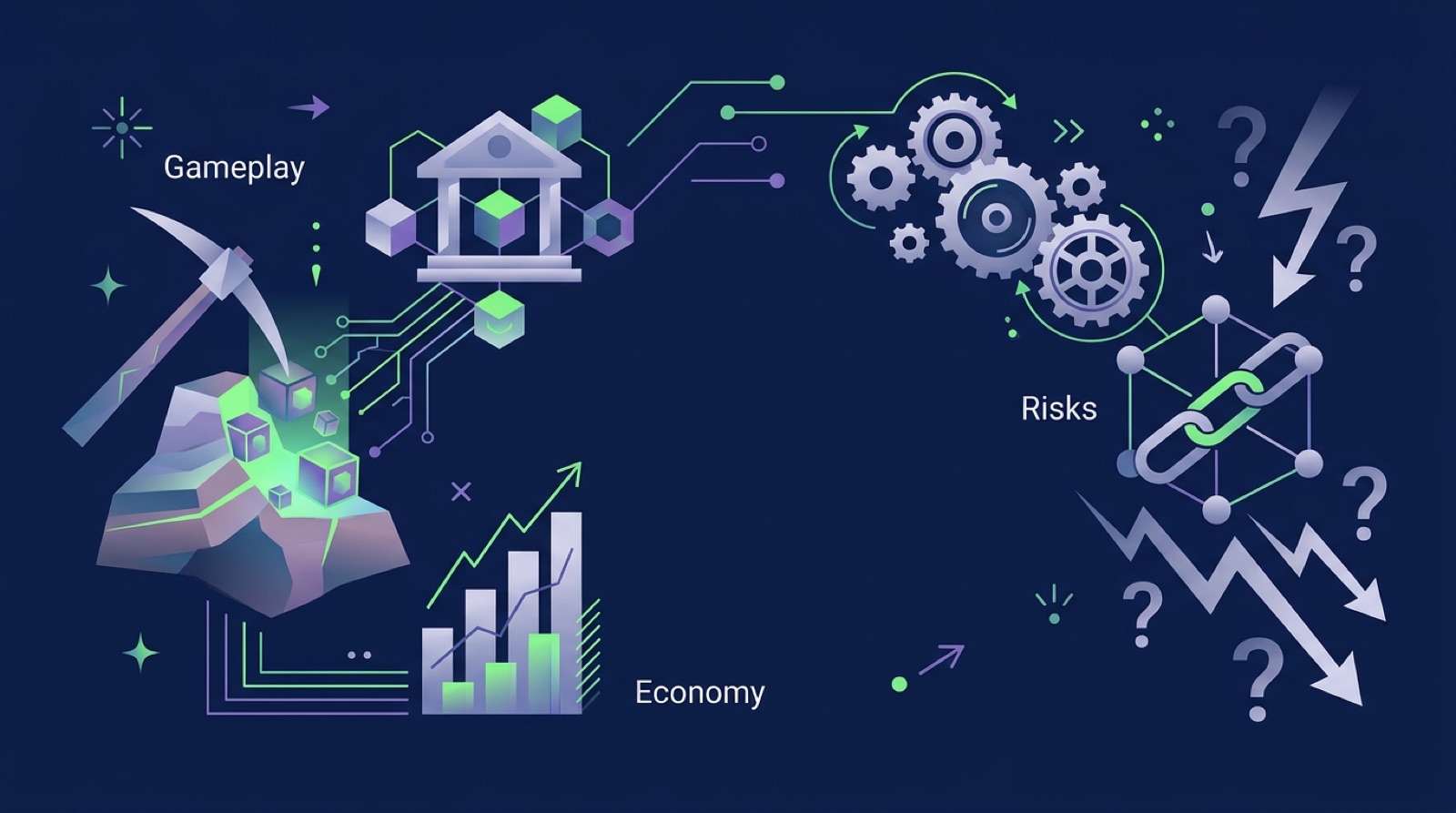
What is Prospectors?
Prospectors is a blockchain strategy game with a Wild West setting. Players take the role of settlers and miners who gather resources, build up an operation and trade what they produce. It launched in the early wave of NFT games on the WAX blockchain, the same ecosystem that hosts Alien Worlds, and it follows the common pattern of that era: a browser-based game, a wallet login, NFTs for key assets and one or more fungible tokens for the in-game economy.
The pitch is a more strategic, economy-focused game than the simple click-to-mine loops that dominated early play-to-earn titles. Instead of pure idle farming, Prospectors asks players to think about resource types, job assignments and market prices.
What this review covers
- How the core gameplay loop is designed
- How the token and NFT economy is structured
- What it costs to start and where the money risk sits
- How it compares with other WAX and web3 games
- What to check yourself, because details change
A note on currency of information. Blockchain games change chains, tokens, rules and even ownership over time. This guide sticks to the stable design of the game and avoids prices, player counts, rankings and recent events. For anything time-sensitive, use the official game documentation and announcement channels, then cross-check a block explorer and a market data tracker.
This is a review of a game and its economics, not financial advice. Players should be 18 or older and should check what applies to token and NFT activity where they live.
How does Prospectors gameplay work?
The core of Prospectors is resource management. Players collect basic resources associated with frontier life, such as gold, wood and food, and use them to keep their operation running and to grow it. The game is built around the idea that different resources feed into each other: you need some to produce others, and you need all of them to expand.
Typical loop
- Connect a compatible wallet and set up an account.
- Acquire or receive the starting NFTs the game requires, such as workers or land-style assets.
- Assign those assets to jobs or production tasks.
- Collect resources after the production period ends.
- Spend, convert, stake or sell resources, or reinvest them into better assets.
What makes it different from idle mining
In the simplest play-to-earn designs, you press a button on a timer and receive tokens. Prospectors adds decisions: which assets to prioritise, which resources to hold, and when to sell. That gives it more depth, though the decisions are still economic more than skill-based. There is no twitch gameplay, and success depends heavily on market conditions and on how early and how efficiently you set up.
Session length
Like most browser-based blockchain games of this style, it is designed for short, regular check-ins rather than long sessions. That suits casual players but also means returns, if any, accrue slowly. Check the current documentation for production timings, because rules and balance changes are common in live games.
How the token economy works
Prospectors uses a multi-resource economy. Instead of a single reward token, in-game resources and a main token play different roles. Resource tokens are generally used inside the game for production and upgrades, while a headline token, historically referred to as Prospectors Gold, serves as the more tradable value layer.
Why multi-token designs matter
- They allow the developers to separate everyday gameplay inputs from the token that outside investors trade.
- They can slow inflation, because players must spend resources to progress rather than only sell them.
- They add complexity, which raises the risk of players misunderstanding conversion rates and fees.
Sinks and sources
Any game economy depends on the balance between sources, where tokens are created, and sinks, where they are destroyed or locked. A healthy design has meaningful sinks such as upgrades, crafting costs, fees and staking, so that rewards do not simply flood the market. When reading Prospectors documentation, look for what players must spend tokens on, not only what they can earn.
Where to check the numbers
Token supply, circulation, price, trading venues and emission rules change. Look at the official tokenomics page for design intentions, a block explorer for actual supply and holder distribution, and a market data aggregator for liquidity and trading volume. Low liquidity can make a token hard to sell at the quoted price, so check how deep the market is before relying on any figure.
What NFTs do you own in Prospectors?
In blockchain games, NFTs are the part you actually own on-chain. In Prospectors, NFTs represent the assets that drive production: characters or workers, land or property-style items, tools and similar items. Because they are standard tokens on the underlying chain, they can be held in your wallet and sold on compatible NFT marketplaces without the developer's permission.
What ownership does and does not mean
- You control the token in your wallet, and nobody can move it without your keys.
- The game's rules, however, remain controlled by the developers. They can rebalance production rates, change requirements or retire features, and that changes what your NFT is worth in practice.
- Marketplace prices depend on demand, and demand follows the game's popularity and token economy.
Checking an NFT before buying
- Confirm the collection through the official game channels, since counterfeit collections are common.
- Review the NFT's attributes and what they actually do in the game today.
- Look at recent sales and the number of listings, not only the floor price.
- Check whether the asset is locked, staked or tied to an account.
- Calculate how long it would take to recoup the cost at realistic, not optimistic, earning rates.
On WAX, collections carry an author and schema on-chain, which helps you verify authenticity. Always verify the collection name and creator account rather than trusting a search result or a message from a stranger.
Can you really earn with Prospectors?
Prospectors is usually described as play-to-earn, meaning that time and assets you put in can generate tokens you may sell. Whether that works out for any one player depends on factors outside your control.
What drives returns
- Token price. Rewards are paid in tokens whose value moves with the market. A rate that looks attractive can fall quickly.
- Player growth. Many play-to-earn economies rely on new players buying assets. When inflows slow, prices tend to fall.
- Entry cost. Higher costs mean a longer payback period, and some players never reach it.
- Game updates. Rule changes can raise or cut production for specific assets.
- Fees and spreads. Marketplace fees, token swaps and network costs reduce what you keep.
A sensible way to think about it
Treat spending on a blockchain game like spending on any entertainment with a speculative element. Only commit money you can afford to lose entirely. If a game's economy only works when its token price rises, you are effectively speculating on the token, not earning a wage.
Do the maths yourself
Write down the full cost of entry, the realistic daily output, the sell price after fees and the time needed to break even. Then run it again with the token price cut in half. If the result is unacceptable, either wait, start smaller or skip it. Do not rely on screenshots of earnings from social media, since they show the best cases.
How to get started safely
The right way to start is slowly and with a clear check at each step. Playing blockchain games always involves a wallet, and a wallet is where most losses from scams occur.
Step-by-step approach
- Read the official documentation first. Find the current chain, wallet options, token list and starter requirements.
- Use a dedicated wallet. Create a separate wallet for gaming with only the funds you plan to use, and keep savings elsewhere.
- Back up the recovery phrase offline. Never type it into a website, share it in chat or store it in a screenshot.
- Start with the minimum. Try the basic experience before buying expensive NFTs.
- Verify every contract and collection. Compare names and accounts against the official channels.
- Check network costs. Some chains have near-zero fees, others do not. Know what each action costs.
- Record your transactions. Many countries treat token sales, swaps and rewards as taxable events, so keep a log.
Typical costs to consider
- Starter NFTs or land-style assets
- Tokens needed for upgrades or fees
- Marketplace and swap fees
- Possible bridging costs if you move tokens between chains
Prices for all of these change, so check the live marketplace and the official guide on the day you start rather than relying on an old article or video.
How Prospectors compares with Alien Worlds and ImmutableX games
Prospectors sits in a crowded field of NFT and token-based games. Two useful reference points are Alien Worlds, another WAX-born game, and the wider web3 gaming platform ImmutableX, which hosts many games on Ethereum-based infrastructure.
| Feature | Prospectors | Alien Worlds | ImmutableX ecosystem |
|---|---|---|---|
| Type | Wild West resource strategy | Sci-fi mining and metaverse | Platform hosting many games |
| Origin | WAX ecosystem | WAX ecosystem | Ethereum scaling platform |
| Main loop | Resource production and trading | Mining, land and community governance | Varies by game |
| Economy | Multi-resource plus main token | TLM token and NFTs | Platform token IMX plus per-game assets |
| Best for | Players who like economic planning | Players who like community-run worlds | Players who want a range of titles |
Reading the table
Alien Worlds is the closer comparison for how a WAX game operates, with its mining mechanics, TLM token and community-driven structure. ImmutableX is not a single game but a platform, so games on it differ widely and rely on the platform's tools for NFT trading and low-cost transactions.
Choosing between them
Pick by gameplay you enjoy first and economics second. If you want hands-on resource planning in a frontier setting, Prospectors fits. If you would rather join a larger community-based universe, Alien Worlds is worth reading about. If you prefer to browse many games from one ecosystem, look at what runs on ImmutableX. In every case, compare current rules, token supply and costs, because all three evolve.
Risks and red flags
No blockchain game is risk-free. These are the main hazards to weigh before you connect a wallet.
Economic risks
- Token inflation. If rewards are created faster than the game destroys tokens, prices tend to fall.
- Thin liquidity. Small markets make large sales hard and can distort quoted prices.
- Dependence on new entrants. Economies that need constant new buyers are fragile.
- Developer control. Rule changes can alter the value of your assets with little warning.
Security risks
- Phishing sites and fake collections. Imitation sites copy game pages to capture wallet approvals.
- Unsolicited messages. Direct messages offering free NFTs, support help or early access are a common scam route.
- Excessive approvals. Granting unlimited permissions to a contract can expose your assets. Review and revoke approvals you no longer need.
- Recovery phrase theft. Anyone who asks for your phrase is trying to steal your funds.
Practical defences
- Bookmark the official site and only use that bookmark.
- Keep a separate gaming wallet with limited funds.
- Read each signing request before you approve it.
- Use a hardware wallet where the chain supports it.
- Ignore anyone who contacts you first about your account.
Regulatory considerations
Rules around tokens, NFTs and rewards differ by country. You must be 18 or older, and you should check local laws and tax obligations. Do not attempt to avoid age checks, KYC or regional restrictions imposed by exchanges or platforms.
Verdict: who is Prospectors for?
Prospectors is a themed, economy-driven blockchain game that suits players who enjoy planning, resource balancing and watching a market, and who are comfortable with a wallet. Its multi-resource design gives it more strategic texture than simple idle-mining titles, and its WAX roots mean an established ecosystem of wallets and marketplaces.
Strengths
- Clear theme and a resource loop that rewards planning
- NFT assets that you hold in your own wallet
- A familiar ecosystem for players already using WAX games
Weaknesses
- Returns depend on token prices and player growth, both unpredictable
- Developer-controlled rules can change asset value
- Multi-token economies can confuse newcomers and hide fees
- The gameplay is more economic than skill-based, so those after action may be disappointed
Who it suits
- Players who like strategy and economic simulation
- Users with a little blockchain experience and a separate gaming wallet
- People who treat spending as entertainment, not investment
Who should avoid it
- Anyone needing guaranteed income
- Anyone who would be unable to cope with losing the money spent
- Players who are not yet comfortable with wallet security
Verdict: worth a look as a game, with caution as an investment. Start small, verify everything through official channels and set a firm limit on spending.
What to check before you play today
Because live blockchain games change often, run through this checklist on the day you plan to play.
Check these items yourself
- Official channels. Read the latest announcements for changes to the chain, tokens, updates or any pauses.
- Documentation. Confirm the current onboarding steps, requirements and gameplay rules.
- Token data. Use a block explorer to see supply and holder distribution, and a market data site for price, volume and liquidity.
- NFT marketplace. Review the floor price, recent sales and the number of active listings for the assets you need.
- Community activity. Look at how many players are active and whether the developers respond to questions.
- Security notices. Check for warnings about fake sites or compromised contracts.
Signs a game is in good health
- Regular, specific development updates
- Clear tokenomics with working sinks
- Steady marketplace trading, not only a few large sales
- Transparent communication when problems arise
Signs of trouble
- Long silence from the team
- Falling activity and widening gaps between buy and sell prices
- Frequent changes to token rules with little explanation
- Pressure to buy quickly or promises of fixed returns
If several warning signs appear, pause and reassess before adding more money. A game being fun and a game being a sound financial bet are separate questions, and only the first is a good reason to play.
Frequently asked questions
What is Prospectors?
Prospectors is a Wild West-themed blockchain game in which players gather resources, manage workers and trade items as NFTs. It began on the WAX blockchain and is built around an in-game economy with fungible tokens. Check the official channels for its current chain and token setup.
Is Prospectors free to play?
Not always. Browser-based blockchain games have historically offered some free or low-cost entry, but earning rates and costs change often. Confirm the current onboarding rules in the official documentation before connecting a wallet or buying anything.
Can you make money with Prospectors?
Possibly, but it is not guaranteed and should not be treated as income. Earnings depend on token prices, player numbers, game rules and your costs, and all of these change. Many play-to-earn economies have shrunk once new-player demand slowed.
Which wallet do I need for Prospectors?
A wallet compatible with the chain the game currently runs on is required. Historically that meant a WAX Cloud Wallet or Anchor wallet. Follow the current instructions on the official site rather than third-party guides, which may be out of date.
How does Prospectors compare with Alien Worlds?
Prospectors is a Wild West resource-management game, while Alien Worlds is a sci-fi mining metaverse. Both started in the WAX ecosystem and use NFTs plus tokens. They differ in theme, game loop and token design, so compare the current rules of each.
Is it legal to play blockchain games like Prospectors?
Play-to-earn games involve real financial risk and are not a form of gambling in every jurisdiction, but some regions regulate token and NFT activity. You should be 18 or older, check your local rules, and never bypass age checks, KYC or regional restrictions.
Mentioned in this guide
dApps in this guide
Alien Worlds is a community-built play-to-earn metaverse on WAX where players mine and play to earn TLM tokens and NFTs.
ImmutableX is a web3 gaming platform on Ethereum whose IMX token covers fees, staking, governance and gas on Immutable zkEVM, aimed at gamers and token holders.
Prospectors is an EOS blockchain real-time strategy game where players mine gold, craft tools and trade using the PGL token.
Session is a decentralized, end-to-end encrypted messaging app with onion routing, supported by the SESH staking token on Ethereum.
Keep reading
Related guides
Web3 gaming · Best list
Best Hyper-Casual Web3 Games to Try in 2026
Hyper-casual web3 games are short, simple titles with blockchain features such as wallets, tokens or collectible items layered on top. This guide explains what to look for, which listed options fit short sessions best, and how to check costs and risks before you commit.
Web3 gaming · Review
CryptoAssault Review 2026: How to Verify a Blockchain Game
CryptoAssault is a blockchain game that many players look up before deciding whether to spend money on it. This guide explains how to judge it on verifiable facts: the official project, the chain and token it uses, the gameplay, the costs, and the security signs to check.
Web3 gaming · Review
Upland Review: How the Blockchain Property Game Works in 2026
Upland is a blockchain property trading game where players buy, sell and develop virtual plots mapped to real-world locations. This review explains how it works, what earning and spending involve, and what to check before putting money in.
Web3 gaming · Review
Upland Review 2026: How the Blockchain Property Game Works
Upland is a city-builder game where players buy, develop and trade virtual properties mapped to real street addresses, using the UPX token. This review explains how it works, how its blockchain history has changed, and what to check before spending money on it.
Web3 gaming · Explainer
Proxcity Game Guide: How This Base City Simulator Works
Proxcity is described as a city simulator on Base, the Ethereum layer 2 network. This guide explains how games of this type generally work, how to set up safely, and how to check the details that change over time.
Web3 gaming · Explainer
Private Beta Blockchain Games: NFT Rewards Explained for 2026
A private beta is an early, invite-only test, and games that pair one with NFT rewards deserve extra scrutiny. This guide explains how these tests work, what a launch announcement can and cannot confirm, and how to check a project before you connect a wallet.
Web3 gaming · Explainer
Raving Rabbids in The Sandbox: A Plain Guide for Players in 2026
Ubisoft's Raving Rabbids characters are coming to The Sandbox, a blockchain-linked virtual world. This guide explains what a crossover like this means for players, how the underlying platform works, and what to check before you spend time or money on it.
Web3 gaming · Explainer
Polygon Gaming Activity in 2026: How to Read the Numbers
Monthly reports that show a chain's gaming activity rising can be useful, but they measure different things and change quickly. This guide explains what Polygon gaming activity means, how to read the numbers behind a strong month, and how to check current figures yourself.