Web3 gaming · Explainer
Pegaxy Explained: How the Horse Racing Earn and Own Model Works (2026)
Pegaxy is a blockchain horse racing game where players race NFT horses called Pegs for prizes, with ownership and rental options. This guide explains how the racing, rewards, token model and risks fit together so you can judge the game before spending anything.
By the DappsAtlas editorial team · Updated
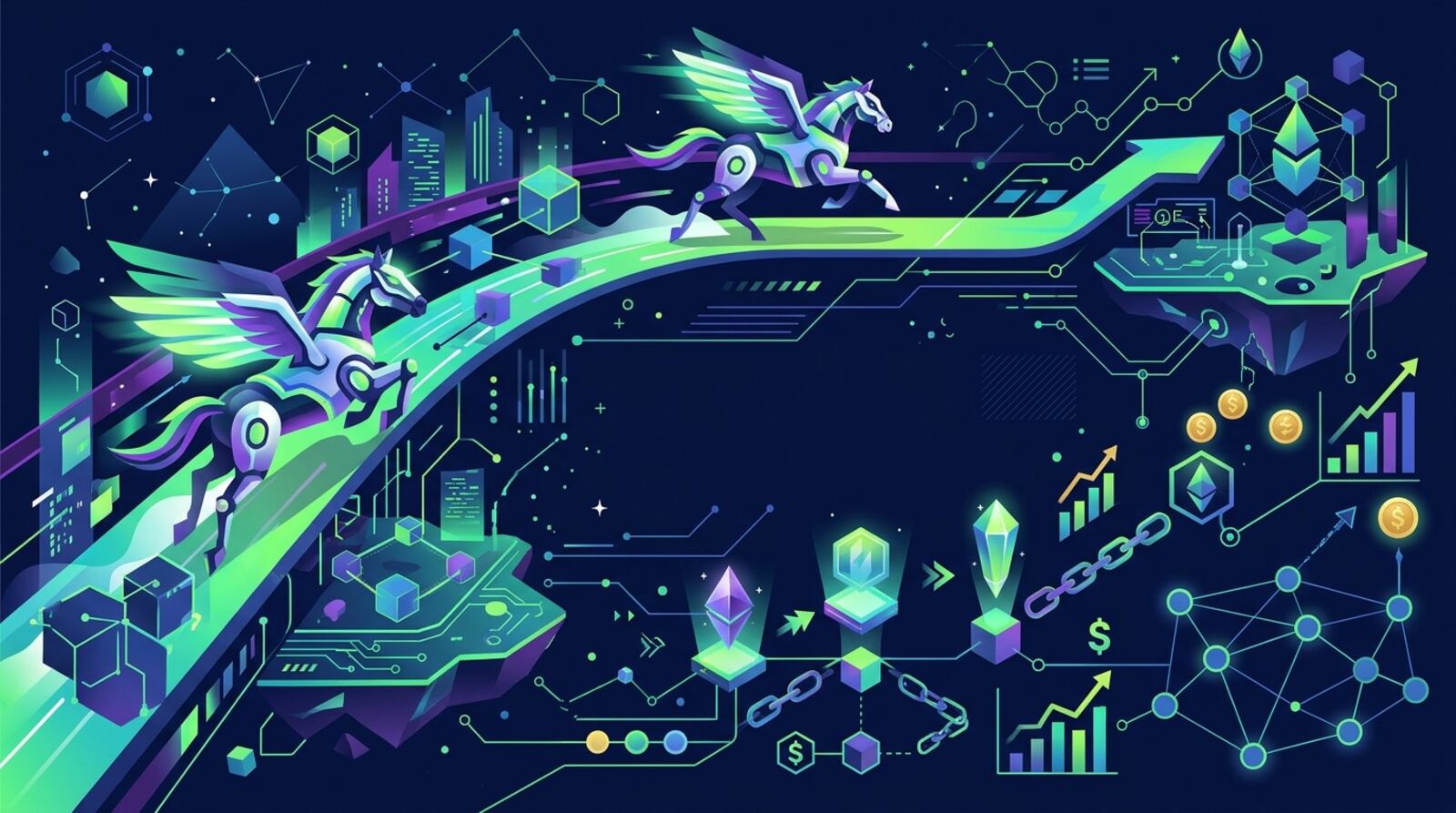
What Pegaxy is and how its racing works
Pegaxy is a play-to-earn racing game built on blockchain technology. Players take part in horse races using NFT horses called Pegs, which are short for Pegasus, and aim to finish in the top three in a race against several other racers. The game combines a competitive racing format with a reward system and an ownership model, so it sits between a racing game and a blockchain collectible economy.
The basic loop is simple to describe. You get a Peg, you enter races that match its capabilities, and you earn rewards when your horse places well. The game uses its own in-game reward currency, called VIS, and a governance token, called PGX. Public descriptions of the game note that the races are player versus player, which means your results depend on how your Peg compares with the other horses in the field, not only on a fixed payout table.
Pegaxy is also described as having a mythological, futuristic style, with Pegs bred from a lineage of winged horses. Official materials and community posts mention a 2D version update, which suggests the game's presentation and features have changed over time. Because details like the interface, race formats and reward rules can shift, the official site should be your primary reference for what the game currently does.
Before going further, understand that Pegaxy is a financial product as much as a game. Race outcomes, NFT prices and token prices all affect what you can earn or recover. Treat the game as a place to learn the mechanics, and do not assume that racing will produce steady income.
How a race is decided: Peg stats and elements
Each Peg has attributes that affect how it performs. Public descriptions mention elemental types and randomised factors that influence each race, so two horses with similar stats may still finish in different positions. This means no single stat guarantees a win, and the game is best understood as a mix of preparation, field selection and luck.
When you enter a race, the main question is whether your Peg suits the conditions. Players often compare the race format, the entry requirements and the likely strength of the field before committing a horse. Because the field is made up of other players' Pegs, the strength of your competition changes from race to race, and a horse that did well in one event may struggle in another.
Some public sources describe larger competitions, such as a global event called The Grand Dash, which can offer additional rewards for strong performance. Event formats, qualification rules and prize pools change over time, so check the current event listings on the official site rather than relying on older posts.
A practical way to think about results is to track your own outcomes over a set number of races, noting the type of race, the entry cost and the reward received. This record shows you whether a Peg is actually profitable after costs, rather than whether it had one lucky finish.
Owning Pegs versus renting them
Pegaxy is commonly described as offering two broad ways to take part: owning a Peg outright or renting one from someone who owns it. The two routes carry very different risks and responsibilities, so you should understand both before choosing.
Owning a Peg means you hold the NFT and carry the full value risk. You keep the horse's rewards, but you also bear the cost of buying it, any maintenance costs in the game, and the chance that the market price falls. If the Peg loses performance or the game changes, your ownership may be hard to convert back into money.
Renting lets you race a horse you do not own, usually in exchange for a share of the rewards paid to the owner. Older community posts described a profit share for renters, with figures around 10 to 20 percent. Treat that as a historical example only. Current rental terms, fee structures and profit splits can differ, and they should be confirmed on the official site and in any agreement you sign.
Whichever route you choose, keep written records of what you paid, what you received and what conditions applied. If a rental arrangement depends on another player honouring terms, consider the counterparty risk. Start with a small position so you can test the process before putting significant money into any horse.
How players earn VIS and PGX
Pegaxy uses more than one token, which is one reason it can be confusing for newcomers. VIS is the in-game reward currency that players earn through racing and events. PGX is a token associated with governance and the wider project. Each token has its own supply, market price and use cases, and their values do not necessarily move together.
Rewards in an in-game currency only have real-world value if you can convert them, either through a marketplace or an exchange where they are listed. Before you count on any reward as income, check whether it can be sold, at what price, and what fees apply. A reward that looks large in the game may be worth little once you account for conversion costs and a falling market price.
Governance tokens usually give holders a say in certain project decisions, but the scope of that say depends on how the project is set up. Read the current documentation to see what PGX holders can actually vote on, and do not assume governance rights translate into profit.
When estimating earnings, separate the rewards you earn from the price changes in the tokens you hold. A good habit is to record the amount of VIS or PGX you receive each week and value it at the price you can actually sell for, so you can see your real return over time.
Breeding and the value of a Peg
Breeding is part of the Pegaxy model. Public descriptions say that newly born Pegs can be sold, and that racing performance can be linked to a horse's value. The idea is that a strong lineage or a well-performing Peg may fetch a higher price, which turns horse ownership into a kind of asset trade alongside racing.
This creates a second source of risk. Breeding costs, the chance of a weak offspring, and the time before a new Peg is ready all affect whether a breeding plan makes sense. A foal that cannot compete well may be hard to sell at a useful price, so breeding should not be treated as a guaranteed way to add value.
The value of any Peg depends on what buyers are willing to pay at a given moment. NFT markets can be thin, meaning there are few buyers for a specific horse, and prices can move quickly. A Peg may look valuable on a listing page while being very difficult to sell at that price.
If you consider breeding, write down the full cost of each step, including the purchase of parent horses, the time needed, and the likely resale range. Compare this with simply renting or racing an existing horse. Often the simpler route has lower risk and is easier to reverse.
Costs, fees and the economics to model
Many people focus only on the rewards a race pays out, but total cost decides whether the game is worth playing. Costs can include the purchase price of a Peg, rental fees or profit shares, entry costs for races, in-game maintenance or upkeep, transaction fees on the blockchain, and the discount you may take when converting tokens to cash.
To estimate your position, list every cost in one place and every reward in another, then compare totals over a fixed period such as one month. Use conservative assumptions. Assume that your Peg wins less often than you hope, that rewards are paid at a lower price than today, and that a sale would take longer than expected.
Blockchain transaction fees can also change, depending on network conditions and the network the game uses. Check current fee levels for any transaction you make, and factor them into small or frequent actions, since they can add up quickly.
The key test is whether you still come out ahead after all costs in a conservative scenario. If the answer depends on a token price rising, or on a constant stream of new players, the position carries more risk than the headline numbers suggest. Many experienced participants recommend keeping spending limited to money they would be comfortable losing entirely.
Risks: token prices, NFT liquidity and the game itself
Pegaxy carries several overlapping risks. The first is market risk. VIS, PGX and Peg prices are set by supply and demand, and they can fall sharply. A horse bought at one price may be worth much less later, even if the game still works as described.
The second is liquidity risk. An NFT or token that is hard to sell may trap your funds. Even if a Peg has a fair value, you might need to accept a steep discount to exit quickly, or wait a long time for a buyer.
The third is game risk. Games change their rules, rewards, and features, sometimes with little notice. Updates to race formats, reward structures or the economy can change the outlook for every horse at once. Read release notes and official announcements, and treat promises about future features as uncertain until they are delivered.
The fourth is platform and counterparty risk. You depend on the company, the blockchain, the marketplaces and any other players you deal with. If a service stops working, a marketplace closes or a rental partner fails to pay, recovering your funds may be difficult. Keep records and use only official channels for transactions.
Finally, there is security risk. Scams often copy the names of popular games and offer fake support, fake rewards or requests for your wallet details. Never share your seed phrase or private keys, and verify any link or message against the official site before acting.
How to evaluate Pegaxy before you join
Before you join, work through a short checklist. Start by reading the official site and documentation to confirm current rules, rewards, fees and rental terms. Then check the status of the project, including recent updates and any official announcements about changes to the game or token.
Next, look at the economics in practice. Ask what a typical race pays, what entry costs are, how often your horse needs to race, and what the realistic resale value of a Peg would be. Be wary of any figure that is presented without a source, a date or a clear explanation of the assumptions behind it.
Then consider the people and the community. Look for balanced discussion that includes losses as well as wins. Be cautious of anyone who promises guaranteed income, pressures you to buy quickly, or asks you to recruit others.
Finally, decide your limits in advance. Set a maximum amount you will spend, a point at which you will stop and review, and a plan for exiting. Writing these rules down before you start helps you avoid decisions driven by a short-term price move or an exciting race result.
Who Pegaxy suits and what to check next
Pegaxy may suit people who enjoy horse racing mechanics, like comparing stats and planning race entries, and who understand that blockchain assets can lose value. It is less suited to anyone who needs a dependable income, who cannot afford to lose the money they put in, or who finds volatile markets stressful.
If you want to compare the wider category, several other blockchain games use similar ideas of collectible assets, competitive play and token rewards. Splinterlands and Axie Infinity are often discussed in the same breath, and each has its own mechanics, costs and risks. Looking at more than one game helps you see what is specific to Pegaxy and what is common across the genre.
If you are new to the space, you might also explore Warsaken or The Lost Glitches to understand how trading card games handle NFT ownership and rewards, or Sorare to see how digital collectibles are used in a fantasy sports setting. These are useful for learning, but each carries its own risks.
Whatever you choose, keep your exposure small, verify information from primary sources, and reassess regularly. A cautious, well-documented approach will tell you more about whether a game fits your goals than any headline earnings figure.
Frequently asked questions
Is Pegaxy still active and what is it?
Pegaxy is a play-to-earn racing game in which you race NFT horses, called Pegs, and can earn in-game rewards and tokens. Its current status, prize structure and token details should be confirmed on the official site and in recent community sources, because these change over time.
Can I rent a Peg instead of buying one?
Some public sources describe Pegaxy as a game where players can rent or buy Pegs, but the exact rental terms, profit splits and access rules can change. Read the current terms on the official site before renting or buying, and keep copies of any agreements you rely on.
Can you make money with Pegaxy?
Play-to-earn rewards depend on race results, the game economy, and the market price of tokens and NFTs. Earnings can fall, and token prices can drop sharply, so an NFT horse may lose value or become hard to sell. Model a conservative scenario with zero token price growth before you commit funds.
Where should I check current Pegaxy information?
Start with the official site and its help or documentation pages for current rules, fees and token information. Then compare recent community discussion, a company profile for background on funding and structure, and your own notes on costs. Treat any single income claim, including screenshots of big earnings, as unverified.
What should I protect first?
Only spend what you can afford to lose. Keep your wallet secure, never share your seed phrase or private keys, and be wary of anyone offering guaranteed returns or asking you to send funds privately. Check your local laws on crypto assets and on any money you earn from a game, and seek tax advice if needed.
Mentioned in this guide
dApps in this guide
Axie Infinity is a Ronin-based NFT game where players collect, combine and battle creatures called Axies, with its own AXS token.
Splinterlands is a blockchain collectible card game on Hive where players battle with NFT cards and earn or stake the SPS governance token.
Alien Worlds is a community-built play-to-earn metaverse on WAX where players mine and play to earn TLM tokens and NFTs.
Wild Forest is a real-time strategy PvP card battler by Zillion Whales on Ronin, with a WF token, for strategy players curious about Web3 gaming.
Warsaken is a trading card game on the WAX blockchain where players collect cards, open packs and earn Loot rewards through play and events.
The Lost Glitches is a Web3 trading card game with RPG progression and PvP battles, using ERC721 NFTs on Ethereum for card and character collectors.
Sorare is a fantasy sports game where users collect licensed digital player cards, build lineups and compete based on real match performance.
Pixels is a web3 farming and exploration game with a PIXEL token, guilds and ecosystem staking, aimed at gamers who are comfortable with wallets and token risk.
Current is a Sui-based lending protocol with isolated markets and one-click yield multiply, focused on tokenized real-economy yield.
Keep reading
Related guides
Web3 gaming · Explainer
Blockchain Brawlers on WAX: What the Play-to-Earn Launch Was
Blockchain Brawlers was a WAX-based play-to-earn fighting game whose 2022 and 2023 launch push drew wide attention. This guide explains what the game was, what its launch involved, how to check its status today, and what to weigh before joining any play-to-earn title.
Web3 gaming · Review
Splinterlands Review 2026: How the Hive Card Battle Game Works
Splinterlands is a blockchain card battle game that runs on the Hive network, with NFT cards and the SPS and DEC tokens. This guide explains how it works, what to check before playing, and the main risks.
Web3 gaming · Explainer
Splinterlands Reclaims the Throne: What the Headline Means
A headline says Splinterlands has reclaimed a top spot. This explainer covers what such rankings measure, how the Hive card battler works, and how to check its standing for yourself.
Web3 gaming · Explainer
Splinterlands and Warner Music Artists: What Is Confirmed in 2026
Searches for Splinterlands alongside Warner Music artists usually point to music-themed contests or in-game music, not a confirmed label deal. This guide explains what public sources support, how Splinterlands works, and how to verify any partnership claim yourself.
Web3 gaming · Explainer
Philippines Tax on Axie Infinity Earnings: What Players Need to Know
Philippine tax authorities have said that income from playing Axie Infinity is taxable, which affects players who earned in tokens and crypto. This guide explains what officials have stated, how the rules generally apply, and what players can do now to keep records and report income.
Web3 gaming · How-to
Parallel Card Game Guide: How to Play and Build a Deck
Parallel is a sci-fi trading card game with digital cards players can own. This guide covers its factions, how a match works, how to build a first deck, and how to handle the wallet and marketplace side safely.
Web3 gaming · Review
Photo Finish Live Review: Solana Horse Racing Game Explained
Photo Finish Live is a Solana horse racing game built around NFT horses and scheduled races. This review explains how the genre works, what to verify before you spend anything, and how it compares with other web3 games.
Web3 gaming · Explainer
GamesOnChain and On-Chain Gaming: How Fair Play Works
On-chain gaming puts game rules, assets or outcomes on a blockchain so anyone can check them. This guide explains what that means for fairness, what it cannot guarantee, and how to judge any platform that promises fun and fair play.