NFT · Explainer
Luca Netz and Pudgy Penguins: Rug Pulls Explained
Luca Netz's interviews about Pudgy Penguins keep returning to one question: how does an NFT project that began under a cloud become a lasting consumer brand? This guide covers the stable background, the meaning of "rug pull," and how to judge any founder's claims.
By the DappsAtlas editorial team · Updated
What is the "Rug Rats" conversation with Luca Netz about?
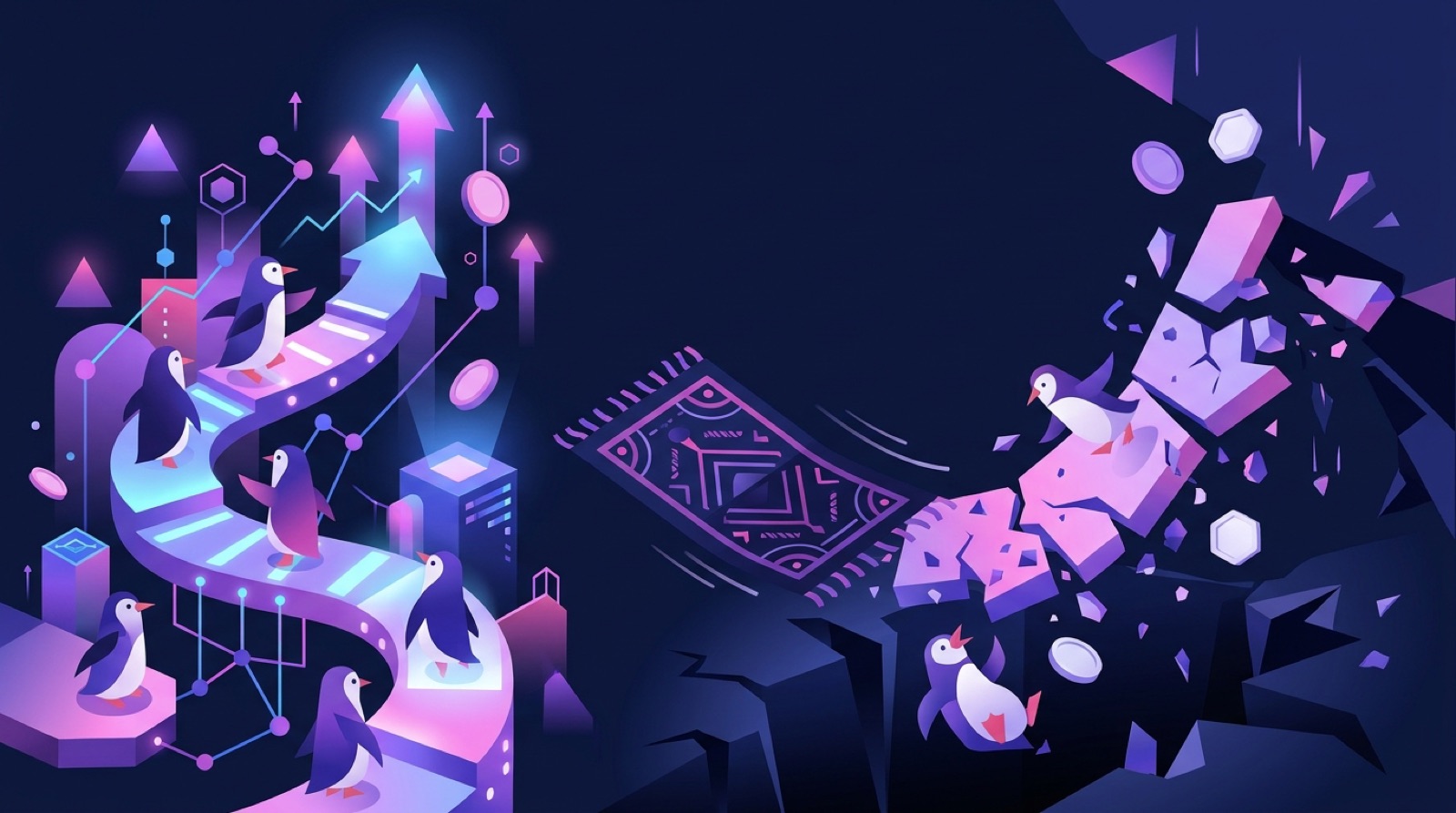
"Rug Rats" is a play on "rug pull," the crypto term for a project whose team takes the money and leaves. The phrase has been used as a title for conversations with NFT founders about trust, accountability, and what it takes to keep a project alive after the hype fades. In this case the guest is Luca Netz, the CEO of Pudgy Penguins.
This guide is not a transcript or a summary of any single episode. Without the source in front of us, we do not attribute specific quotes, numbers, or announcements to Netz. Instead, it explains the background that makes such a conversation worth having, using facts that are well established and unlikely to change.
The questions interviews like this tend to raise are consistent:
- How does a project recover after its original team leaves?
- Is an NFT a collectible, a membership, or a license to intellectual property?
- What do holders actually own, and what does the company own?
- How should a founder be judged after a rocky start?
- Where do physical products and tokens fit in?
Each of these is a lens you can apply to any NFT project, not just Pudgy Penguins. The sections below cover who Netz is, what a rug pull really is, how Pudgy Penguins evolved, and a practical checklist for vetting projects yourself. Anything time-sensitive, such as current prices, sales figures, or partnerships, should be checked at the source rather than taken from an article or a podcast clip.
Who is Luca Netz and how did he end up running Pudgy Penguins?
Luca Netz became CEO of Pudgy Penguins in 2022. The project had launched in 2021 as a collection of 8,888 penguin-themed NFTs on Ethereum. Early on, its original founders stepped away amid community frustration, and Netz led a purchase of the project from them in 2022. The price was widely reported at around two and a half million dollars, though you should confirm figures from primary or reputable sources.
What makes Netz notable in NFT circles is the direction he took afterward. Rather than treating the collection as a set of profile pictures to flip, he framed Pudgy Penguins as an entertainment and consumer brand, with the NFTs at the center as proof of membership and, in his framing, a stake in the brand's success.
That positioning is why interviews with him often cover topics outside crypto: retail distribution, licensing, toy manufacturing, and how to reach people who have never owned a wallet. It is also why he gets asked about trust. A founder who inherits a community that felt burned must rebuild credibility, and the way he does it, through consistent communication and delivery, is a useful case study.
Keep in mind the distinction between a founder's public persona and verifiable facts. Public persona is shaped by interviews and social media. Verifiable facts live in contracts, company filings, product listings, and independent reporting. A good reader tracks both but trusts the second more.
What is a rug pull, and how does it differ from a failed project?
A rug pull is a project failure with an element of deception: the team takes funds and abandons the project, or deliberately drains value from holders. The word comes from the image of pulling a rug out from under someone. It is not the same as a project that simply fails or loses value.
Common forms in NFTs include:
- Mint-and-vanish: the team sells a collection, collects the proceeds, deletes its social accounts, and never delivers the promised roadmap.
- Insider dumping: the team or early insiders sell large holdings at the top while still promoting the project.
- Liquidity removal: for token-based projects, the team withdraws the funds that let people sell, leaving holders unable to exit.
- Malicious contract tricks: hidden functions let the deployer change metadata, block transfers, or mint extra supply.
- Slow rugs: the team stays visible but gradually stops building, communicating, or supporting holders.
The last category matters most for understanding stories like Pudgy Penguins. The line between a rug pull and an abandoned project is blurry, and communities often disagree about where it falls. What is clear is that disappointment alone is not proof of fraud, and a recovery does not erase the original grievance.
When you evaluate a project, ask what the team can do unilaterally with the contract, the treasury, and the metadata. Fewer unilateral powers mean fewer ways to rug. Verify this on a blockchain explorer or through a reputable audit, not through the team's own description.
How did Pudgy Penguins go from a rocky start to a consumer brand?
Pudgy Penguins launched in July 2021 during the first major wave of profile-picture NFT collections. Its supply was 8,888, and its artwork, simple cartoon penguins, was recognizable and easy to reproduce on merchandise. Like many collections from that period, it saw a surge of attention and then a long, difficult stretch when prices and interest fell.
The 2022 change in ownership was the turning point. Under Netz, the project shifted from "NFT collection" to "brand that happens to start with an NFT collection." The steps most often cited in reporting include:
- Giving holders commercial rights to use their own penguin, a model many other projects have also adopted.
- Launching Pudgy Toys, physical plush and collectible products sold through mainstream retailers, including Walmart according to widely reported coverage.
- Building digital experiences and media around the characters.
- Introducing a token, PENGU, in late 2024, with a portion distributed to NFT holders.
These are broad strokes. Details such as sales volumes, retailer lists, token distribution percentages, and partnerships change over time, and some have been disputed or revised. Treat any number you see in a headline as something to verify with the project's official channels and independent reporting.
The larger lesson is not that this path guarantees success. It is that the project moved its source of value away from speculation on NFT floor prices and toward products and audiences outside crypto, which is a different risk profile.
What does an IP-first NFT model mean for holders?
An IP-first NFT project treats its characters, art, and story as intellectual property that can be licensed, merchandised, and adapted, with the NFT acting as a membership token or a stake. This differs from earlier models where the NFT was the product and the value came mostly from scarcity and resale.
The model typically has three layers:
- The NFT: a token on a blockchain that proves ownership of a specific character.
- The rights: terms that say what the holder may do with that character, for example use it commercially.
- The brand: the company-controlled wider universe, including products, media, and partnerships.
The tension sits between layers two and three. Holders want the brand to grow because it supports the value of their token, but a company growing a mass-market brand has its own incentives, such as protecting trademarks, controlling quality, and appealing to a general audience that may not care about NFTs.
Questions worth asking about any IP-first project:
- Who owns the trademarks and the underlying IP, the company or the holders?
- Do holders share in revenue, and is that a legal commitment or a discretionary gesture?
- What happens to holder rights if the company is sold or changes direction?
- Are the terms written down and readable?
Answers that are vague or only given verbally in interviews are weaker than answers set out in published terms.
How do community tokens like PENGU change the picture?
Tokens linked to NFT communities add another layer to the trust question. A token can give holders liquidity and a way to participate, but it also introduces new risks that NFT-only projects did not have.
General points that hold for any community token:
- Distribution matters. Who received tokens, how many went to the team, investors, and the community, and when they unlock, shapes selling pressure.
- Liquidity matters. A token you cannot sell without moving the price sharply is riskier than one with deep markets.
- Utility claims need proof. "Governance" or "rewards" can mean a lot or nothing depending on what the token actually does.
- Price volatility is high. Tokens can fall quickly, and a link to a well-known brand does not prevent that.
For PENGU specifically, details such as supply, allocation, unlock schedules, and trading venues are published by the project and visible on-chain. Check those directly, and use a reputable market-data site for current price and volume instead of relying on an article or a social post.
A useful habit is to separate three questions: is the brand growing, is the NFT collection holding value, and is the token performing? These can move independently. A successful toy line does not automatically lift NFT floor prices, and a strong token does not prove the underlying business is healthy.
How can you evaluate a founder and an NFT project yourself?
You do not need inside information to vet a project. Most of what matters is public. Use this checklist before you buy or mint.
Team and accountability
- Are the founders publicly identifiable, with a track record you can check independently?
- Has the team changed since launch, and was the change explained clearly?
Contract and treasury
- Is the contract verified on a blockchain explorer?
- Can the owner change metadata, pause transfers, or mint more? Is ownership renounced or held in a multisig?
- Are treasury and royalty wallets visible and described?
Delivery history
- Compare past promises with what shipped. Delivered products beat future roadmaps.
- Look for independent coverage of releases, not only the team's own posts.
Incentives
- How much did the team keep, and have they sold?
- Do holder benefits have written terms?
Community signals
- Are criticisms answered or deleted?
- Is the community discussing products and policy, or only price?
No checklist eliminates risk. It helps you avoid the obvious traps and see how much trust you are being asked to extend. If a project's value depends mostly on the founder's continued goodwill, price that in.
What are the common red flags and green flags?
The table below sets out signals that tend to separate sturdier projects from risky ones. None is conclusive alone.
| Area | Healthier sign | Warning sign |
|---|---|---|
| Team | Identifiable, with past delivery | Anonymous with no history, or deleted profiles |
| Contract | Verified, limited admin powers | Unverified, hidden owner functions |
| Communication | Regular, specific, handles bad news | Vague hype, deletes criticism |
| Roadmap | Shipped items you can verify | Long promises with no deadlines |
| Revenue | Products or services outside the mint | Value depends on new buyers arriving |
| Holder terms | Written and public | Verbal assurances only |
| Urgency | Time to read and research | Countdowns, pressure, "last chance" |
Watch also for impersonation. Fake mint pages, cloned social accounts, and direct messages offering allowlist spots are common ways people lose assets, even in well-run projects. Always reach a project through links you have verified, and bookmark them.
If you are considering a purchase after hearing a founder speak, remember the interview is a sales environment even when it feels like a conversation. Good founders can be sincere and still be wrong about the future. Treat their statements as claims to check, not guarantees.
How should you buy, hold, and trade NFTs more safely?
Even a legitimate project can cost you money if you handle assets carelessly. Practical habits:
- Use a dedicated wallet for minting and trading, separate from long-term holdings, ideally a hardware wallet for valuable items.
- Never share your seed phrase. No project, marketplace, or support agent needs it.
- Review token approvals. Marketplace and mint approvals can persist. Revoke those you no longer use.
- Read what you sign. If a signature request looks unusual, stop and check.
- Avoid unsolicited links. Treat surprise airdrops and urgent direct messages as hostile.
- Size positions conservatively. NFTs can be hard to sell, and floor prices can drop quickly.
Where you trade also matters. Different venues serve different needs: NFTX turns NFT collections into vault-backed tokens so you can swap against a pool at floor price, while TokenWorks runs NFTStrategy, a protocol aimed at experienced, risk-tolerant users that uses trading fees to buy, relist, and burn NFTs. AtomicHub focuses on gaming items and collectibles on WAX and EOS-family chains. Foundation, an art marketplace, was reported by its team as taken offline indefinitely on April 27, 2026, a reminder that platforms can disappear, so keep your assets in a wallet you control and do not rely on a single venue.
Nothing here is financial advice.
Where should you check current facts about Pudgy Penguins and similar projects?
Interviews and articles age quickly. For anything that changes, go to primary sources and use more than one.
- Collection data: a reputable NFT marketplace or analytics site shows current floor price, volume, holder count, and recent sales.
- Token data: a market-data site and a blockchain explorer show price, supply, and large wallet movements.
- Contract details: a blockchain explorer shows whether the contract is verified and who controls it.
- Company news: the project's official website and verified social accounts, cross-checked with independent news outlets.
- Retail and product claims: the retailer's own listings and the company's published announcements.
- Legal and tax rules: your local regulator or a qualified adviser, since NFT and token rules differ by country and change.
When you listen to a conversation such as "Rug Rats," take notes on specific claims, then check each one later. Separate what the guest said they plan to do from what has been shipped. Over time, the gap between those two lists is the best measure of a founder's reliability.
If you are new to NFTs, start by watching a project for a few weeks before buying. Follow its announcements, see whether delivery matches the messaging, and note how the team handles setbacks. Patience costs little, and it filters out many of the projects that rely on urgency.
Frequently asked questions
What is a rug pull in NFTs?
A rug pull is when a project's team takes investors' money and abandons the project, or drains liquidity, without delivering what was promised. In NFTs it usually means mint proceeds are taken and the roadmap is dropped, or the team dumps its holdings and disappears.
Who is Luca Netz?
Luca Netz is the CEO of Pudgy Penguins. He took over the project in 2022 after the original founders left, and he has since steered it toward toys, licensing, and a broader consumer brand.
What is Pudgy Penguins?
Pudgy Penguins is a collection of 8,888 penguin NFTs on Ethereum, launched in 2021. It later grew into a brand with physical toys, digital media, and the PENGU token.
Can I rely on what a founder says in an interview?
Treat any specific claim from an interview as a statement to verify, not a fact. Check the official project channels, on-chain data for the contracts, and reputable news coverage. Prices, floor values, sales figures and token details change often, so confirm them on the day.
Does a project's success mean its NFTs are a safe buy?
Not on its own. Strong branding and retail deals reduce some risks, but NFT prices can still fall sharply, liquidity can dry up, and brands can fade. Only spend what you can afford to lose, and do your own research.
How can I avoid scams when buying NFTs?
Use only the project's official links, keep a separate wallet for minting and trading, review and revoke token approvals regularly, and never share your seed phrase. Be suspicious of surprise airdrops, urgent mint announcements, and direct messages offering deals.
Mentioned in this guide
dApps in this guide
NFTX turns NFT collections into vault-backed ERC20 tokens so users can buy and sell NFTs instantly at floor price against a pool.
TokenWorks runs NFTStrategy, an Ethereum protocol of tokens that use trading fees to buy, relist and burn NFTs, aimed at experienced, risk-tolerant users.
AtomicHub is a multichain NFT marketplace for gaming items, collectibles and digital art, centered on WAX and EOS-family chains.
Foundation was an Ethereum NFT art marketplace for creators; the team took it offline indefinitely on April 27, 2026 after a failed sale.
Common is a non-custodial ZK privacy dapp on Arbitrum and Aleph Zero EVM that lets users shield funds and withdraw to a new, unlinkable wallet.
Pudgy Penguins is a penguin-themed brand with a PENGU meme token, an NFT-linked community and an official merchandise shop for fans.
Keep reading
Related guides
NFT · Best list
Best PFP NFT Avatars in 2026: Top Collections Compared
PFP NFTs are profile-picture collections that double as membership badges. This guide covers the collections that have lasted, how to judge them yourself, and where to trade them without getting burned.
NFT · Explainer
Global NFT Financial Regulations Explained for 2026
NFTs do not have one global rulebook. Whether an NFT is treated as a collectible, a security, a payment tool or property depends on how it is built, sold and marketed, and on where buyers and platforms are located.
NFT · Best list
Best Layer 2 Blockchains for NFTs in 2026: Compared
Layer 2 networks make minting and trading NFTs cheaper than Ethereum mainnet. This guide compares the leading options by cost, marketplace depth, security model and use case.
NFT · Explainer
Ghxsts vs Art Blocks: Reading Top 10 NFT Sales Lists
A headline about Ghxsts taking the spotlight from Art Blocks in a top 10 NFT sales list raises a bigger question: how are these rankings built, and what do they actually tell you? This guide explains the mechanics and how to check any such claim yourself.
NFT · Explainer
Madonna and the Bored Ape NFT: What Happened and What It Means
Madonna's public move into the Bored Ape Yacht Club community in 2022 drew wide attention, and a later lawsuit made it a case study in celebrity NFT promotion. This guide explains what happened, what the legal claims were, and how to check a celebrity-linked NFT before you trade it.
NFT · Explainer
Loot Royalty Fees and Falling NFT Trading Volume Explained
When a collection adds creator royalties, trading can move to venues that skip or ignore them, and volume on the original marketplace often falls. This guide explains how royalties work on NFTs, why Loot-style royalty changes can reduce trading volume, and how to check the current royalty setup yourself.
NFT · Explainer
Madonna's Bored Ape NFT: What It Was and What It Means
Madonna bought a Bored Ape Yacht Club NFT in 2022 and worked with the digital artist Beeple on a separate NFT series, moves that drew both fan interest and a lawsuit. This guide explains what happened, what the lawsuit alleged, and how readers can check where such assets stand today.
NFT · Explainer
Loot NFTs Explained: The Complete Guide for 2026
Loot is a set of 8,000 text-only NFT item bags launched in 2021 that became a base layer for games and derivative projects. This guide explains what a Loot bag contains, how the project spread, and how to buy, check and trade one safely.