Web3 gaming · How-to
How to Breed Axies in Axie Infinity: Step-by-Step Guide
Breeding is how new Axies enter Axie Infinity. This guide covers the requirements, gene rules, costs, the exact steps, and the checks that keep you from wasting tokens on a bad pairing.
By the DappsAtlas editorial team · Updated
What does it mean to breed an Axie?
Axie Infinity is a blockchain game from Sky Mavis in which players collect and battle creatures called Axies. Each Axie is an NFT on the Ronin network, so you own it in your own wallet and can trade it on the in-game marketplace. Breeding is the process that creates new Axies from two existing ones.
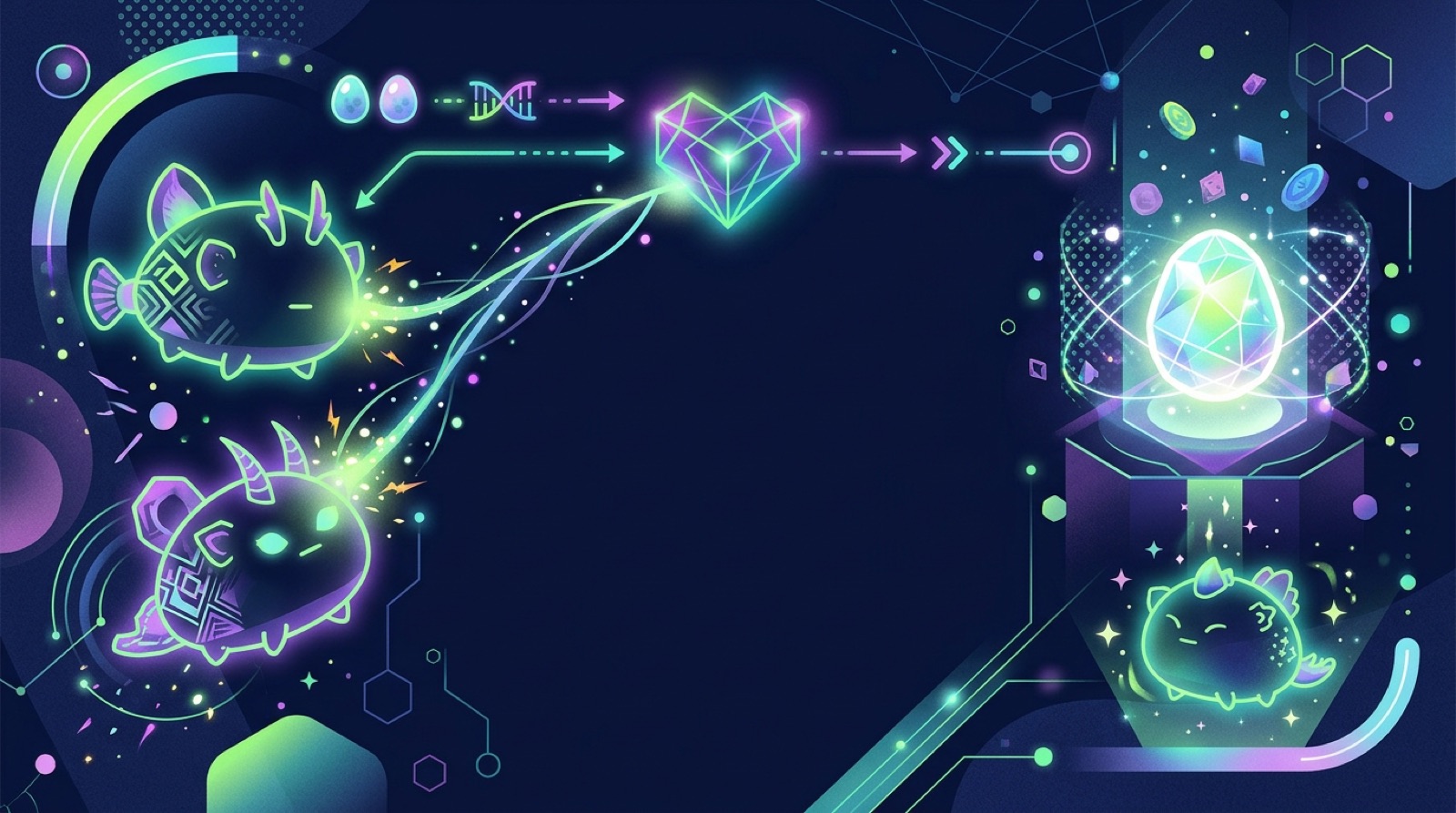
When you breed two Axies, you pay a fee in the game's tokens. The result is an egg. After a waiting period the egg hatches into a new Axie that inherits body parts, a class and stats from its parents. Because inheritance is probabilistic, breeding is part strategy and part luck.
Before you start, you need:
- A Ronin wallet that you control, with your seed phrase stored offline.
- Two Axies in that wallet, bought on the marketplace or already owned.
- Enough AXS and SLP to cover the breeding fee, plus a little RON for network use where required.
- A clear idea of what you want from the offspring: a certain class, a certain body part, or simply a cheap Axie to sell.
The rules in this guide are the long-standing ones. Game rules, fees and versions change, and Sky Mavis has released more than one Axie ruleset over time. Treat any figure here as a reason to check the live breeding screen, not as a current quote. Breeding is also not a way to guarantee income, so decide how much you are willing to risk before spending anything.
How do Axie genes and inheritance work?
Every Axie has six body parts: eyes, ears, back, mouth, horn and tail. Each part carries three genes. The dominant gene (often written D) is the one you see on the Axie. Behind it sit two recessive genes, R1 and R2, which are hidden but can be passed on.
When two Axies breed, each parent contributes a gene for each body part. In the standard model, the chance that a parent passes on a given gene depends on its position:
| Gene position | Chance of being passed on by one parent |
|---|---|
| Dominant (D) | 37.5% |
| Recessive 1 (R1) | 9.375% |
| Recessive 2 (R2) | 3.125% |
These add up to 50% per parent, since the child's gene comes from one of two parents. In practice, a part that both parents show as dominant is the likeliest result, but the hidden genes can surface.
The offspring's visible part is decided by the gene combination it receives. Every Axie also has a class, such as Beast, Aquatic, Plant, Bird, Bug or Reptile, and rarer classes exist. The class affects base stats (health, speed, skill and morale) and how well parts of the same class work together in battle.
It helps to look at the full gene profile of each parent, not only the visible parts. Community gene calculators can show the probabilities for each pairing. Rarity also matters. Some parts and classes are scarcer than others, and special parts such as mystic ones have their own rules, so check how they behave in the current ruleset before relying on them.
Which Axies can be bred together?
Not every pair of Axies can be bred. The game enforces a few rules, and it is worth checking them before you buy anything.
Typical requirements:
- Breed count. Each Axie has a limit on how many times it can be bred. In the Classic ruleset this is seven. Once an Axie reaches its limit, it cannot be used again.
- No close relatives. Parents and children cannot be bred together, and siblings cannot be bred together. The game blocks these pairings.
- Ownership. Both Axies must be in the wallet you are using. You can breed Axies you own, or buy one on the marketplace and breed it afterwards.
- Not egg-stage or locked. An Axie that is listed for sale, being used in another action, or otherwise locked may need to be unlisted first.
- Version compatibility. Axies from different game versions may follow different breeding rules, so check what your Axies are.
The breed count matters a lot for value. An Axie with zero breeds is worth more to a breeder than one that is nearly used up, because the cost rises with each breed and the number of remaining chances falls.
When buying Axies for a planned pairing, open each Axie's page and look at its family tree. It shows parents and siblings, which tells you whether the pair is blocked. A pair that looks perfect on genes but shares a parent will fail, and you will have spent money on an unusable combination.
What does breeding cost?
Breeding is paid in the game's two tokens: AXS (Axie Infinity Shards) and SLP (Smooth Love Potion). The AXS part is a fixed fee per breed. The SLP part rises with each time an Axie has been bred, so the first breed is the cheapest and the last is the most expensive. The fee for a pairing is based on both parents' breed counts.
I am not quoting exact numbers here, because fees and token prices have changed over time and will again. Check the breeding screen, which shows the requirement before you confirm.
What to add up before you commit:
- Parent cost. What you paid for each Axie, or what you could sell it for.
- Breeding fee. The AXS and SLP shown on the breeding screen, valued at current prices.
- Network and marketplace costs. Any Ronin fees and the marketplace fee when you sell.
- Time cost. Eggs need to hatch before you can see the result, and listings may take time to sell.
- Price risk. Both tokens and Axie prices move. A breed that looks profitable today may not be next week.
A useful habit is to find the market price of Axies similar to the ones you expect to produce. Look at recent sales, not asking prices, because many listings never sell. If the likely sale price does not cover your total costs with a margin, skip that pairing. Where to check prices: the in-game marketplace for Axies, and a major price tracker for AXS and SLP.
How do you breed Axies step by step?
The interface can change, so menu names may differ slightly. The overall flow stays the same.
- Set up your wallet. Install the Ronin wallet, create a new wallet or import one, and back up your seed phrase offline. Never share it or type it into a website.
- Connect to the game. Use the official Axie Infinity site or app and connect your Ronin wallet. Check the address in your browser before signing in.
- Fund the wallet. Make sure you hold enough AXS and SLP for the fee, and a small amount of RON if needed. If you buy tokens on an exchange, withdraw to your Ronin address using the correct network.
- Get two Axies. Buy them on the marketplace or use ones you own. Check each Axie's genes, breed count and family tree.
- Open the breeding screen. Select the first parent, then the second. The game will tell you if the pair is not allowed.
- Review the cost. Read the AXS and SLP amounts shown. Confirm that your wallet has enough of both.
- Confirm and sign. Approve the transaction in your wallet. Check that the contract and amounts match what you expect.
- Wait for the egg. The new egg appears in your account after the transaction completes.
- Hatch it. Once the waiting period has passed, hatch the egg to reveal the new Axie.
If a step fails, do not retry repeatedly with different sites. Go back to the official game, check the transaction status in your wallet, and look at the help pages.
What happens after breeding: eggs, hatching and checking the result
A bred Axie does not appear immediately. The breeding transaction produces an egg, which needs a set waiting period before it hatches. The length has been a matter of days rather than hours in the standard rules, but check the game for the current timing.
When the egg is ready, you hatch it from your account. The game then reveals the Axie's class, body parts, stats and gene profile. Take a few minutes to review it before deciding what to do next.
What to check on a new Axie:
- Class and parts. Do the body parts match the class? More parts of the same class usually means higher purity, which many players value.
- Hidden genes. Recessive genes matter if you plan to breed this Axie later.
- Stats. Health, speed, skill and morale shape how it plays in battle.
- Part rarity. Scarcer parts tend to attract more interest from buyers.
- Breed count. A newly hatched Axie starts with no breeds used, which adds to its value to other breeders.
You then have three options. You can keep the Axie to battle with, list it on the marketplace, or hold it as a future breeding parent. If you plan to sell, compare it with recently sold Axies that have similar parts, class and breed count. Do not rely on asking prices. If the result is a poor match, it is often better to accept that outcome than to keep breeding in the hope of a better roll, since each further breed costs more.
How do you choose parents for the offspring you want?
Because genes pass on by probability, you cannot force a result, but you can improve your odds.
Practical approaches:
- Match classes. Pairing two Axies of the same class tends to give offspring of that class and keeps the parts on-theme.
- Pick parents with strong dominant genes. The dominant gene has the highest chance of passing on, so parents showing the parts you want in the dominant slot are a good starting point.
- Look at recessives. A parent with a desirable part in R1 or R2 can still pass it on, just less often. Use a gene calculator to see the odds.
- Prefer fresh parents. Axies with few breeds used cost less in SLP to breed and keep their resale value.
- Avoid shared ancestry. Check the family tree early so you do not buy a blocked pair.
- Think about the buyer. Some players want strong battle teams, others want collectible parts or high purity. Decide who you are breeding for.
Buying parents:
It is usually cheaper to buy one or two well-matched Axies than to hunt for a perfect pair. Compare listings over several days, and look at sales history to avoid overpaying. When buying from another player, confirm you are on the official marketplace, since fake listings and look-alike sites exist.
Keep a simple record of each pairing: the parents, the fee paid and the result. After several rounds you will see which combinations tend to give results you can sell for more than they cost.
Is breeding Axies profitable?
Breeding can make money, but it can also lose money. Treat it as a speculative activity, not income.
Factors that decide the outcome:
- Token prices. The fee is paid in AXS and SLP, and the sale is usually paid in another token or currency. Price swings between breeding and selling can erase a margin.
- Demand. Buyers pay more for Axies that suit current battle strategies or collectors' tastes. What is popular changes with game updates.
- Supply. If many players breed similar Axies, prices fall.
- Fees. Marketplace and network costs reduce what you keep.
- Rising SLP costs. Later breeds cost more, so a high breed count can make further breeding uneconomic.
- Game changes. Rule changes, new versions or balance patches can alter how valuable certain Axies are.
A simple check before each breed:
- Add the parent value you are risking, the breeding fee, and selling costs.
- Find recent sale prices of Axies like the likely result.
- Subtract your costs from a realistic, not best-case, sale price.
- If the margin is thin or negative, do not breed.
The current state of the Axie economy, including activity levels and prices, is time-sensitive, so check marketplace data and the official channels rather than relying on any article. Only spend money you can afford to lose, and be aware of the tax rules in your country, since selling crypto assets can create a taxable event.
What are the common mistakes and risks?
Breeding involves signing transactions that spend your tokens, so the main risks are security ones.
Mistakes that cost players money:
- Not checking relatives. Buying two Axies that cannot be bred together.
- Ignoring breed counts. Paying a premium for an Axie with only one breed left.
- Chasing a result. Breeding again and again after a poor roll, spending more each time.
- Underfunding the wallet. Starting a breed without enough of one token.
- Overpaying for hype. Buying parents at a peak price with no sales data behind it.
Security habits:
- Never share your seed phrase or private key. No support person or giveaway needs it.
- Use only the official game and marketplace, and type or bookmark the address yourself.
- Read every wallet prompt. Reject signature requests you do not understand.
- Be wary of private messages offering cheap Axies, free tokens or help with a stuck transaction.
- Keep most of your holdings in a separate wallet and use a smaller one for play.
- Use a hardware wallet for valuable Axies where it is supported.
If you think a wallet is compromised, move remaining assets to a new wallet as soon as you can, and revoke any token approvals you no longer need. Report suspicious sites to the official support channels.
Where to go next: other web3 games and where to check live data
If you enjoy owning and trading game assets but want a different setting, other web3 games work on different models.
ImmutableX is a web3 gaming platform on Ethereum. It hosts games and NFT marketplaces, and its IMX token is used for fees, staking and governance, including gas on Immutable zkEVM. It suits players who want to explore several games and collectibles in one ecosystem.
Alien Worlds is a community-built play-to-earn game on WAX. Players mine and play to earn TLM tokens and NFTs. It has no breeding mechanic like Axie Infinity, but it is another example of earning in-game assets through gameplay.
Whichever game you choose, the same habits apply: read the rules, check current token and NFT prices from live sources, never invest more than you can lose, and be careful about wallet security.
Where to check current information on Axie Infinity:
- The in-game breeding screen for fees, limits and eligible Axies.
- The official help pages and announcements for rule and version changes.
- The marketplace's sales history for Axie prices.
- A major price tracker for AXS, SLP and RON.
Axie Infinity has changed its rules, versions and economy several times since launch. If something in this guide does not match what you see in the game, trust the game and the official documentation, since they reflect the live rules.
Frequently asked questions
What do I need to breed an Axie?
Two Axies that are not closely related, each with breeds remaining, plus the in-game breeding fee paid in AXS and SLP. You also need a Ronin wallet that holds both Axies and enough tokens. Exact fees and limits depend on the Axie version and the current game rules, so confirm them on the breeding screen.
How many times can an Axie be bred?
In the standard Classic ruleset, each Axie can be bred up to seven times. The SLP cost goes up with each breed, so later breeds cost much more than the first. Check the breed count on the Axie's page before buying or pairing it.
Can I breed an Axie with its sibling or parent?
No. Parents and children cannot be bred together, and neither can siblings or other close relatives. The game blocks these pairings. When buying Axies to breed, check how they are related so you do not end up with a pair you cannot use.
Can I guarantee a specific body part in the offspring?
Not reliably. Each part has dominant and recessive genes, and the child receives them by probability, so you can only improve your odds. The dominant gene is the most likely to be passed on, but a recessive gene can still appear. Plan for variety in the results.
Is breeding Axies profitable?
Not guaranteed. Profit depends on token prices, breeding fees, the demand for the Axies you produce, and marketplace fees. All of these change often. Work out your break-even price before you breed, and only spend what you can afford to lose.
Where do I check current breeding costs and rules?
The in-game breeding screen and the official Axie Infinity help pages show current fees and rules. The marketplace shows live prices for Axies and tokens. Always use the official game interface and a wallet you control, and never enter a seed phrase on any site.
Mentioned in this guide
dApps in this guide
ImmutableX is a web3 gaming platform on Ethereum whose IMX token covers fees, staking, governance and gas on Immutable zkEVM, aimed at gamers and token holders.
Alien Worlds is a community-built play-to-earn metaverse on WAX where players mine and play to earn TLM tokens and NFTs.
Immutable zkEVM is an EVM-compatible blockchain for web3 games from Immutable, aimed at game studios and players, with an IMX token.
Axie Infinity is a Ronin-based NFT game where players collect, combine and battle creatures called Axies, with its own AXS token.
Infinity is a DeFi lending and borrowing protocol offering floating and fixed rates and yield curve trading, still shown as testnet or beta on its homepage.
Match-Trader is a B2B trading platform and back-end suite for forex brokers and prop trading firms, with built-in TradingView charts and CRM modules.
Ronin is an EVM-compatible gaming blockchain, home to Axie Infinity and Pixels, with RON as its token, aimed at Web3 gamers and developers.
Keep reading
Related guides
Web3 gaming · How-to
7 Ways to Earn in the Axie Infinity Economy (2026 Guide)
Axie Infinity pays players through several separate activities, not just one. This guide explains seven of them in general terms, what each requires, and what to check before you commit time or money.
Web3 gaming · Explainer
Axie Origin Alpha Explained: Timing, Rules and How to Check
Axie Origin is the skill-based competitive mode inside Axie Infinity, and its alpha seasons are test phases that change rules and rewards. This guide explains how alpha phases work, what a late-March alpha would mean for players, and how to confirm dates on official channels before you act.
Web3 gaming · Best list
Best NFT Play-to-Earn Games From A to F: A 2026 Guide
This guide covers the NFT play-to-earn games that drew the most attention in 2022, from A to F, and explains what each one was, how its economy worked, and where it stands now. Use it to judge older hype and to check any game before you spend time or money on it.
Web3 gaming · Explainer
Bomb Crypto and BCOIN Explained: Gameplay, Rewards, Risks
Bomb Crypto is a Bomberman-style play-to-earn game, and BCOIN is the token it pays out. This guide covers how the game works, what BCOIN does, and what to check before you spend anything.
Web3 gaming · How-to
How to Build an Untitled 2D Platformer Game in 2026
A practical path from an empty project to a playable 2D platformer, covering engine choice, movement code, levels, phone controls, testing and publishing. It also explains when blockchain features make sense in a small game and when they add risk without value.
Web3 gaming · Explainer
How Play-to-Earn Games Let Players Earn Rewards
Play-to-earn games reward certain actions with in-game currencies, tokens, NFTs or other prizes. Learn where those rewards come from, what they may be worth, how cashing out works and why earnings are never guaranteed.
Web3 gaming · Explainer
How to Buy Into VulcanVerse With a Credit Card in 2026
Card payments for VulcanVerse depend on the sale channel, the payment processor and your card issuer. This guide shows how to check each step before you spend anything.
Web3 gaming · Explainer
The Power of DAOs in Blockchain Gaming: Lessons from Gabby Dizon
A DAO lets a group of token holders pool money, assets and votes to run a project together. Yield Guild Games, co-founded by Gabby Dizon, is the best-known gaming example and shows both what the model can do and where it breaks down.