AI and crypto · Explainer
How Hivemind AI Agent Swarms Coordinate Specialist Agents
Hivemind is a loose label for groups of AI agents that share memory, split roles and vote on answers. This guide explains how these swarms are built, where they tend to fail, and where blockchain projects fit in.
By the DappsAtlas editorial team · Updated
What does hivemind mean for AI agent swarms?
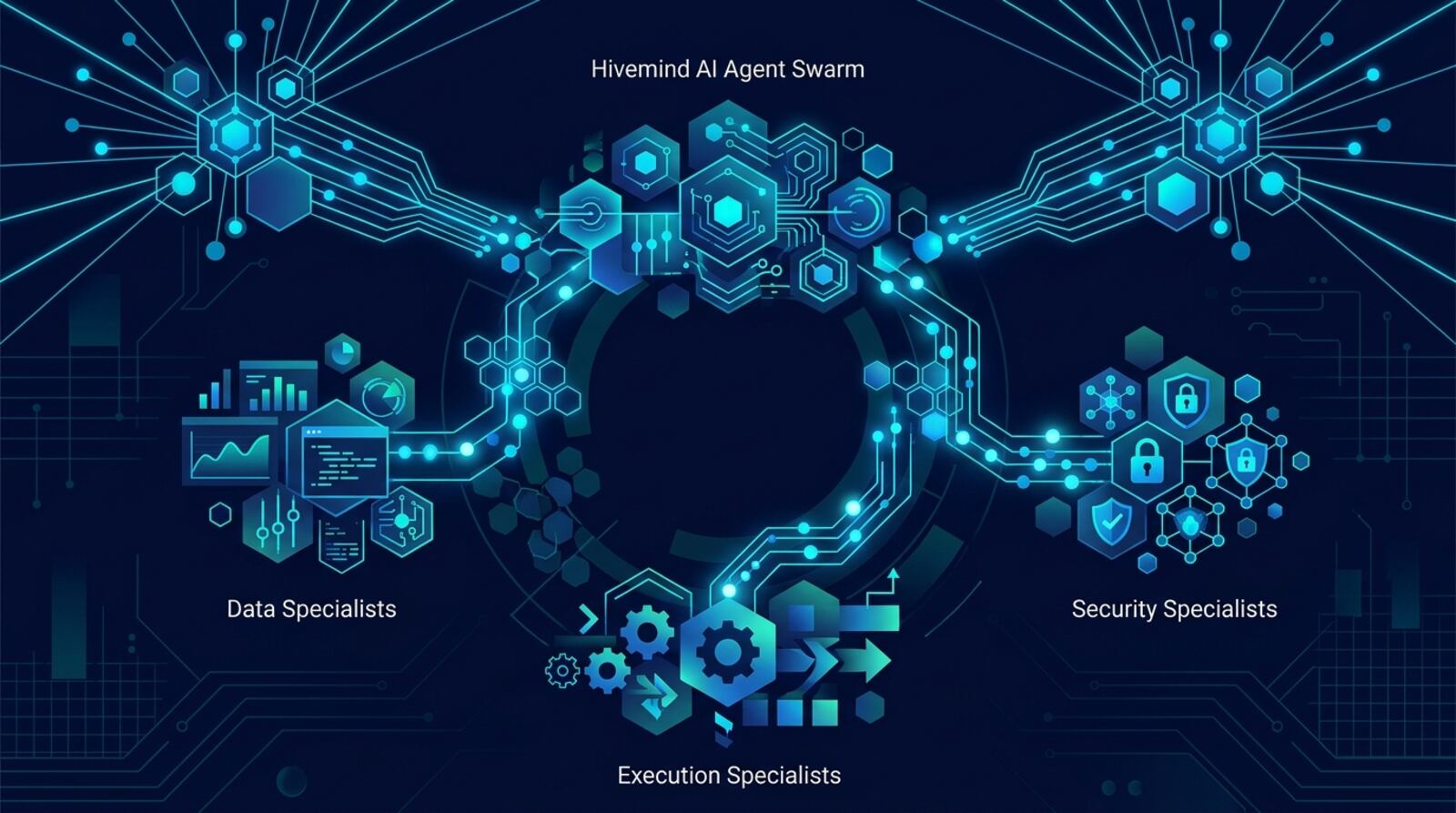
In AI, hivemind usually refers to a group of software agents that share goals, memory or results so they act less like isolated chatbots and more like one coordinated system. The name borrows from social insects, where many simple units produce complex colony behaviour without a single boss. In practice, a hivemind setup gives each agent a narrow job, lets agents pass information to each other, and combines their outputs into a final answer or action.
The word is used loosely, so it helps to know what you are looking at. Public reporting for this topic show several unrelated projects using the same name. One is a graph-based framework for building agents from nodes and connections. Another is an experimental repository for swarm and multi-agent consensus. A third is a skill for a coding assistant that coordinates fault-tolerant agent teams. A fourth is a tool that records what coding agents actually did and shares those lessons with a team. Defense software is also in the mix: reporting dated late May 2026 in the results says the Pentagon selected Shield AI to integrate its Hivemind autonomy software onto a low-cost uncrewed combat drone program, which shows how swarm autonomy is being tested in high-stakes settings.
The common idea is not a single standard. When you evaluate any project, ask four questions: how agents are created, what they share, who decides when work is done, and what happens when one agent is wrong. The answers will tell you more than the name does.
How do specialized agents divide the work?
A swarm works when a task is split into parts that different agents can handle well. Specialization usually comes from four levers: the instructions given to the agent, the tools it can call, the model it runs on, and the data or memory it is allowed to read.
A common layout uses a small set of roles:
| Role | Main job | Typical output |
|---|---|---|
| Planner | Breaks the goal into steps and assigns them | Task list with owners |
| Researcher | Gathers facts from approved sources | Notes with sources attached |
| Builder | Writes code, drafts text or runs a tool | Draft artefact |
| Reviewer | Checks the draft against rules and tests | Pass or fail with reasons |
| Coordinator | Tracks status and resolves conflicts | Final summary and next action |
Specialists are not automatically better. A narrow agent with poor tools will still fail, and extra roles add cost and delay. Start with the fewest agents that can finish the job, then add a role only when you can name the failure it prevents.
A reviewer that uses different instructions or a different model from the builder is more useful than a copy of the builder, because it is less likely to repeat the same mistake. A reviewer with identical settings often agrees with the builder for the same wrong reasons.
Write a short brief for each role covering its goal, what it may read, what it may change and what counts as done. Clear boundaries reduce duplicated work and make it easier to trace which agent produced a bad result.
How do agents in a swarm reach agreement?
Once several agents produce answers, something has to decide which answer is used. Swarm designs use several methods, and each suits different risks.
Majority voting is simple: several agents answer, and the most common answer wins. It works best when errors are random. It fails when all agents share the same blind spot. Weighted voting gives more influence to agents with a better track record on similar tasks. Quorum rules require a minimum number of agreeing agents before any action is taken.
Byzantine fault tolerance is a classic distributed-systems idea. It aims to keep a system correct even when some participants fail or act maliciously. In the standard formulation, a network of n participants can tolerate up to f faulty ones only if n is at least 3f plus 1. This is a useful reference point for swarm designers, but it assumes the participants are truly independent, which AI agents built on the same model often are not.
A typical task lifecycle looks like this:
- The coordinator posts the goal and the rules for done.
- Specialists work in parallel within their boundaries.
- Outputs are compared against tests or a reviewer's checklist.
- Disagreements trigger one more round, then escalate to a human if unresolved.
- The final result and its supporting evidence are logged.
The escalation step matters most. A swarm that cannot agree should stop and ask, not keep voting until something passes.
What is a graph-based agent workflow?
Many hivemind frameworks represent agents as a graph. Each node is a step, such as a model call, a tool call or a check. Each edge is a transition that passes state from one node to the next. Conditional edges let the workflow branch, for example sending a failed test back to the builder or sending a passing result to the publisher.
Graphs make swarms easier to reason about because the flow is explicit. You can point to the exact node that produced a bad output, see what state it received and decide whether to change the prompt, the tool or the routing. Some graph-based frameworks also allow loops, where an agent revises its work until a condition is met.
Loops need limits. Without a maximum number of iterations or a time budget, two agents can pass a task back and forth indefinitely while costs rise. Good graph design includes:
- A hard cap on loop count for every cycle.
- A timeout and a fallback path for each node.
- A checkpoint after each node so a failed run can resume rather than restart.
- Logs that record each edge taken, the input and the output.
- A clear end state for success, failure and needs-human-review.
When you read a framework's documentation, look for how it handles these points. A diagram that shows only the happy path tells you little about how the system behaves under stress.
How can you check that a swarm's output is right?
A swarm can produce confident, polished and wrong output. Checking it is the step most often skipped, and it is the step that decides whether a hivemind is useful.
Start with objective tests where they exist. For code, that means unit tests, type checks and runs against sample inputs. For data work, it means reconciliation against a known source. For text, it means a checklist of facts that must be sourced and claims that must not appear. An independent reviewer can handle the rest, but it should follow the checklist rather than simply agreeing with the builder.
Evaluation on realistic tasks is more informative than a handful of hand-picked prompts. Some testing tools replay recorded production usage in a sandbox and score agents on the results. This approach shows how an agent behaves on the kinds of work you actually have.
In decentralized settings, verification can be handled by a network of independent validators that check outputs before they are accepted. Mira is one example in the results, described as a network that verifies AI outputs through independent validators. The principle is the same as in any review process: the checker should not share the same incentives or the same weaknesses as the thing being checked.
For high-stakes outputs, record the evidence along with the answer. A result that cannot be traced to its inputs, tests and reviewer notes is hard to defend later.
What are the main risks of a hivemind of AI agents?
Hivemind systems share the strengths and weaknesses of multi-agent AI, and several risks are worth planning for.
Error propagation is the most common. One agent's mistake becomes another agent's input, and by the time the output reaches a human it looks well supported. Shared memory and shared retrieval make this worse because a bad entry can reach many tasks.
Homogenization is a more subtle risk. Agents built on similar models, trained on similar data and given similar prompts can converge on similar answers. A 2025 research discussion in the results, titled around an artificial hivemind effect, argues that AI agents can amplify social contagion and lower the threshold for people to adopt the same views. Treat that as a research claim rather than settled fact, but the design lesson holds: diverse inputs, diverse models and independent reviewers reduce the risk of a swarm agreeing with itself.
Other risks include cost growth from repeated model calls, latency from long chains of steps, unclear accountability when no single agent owns a decision, and prompt injection through content the agents read. Over-automation is the last one. Letting a swarm send messages, publish content, change code or move money without a human checkpoint turns a small error into a large one.
A useful habit is to write down, for each action the swarm can take, the worst plausible outcome and whether a person must approve it first.
Where do blockchains and crypto projects fit in?
Blockchain projects appear in the AI agent space for a few distinct reasons. Each reason has different tradeoffs, and none of them proves that a token or a network is technically better.
Audit trails are one use. Recording a hash of an output or a workflow step on a public ledger can help show that a record existed at a given time and has not changed since. Talus, which runs on Sui, describes a protocol that lets autonomous agents run verifiable workflows on-chain, which is one version of this idea.
Payments between agents are another. Kite describes an EVM-compatible blockchain and identity system for AI agent payments with stablecoin settlement. The question for any such system is how it handles authorization, spending limits and dispute resolution, not only how fast it settles.
Compute supply is a third area. Decentralized GPU and inference networks such as io, Golem, Chutes and Morpheus aim to rent computing power to AI developers. Swarms that run many model calls may care about where that compute comes from, its price and its reliability.
Privacy is a fourth. Mind Network describes fully homomorphic encryption infrastructure for AI agents, which allows some computation on encrypted data.
Agent-token platforms, such as Virtual Protocol, offer ways to create, tokenize and co-own AI agents. Token prices are volatile, and token supply, unlock schedules and project status change often, so check current official documentation and on-chain data rather than relying on any older summary. This is not financial advice.
How do you evaluate or set up a swarm safely?
If you plan to build or buy a swarm, a short checklist prevents most avoidable problems. The aim is defensive: limit what can go wrong and make failures visible.
Start with scope. Write down what the swarm may do, what data it may read and what it must never touch. Give each agent the least privilege it needs. An agent that drafts text does not need access to payment keys, and a research agent does not need write access to production systems.
Keep secrets out of prompts, shared memory and logs. Use a dedicated secrets manager and rotate credentials on a schedule. Run agents that execute code or open web pages in a sandbox with restricted network access.
Add human approval for any action that is hard to reverse, including payments, deletions, publishing, account changes and transactions on a blockchain. Set budget caps on model calls and tool use so a loop cannot run up costs overnight.
Keep a kill switch that stops all agents and revokes their tokens. Log every tool call with inputs, outputs and timestamps, and review the logs after incidents and periodically.
Finally, test before trusting. Use replayed or synthetic tasks, include adversarial inputs such as hidden instructions in documents, and recheck the setup whenever a model, tool or framework is updated. A swarm is only as safe as its weakest tool permission.
Frequently asked questions
Is hivemind a single product I can buy or install?
No. Hivemind is a name used by several unrelated projects, including an open-source graph framework, an experimental swarm repository, a coding-assistant skill and a team memory tool. Some companies also use the name for commercial autonomy software. Read each project's documentation to see what it actually does before you adopt it.
Do agents in a swarm learn permanently from each other?
Only if the system is designed to write new information into a shared store and reuse it later. Many setups only pass context within one task and then discard it. If a team memory is used, decide who can write to it, how entries are reviewed and how outdated or wrong entries get removed.
Is a bigger swarm always better?
No. Each added agent adds model calls, latency, coordination overhead and new failure points. A single well-scoped agent with good tools often beats a large swarm on simple tasks. Add roles only when you can name the specific failure they prevent.
Can a swarm of agents make trading or payment decisions on its own?
Not without strict limits. Any agent that can move funds should have a spending cap, an allowlist of destinations, a human approval step and a way to stop it quickly. Crypto markets are volatile and automated trading can lose money fast, so treat any agent that trades as a high-risk tool and check local rules on financial products where you live.
Where should I check the current status of a token-based AI project?
Start with the project's official documentation, its published security audits if any exist, its public code repository and announcements from its own channels. For token prices, supply and on-chain activity, use a block explorer or a market data source you trust. Be cautious with third-party summaries that lack dates or sources, because token details and project status change often.
Mentioned in this guide
dApps in this guide
Mind Network is an FHE privacy infrastructure project for AI agents and Web3, now focused on x402z confidential agent payments, with the FHE token.
Talus is an AI infrastructure network on Sui whose Nexus protocol lets autonomous AI agents run verifiable workflows on-chain, aimed at developers.
An onchain platform for creating, tokenizing and co-owning AI agents, with its VIRTUAL token listed on major exchanges.
Mira Network is a decentralized network that verifies AI outputs through independent validators, with a native MIRA token, aimed at AI developers.
io.net is a Solana-based decentralized GPU network that rents pooled compute to AI developers and rewards suppliers with its IO token.
Golem is an open-source peer-to-peer marketplace where people rent out spare computing power and pay in the GLM token, now aimed at AI workloads.
Kite is an EVM-compatible blockchain and Passport system for AI agent payments with stablecoin settlement, for developers and agent users.
Hue is an AI agent testing tool that replays real production usage in sandboxes to score agents, aimed at engineering teams.
Chutes is a decentralized, serverless AI inference platform on Bittensor with an OpenAI-compatible API and pay-per-token pricing for developers.
Keep reading
Related guides
AI and crypto · Explainer
How AI Is Changing Crypto and Web3: A 2026 Explainer
AI is being combined with crypto and Web3 in a few specific ways: running compute on decentralized networks, letting software agents handle wallets, and building trading, data and privacy tools. This guide explains each use, the trade-offs, and how to check whether a project is what it claims.
AI and crypto · Explainer
Hivemind AI Networks: Guide for Users, Developers and Investors
Several unrelated projects share the Hivemind name, so this guide uses the term for AI networks where many independent contributors pool compute, data or models. It explains what users, developers and investors should check before relying on one.
AI and crypto · Best list
10 AI Crypto Tokens to Know in 2026
AI crypto tokens can be tied to compute, data, agents, or AI infrastructure—but a project’s purpose does not guarantee its token has lasting utility. Here are 10 tokens to research, what their projects do, and what to check before taking any risk.
AI and crypto · How-to
How to Build Your First dApp Using AI in 2026
Building a first dApp is more manageable than it looks, and AI coding assistants can speed up drafting code and explaining errors. This guide walks through a beginner path from idea to testnet deployment, with the checks you need before touching real funds.
AI and crypto · Explainer
Hivemind Radar and the AI Economy: What the Reports Show
Hivemind, in the sources available here, is Shield AI's autonomy software for drones and vessels, which uses onboard sensors such as radar rather than GPS. This guide explains what it does, what the reports say about it, and what does and does not link it to the AI crypto economy.
AI and crypto · Explainer
Hivemind AI Agent Swarms: How They Work in 2026
Hivemind is a name used for several open-source and commercial systems where many AI agents share context and split work, and this guide explains how those swarms function, what the evidence shows, and why a farming game called Pixels does not belong in that picture.
AI and crypto · Explainer
Hivemind and Agentic Web3 Discovery: What It Means in 2026](#)
Hivemind is a useful word for how groups of AI agents share memory, tasks and tools, but the name is also used by several unrelated projects. This guide explains the idea, sorts out the naming confusion, and shows how agent-driven discovery in Web3 works and where its limits are.
AI and crypto · Explainer
How AI Improves Writing Efficiency and Accuracy in 2026
AI writing tools can speed up drafting and catch many mechanical errors, but the accuracy gains depend on how you use them and on your own checks. This guide explains where the efficiency comes from, where the tools fail, and how to build a review process that keeps your facts and voice intact.