DeFi · Explainer
How Compound Finance Works: A Beginner Guide for 2026
Compound is one of the longest-running lending protocols in DeFi. This guide explains how supplying, borrowing, interest rates, liquidations and governance work, plus a practical path for learning the protocol safely.
By the DappsAtlas editorial team · Updated
What Compound is and why it matters
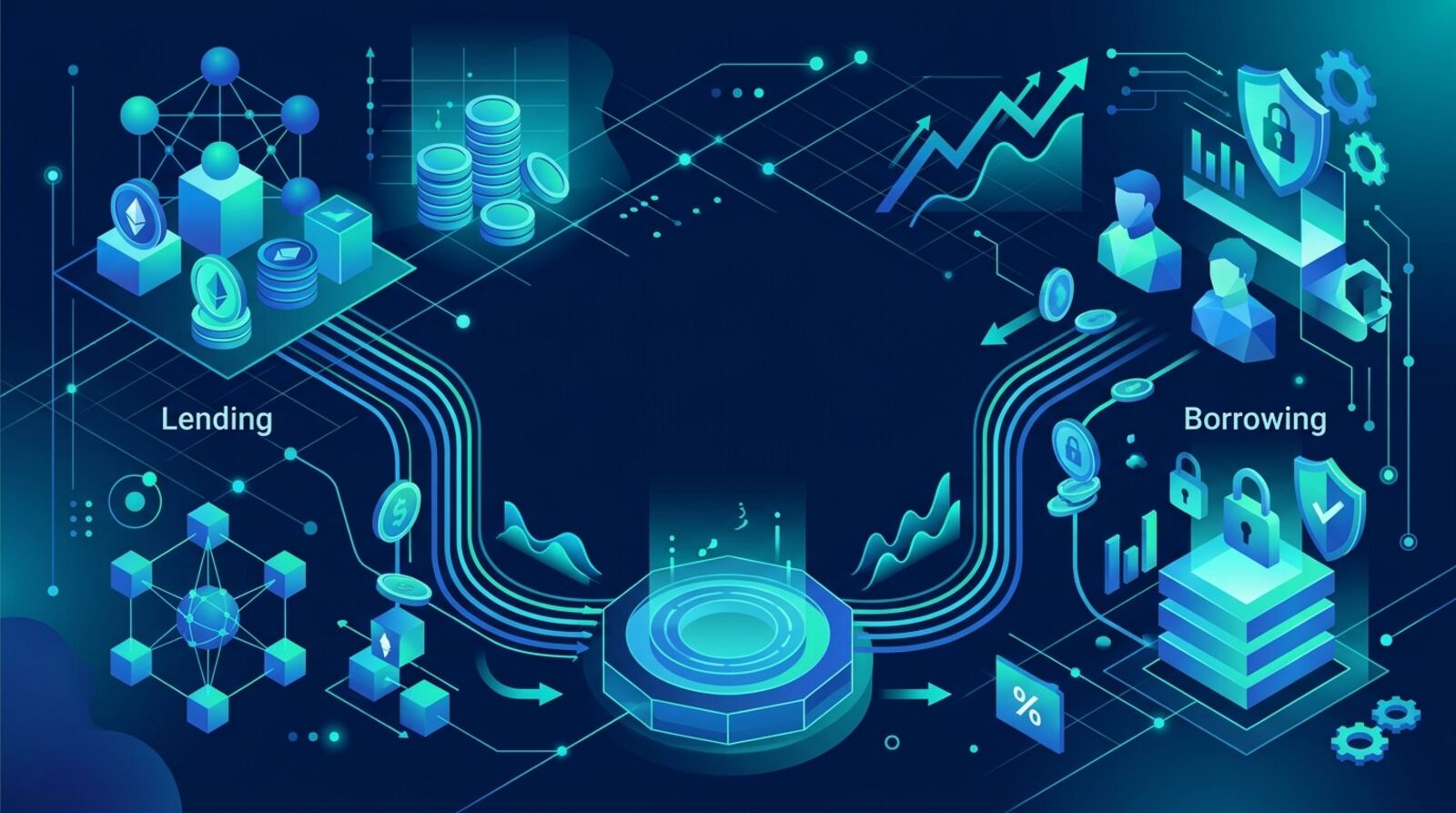
Compound is a decentralized lending protocol. People deposit crypto assets into shared markets and earn interest from borrowers, or they borrow assets by putting up other crypto as collateral. The protocol is non-custodial, which means the smart contracts hold the pooled funds and you control access through your own wallet.
Compound is one of the earliest and most studied lending protocols in decentralized finance. Its design, where interest rates respond to supply and demand inside each market, became a reference point for many later lending platforms. Understanding Compound therefore gives you a useful base for comparing other DeFi lenders.
Governance is handled by holders of the COMP token, who vote on proposals that change protocol parameters, add markets or adjust settings. Governance decisions can affect risk, so it is worth reading proposals if you rely on the protocol heavily.
Before you learn the details, keep one distinction in mind. Supplying assets to earn yield is different from borrowing. Each action has its own risks, costs and interface steps, and a beginner should learn them one at a time rather than together.
How lending and borrowing work on Compound
When you supply an asset to a Compound market, you add it to a shared pool. Borrowers draw from that pool, and the interest they pay flows back to suppliers, minus any protocol reserve set by governance. Your balance usually grows over time, and the exact mechanics depend on which version of Compound the market uses.
Borrowing works in the opposite direction. You deposit collateral first, then borrow up to a limit set by the collateral factor for each asset. That limit leaves a buffer, so small price moves do not immediately put the loan at risk.
A simple way to think about one cycle is this:
- Supply an asset and receive a claim on the pool.
- Earn interest while the asset sits in the market.
- Withdraw when you want, as long as the market has enough liquidity.
Borrowing adds steps. You must keep your collateral value above the required threshold, track the debt as interest accrues, and repay before you withdraw collateral. Many losses in DeFi come from skipping one of these steps rather than from the protocol itself.
Compound v2 and Compound III: what changed
Compound v2 is the original design that many people remember. Each asset has its own market, and depositors receive interest-bearing tokens that increase in value relative to the underlying asset as interest accrues. Borrowing is done against collateral within the same pool of markets.
Compound III, often written as Compound V3, takes a different approach. Each market centers on one base asset, which is typically a stablecoin. Suppliers lend the base asset to earn yield, and borrowers take it out against a set of accepted collateral assets. The design aims to make risk easier to reason about because the lending exposure is concentrated in one asset per market.
The supported chains and available markets differ between versions and change over time. Public reporting used for this guide confirm that Compound V3 runs on Ethereum and several other chains, but they do not give a complete live list, so check the official deployment information for the current status.
When you use Compound, read the version label in the interface and the documentation. Terms such as collateral, base asset and reserves mean slightly different things in each design.
How interest rates are set on Compound
Compound sets interest rates algorithmically based on utilization. Utilization is the share of a market's supplied assets that is currently borrowed. When utilization is low, borrowing rates are usually low, which encourages borrowing. As utilization rises, rates climb, which attracts more suppliers and discourages excess borrowing.
This model means yields are not fixed. A rate you see when you deposit can drop if more liquidity enters the market, and it can rise sharply during periods of high demand. Some markets also have caps or reward programs that change the total return separately from the base rate.
To track rates yourself, use the official interface or the protocol's published dashboards. Compare the supply rate, borrow rate and any incentive rewards separately, because a high headline number can include temporary token rewards that may not last.
The key habit is to check rates before acting and to recheck them periodically. Learning how utilization moves rates is one of the most useful skills for understanding why a market behaves as it does.
Collateral, liquidations and staying safe
Borrowing against collateral means your position is only safe while its value stays within the protocol's limits. Each asset has a collateral factor that determines how much you can borrow against it. If the value of your debt rises relative to your collateral, your account can move past the liquidation threshold.
When that happens, anyone can act as a liquidator. A liquidator repays part of the borrower's debt and receives a portion of the collateral at a discount. This discount is the incentive that keeps liquidations running, and it also means borrowers can lose a meaningful share of their collateral.
Price feeds, called oracles, tell the protocol what each asset is worth. If an oracle reports a wrong or delayed price, positions can be liquidated unfairly or fail to be liquidated when they should be. Oracle risk is one reason DeFi borrowing needs extra margin.
A practical rule for learners is to borrow far less than the maximum allowed, monitor the position, and add collateral or repay before the buffer gets thin. Learn how liquidation works by reading the documentation and watching a small test position, rather than by testing with a large amount.
The COMP token and how governance works
COMP is the governance token of the Compound protocol. Holders can delegate their voting power and vote on proposals. Typical proposals cover adding or removing assets, changing collateral factors, adjusting reserve factors and deciding how token rewards are distributed.
Governance is important because it sets the rules that control risk. A proposal that raises a collateral factor, for example, changes how much users can borrow against an asset. Reading the proposal text and the discussion around it helps you understand why a change was made.
COMP is also a tradable token with its own price, and its value does not directly represent a share of protocol revenue. Holding COMP exposes you to market volatility as well as governance decisions. Do not treat a governance token as a guaranteed income source.
To follow governance, use the official governance forum and on-chain voting pages. Check the current proposal status yourself rather than relying on summaries, which can be out of date or incomplete.
Risks to understand before using Compound
Every DeFi protocol carries risks, and Compound is no exception. The main ones to understand are:
- Smart contract risk: bugs or exploits in the code can lead to loss of funds, even in long-running protocols.
- Oracle risk: incorrect or delayed prices can trigger wrong liquidations or hide real risk.
- Liquidation risk: falling collateral values can cost borrowers part of their deposits.
- Market liquidity risk: you may be unable to withdraw immediately if a market has little available supply.
- Rate risk: yields and borrowing costs can change quickly.
- Stablecoin risk: when a market uses a stablecoin as its base asset, a loss of its peg affects your balance.
- Governance risk: parameter changes can alter the risk profile of markets you use.
None of these risks can be removed completely. A reasonable goal for a beginner is to understand each one well enough to recognize it in a live position. Reading audit summaries and the protocol's own risk documentation is a good starting point, but an audit does not guarantee safety.
Remember that DeFi lending is not insured like a bank deposit, and in many places it may not be regulated like one. Check the rules and tax treatment that apply where you live before using any protocol.
A step-by-step path to learning Compound
A practical learning path can keep the subject manageable. Work through these steps in order, and do not move to the next one until the current one feels clear.
- Read the official introduction to the protocol and note which version of Compound you are looking at.
- Learn the vocabulary: supply, borrow, collateral factor, utilization, liquidation and reserves.
- Study how interest rates respond to utilization by watching a market for a few days in the official interface.
- Read one recent governance proposal from start to finish, including the discussion and the vote result.
- Review the risk documentation and any audit reports the protocol publishes, and note what each one does and does not cover.
- Only after that, consider a small supply transaction, and track the balance and the rate for at least a week.
- Repeat the process with borrowing only if you fully understand liquidation thresholds and can monitor your position.
Public reporting used for this guide did not confirm any particular Compound education sessions, so this path relies on public documentation and your own observation. If you join a community event or course, confirm that it is run by a credible source and that it does not ask for your private keys or promise returns.
Security checklist for learners
Good security habits matter more than any technical detail when you use DeFi. Practical steps include:
- Store your recovery phrase offline and never type it into a website or share it with anyone.
- Use a hardware wallet for larger balances, and keep the device firmware updated.
- Bookmark official sites yourself rather than following links from messages or search ads, because fake copies are common.
- Check the contract addresses you interact with against the official documentation before approving any transaction.
- Review token approvals in your wallet and revoke any you no longer need.
- Be wary of unexpected direct messages offering help, support or airdrops, since these are a frequent scam method.
- Read the transaction details your wallet shows before you sign, including the spender address and the amount.
These habits protect you whether Compound is working perfectly or not. A small amount of routine checking prevents many of the losses that happen to new users.
If something goes wrong, stop interacting with the site, do not send more funds, and use the official support or community channels that you verified yourself.
Frequently asked questions
Is Compound a bank or an exchange?
Compound is a non-custodial lending protocol. Your funds sit in smart contracts that you interact with from your own wallet, and no company holds your keys. Compound is not a bank, and deposits are not insured like bank accounts. Returns and borrowing costs change with market conditions, and smart contract, oracle and liquidation risks always apply.
Where can I find reliable Compound learning material?
Start with the official documentation and the protocol's public governance and developer resources, which describe how each version works. Public reporting used for this guide did not confirm any specific Compound-run education sessions, so check the official channels for current events, and be cautious of anyone offering paid courses or private calls that promise returns.
Should I start with a small amount?
Many people use a test amount first, read the current market details inside the app, and check the interest rate and collateral settings before depositing or borrowing. Keep the amount small until you understand how a position changes when prices move. Nothing here is financial advice, and you should only use funds you can afford to lose.
What is the difference between Compound v2 and Compound III?
Compound v2 uses pooled markets where deposits are represented by interest-bearing tokens that grow in value over time. Compound III uses a single base asset per market, such as a stablecoin, that you can supply to earn yield or borrow against other accepted collateral. Check which version a given market belongs to before you interact with it.
Are Compound rates fixed?
Interest rates are set by formulas based on how much of a market is borrowed. Rates can change quickly, so the figure you see when you deposit may not be the figure you earn over a month. Check current rates in the app or the official data dashboards before you make a decision.
What should I remember before using Compound?
Lending and borrowing always carry risk, including loss of funds from bugs, oracle failures, liquidations and token price drops. Learn the mechanics on a small scale, keep your wallet secure, and never invest money you cannot afford to lose. This is general education, not financial advice, and you should check the rules and regulations that apply where you live before using any DeFi protocol.
Mentioned in this guide
dApps in this guide
Compound is a decentralized lending protocol where users earn interest on deposited crypto or borrow against collateral, governed by COMP holders.
Compound V3 is a lending protocol on Ethereum and nine other chains where users supply a base asset for yield or borrow it against collateral.
Aave V3 is a non-custodial DeFi lending protocol on 21 chains where users earn interest on deposits or borrow against collateral.
Morpho is a decentralized lending protocol with isolated markets, curated vaults and fixed-rate loans for crypto lenders, borrowers and developers.
SparkLend is a stablecoin lending market on Ethereum and Gnosis with governance-set rates, backed by Sky's Liquidity Layer, for borrowers and savers.
Euler V2 is a modular DeFi lending protocol for lenders, borrowers and market curators, with about $268M TVL across 16 chains.
Lido is a liquid staking protocol where users stake ETH and receive stETH, a reward-earning token usable across DeFi, governed by LDO holders.
Curve is a decentralized exchange on Ethereum built for low-slippage swaps of stablecoins and similar assets, with CRV governance and a crvUSD stablecoin.
Keep reading
Related guides
DeFi · Review
Aave Guide 2026: How the DeFi Lending Protocol Works
Aave is a non-custodial lending protocol where you can earn interest on crypto you deposit or borrow against your collateral. This guide explains how it works, what can go wrong, and how to use it with care in 2026.
DeFi · Explainer
COMP Token: Why Compound's Token Can Spike in 24 Hours
COMP is the governance token of the Compound lending protocol, and it can jump up 24-hour gainer lists for reasons that have little to do with the protocol's day-to-day use. This guide explains what COMP does, why short-term rankings are misleading, and how to check public sources yourself.
DeFi · Explainer
Compound Explained: Ethereum DeFi Lending Guide for 2026
Compound is one of the oldest and most studied lending markets on Ethereum, so learning how it works gives a clear view of the wider DeFi lending, borrowing and stablecoin landscape. This guide explains the mechanics, the risks and the related protocols to compare.
DeFi · Review
JUST Review 2026: How the TRON Lending Protocol Works
JUST is a lending and borrowing protocol on the TRON blockchain that uses its own JST token as collateral. This guide explains how that model works, what public sources do and do not confirm, and what to check before you deposit or borrow.
DeFi · Explainer
CoW Swap Active Users Hit a High: What It Means in 2026
A reported record in CoW Swap active users is a useful signal, but a single headline number says little on its own. This guide explains what the metric measures, what the available reports do and do not confirm, and how to check usage and security yourself before you trade.
DeFi · Explainer
CoW Swap and the Gouda Token Claim: What Is Known in 2026
CoW Swap is a DEX aggregator that matches trades in batches to limit MEV losses. This guide explains how it works, what the COW token does, what the sources do and do not show about a 'Gouda' token, and how to protect yourself after the 2026 frontend attacks.
DeFi · Review
Compound Review 2026: How the DeFi Lending Protocol Works
Compound is one of the longest-running lending markets in decentralized finance. This guide explains how it works, how its two main versions differ, what the COMP token does, and the risks to weigh before you deposit or borrow.
DeFi · Explainer
Credit Cards and DeFi: How Card Purchases Work in 2026
Some DeFi platforms now let you pay by card instead of moving crypto from an exchange first. This guide explains how card-funded DeFi works, what it costs, what the risks are, and how to check what Bogged currently supports.