SocialFi and DAOs · Explainer
Why Blockchain and Social Media Still Don't Mix Well in 2026
Blockchain promises ownership, portable identity and censorship resistance for online social life, but storage costs, wallet friction, moderation limits and token-driven incentives keep most blockchain social apps small. This guide explains each barrier and what to check before you join one.
By the DappsAtlas editorial team · Updated
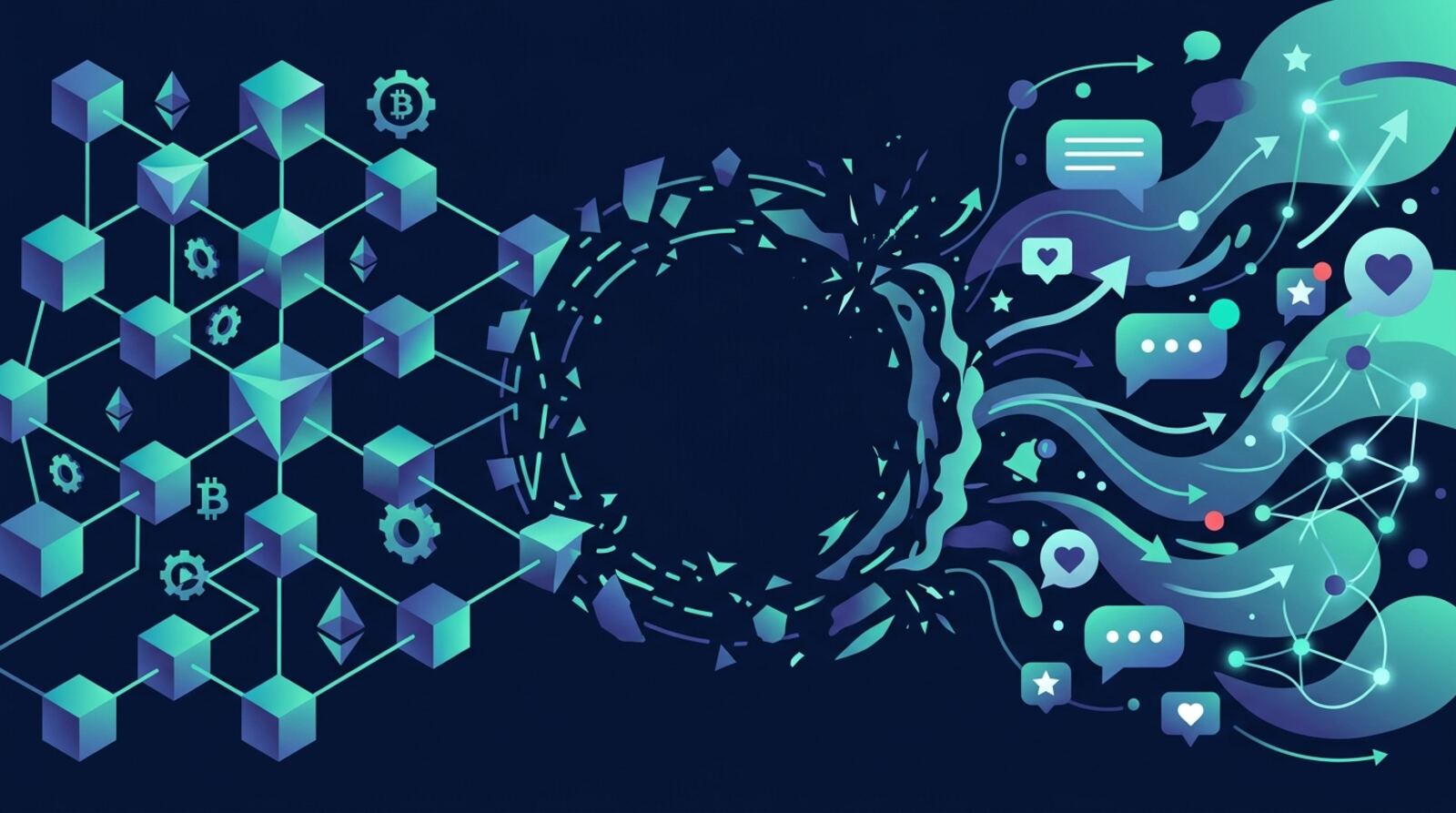
Why most posts are not stored fully on-chain
A blockchain is a shared ledger. Every node that keeps a copy must store and verify the data written to it, which is what makes the system trustworthy. The same property makes it a poor place for large files. A photo, a video or a long article takes far more space than a transaction record, and storing it on every node is expensive for the network and for the people who run it.
For that reason most blockchain social apps keep content off-chain. The file sits on a decentralised storage network, a content delivery service or a conventional server. The chain records a pointer, usually a content identifier or hash, along with ownership details or a signed action. Anyone can check that the file matches the record, but the file itself may not be permanently stored on the chain.
This design has consequences. If the storage provider stops hosting a file, the post may disappear from the interface even though its record remains on the chain. Some apps pay storage providers to keep files available, and others depend on a single host. Before you rely on any app for content you care about, check where the files are kept, who pays to keep them available, and what happens if the app shuts down.
The practical lesson is that blockchain can prove what was posted and who posted it, but it does not automatically make content durable or easy to find. Those are separate engineering problems, and they often have separate points of failure.
Fees and speed make everyday interaction costly
Every action on a public blockchain has a cost. A like, a follow, a comment or a profile update may require a transaction, and each transaction pays a network fee. When fees are low, this is a minor inconvenience. When fees rise during busy periods, a simple interaction can cost more than the user expects, and some users will simply stop engaging.
Speed is the second issue. Social apps depend on quick feedback: a post should appear, a reply should load and a notification should arrive without delay. Blockchains confirm transactions in blocks, and confirmation times vary by network. Many developers use batching, sponsored transactions and layer-2 networks to hide this delay, but the trade-offs are real. Some of these methods depend on a smaller set of operators, and they may add their own assumptions about trust.
There is also a design tension. Making every interaction an onchain event gives strong records but limits how often users can act. Keeping most activity off-chain makes the app feel fast but weakens the claim that the data is verifiable and portable. Many projects choose a hybrid model, and the right balance depends on what the app is trying to prove.
When you evaluate an app, look at which actions cost you money, which ones are free, and what the app says about delays. Fee levels and network conditions change often, so check current figures on the network explorer or the app's documentation rather than relying on a number from an article.
Wallets and keys are a hard first step
Most social users know how to sign in with an email address, a phone number or a platform account. Blockchain apps usually ask for a wallet. A wallet holds a private key that proves control of an account, and that key is also what authorises payments. For someone new to crypto, the idea that losing a key can mean losing access is a large barrier.
Wallets have improved. Some apps create a wallet for new users in the background, use social recovery methods or allow login through familiar accounts. These options reduce friction, but they introduce choices about who holds recovery power and how it can be used. A recovery method that depends on one provider can recreate the same dependence that decentralised apps were meant to avoid.
The risks are concrete. A seed phrase written on paper can be copied, photographed or stolen. A phishing page can look like an official app and ask you to sign a transaction that drains a wallet. A signature request may grant an app broad permission over your tokens, even when the interface shows only a simple action.
Defensive habits help. Use a dedicated wallet for social apps, keep only small balances in it, and never enter a seed phrase on a website or into a chat. Check the official domain from the app's own channels before you connect. Read each approval prompt, and revoke token permissions you no longer need using a reputable permissions tool.
Moderation is harder when records are permanent
Moderation is one of the hardest parts of any social network, and blockchains make it harder. Public records are designed to be difficult to change. When spam, harassment or illegal material is written onchain, removing it may be impossible in the usual sense. The most an app can do is hide the content in its own interface, while the underlying record remains available to anyone who reads the chain.
This creates a gap between what users expect and what the technology provides. People want to report abuse, have it reviewed and see it removed. Blockchain systems can record reports and votes, but the enforcement usually happens at the interface or storage layer. That means different apps can apply different rules to the same content, which may be fair in some cases and confusing in others.
Spam and bots are also a concern. If posting costs very little, automated accounts can flood a feed. If posting costs enough to deter bots, new users may be priced out. Some projects use reputation scores, staking or community voting to filter activity, but each method has trade-offs, and attackers look for ways around them.
For users, the practical point is to read the app's content policy and reporting tools before you invest time. Ask who can hide or remove posts, how appeals work, and whether the rules are published. A decentralised label does not answer those questions by itself.
Public ledgers create privacy trade-offs
Public blockchains are transparent by design. Anyone can see the addresses involved, the time and amount of each transaction, and the assets an address holds. In a social context, that can reveal who follows whom, which content someone pays for, and how often they interact with a community. Even if your name is not attached, patterns can point to a real person.
Some developers respond with privacy tools. These include encrypted messaging, zero-knowledge proofs and separate addresses for different activities. Such tools can reduce exposure, but they add complexity and may limit how the app works with others. Encrypted content also creates its own problems for moderation and for recovery if keys are lost.
Privacy and permanence interact. A record written to a public chain may stay there for a long time, even after you delete the post from an interface. Users who change their minds, or who are in a difficult situation, may find that the record cannot be fully erased. This is one reason many people still prefer conventional platforms for personal content.
Before you post or pay for anything, decide what you are comfortable making permanent and public. Use separate wallets for social activity, avoid linking your real identity to them, and read how the app handles encryption and deletion. If the app says content can be removed, check whether that refers to the interface, the storage layer or the chain itself.
Token incentives can crowd out real conversation
Many blockchain social apps use tokens to reward posting, reading, trading or referring new users. Rewards can draw early attention, but they also change what users optimise for. When earnings are the main reason to post, the feed can fill with low-effort content, engagement farming and coordinated activity designed to trigger payouts.
Token prices add another layer. If the value of a reward token rises quickly, people join for the gains and leave when prices fall. This pattern can make activity look strong in a dashboard while the community itself stays thin. Some apps have seen sharp swings in usage after a token launch, and the lesson is that a spike in activity is not the same as a healthy community.
There is also the matter of who receives the rewards. Early participants, insiders and bots may capture a large share, which leaves newer users with little. Reward systems that depend on constant new money tend to weaken as growth slows.
If you are considering an app with a token, read the documentation on how rewards are issued and whether they can be claimed by everyone. Look for a clear description of supply, vesting and any treasury controls. Be wary of promises of fixed income from posting, and do not treat token value as a measure of product quality. Where rewards are involved, check local laws, since some rules on prizes, gambling-like mechanics and securities can apply.
Network effects favour the platforms people already use
Established social networks have large user bases, mature apps, reliable infrastructure and years of work on search, recommendations and safety tools. A new blockchain social app must offer something far better to persuade people to move, and most users are not willing to rebuild their social life from scratch for a small gain in ownership.
Network effects work against new entrants. A social platform is only useful when your friends are there. If most of your contacts are on one service, a rival with better privacy or ownership will struggle to win your attention, even if the rival is technically stronger. This is why many blockchain social projects target niche communities, creators or specific features rather than general audiences.
Some projects have found real traction in areas where ownership matters most, such as creators selling content directly, communities that want shared governance or fans who collect digital items. These niches show that the technology can serve real needs. They do not yet show that blockchain social media can replace mainstream networks for everyday use.
When you judge the field, separate product value from ideology. Ask whether the app solves a problem you have, whether your contacts use it, and whether it works well without a token or wallet. An app that meets those tests can be useful even if the wider vision is still unproven.
What would need to change, and how to evaluate apps today
The barriers above are not permanent, but they are unlikely to disappear through a single breakthrough. Progress probably depends on several changes at once: cheaper and faster transactions, better storage and recovery methods, clearer standards for portable identity, moderation tools that respect both safety and user control, and reward designs that do not depend on constant speculation.
Users can help by asking better questions before they commit. Does the app store content in a durable way? What does a wallet approval allow? Can you leave with your data? Who can remove or hide content, and under what rules? How are rewards funded, and who receives them? Answers to these questions separate durable projects from short-lived experiments.
It also helps to keep the financial side small and separate. Use a dedicated wallet, keep balances modest and avoid staking or purchasing tokens to access basic social features. Check current fee levels, token data and user activity on independent dashboards and the network explorer, since these figures change often and a single snapshot can mislead.
Finally, treat blockchain social media as an area still being tested. The technology has real strengths in ownership and transparency, and it has real weaknesses in cost, usability and governance. Understanding both sides lets you judge each new app on its own terms rather than on its marketing.
Frequently asked questions
Are blockchain social media posts stored on the blockchain?
Not fully. Most blockchain social apps store the heavy content, such as images, video and long posts, off-chain on decentralised or conventional storage, and keep only references, ownership records or actions on the chain. Some apps store more on-chain than others, so read how a specific app handles your posts.
Do I need cryptocurrency to use a blockchain social app?
Not always. Many apps work with ordinary email or social login and create a wallet in the background. Be careful with any app that asks you to move funds, sign unclear messages or share a seed phrase. Read what each signature does before you approve it.
How do I check whether a blockchain social app is still active?
Start with the app's own documentation, then look at its public contract addresses and audit reports if it publishes them. Check current token prices, total value locked and user activity on independent dashboards rather than trusting a single figure. Treat any claim of guaranteed earnings as a warning sign.
Is it legal to earn tokens for posting or watching content?
Yes, when the feature involves money, tokens or games with real value. The rules differ by country, and some jurisdictions restrict token sales, prize-style rewards and online gambling-like mechanics. Check local laws before you deposit funds, and only use these apps if you are old enough to do so where you live. If you are under 18, do not take part in any token-based or gambling-like feature.
What is the safest way to try a blockchain social app?
Be sceptical of anything that asks for your seed phrase or private keys, promises fixed returns for posting, or pushes you to sign a transaction you do not understand. Keep only the funds you can afford to lose in a hot wallet, use a separate wallet for social apps, and verify the app's official domain from its own channels before connecting.
Mentioned in this guide
dApps in this guide
Lens is an open onchain social protocol where one account and social graph work across many apps, built for developers, creators and web3 users.
Zora is a web3 content platform where creators mint and trade posts as tokens on its own network and on Base, with a native ZORA token.
Minds is an open-source social network with creator monetization, a MINDS token and white-label community apps for brands and creators.
Towns is an open-source protocol on Base for encrypted, ownable group chat Spaces with onchain memberships, aimed at communities and developers.
friend.tech V1 is an ETH-based SocialFi app on Base where users trade keys tied to social profiles, now alongside a FRIEND-token v2 Clubs product.
Access Protocol is a Solana content monetization protocol where supporters stake ACS tokens to unlock creator and media content.
Mask Network is a Web2-to-Web3 protocol for sending crypto, using dApps and sharing encrypted content from social media, with a MASK token.
DSCVR is a community-driven Web3 social content platform, started on the Internet Computer and later tied to Solana, Eclipse and an AI focus.
Keep reading
Related guides
SocialFi and DAOs · Explainer
DeSo and MetaMask: What the SocialFi Integration Means in 2026
DeSo's MetaMask integration lets people use an Ethereum-compatible wallet to take part in a social blockchain built around SocialFi. This guide explains what the connection does, how to set it up with care, and what to weigh before posting or trading.
SocialFi and DAOs · Explainer
How Social Media Platforms Are Moving Into Web3 in 2026
Large social networks and smaller startups are testing blockchain features such as creator tokens, portable profiles and tipping wallets. This explainer covers what web3 social means, why platforms are experimenting, where the risks sit, and how to judge a web3 social app before you join.
SocialFi and DAOs · Explainer
Social Dapps in 2026: Trends, Models and Risks Explained
Social dapps aim to move profiles, posts, group chats and creator income onto public blockchains. This guide explains the main models, the trends shaping the category in 2026, and what to check before you use one.
SocialFi and DAOs · Explainer
Why Mark Zuckerberg and Meta Struggle With the Web3 Economy
Critics often say Mark Zuckerberg and Meta do not grasp how a web3 economy works. This guide explains what that claim means, where the criticism is fair, where it misses, and how to judge web3 social apps for yourself.
SocialFi and DAOs · Explainer
What Is XCAD Network and Can You Earn Watching YouTube?
XCAD Network is a creator-economy project that issues tokens tied to video creators and communities. This guide explains how it works, what 'earning by watching YouTube' has meant, and how to check what is currently on offer.
SocialFi and DAOs · Best list
15 Women Pioneering the Blockchain Space in 2026
Women have built base protocols, exchanges, regulated banks, legal frameworks and education programs in blockchain. This guide profiles 15 of them, what each is known for, and how to verify who is worth following.
SocialFi and DAOs · How-to
What Is a VRM Avatar and How to Use It in the Metaverse
A VRM avatar is a portable 3D character file built on glTF that carries its own skeleton, facial expressions and licence terms. This guide explains what is inside one, how to get or make one, and how to use it across virtual worlds, streams and web3 apps.
SocialFi and DAOs · Explainer
Women Shaping Blockchain and Web3: Who They Are and How to Follow Them
Women have led projects, research and community building across blockchain and web3, and the names that appear on industry lists change from year to year. This guide explains what those lists measure, which women and programs are worth following, and how to find and assess women-led work yourself.