Web3 gaming · Explainer
What Is Decentraland? How Its Open World Economy Works in 2026, dek_placeholder
Decentraland is a browser-based virtual world where users own land and items as blockchain tokens and trade them for MANA. This guide explains how its economy fits together, what the main assets do, and what to check before spending money.
By the DappsAtlas editorial team · Updated
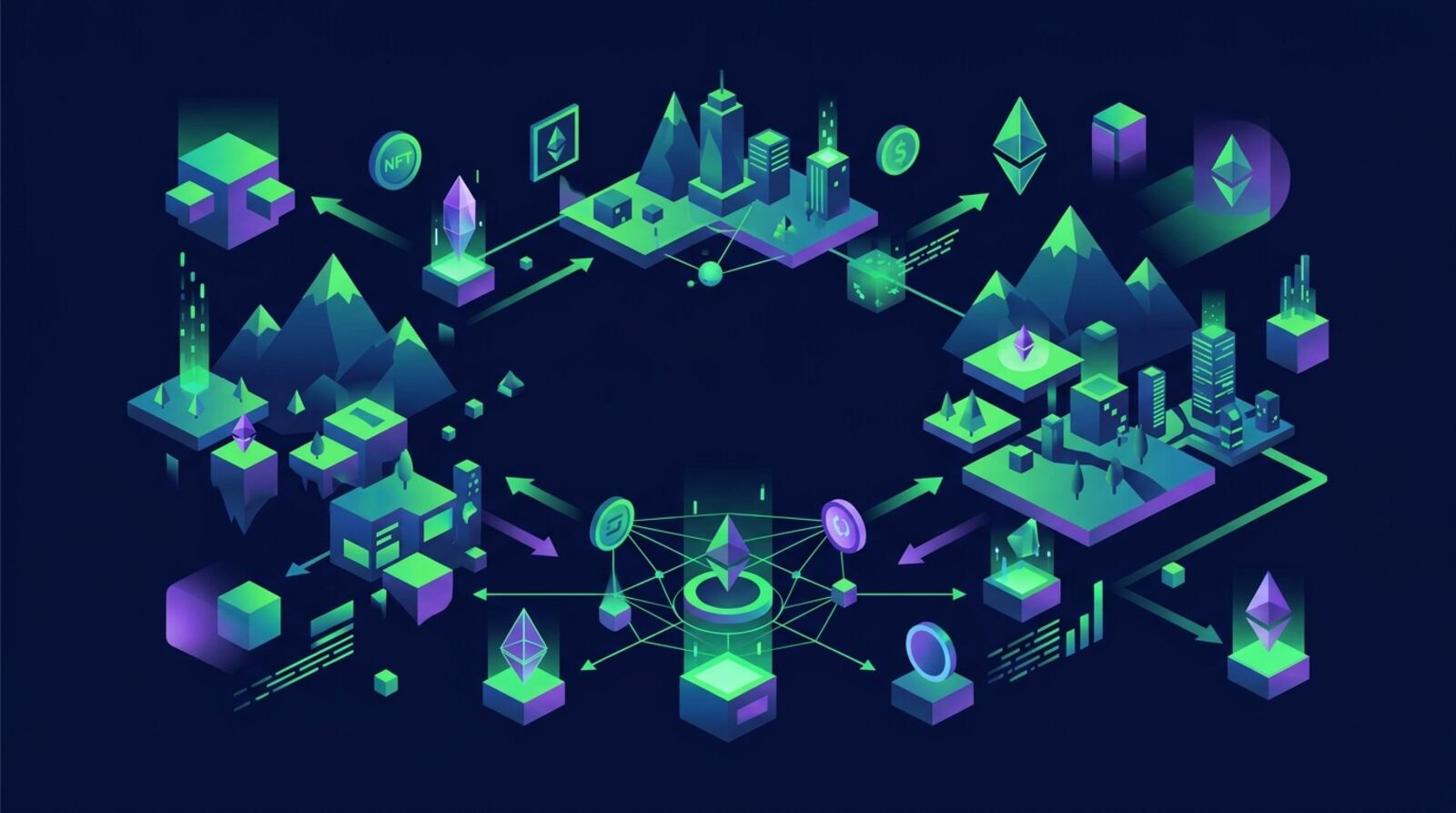
What Decentraland is and why it is called a metaverse
Decentraland is an online virtual world that runs in a web browser. Users create an avatar, walk around a grid of districts, visit buildings, attend events, chat with other people and play small games built by creators. It is often called a metaverse because it combines a persistent 3D space with social life and commerce.
What sets it apart from a typical online game is the ownership layer. Land, wearables and names are issued as blockchain tokens, so a user can hold them in a personal wallet rather than in a company account. The platform was launched by Decentraland Foundation, and its rules and parcel ownership are now shaped largely by its community through a decentralized autonomous organization, known as the DAO.
The project sits within the Ethereum ecosystem. Its native currency is MANA, and many of its in-world items are NFTs that can be bought, sold and transferred outside the platform. Public reporting describes it in similar terms, as a decentralized virtual world where users trade land, collectibles and in-game items with MANA.
It helps to think of Decentraland as three things at once: a place to visit, a set of digital property rights, and a marketplace. Each part connects to the others. Traffic brings interest to land, interest raises demand for items, and creators who build popular experiences add value to the parcels they sit on. Understanding that loop is the easiest way to understand the open world economy.
How LAND parcels and estates work
The map is divided into square parcels, each a LAND token. A parcel is a fixed-size plot in the virtual world, and the total number of parcels is limited. That scarcity is central to how the economy works, because demand for a limited set of plots can push prices up over time.
Several parcels can be grouped into an estate. An estate is also a token, and the owner can set rules for how the combined space is used. Estates let a single owner build larger districts, shops or event venues without managing each plot one at a time.
Parcels can be left empty, built on, or leased. Owners can add scenes made with the platform's software development kit, which lets creators place 3D objects, add interactive behaviour and publish experiences. Scenes can host a shop, a gallery, a game or a concert.
Because the land records live on the blockchain, the parcel's owner is the wallet that holds the token. Buying a parcel means buying from its current holder, usually through a marketplace or a direct sale, and the transaction shows on the chain. Always confirm the parcel coordinates and the contract before you pay, since similar-looking listings can be mistaken or fraudulent.
What the MANA token does
MANA is the platform's main currency. It is an ERC-20 token, which means it is a fungible token that follows a common Ethereum standard and can be held in most standard wallets. Users spend MANA to buy LAND, estates, wearables, names and some other items in the marketplace.
MANA also has a governance role. Holders can take part in DAO votes on proposals that affect the platform, such as changes to rules, funding and the use of community resources. Voting power is tied to the tokens and governance structure in place at the time, so check the current governance documentation before you rely on any specific voting mechanism.
The token's price is set by the open market, not by the platform. It is influenced by general crypto market conditions, interest in the metaverse sector, and news about Decentraland itself. Exchanges list MANA and publish current price, volume and market capitalisation. Those numbers change constantly, so check a live source for any figure you need, and treat any older number as historical.
For a visitor, MANA is only needed when buying something. Exploring the world, chatting and attending events do not require a balance. For a buyer or seller, it is worth tracking fees, network costs and the conversion rate between MANA and any other currency you hold.
Wearables, emotes and names
Wearables are NFTs that change how an avatar looks. They include clothing, accessories, hairstyles and other visual items. Many are sold through the official marketplace, and others change hands on secondary markets. Some wearables are rarer than others, and rarity is a major factor in value.
Emotes are animations that avatars can perform. Like wearables, they can be collected and traded. Names are another type of asset. A user can claim a unique name that appears above their avatar, and that name is tied to their wallet.
Wearables and names have been issued on Polygon as well as Ethereum, so the network matters when you buy or move an item. Sending an asset to the wrong network can make it hard to recover, so check the network setting in your wallet before any transfer.
Not every item has resale value. Some are mainly for personal style and may trade for little after the initial purchase. Before buying an item for resale, look at recent sales history on the marketplace you plan to use and remember that fees and price drops can eat into any gain.
How creators and the community add value
Most of the content in Decentraland is made by its users, not by the platform. Creators build scenes, games and experiences, then publish them on parcels they own or rent. Visitors who enjoy a scene return to it, and that traffic makes the parcel more valuable.
Brands, artists and organisers have used the platform for events, exhibitions and product launches. These are often short-term and may be tied to a specific campaign. Their impact on land values and item prices is hard to predict, so they should not be treated as a reliable source of returns.
Services also form part of the economy. Builders may be hired to design a scene, and some owners pay for hosting, maintenance or event production. Those costs are paid in MANA or other currencies, depending on the arrangement.
For a creator, the practical path is to learn the scene-building tools, make a simple experience, and test it with real visitors. Start small. A clear, working scene is more useful than an ambitious one that never loads, and feedback from visitors is the fastest way to improve.
How governance and the DAO work
Decentraland is governed by a DAO, where decisions about the platform are made by token holders through proposals and votes. The aim is to let the community shape rules, use of funds and development priorities rather than leaving all decisions to a single company.
A proposal is usually written and discussed before it goes to a vote. Read the proposal in full, check who is sponsoring it, and look at how the outcome would be carried out. Governance processes can change over time, so use the official governance resources to see the current process.
Voting can be a useful way to take part, but it also carries responsibility. Votes can affect the value of land and tokens, and the outcome of a proposal may not match what its authors predicted. Treat voting as a decision about the platform's future, not as a way to earn rewards.
If you want to follow governance without holding a large position, reading proposals and joining public discussion is a low-cost starting point. Many active members share analysis and updates, but check their claims against primary sources before acting on them.
Risks and how to check before you buy
The main risk in any blockchain-based world is that the value of the assets can fall sharply. LAND, MANA, wearables and names all depend on market demand, and that demand can shift quickly. Do not buy an asset you cannot afford to lose, and avoid borrowing money to purchase it.
Asset prices can also be affected by thin markets. Some items sell rarely, so a single sale may not reflect the true value of similar items. Check recent sales and listings over a period of time, not just one transaction.
Security is a separate risk. Phishing sites often copy the look of popular platforms, and fake listings may ask for your seed phrase or ask you to approve a contract that drains your wallet. Only connect your wallet through the official site or a well-known app, bookmark the correct address, and read each approval request carefully.
Finally, check your local laws and tax rules. Buying, selling and trading digital assets may create tax obligations in your country, and the rules vary. A qualified tax adviser can explain your position.
How to get started as a visitor or buyer
You can explore Decentraland without spending anything. Open the official site in a supported browser, choose a guest or wallet option, and walk around the map. Many scenes are free to visit, and you can chat with other users, join events and see how the community uses the space.
If you want to own assets, install a reputable wallet and make sure you store your recovery phrase offline. Start with a small amount of MANA on a fee-friendly network, and buy one item to learn how the process works. Read every transaction prompt before you confirm it.
To learn about land, browse parcels on the official marketplace and on other marketplaces that show ownership history. Compare recent sales, consider the location and any scene on the parcel, and remember that activity can change over time.
For a deeper look at the wider sector, compare Decentraland with other virtual worlds. Each platform has different tokens, rules and communities, and choosing one should depend on what you want to do there, not on hype around a single name.
Frequently asked questions
Do I need to pay to use Decentraland?
No. Decentraland is free to enter and explore through a web browser. Buying land, wearables or names is optional, and those purchases carry market risk, so only spend what you can afford to lose.
Which blockchain does Decentraland use?
Decentraland is built on Ethereum, and the LAND parcels are Ethereum-based NFTs. Some wearables, names and other items were issued on Polygon, so check the network shown on each asset before you buy or transfer it. Your wallet must support the network of the asset you hold.
What is MANA used for?
MANA is the token used to buy LAND, wearables and names, and it can be used to vote on DAO proposals. Its market price moves with the wider crypto market. Current price, supply and trading volume change often, so check a live market data source rather than relying on any figure in an old article.
Is buying LAND a good investment?
Owning LAND gives you control over that parcel and what gets built on it, and it can be rented, sold or used to host experiences. It does not guarantee a profit. Values depend on demand, location and the activity around your parcel, and they can fall as well as rise.
How do I keep my Decentraland assets safe?
Ownership is recorded on the blockchain, so the wallet holding the asset controls it. Use a hardware wallet or a well-reviewed software wallet, never share your seed phrase, and be wary of unexpected requests to sign transactions or approve token access. Check the contract and network before any approval.
Mentioned in this guide
dApps in this guide
The Sandbox is a blockchain-linked virtual gaming world on Polygon and Ethereum, with token SAND and a new AI game engine in beta for creators.
Upland is a mobile and browser city-builder game where players buy, develop and trade virtual properties tied to real addresses, using the UPX token.
MegaWorld, formerly MegaCryptoPolis, is a 2018 on-chain city-building game now rebranding as MCPOLIS with AI agents playing alongside humans.
Alien Worlds is a community-built play-to-earn metaverse on WAX where players mine and play to earn TLM tokens and NFTs.
Axie Infinity is a Ronin-based NFT game where players collect, combine and battle creatures called Axies, with its own AXS token.
ImmutableX is a web3 gaming platform on Ethereum whose IMX token covers fees, staking, governance and gas on Immutable zkEVM, aimed at gamers and token holders.
Foundation was an Ethereum NFT art marketplace for creators; the team took it offline indefinitely on April 27, 2026 after a failed sale.
Decentraland is an Ethereum-based virtual world for attending events, creating experiences and using MANA, including around NFT land.
Keep reading
Related guides
Web3 gaming · Review
Upland Review 2026: How the Blockchain Property Game Works
Upland is a city-builder game where players buy, develop and trade virtual properties mapped to real street addresses, using the UPX token. This review explains how it works, how its blockchain history has changed, and what to check before spending money on it.
Web3 gaming · How-to
How to Explore NFT Worlds and Earn WRLD in 2026
NFT Worlds is a set of 10,000 Ethereum-based virtual worlds tied to a Minecraft-style experience and the WRLD token. This guide explains how to get set up, explore the worlds, understand how WRLD rewards work, and avoid common scams.
Web3 gaming · Explainer
Virtual Worlds in Blockchain Gaming: What Is Real in 2026
Virtual worlds are one of the most visible branches of blockchain gaming, but they have not replaced other formats. This guide explains what they are, how land, avatars and tokens work, which projects are worth knowing, and how to judge the claims before you spend time or money.
Web3 gaming · Explainer
Vulcanverse Explained: How Its Player Economy Works in 2026
Vulcanverse is a fantasy metaverse tied to the Vulcan Forged name and a player economy built on tokens and NFTs. This guide explains what public sources confirm, what they leave unclear, and how to check its status before you spend anything.
Web3 gaming · How-to
What Is DeHeroGame? A Plain Guide to Its NFT Hero Card Game
DeHeroGame is a blockchain card game built around NFT hero cards and the AMG governance token, aimed at players interested in GameFi. This guide explains how it is meant to work, what to verify before you take part, and how to avoid the fake giveaways that often surround similarly named projects.
Web3 gaming · Explainer
What Is Cryptocurrency Gaming? How It Works in 2026
Cryptocurrency gaming uses blockchain networks for some game assets, currencies or transactions. Learn how wallets, tokens and NFTs fit into play, what “ownership” really means, and how to assess costs and risks before you begin.
Web3 gaming · How-to
What Is Gameta and How Do You Use It? A Step-by-Step Guide
Gameta is a Web3 gaming project, and details such as chains, games and token terms change over time. This guide explains how platforms like it work, how to confirm you are on the real one, and how to get started with limited risk.
Web3 gaming · How-to
What Is Crypto Unicorns and How Do You Play It? (2026 Guide)
Crypto Unicorns is a web3 farming and breeding game from Laguna Games built around Unicorn and Land NFTs. This guide covers what it is, how the pieces fit together, and how to start without avoidable mistakes.