Web3 gaming · How-to
How to Play and Win Wolf Game: Sheep, Wolves and WOOL
Wolf Game was an on-chain NFT game where sheep earn WOOL and wolves take a cut. This guide covers the mechanics, the strategies that follow from them, and the risks to weigh before you spend anything.
By the DappsAtlas editorial team · Updated
What is Wolf Game and how does it work?
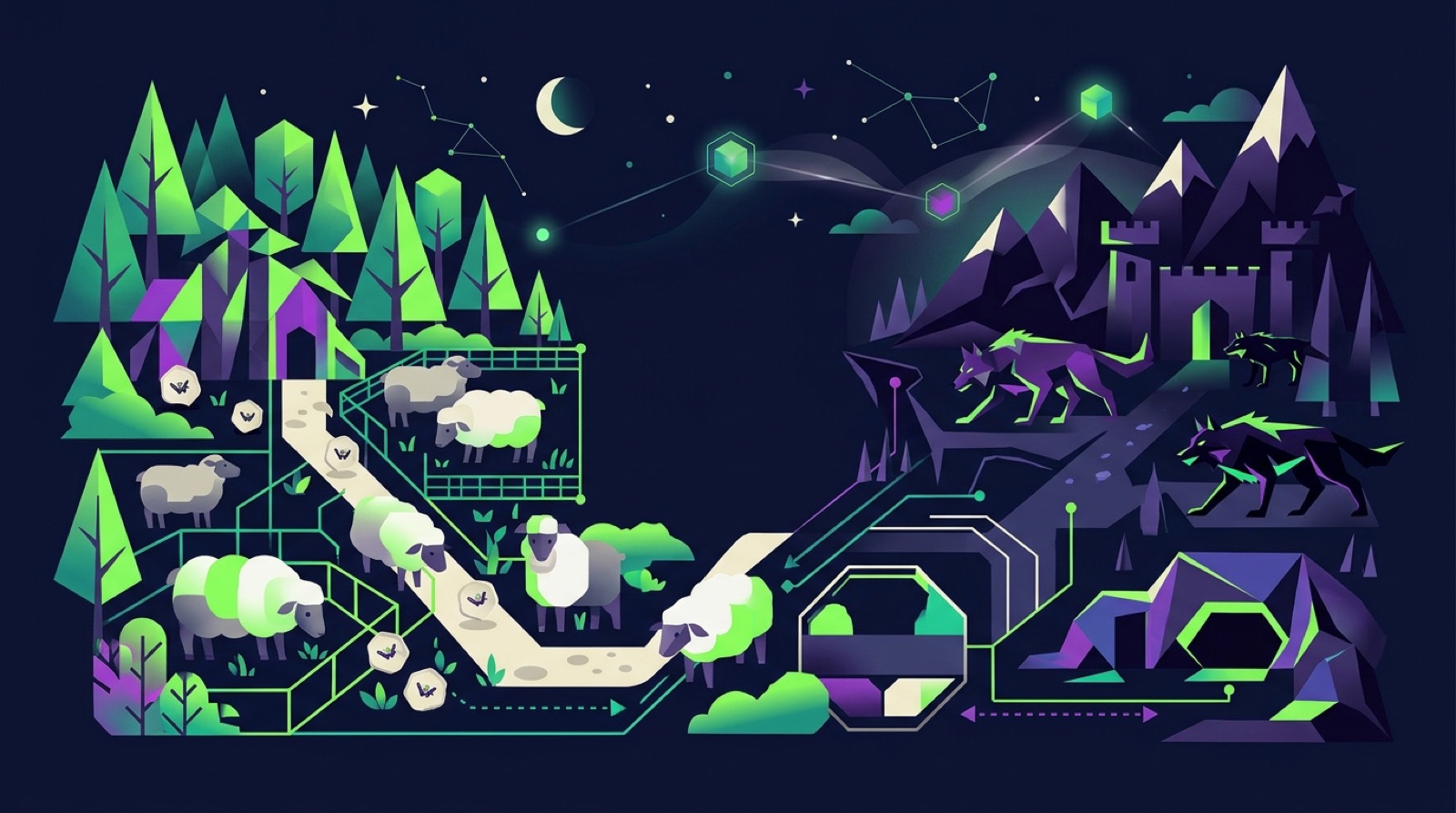
Wolf Game is an NFT game on Ethereum that launched in 2021. It uses pixel-art characters that are either sheep or wolves, and it was designed around a simple conflict: sheep generate income, and wolves take a share of it.
The core loop has three parts:
- Mint a character. Early mints were paid in ETH, and later ones in the game's token, WOOL.
- Stake the character in the game's Barn contract. Staked sheep earn WOOL over time.
- Claim or unstake to collect WOOL, which exposes you to the wolf tax and theft rules.
What made the game unusual was that the mechanics are adversarial. Most NFT projects reward every holder the same way. In Wolf Game, one group's earnings are partly another group's income, so the outcome depends on which character you hold and how you handle claims.
A note on scope: the figures below describe the original design as widely documented. Projects like this can add features, change parameters or go quiet, so check the official channels and the verified contract on a block explorer before spending anything. Treat any current activity level, token price or collection floor price as something to look up yourself, not something this guide can state.
This is a game with a chance element and real money at stake. You must be 18 or older, and you should check that participating is legal where you live.
Sheep vs wolves: what each role does
Your character type decides how you earn, so the first question is which one you hold or want.
| Sheep | Wolf | |
|---|---|---|
| Share of mints (original design) | About 90% | About 10% |
| How it earns | Steady WOOL while staked | A cut of WOOL claimed by sheep, plus stolen mints |
| Main risk | Tax on claims and theft on unstaking | Lower supply and dependence on sheep activity |
| Skill element | Timing of claims | Alpha score and timing of staking |
Sheep earn WOOL at a fixed daily rate while staked in the Barn. In the original contracts, a sheep must be staked for a minimum period before it can be unstaked.
Wolves carry an alpha score, a trait that sets how large a share of the wolf pool they receive. A higher alpha means a larger slice. Wolves do not earn by themselves; their income comes from sheep claiming WOOL and from minting.
The design deliberately keeps wolves scarce. Because roughly one in ten mints is a wolf, the pool of wolves sharing the tax is small compared with the sheep paying it.
There is an intended balance: if too many players hold wolves, sheep income suffers, and if sheep players leave, wolves earn little. This is why the game's health depends on active participation from both sides.
What you need before you start
Before you touch the game, set up properly. Most losses in games like this come from avoidable mistakes, not from the game rules.
Checklist
- Use a wallet you control. A standard Ethereum wallet such as MetaMask works. Keep your recovery phrase offline and never type it into a website.
- Use a separate wallet for gaming. Fund it only with what you can afford to lose, so a bad approval cannot reach your main holdings.
- Reach the game through official channels. Find the project's official social accounts and check that the site address matches. Public reporting and ads can lead to copycat sites.
- Verify the contract. On a block explorer, confirm that the address you interact with is the verified one listed by the project.
- Budget for gas. Every mint, stake, claim and unstake is an Ethereum transaction. Gas fees change constantly, so check a gas tracker before each action.
- Check the game is live. Look at recent contract transactions and marketplace activity. If there are few or none, the economy may be inactive.
Also decide in advance what you are playing for. If the aim is to earn income, check that WOOL has a market and that fees do not consume the payout. If the aim is collecting, the calculation is different. Settle this before spending, not after.
How to mint a sheep or wolf
Minting is the entry point, and it works like a draw rather than a shop. You do not choose sheep or wolf. The contract decides.
How to mint, step by step
- Connect your wallet to the official minting page.
- Choose the number of tokens, if the contract allows more than one per transaction.
- Confirm the price. In the original design, the first 10,000 characters were paid in ETH at a fixed price, and later generations were paid in WOOL at rising costs.
- Choose whether to stake on mint, if offered. This sends the new character straight to the Barn.
- Approve the transaction and wait for confirmation.
The odds in the original design
- About 90% of mints are sheep and about 10% wolves.
- Each mint has a roughly 10% chance of being claimed by a random staked wolf instead of going to you. You pay, and the wolf holder gets the token.
That second rule is why minting is a gamble. You can pay and receive nothing. Check the current contract for the exact probabilities, since they are set in code.
A safer route for many players is buying a character on a marketplace. You skip the draw and see exactly what you get, including the alpha score of a wolf. You pay a premium for that certainty, and you should check the floor price and recent sales yourself.
How staking, claiming and the wolf tax work
Staking moves your character into the Barn contract, where it becomes productive.
For sheep
- Staked sheep accrue WOOL continuously at a fixed daily rate.
- You can claim accrued WOOL without unstaking. In the original rules, a share of every claim, around one fifth, goes to the wolf pool as tax.
- You can unstake to take the sheep back into your wallet. Here the risk is larger: there is a 50% chance that all the pending WOOL is taken by wolves.
- A minimum staking period applies before unstaking is allowed.
For wolves
- Staked wolves accumulate a share of the tax and of stolen mints, weighted by alpha score.
- Wolves collect that share on claim and can leave the Barn without the sheep's 50% theft risk.
The key practical point is the difference between claiming and unstaking. Claiming costs a predictable tax. Unstaking costs a coin flip on everything you have accrued. A player who understands this behaves very differently from one who simply clicks unstake.
Because all of this runs on-chain, every action has a gas cost. Frequent small claims can cost more in fees than they return, so compare the WOOL you would claim against the current gas price before you act.
How to win as a sheep owner
No strategy guarantees a profit, but some choices clearly reduce avoidable losses.
- Claim, do not unstake. Because unstaking risks all pending WOOL on a 50% chance, a sheep you intend to keep productive should stay in the Barn. Pay the claim tax and keep the sheep working.
- Unstake only with a reason. Good reasons include selling the NFT or moving it to another wallet. If you must unstake, claim first so that less WOOL is exposed to the coin flip.
- Batch your claims. Gas is a fixed cost per transaction, so claiming a larger amount less often usually wastes less. Compare against the tax, which scales with the amount, and decide what suits your budget.
- Know your WOOL plan. Earned WOOL is only worth something if you can use or sell it. Check where WOOL trades and how deep the market is before counting on a payout.
- Watch the break-even. Add up the mint or purchase price, gas and taxes, then compare against realistic WOOL income. Many players find that costs are higher than they assumed.
- Avoid chasing. Buying in after a surge in attention often means paying peak prices for a game whose income may be falling.
Being a sheep owner is mostly a game of patience and cost control rather than skill. The 50% theft rule is the main trap, and avoiding it is the single most useful habit.
How to win as a wolf owner
Wolves are the scarcer role, and their strategy is different because income comes from other players.
What matters most
- Alpha score. A wolf's share of the pool scales with its alpha. A higher alpha earns proportionally more, so the same price can buy very different income. Check the trait before buying.
- Sheep activity. Wolves are paid from sheep claims and from stolen mints. If few players are minting or claiming, wolf income shrinks. Look at recent contract activity, not at old screenshots of earnings.
- Staking early and staying staked. Rewards accrue to wolves that are in the Barn. An unstaked wolf earns nothing, so keep yours staked unless you have a reason to move it.
- Pool dilution. More wolves means each one gets a smaller slice. The supply of wolves is limited by the 10% mint rate, but the pool still changes as characters are staked and unstaked.
Be realistic about wolf economics
Wolf income is not a guaranteed yield. It depends entirely on other players choosing to play. In a quiet period, a wolf can earn very little while still carrying the cost of the original purchase.
If you hold a wolf, check regularly how much WOOL your pool is paying out, compare that with gas costs for claiming, and decide whether the token is worth the effort. Do not assume past payouts will continue.
Costs, risks and realistic expectations
Wolf Game blends gaming with chance, and it involves real money. Be clear-eyed about what that means.
Main risks
- Chance in the mint. You can pay for a mint and have the token taken by a wolf. Nothing in the contract lets you recover that.
- Coin-flip losses. Unstaking a sheep risks all pending WOOL on a 50% chance.
- Token risk. WOOL's value depends on demand. If players leave, income can fall, and the token can lose most of its value.
- Gas costs. Ethereum fees can make small actions unprofitable.
- Smart contract risk. Any on-chain game can contain bugs. Randomness in NFT mints has been a recurring concern across the industry, and some players use contracts or bots to improve their odds at others' expense.
- Project risk. Teams can change direction, add features or stop supporting a game.
Sensible limits
- Only spend money you can afford to lose.
- Set a budget before minting and stick to it.
- Do not borrow to play.
- Treat any earnings as a bonus, not as income.
This activity is for adults only, 18 or older, and legal status varies by country and region. Check your local laws before playing. If gambling-style mechanics are causing you stress or losses, stop and consider a support service in your area.
Scams and wallet safety
Popular NFT games attract imitators and scammers. Defensive habits matter more than any in-game tactic.
Common threats
- Fake sites and ads. Copycat pages ask you to connect your wallet and sign something harmful. Access the game only from the project's official accounts.
- Fake support and DMs. Nobody legitimate will ask for your recovery phrase. Ignore unsolicited messages offering help, free mints or airdrops.
- Malicious approvals. A transaction can give a contract permission to move your NFTs or tokens. Read what a wallet prompt asks for, and reject anything you do not understand.
- Fake WOOL or NFT tokens. Scam tokens with similar names are common. Check contract addresses against official sources.
- Marketplace traps. Check that a listed NFT belongs to the verified collection, and compare traits and alpha scores yourself.
Good habits
- Use a separate gaming wallet with limited funds.
- Review and revoke old token approvals with a reputable approval-checking tool.
- Consider a hardware wallet for any valuable NFTs.
- Bookmark official pages instead of searching each time.
- Slow down. Scams rely on urgency.
If you suspect a compromised wallet, move remaining assets to a fresh wallet created from a new recovery phrase, and revoke approvals from the old one if you can.
What to do if Wolf Game is quiet, and where to go next
Wolf Game's popularity peaked early, and activity in games like this can change quickly. The first thing to do is check whether the game is active. Look at recent contract transactions on a block explorer, the project's official announcements, and the number of recent marketplace sales. Do not rely on old articles or videos for current conditions.
If activity is low, you have several options:
- Hold the NFT as a collectible. Value then rests on art, history and community rather than yield.
- Sell on a marketplace. Check the verified collection page and recent prices.
- Move on. Many players treat a quiet game as a lesson and look for a better fit.
If you want an ongoing play-to-earn game with a different structure, Alien Worlds is one example. It runs on WAX and centres on mining and earning TLM tokens and NFTs. It has its own costs, token risks and rules, so read how it works and set a budget before joining, exactly as you would with Wolf Game.
Whichever game you choose, the same principles hold. Understand the contract rules, work out your break-even, keep your wallet secure, and never risk more than you can lose. A game that pays you in its own token is only as good as the demand for that token.
Frequently asked questions
Can you win money playing Wolf Game?
No. Minting is partly chance, and the original design includes a risk of losing a sheep to a wolf or having WOOL stolen when unstaking. Returns depend on WOOL demand, ETH gas costs and how many players remain, so profit is never guaranteed.
What are the odds of minting a wolf?
In the original design, 90% of mints are sheep and 10% are wolves. Each mint also carries a chance the token goes to a staked wolf instead of you. Check the current contract documentation, because later updates may change these rules.
Do sheep or wolves earn more?
Sheep earn WOOL by being staked in the Barn. When you claim WOOL, a share goes to staked wolves as tax. If you unstake a sheep, there is also a chance that all of its pending WOOL goes to wolves.
Is staking in the Barn safe?
Not necessarily. Staking in the Barn means the NFT is held by the game contract, but it does not make you immune from the wolf mechanics. Safety comes from understanding the rules, using the official contract, and keeping your wallet secure.
How do I check if Wolf Game is still active?
Check the project's official social accounts and the verified contract on a block explorer, then look at recent transactions and marketplace activity. If the game looks inactive, treat it as a collectible rather than an income source.
Are there alternatives to Wolf Game?
Yes, if you want a play-to-earn game with an ongoing community. Alien Worlds is one example, built on WAX around mining and earning TLM. It has different mechanics and risks, so read its rules before joining.
Mentioned in this guide
dApps in this guide
Alien Worlds is a community-built play-to-earn metaverse on WAX where players mine and play to earn TLM tokens and NFTs.
Common is a non-custodial ZK privacy dapp on Arbitrum and Aleph Zero EVM that lets users shield funds and withdraw to a new, unlinkable wallet.
nReach is a B2B outbound sales platform for Web3 companies, offering a contact database and automated Telegram, email and Slack outreach.
Stake is an online casino and sportsbook with crypto and local-currency payments, a VIP program and loyalty rewards, for adults where gambling is legal.
Keep reading
Related guides
Web3 gaming · How-to
DEFY Disrupt Game Guide: How to Play and Earn
DEFY Disrupt is a web3 game, and the way to play and earn is to confirm the official version, set up a safe wallet, learn the core loop, and judge rewards against costs. This guide covers the steps, risks and checks that stay valid as the game changes.
Web3 gaming · Best list
Best Play-to-Earn Crypto and NFT Games in 2026
Play-to-earn has moved from pay-to-grind guilds to games that need to be fun first. This guide shortlists the titles worth a look in 2026, explains what they realistically pay, and shows how to check a game before you put money in.
Web3 gaming · How-to
How to Play Voxie Tactics: Beginner Guide to Voxies and Battles
Voxie Tactics is a free-to-play tactical RPG where you collect characters called Voxies, equip them and fight turn-by-turn. This guide covers setup, team building, game modes and the Web3 side, including how to stay safe.
Web3 gaming · How-to
Ultimate Champions: How to Play and Earn, Step by Step
Ultimate Champions is a web3 sports game built around collectible athlete cards. This guide covers how to get started, how rewards generally work, what to check first and where the risks sit.
Web3 gaming · How-to
How to Play and Win X World Games: A 2026 Beginner's Guide
X World Games pairs a Web3 gaming ecosystem and the XWG token with missions, battles and base-building. This guide covers how to get started, what actually drives rewards, and how to limit your risk.
Web3 gaming · How-to
How to Play and Win Upland: A Beginner's Strategy Guide
Upland is a free-to-start property-trading game laid over real-world maps. This guide covers how its economy works, how to build a sound strategy, and what winning realistically means.
Web3 gaming · How-to
How to Play ARC8 2: Rules, Practice Mode and Risk Limits
ARC8 2 is a wagering product, so no strategy guarantees a win. This guide explains what public sources show, how to learn the rules in practice mode, and how to keep spending within a limit you set before you start.
Web3 gaming · How-to
How to Play and Win Trouble Punk: Rules and Strategy
The sources reviewed describe Hasbro's classic board game Trouble, not a verified Trouble Punk release, so this guide sets out that rule set and how to check whether a Trouble Punk product follows the same rules before you play or spend anything.