NFT · Explainer
How ENS Domain Names Work: Short Names, Costs and Renewals in 2026
ENS names are human-readable addresses ending in.eth that point to crypto wallets, and they are also tradable NFTs. This guide explains how they work, what they cost to keep, and how to protect one from loss or phishing.
By the DappsAtlas editorial team · Updated
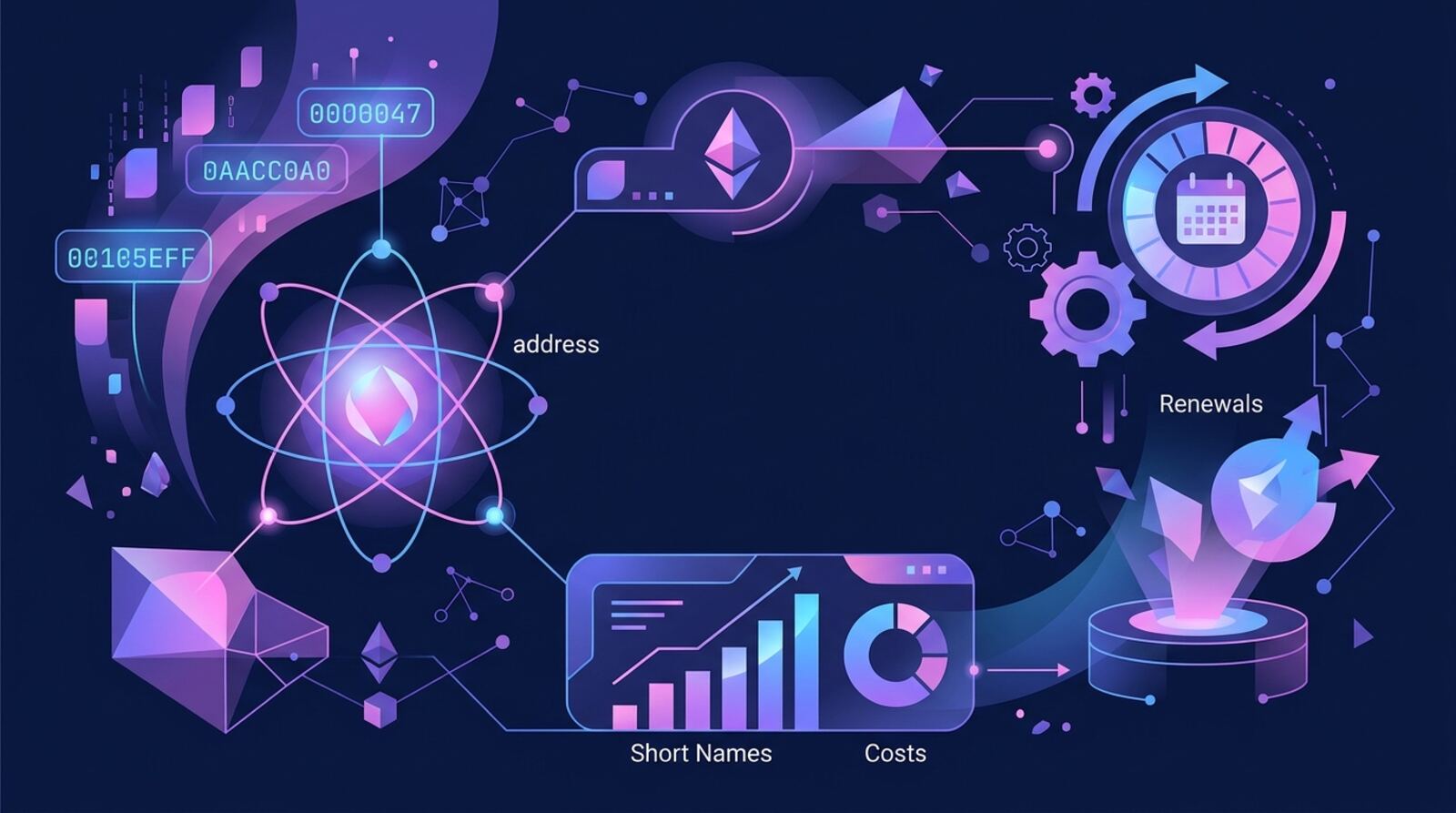
What an ENS domain name is
An ENS domain is a name ending in.eth, such as name.eth, that points to a crypto wallet address. Instead of sending funds to a long string of characters, a person can send them to a readable name. ENS stands for Ethereum Name Service, and it was founded in 2017. The system runs on the Ethereum network, and names are recorded on-chain, so no single company controls the registry in the way a traditional registrar does.
Each.eth name is also represented as an NFT. That means the wallet that holds the name can transfer it, sell it or use it as a public identity. Because of this dual role, ENS names sit between a naming service and a digital collectible. Many people use one name as a personal handle across apps, while others hold names as assets.
The name itself is only part of the picture. A name can point to many things at once: a wallet address for each supported blockchain, a website hash, an avatar image, a social handle or a text record with a short description. Owners choose which of these to set. A name with no records only works as a label, and it will not send funds or show an avatar until the owner configures it.
If you are new to the topic, think of ENS as a directory layer. It sits on top of wallets and decentralized apps, and any app that supports ENS can resolve a name to an address. The ENS team and community maintain the core contracts, and the official ENS app is the usual place to register, renew and edit names.
How ENS names resolve to wallet addresses
Resolution is the process of turning a name into an address. When someone types a.eth name into a supported wallet or app, the app looks up the name's resolver contract, reads the address record and sends the transaction to that address. The owner controls the resolver settings, so the owner decides which address a name resolves to.
There is also a reverse record. A reverse record lets an address point back to a name, so an app can show a readable name next to a wallet address. Setting a reverse record is optional, but it is what makes a wallet show a name instead of a long hex string in many interfaces.
Records work differently from ownership. Owning a name gives you control over its records, while the records themselves can point to any address you choose, including addresses on other chains. Before sending a large amount, double-check the resolved address with a small test transfer, especially if the name was recently changed or you do not know the owner.
Keep the difference between the owner and the resolved address in mind. A name can be owned by a cold wallet but resolve to a hot wallet used for daily activity. This setup is common and sensible, but it also means that changing either side without thinking can send funds to the wrong place.
Why short ENS names attract attention
Short names attract attention for simple reasons. There are few of them, so each one is scarce. A three-letter.eth name is among the most limited in the system, and people sometimes buy them for branding, collecting or resale. The scarcity is the main driver of their value, not any special feature of the name itself.
Names of three characters or fewer have historically carried higher registration and renewal fees than longer names. This pricing rule is designed to reduce speculative rushes for short words. Longer names are generally cheaper, and names with five or more characters are usually the most affordable to hold.
A short name can be worth a lot to some owners and very little to others. A brand, a community or a known individual may find a short name useful as a memorable handle. Another owner may only hold it as an asset. Market prices for short names change with demand, so no fixed figure applies for long.
If you already own a short name, decide early whether it has a use for you. Consider whether you will renew it, sell it or let it lapse. The decision should weigh the annual cost against any real use, not just the chance of a future sale.
What ENS names cost to register and renew
Registering a.eth name involves a fee that depends on the length of the name and the registration period you choose. Renewal is a separate payment that extends the name for another period. Fees are set in the protocol and can be paid in ETH, but the dollar value moves with the market. Because of this, any dollar figure you read may already be out of date.
The best way to check the current cost is the official ENS app. It shows the registration or renewal price before you sign the transaction. Compare it with the price of other names of the same length, and check the gas cost on top of the registration fee. Gas is charged by the Ethereum network and changes with network activity.
Some owners ask whether a renewal is worth the cost. A useful test is to ask whether you would pay the same amount to register the name fresh today. If the answer is no, the name may not be worth keeping for its own sake. If you use the name daily for a wallet, a profile or a business identity, the renewal may be cheap compared with the cost of changing your address everywhere.
Budget for renewals as a recurring expense. Set a calendar reminder well before the expiry date, and treat the fee as part of your running costs for any name you rely on.
What happens when an ENS name expires
Every.eth name has an expiry date. When it passes, the name enters a grace period. During this window the current owner can still renew the name, usually at the standard fee. Once the grace period ends, the name can be bought again by anyone, often through a premium pricing phase.
The exact timing of these phases can change as the protocol is updated, so check the official ENS documentation for current periods. Do not rely on a fixed number from a third-party article or forum post, because that figure may be outdated.
Missing the renewal date has real consequences. Records stop resolving once the name expires, which can break payments and logins that depend on the name. A lapsed name may be taken by another owner, and that person may set records that point somewhere else. The practical risk is therefore not just losing a label but sending funds to the wrong place if someone else takes it.
To avoid this, check the expiry date in the ENS app and renew early. Keep a note of which wallet owns each name, and make sure you still have access to that wallet. If you hold several names, list them in one place with their expiry dates so none of them slips past unnoticed.
How to buy an ENS name
There are two main ways to get a.eth name. The first is primary registration, where you register an available name directly through the official ENS app. This route involves paying the registration fee and choosing a registration period. The second is buying an existing name from its current owner, usually on a secondary marketplace.
OpenSea and other NFT marketplaces list many ENS names for sale. Because a name is an NFT, the buyer typically receives the name by transfer from the seller. Before you buy, check the listing carefully. Confirm the name, the expiry date, the current records and the sale history. Also look at whether the name is listed at a price that matches comparable names of similar length.
A purchase from another owner does not reset the expiry date. You are buying the name with whatever time remains on it, so the expiry date matters. If the name expires soon, you will need to renew it right after you buy it. Check that the resolver settings also match what you expect, because a seller may have left old records in place.
Never pay a seller outside the marketplace or through a private chat. Use the marketplace's own purchase flow, and confirm the transfer after the sale. Treat any request to send funds to an unfamiliar address as a warning sign.
How to protect your ENS name from phishing and loss
Your ENS name is controlled by the wallet that holds it. Anyone who gets access to that wallet can change the records, transfer the name or let it lapse. The first defence is to protect the wallet itself. Use a hardware wallet where you can, keep your seed phrase offline, and never type it into a website, app or message.
Be careful with approvals and signatures. Many scams work by asking you to sign a message or approve a contract that gives away control. Read what each request does before you confirm it. If a site asks you to sign something unrelated to registering, renewing or editing a name, stop and check the request first.
Phishing sites often copy the look of official ENS pages. Bookmark the official site yourself, and type the address rather than clicking links from emails, social posts or search ads. Verify the domain in your browser before connecting a wallet. Be wary of support accounts that message you first, since legitimate teams rarely ask for seed phrases or private keys.
If you think a name has been compromised, move the name and remaining funds to a new wallet you control, starting with the most important assets. Update any services that rely on the name. Report the incident to the platforms involved, and keep records of the transactions in case you need them later.
Using an ENS name with wallets and apps
ENS works with many wallets and apps. Some wallets let you register and manage names from within the app, while others simply resolve names when you send a payment. imToken, for example, provides an ENS page in its browser, where you can authorize access to your wallet address and manage names. Check the current steps in the wallet's support pages, since menus and screens change with updates.
When you use an ENS name in a wallet, check the resolved address before you send funds. Some wallets show the address and the name side by side, which makes it easier to spot a mismatch. If the address does not look right, do not send until you have confirmed it through another source.
Some services accept ENS names as login identifiers or as profile handles. These uses are convenient, but they also mean that a compromised name can affect more than one account. Review which services are linked to your name, and keep your recovery options current.
For everyday use, pick one wallet you trust for your ENS name and use it consistently. Avoid mixing many wallets with one name unless you have a clear reason. Keep a short list of which app or service uses which address so you can update them quickly if something changes.
Where ENS names are heading in 2026
ENS continues to expand beyond its original role. The project has added support for records across several blockchains and has worked on tools that connect ENS to traditional web domains. Reports in public reporting also mention an application to ICANN for a.ens generic top-level domain. Whether that application succeeds and when it could matter to users is not something to assume. Check the official ENS blog and ICANN's published application records for the current status.
These developments are worth watching, but the basics matter more for most people today. A.eth name works on Ethereum-compatible apps, and it is an NFT that you can hold, transfer or sell. Its value to you depends on how you use it, not on the headlines around the project.
Before making any decision about a name, check the current price in the ENS app, read the official documentation, and confirm the expiry date. Use a wallet you control, and treat unsolicited messages about your name with caution. If you plan to trade names, keep track of fees and gas, since these reduce your return.
Keep this guide as a checklist rather than a forecast. The mechanics of registration, resolution, renewal and security are stable, and the official ENS sources will show any changes as the protocol evolves.
Frequently asked questions
Can I keep a name I registered years ago?
Yes, in most cases. The registration fee is paid once for a set period, and the name can be renewed before it expires. Renewal is usually cheaper than a new registration, but the exact cost depends on name length and current prices, so check the official ENS app before you renew.
Why are three-letter.eth names so expensive?
Short names are scarce, so they tend to trade at higher prices on the secondary market. Annual renewal fees for short names are also higher than for longer names. Whether a short name is worth the cost depends on how you plan to use it.
How do I renew an ENS name safely?
Renewal happens on the ENS app, and you need to sign a transaction from the wallet that controls the name, or from a wallet with permission to act for it. Keep your wallet access, the registrar contract and your recovery method in order well before the expiry date.
Can someone take over my ENS name through a phishing site?
Your name is controlled by the wallet that owns it, so the risk is mostly about signing the wrong transaction or giving approval to a malicious site. Use a hardware wallet where possible, bookmark the official ENS site, and never enter your seed phrase on any website or in any support chat.
Can I buy an ENS name from another owner?
Yes. Most ENS names trade as NFTs on marketplaces such as OpenSea. Check the listing, the sale history and the name's expiry date before you buy, and remember that buying a name does not extend its registration beyond the time remaining.
Mentioned in this guide
dApps in this guide
OpenSea is a peer-to-peer NFT marketplace for buying, selling and minting digital collectibles, aimed at collectors, creators and developers.
Element Market is a multi-chain NFT marketplace and aggregator for collectors and traders buying NFTs, collectibles and GameFi assets across many blockchains.
OKX NFT Marketplace is a multi-chain NFT trading platform in OKX Wallet that aggregates listings and supports minting, for collectors and OKX users.
Rarible is a multichain NFT marketplace whose RARI token governs the protocol, RARI Chain and Foundation treasury, for creators, collectors and token holders.
LooksRare is an Ethereum NFT marketplace with LOOKS token rewards and raffles, aimed at active NFT traders who want an alternative venue.
Ethereum Name Service maps human-readable .eth names to Ethereum addresses and other records for Ethereum users.
Keep reading
Related guides
NFT · Explainer
NFT Marketplace Aggregators Explained: How They Work in 2026
NFT marketplace aggregators gather listings from many venues so buyers and sellers can find the best price in one place. The race to lead this category has changed hands several times, so this guide explains how aggregators work, how to judge who is ahead, and how to protect yourself while trading.
NFT · Explainer
OpenSea's Stolen NFT Policy in 2026: How the Hold and Reports Work
OpenSea has added safeguards aimed at stolen NFTs, including a short hold on offers for certain flagged items and a process for reporting theft. This guide explains how those measures work, what victims and buyers should do, and where the policy stops protecting you.
NFT · Explainer
Coinbase NFT Marketplace: What Went Wrong and What to Do Now
Coinbase entered the NFT market with a large existing user base and high expectations, then saw weak trading. This guide explains what happened, what the launch coverage shows, and what holders and buyers should do now.
NFT · Review
Diplo's BAYC NFT: What the Bored Ape Purchase Meant in 2026
Diplo's public move to a Bored Ape NFT in late 2021 made BAYC a talking point beyond crypto circles. This guide explains what happened, how the collection works, and how to check ownership and buy or sell with less risk in 2026.
NFT · Explainer
Speculating on ENS NFT Domains in 2026: How It Works
ENS names ending in.eth are tradable NFTs, and speculators buy them hoping resale prices rise. This guide explains how the names work, what drives interest, and the renewal, security and cost risks to check before you bid.
NFT · Explainer
Enjin Decentraland NFT Awards: How Nominations and Voting Work
Enjin has announced NFT awards inside Decentraland with nominations open, and this guide explains what that kind of in-world award usually involves, how to take part safely, and how to check the announcement yourself. The live search was unavailable while writing, so categories, deadlines and prizes are left for you to confirm on the official channels.
NFT · Explainer
ENS Registration Surges: Why Demand Spikes and How to Register
Ethereum Name Service registrations often jump when a notable sale or event draws attention to.eth names. This guide explains why that happens, how registration, renewal and resale work, and what to check before you pay.
NFT · Explainer
Eminem and the Bored Ape Yacht Club: What Ownership Means in 2026
Eminem's reported ownership of a Bored Ape brought attention to the Bored Ape Yacht Club. This explainer covers what that kind of ownership does and does not mean, how to check holdings yourself, and what buyers should understand before purchasing.