NFT · Explainer
Bored Ape Metaverse Explained: Otherside, Land and BAYC
Bored Ape Yacht Club's metaverse plans centered on Otherside, a project from Yuga Labs that tied land, avatars and a token to BAYC holders. This guide explains what was promised, how the pieces fit together, and how to check the current status yourself.
By the DappsAtlas editorial team · Updated
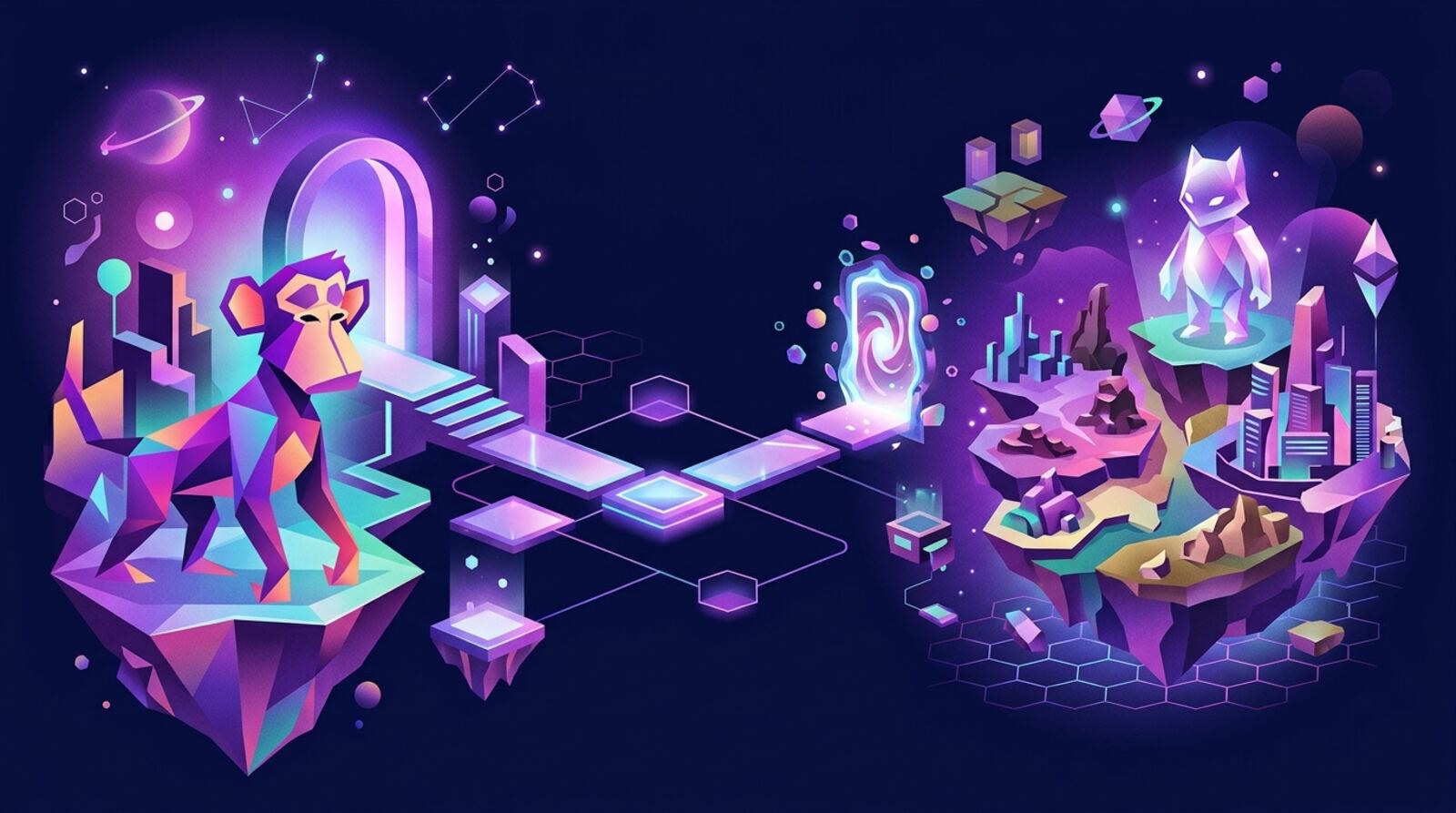
What Bored Ape Yacht Club is
Bored Ape Yacht Club, usually shortened to BAYC, is a collection of 10,000 unique cartoon ape images stored as ERC-721 tokens on Ethereum. It was launched in 2021 by Yuga Labs. Each ape is generated from a set of traits such as clothing, backgrounds, fur and facial expressions, and the rarity of a trait affects how collectors value a particular token.
The collection became one of the best-known NFT projects, partly because of its community. Owners often use their ape as a profile picture, and the project's brand has been extended through merchandise, events and partner collaborations. Owning a token is a claim to a specific digital item on a blockchain. It does not give you the copyright to the artwork in the sense of unlimited commercial rights, so read the license that comes with the project before you build a business around the images.
When people talk about the Bored Ape metaverse, they usually mean the set of projects Yuga Labs built on top of the BAYC brand, rather than the original collection alone. Understanding that distinction matters, because the ape itself, a land parcel, a token and a spin-off collection each carry different rights and risks.
What the Otherside metaverse was meant to be
Otherside was introduced as Yuga Labs' metaverse, a shared virtual world where holders of Yuga's NFTs could explore, interact and, according to the original plans, build and play. The project was framed as a place where digital identity, ownership and community events would overlap, and where avatars and items could carry across experiences.
The central idea was that the blockchain would record who owns what, while the game or world would give those items use. Early messaging focused on land, avatars and creative tools, but the exact features, release timing and rules for each part have changed over the life of the project. Anything you read about a finished world should be checked against the latest official statements, because early roadmaps often differ from what is delivered.
For a reader today, the most useful way to think about Otherside is as a long-running project with a history of promises and updates. Some elements may be live, others may be in development, and some early ideas may have been dropped. Treat roadmaps as intentions rather than guarantees.
How Otherdeeds and virtual land worked
Yuga Labs sold virtual land through a series of NFTs called Otherdeeds. Land was the core asset of the metaverse concept, because owners could in theory build on it, host experiences or rent it to others. Holders of certain Yuga NFTs were given priority access to the land sale, which was one of the most discussed parts of the launch.
To understand how a land NFT works, it helps to separate three things. The token is the record of ownership on the blockchain. The world is the software that decides what a parcel can contain. The rules are the terms set by the company, which can govern usage, resale, royalties and how the land is developed.
Before you consider any land NFT, read the official documentation for that specific sale and confirm the contract address against Yuga Labs' own channels. Also check whether the land can be used in the current version of the world, whether any building or hosting permissions exist, and what happens to the token if the project changes direction. A land deed can lose much of its usefulness if the world it belongs to stops developing.
What role ApeCoin plays in the ecosystem
ApeCoin, with the ticker APE, is an ERC-20 token associated with the Bored Ape ecosystem. It was introduced in 2022 and is tied to ApeCoin DAO, a governance structure where token holders can vote on proposals that affect the ecosystem. The token was distributed to holders of Yuga NFTs as part of its launch.
Governance tokens typically give holders a say in decisions rather than a guaranteed return. Votes can cover treasury spending, partnerships and product direction. The practical value of such a vote depends on how active the community is, how the rules are written, and how much of the token supply is held by people who participate.
If you hold or are considering APE, you should look at the official ApeCoin DAO materials to understand what the token does today, how voting works and what the treasury is used for. Check the token's contract address on a block explorer, and be aware that tokens with a community identity are often targeted by impostor tokens. Verify every address through official sources before you trade.
Mutant Apes and the wider Yuga ecosystem
Mutant Ape Yacht Club, shortened to MAYC, was released as a spin-off from the original collection. It is a separate set of up to 20,000 NFTs on Ethereum and was created through a serum mechanism that let existing Bored Ape holders convert their ape into a mutant. Mutants are generally a separate collection with their own trait mix and trading history.
The spin-off shows how Yuga Labs extended its brand across several collections. Each collection can have its own rules, pricing and community. When you look at the ecosystem, separate the original apes, the mutants and any other Yuga releases, because each can have different rights and value.
The mutant collection is listed on major marketplaces, so you can see its items and recent activity there. Keep in mind that a mutant's value is linked to the same brand and community, but it is not the same asset as a Bored Ape, and changes to one collection's terms may not apply to the other.
What the metaverse launch claim means in practice
Phrases like the metaverse is here usually refer to a launch, a milestone or an update. Because NFT projects change quickly, a claim that something has arrived should be checked against the project's official statements and the details of what is actually available to users. Launch announcements often describe a first version of a product rather than a finished world.
A useful test is to ask what a user can do today. Can you log in? Can you move around, interact with others or use an item you own? Are the features described in the announcement live, in beta, or still planned? Each answer tells you more than a headline does.
If you are reading this guide later, the key point is that the Bored Ape metaverse may have changed since it was first described. Treat any older article, including this one, as a starting point. Use the official Yuga Labs channels and project documentation to confirm the present state of the world, its features and any token rights.
How to check the current status yourself
Because live status, prices and roadmap details change often, this guide does not state them. Instead, use a short, repeatable process to check the position for yourself.
- Open the official Yuga Labs website and find the Otherside page and the most recent announcements.
- Check the dates and wording of each update, and note whether a feature is described as live, in beta or planned.
- Look at the project's documentation or help center for rules on land, avatars, tokens and any usage rights.
- Compare the contract addresses listed by the official source with the ones shown on a block explorer.
- Look at recent sales and listings on marketplaces to see actual activity, but do not treat a floor price as a valuation.
Keep a note of what you checked and when. If an official source is silent on a feature, assume it is not yet available until the project confirms otherwise.
Risks of buying Bored Ape and metaverse assets
Collectibles and metaverse assets carry several kinds of risk. Their value depends on demand, which can fall quickly. Project decisions can change the rules or the purpose of an asset. Liquidity can be thin, so you may not be able to sell at the price you expect. Some collections also have licensing or copyright terms that limit how you can use the artwork.
Security risks are just as important. Scam sites often copy the look of official pages, and fake support accounts may ask for your seed phrase or ask you to approve a malicious transaction. Read every approval request carefully, since granting a contract broad permission can let it move your tokens.
The defensive steps are straightforward. Buy only from marketplaces you have verified independently, keep your seed phrase offline and never share it, use a hardware wallet for valuable holdings, and revoke token approvals you no longer need. Only spend money you can afford to lose, and remember that no project or influencer can guarantee a return.
How to buy and sell safely on marketplaces
Most people buy and sell BAYC-related NFTs on established marketplaces. Before you use any platform, confirm its web address through a trusted source rather than a link in a message, and check that it connects to your wallet without asking for your seed phrase.
Once you are on a marketplace, compare the listing details carefully. Check the contract address, the token ID, the collection name and whether the item is a Bored Ape or a mutant. Look at the full transaction before you sign, including any fees, royalties and approval requests.
When selling, consider how long you want to hold the asset and whether a listing or an auction suits your goals. Keep records of purchases for tax purposes, as the rules for digital assets vary by country and can change. If you are unsure about the tax or legal treatment of your holdings, speak with a qualified professional in your jurisdiction.
Frequently asked questions
Does owning a Bored Ape give me access to a metaverse?
Not necessarily. Membership rights and in-world features depended on the project's own terms and development progress, not on the NFT alone. Check Yuga Labs' official channels for what each token currently unlocks, since those terms can change.
What is Otherside?
Otherside was the metaverse project from Yuga Labs, the company behind BAYC. Its land was sold as Otherdeeds, and BAYC holders had early access to the sale. Whether a playable world has launched in full, and how it works today, should be confirmed on Yuga Labs' official site and social accounts.
Where should I check the current status of the metaverse?
Start with the official Yuga Labs website and its announcement channels, then look at the Otherside project's own pages. Cross-check any claim you see on social media or in a forum against those primary sources. Also look up the contract address of any token you are considering on a block explorer before you interact with it.
What is a Bored Ape worth today?
Price moves with interest, market sentiment and the project's news, so no figure in this guide should be treated as current. Look at recent sales and floor data on the marketplaces listed on this site, and keep in mind that a floor price shows the cheapest listing, not what a buyer will pay for a specific token.
What should I check before buying a Bored Ape or metaverse NFT?
Read the official terms of any token or land sale, confirm the contract address against official sources, and assume that you could lose most or all of what you spend. Use a hardware wallet for significant holdings, never share your seed phrase, and be wary of direct messages offering free mints or support.
Mentioned in this guide
dApps in this guide
OpenSea is a peer-to-peer NFT marketplace for buying, selling and minting digital collectibles, aimed at collectors, creators and developers.
Ethereum PFP NFT collection of up to 20,000 Mutant Apes from Yuga Labs, spun off from Bored Ape Yacht Club, for collectors and community members.
Element Market is a multi-chain NFT marketplace and aggregator for collectors and traders buying NFTs, collectibles and GameFi assets across many blockchains.
Sudoswap V2 is a decentralized NFT marketplace on Ethereum, Base, Berachain and Arbitrum with on-chain royalties and ERC-1155 support, for NFT traders.
ApeCoin (APE) is an ERC-20 governance and utility token and the native gas token of ApeChain, for users of the Ape ecosystem.
Keep reading
Related guides
NFT · Review
Diplo's BAYC NFT: What the Bored Ape Purchase Meant in 2026
Diplo's public move to a Bored Ape NFT in late 2021 made BAYC a talking point beyond crypto circles. This guide explains what happened, how the collection works, and how to check ownership and buy or sell with less risk in 2026.
NFT · Explainer
Bored Ape Roadmap Explained: What It Means for Mutant Apes
Interest in a renewed Bored Ape roadmap has put Mutant Apes back in focus. This guide explains what roadmaps usually promise, how the two collections are linked, and how to check any holder benefit before you act.
NFT · Explainer
Otherdeed Land Parcel Sale: What the Record Prices Show
A single Otherdeed parcel from Yuga Labs' 2022 Otherside land drop drew a record price, and the public reports vary. This explainer covers what Otherdeeds are, what the record sales were, and how to verify a land sale figure yourself.
NFT · Explainer
Bored Ape Otherside Land Price: 305 APE or 6,500 Explained
The Otherside land sale listed parcels at 305 APE or 6,500, a price tied to the metaverse project that grew out of Bored Ape Yacht Club. This guide explains what those figures meant, what they do not tell you about value today, and how to research the topic safely.
NFT · Explainer
How Boson Protocol Sells Physical Fashion in Virtual Worlds
Boson Protocol lets sellers attach a physical item to an NFT that can be redeemed for the real product, and it has been used to sell physical fashion inside virtual worlds such as Decentraland. This guide explains how the escrow and redemption model works, what the Metaverse Fashion Week collaborations showed, and what to check before buying or selling today.
NFT · Explainer
Bored Ape Yacht Club Copycat Ruling: What the NFT Case Means
A court headline says copycat Bored Ape-style NFTs infringed Yuga Labs' copyright. This guide explains what that kind of ruling means, what it does not settle, and what holders and buyers can check now.
NFT · Explainer
Bowie NFTs on OpenSea: The Blockchain Series and How to Check It
David Bowie's estate released an NFT series on OpenSea in September 2022, and this guide explains what that series was, how it was structured, and how to research and buy Bowie-related NFTs safely today. It also covers the limits of what public public reporting shows about current listings.
NFT · Explainer
Bored Ape NFTs and Limited Edition M&M's: How Brand Collabs Work
In August 2022, Mars paired a small run of M&M's gift jars with Bored Ape Yacht Club NFTs through the KINGSHIP brand. This guide explains how that kind of collab worked, what owners received, and how to check for newer limited drops safely.